Concrete Pad Sizing for Above-Ground Polyethylene Tanks: ACI 360R-10 Framework and the ACI 318 Boundary
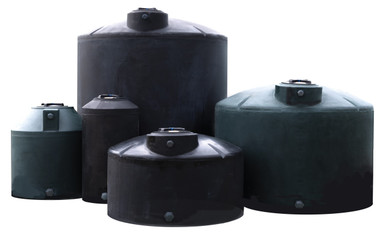
Above-ground polyethylene tank installations stand or fall on the foundation. The tank shell distributes load axisymmetrically across the bottom, but the concrete pad has to deliver uniform support, resist differential settlement, accommodate thermal cycling, anchor the tank against seismic and wind loads, and provide a level, smooth, debris-free contact surface. A poorly designed pad is the most common cause of premature polyethylene tank failure that has nothing to do with the tank chemistry. This walkthrough covers concrete pad sizing for above-ground PE tanks at the engineering-specification level: which ACI document actually governs (it is not ACI 318), how to size pad thickness and reinforcement, how to handle anchoring, and where the OneSource catalog products live across the load range.
Which ACI Document Governs: 360R, Not 318
A common engineering shortcut is to reach for ACI 318 (Building Code Requirements for Structural Concrete) for any concrete design. For a soil-supported slab carrying a tank load, ACI 318 explicitly defers. ACI 318-19 Section 22.1.1.2 reads: "Design and construction of soil-supported slabs, such as sidewalks and slabs on grade, shall not be governed by this Code unless they transmit vertical loads or lateral forces from other parts of the structure to the soil." A polyethylene tank pad supports a vertical load from the tank but does not transmit loads from a building structure into the soil. ACI 318 does not directly govern.
The applicable design document is ACI 360R-10, "Guide to Design of Slabs-on-Ground" (now superseded by ACI 360R-22 in some jurisdictions, but 360R-10 remains widely cited). ACI 360R provides the engineering basis for slab-on-ground thickness, reinforcement, joint spacing, and subgrade preparation. For tank pads with significant lateral load transfer to the foundation (anchored tanks in seismic or hurricane-zone installations), ACI 318 chapters on anchorage to concrete (Chapter 17 in ACI 318-19) apply at the anchor-bolt design level even though Chapter 22 does not govern the slab itself.
The Three Loading Cases the Pad Must Carry
A polyethylene tank pad has to handle three loading cases simultaneously:
- Static gravity load: the weight of the tank shell plus the contained liquid at maximum fill. For a 5,000-gallon water tank, the load is approximately 41,700 lb (water weight) plus the tank shell weight (typically 700 to 1,200 lb for a 5,000-gallon HDPE shell). Distributed across the tank footprint (a 102-inch-diameter tank has about 8,170 square inches of footprint), the bearing pressure is approximately 5.2 psi or 750 psf — modest by structural standards.
- Lateral wind or seismic load: the tank shell is a cylinder presenting significant projected area. ASCE 7-22 wind-load calculations for an above-ground tank (treated as an enclosed structure or as an open-frame structure depending on geometry) generate a lateral load that must transfer through the anchor system into the pad. Seismic loads under ASCE 7-22 Chapter 15 (nonbuilding structures) similarly load the anchor system.
- Thermal differential: the polyethylene shell expands and contracts with temperature; the concrete pad does the same at a different rate. The shell-to-pad interface must accommodate the differential without inducing point-loading stress concentrations in the polyethylene shell. A smooth, level pad surface and a sand or gravel cushion (where appropriate) handle this.
Pad Thickness Sizing
For a typical polyethylene tank installation on competent subgrade (allowable bearing capacity 1,500 psf or higher, no significant differential-settlement risk), a 6-inch reinforced concrete pad sized 12 inches larger than the tank diameter on each side is the entry-point specification. Pad thickness scales with tank size and subgrade conditions:
| Tank Capacity | Typical Diameter | Recommended Pad Thickness | Pad Footprint |
|---|---|---|---|
| 1,000 gal vertical | 72 in | 4 in | 96 in × 96 in |
| 2,500 gal vertical | 95 in | 4-6 in | 120 in × 120 in |
| 5,000 gal vertical | 102 in | 6 in | 126 in × 126 in |
| 10,000 gal vertical | 119 in | 6-8 in | 144 in × 144 in |
| 15,000 gal vertical | 142 in | 8 in | 168 in × 168 in |
| 20,000 gal vertical | 165 in | 8-10 in | 192 in × 192 in |
Thicker pads are warranted on weaker subgrade (clay sites, fill sites, expansive-soil sites), in seismic zones D-F under ASCE 7-22, or where the AHJ has stricter requirements. A geotechnical engineer should evaluate any site with marginal subgrade conditions, organic content, expansive soil, or high water table.
Reinforcement
For the standard 6-inch pad: #4 (1/2-inch diameter) reinforcing bar at 12 inches on center each way, placed at mid-depth of the slab. Welded wire reinforcement (6×6 W2.9×W2.9) is an acceptable alternative for smaller pads but rebar is preferred for tank pads because of the load-distribution and seismic-anchorage demands. For 8-inch and 10-inch pads, increase to #5 (5/8-inch) at 12 inches on center each way, or #4 at 8 inches on center.
Concrete strength: 4,000 psi (28-day compressive strength) is the workhorse specification. Higher strength (5,000 or 6,000 psi) is warranted where the anchor-bolt design demands it or where the AHJ requires it. Air entrainment is required in any climate exposed to freeze-thaw cycling — typically 5 to 7 percent entrained air per ACI 318-19 Chapter 19.
Anchoring the Tank to the Pad
For seismic and wind anchoring, the tank manufacturer specifies the anchor pattern, anchor-bolt size, and uplift load. For Norwesco, Snyder Industries, Chem-Tainer, and Enduraplas above-ground vertical tanks, the anchor pattern is typically a hold-down lug or hold-down strap arrangement at the tank base. The pad must accommodate the bolt embedment per ACI 318-19 Chapter 17 (anchorage to concrete). Embedment depth is set by the bolt-pullout capacity required by the wind or seismic load case; typical embedment is 6 to 12 inches for 5/8-inch to 3/4-inch anchor bolts.
Anchor bolts must be installed cast-in-place where possible. Post-installed anchors (epoxy or expansion) are acceptable per ACI 318-19 Chapter 17 with appropriate reduction factors but require qualified installer and field-verification testing. Cast-in-place is preferred for tank-pad anchors because of the tension and seismic load case.
Surface Finish and Tank-Pad Interface
The pad surface contacting the tank bottom must be smooth, level, and free of debris. Polyethylene tanks transfer load axisymmetrically; any high spots, ridges, embedded objects, or debris become point-stress concentrations that can fatigue the polyethylene shell over years of service. The acceptable surface tolerance is typically 1/8 inch over any 10-foot span.
For sand-bedded installations on a graded earth pad (an alternative to a poured concrete pad for non-anchored installations on competent subgrade), the bedding sand layer is 4 to 6 inches deep, screeded smooth and level, with edge containment to prevent erosion. This approach is common for water tanks in residential and small-agricultural settings but is not appropriate for chemical-service tanks where leak-detection or seismic anchoring requires a hard foundation.
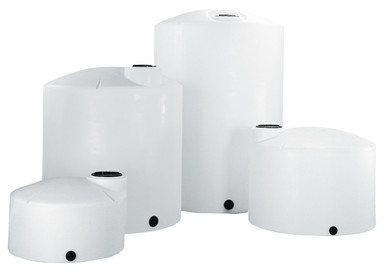
OneSource Above-Ground Vertical Tanks Across the Pad-Sizing Range
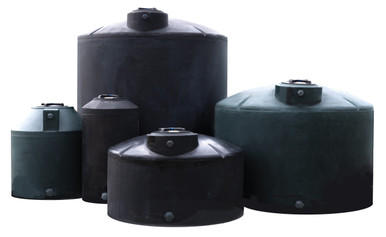
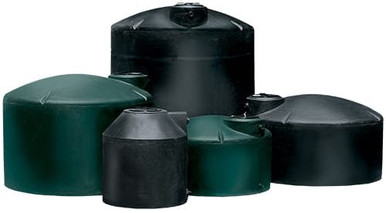
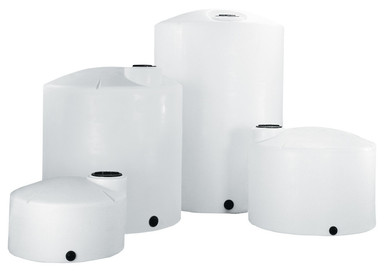
The pad-sizing decision is driven by tank capacity. The OneSource catalog covers the residential-through-industrial range:
Small Vertical (1,000 to 2,500 gal — 4-inch Pad)
Polyethylene vertical tanks in the 1,000 to 2,500-gallon range install on a 4-inch reinforced pad sized 12 inches larger than the tank diameter on each side. Norwesco and Snyder Industries dominate this segment with rotomolded HDPE construction.
Mid-Size Vertical (5,000 to 10,000 gal — 6-inch Pad)
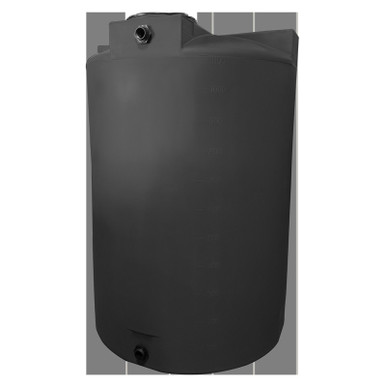
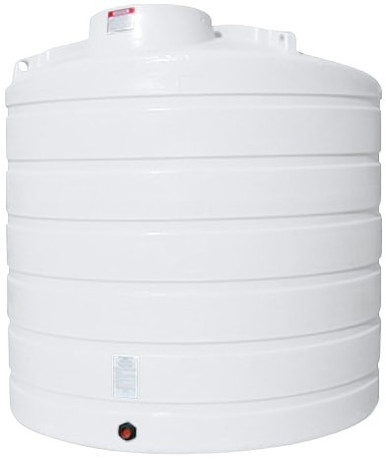
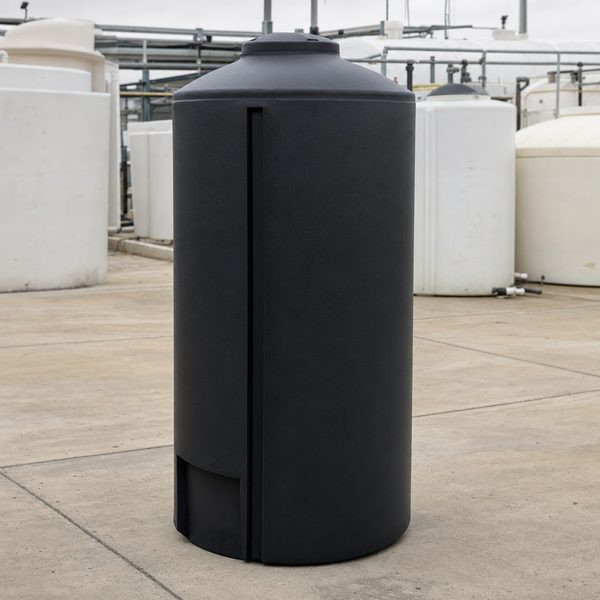
- Norwesco 5,000-gallon vertical (multiple SKUs including N-43282 series for HDPE white and N-43287 series for HDPE black) — 6-inch pad recommended, 126 × 126 inch footprint.
- Snyder Industries 5,000-gallon vertical (5500102N45 series) — same pad sizing.
- Norwesco 10,000-gallon vertical (multiple SKUs) — 6 to 8-inch pad, 144 × 144 inch footprint.
Large Vertical (15,000 to 20,000 gal — 8 to 10-inch Pad)
- Norwesco 15000 Gallon Plastic Vertical Fertilizer Storage Tank in Yellow (MPN 44942, listed at $21,299.99) — 8-inch pad recommended, 168 × 168 inch footprint with anchor-pattern provisions.
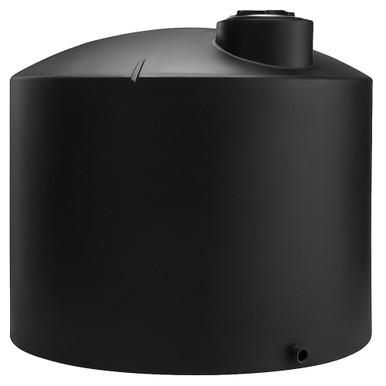
- Snyder Industries 18800 Gallon HDPE Vertical Liquid Storage Tank in Black (MPN 3030000N33, listed at $42,653.99) — 8-inch pad, 192 × 192 footprint, anchor-pattern detail per Snyder installation guide.
- Snyder Industries 18800 Gallon HDPE Vertical Liquid Storage Tank with ASTM rating (MPN 3030000N39, listed at $38,776.15) — same pad sizing class.
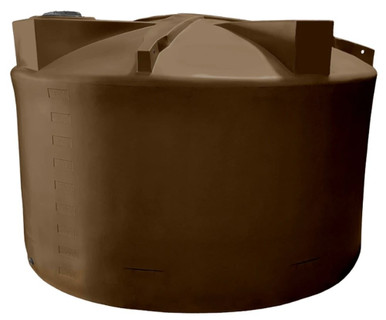
- Norwesco 20000 Gallon HDPE Vertical Liquid Storage Tank (MPN 43827, listed at $43,299.99) — 8 to 10-inch pad, 192 × 192 footprint, full anchor pattern. The largest workhorse vertical in the rotomolded HDPE catalog.
- Norwesco 20000 Gallon Vertical Fertilizer Storage Tank in Yellow (MPN 44926, listed at $34,805.00) — fertilizer-service yellow pigmentation, same pad sizing.
- Snyder Industries 20000 Gallon Plastic Vertical Liquid Storage Tank in White (MPN 3030000C37, listed at $37,724.00) — Snyder 20K vertical, same pad sizing class.
- Snyder Industries 20000 Gallon HDPE Vertical Liquid Storage Tank (MPN 3030000C26, listed at $48,171.00) — heavier-wall HDPE 20K vertical, 10-inch pad recommended for high-SG service.
Subgrade Preparation
The pad performance depends on the subgrade. Required preparation:
- Strip topsoil and organic material: typically 6 to 12 inches of removal. Organic material is unsuitable as subgrade — it decomposes over years and creates differential settlement.
- Compact subgrade: to 95 percent of standard Proctor maximum dry density (ASTM D698) over the pad footprint plus a 12-inch extension beyond. Compaction testing should be documented for pads serving tanks above 5,000 gallons.
- Capillary break: 4 to 6 inches of compacted gravel or crushed stone (3/4-inch maximum) under the pad serves as a capillary moisture break and helps level out subgrade unevenness.
- Vapor retarder: a 10-mil polyethylene vapor retarder under the pad is recommended in any conditioned-space application or where surface moisture would interfere with operations or product. For outdoor unsheltered installations, the vapor retarder is optional.
Joints and Crack Control
For pads larger than 144 inches (12 feet) in any direction, control joints reduce shrinkage cracking risk. Saw-cut control joints to depth equal to one-quarter of the pad thickness, spaced at 24 to 36 times the pad thickness. For a 6-inch pad, control joints at 144 to 216 inches (12 to 18 feet) on center. For tank pads sized 168 × 168 inches or smaller, a single pour without intermediate control joints typically performs well; larger pads benefit from a single control joint along the centerline of each side.
Cure and Acceptance Testing
Concrete must reach design strength before tank installation. The standard 4,000 psi mix reaches design strength at 28 days. Tank installation can proceed at 7 days if necessary (concrete is typically at 65 to 70 percent of design strength), but full design loading should wait for the 28-day acceptance. Field-cured cylinders or maturity-method monitoring documents the strength gain. Verify the placement temperature was within the 50°F to 90°F (10°C to 32°C) range for cold-weather and hot-weather concrete provisions per ACI 305 and ACI 306.
Pad Cost Reference
For budgetary planning, a 6-inch reinforced pad sized 144 × 144 inches (16 cubic yards of concrete plus rebar plus excavation/forming/finishing labor) typically runs $3,500 to $6,500 in 2026 markets. An 8-inch pad sized 192 × 192 inches runs $6,000 to $12,000. Costs scale with regional concrete pricing, site access, and excavation conditions. For tanks in the 15,000 to 20,000-gallon class, the pad cost is a meaningful fraction of the total installed cost — engineering it correctly the first time is the right discipline.
Pad Repair and Re-Use After Tank Replacement
Polyethylene tank service life under proper installation typically runs 20 to 30 years for water service and 10 to 25 years for chemical service depending on chemistry and operating temperature. The concrete pad, by contrast, is a 50-plus year asset under reasonable conditions. When the tank is replaced at end-of-life, the existing pad usually serves the next tank without modification. The exception is when a larger replacement tank changes the anchor pattern: post-installed anchors per ACI 318-19 Chapter 17 can adapt the existing pad to a new anchor layout, but anchor-to-edge distance, anchor-to-anchor spacing, and concrete-cover requirements must be verified to confirm the existing pad accommodates the new layout. Where the new tank is significantly larger, an extension pour bonded to the existing pad with dowels, or a complete pad replacement, is the right engineering decision. Plan the pad-tank lifecycle together at original installation: a pad sized one tank-size up from the planned tank gives flexibility for future capacity expansion without pad replacement cost.
Pad Drainage and Site Grading
Site grading around the pad matters for tank longevity. The pad surface should drain water away from the tank, with a minimum 1-percent slope on the surrounding grade away from the pad edge. Standing water at the pad edge promotes freeze-thaw damage at the pad perimeter and creates a localized soil-erosion path that can undermine the pad over years. For installations adjacent to a building or a paved area, coordinate the pad finish elevation with surrounding grade to ensure positive drainage in all directions.
Cross-References
For seismic and wind anchoring details by state, see the OneSource state-regulations pillars including California (high seismic), Florida (hurricane wind), and Texas (mixed wind/seismic). For chemical-compatibility verification on the inner tank surface, see the chemical compatibility hub.
For pad-specification consultation, anchor-pattern drawings, and freight on Norwesco, Snyder Industries, Chem-Tainer, and Enduraplas above-ground vertical tanks, contact OneSource Plastics at 866-418-1777. For LTL freight quoting on tank delivery to your installation site, use the freight estimator.