Container vs Tank: When To Buy a Tote, IBC, Drum, Cube, or Tank

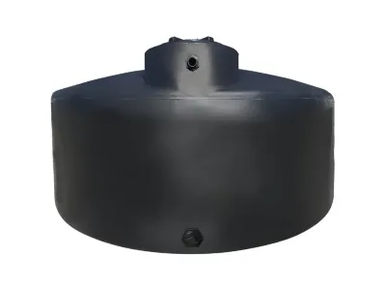
Buyers searching for "55 gallon tank" or "275 gallon tank" usually arrive looking for a vertical storage tank but actually need an IBC tote, a drum, or a cube. The form-factor question is upstream of the capacity question. The right form factor depends on six things: how the liquid moves through the system, how it's transported, how often it's refilled, what regulatory packaging code it falls under, what stacking and footprint constraints the site imposes, and how much capital the buyer wants to deploy. This guide walks the form-factor decision so you don't pay tank money for a job that wants a drum, or accept drum cycling cost on a job that wants a tank.
OneSource Plastics' commodity catalog spans all five form factors: stationary tanks (Norwesco, Snyder, Chem-Tainer, Enduraplas, Bushman vertical and horizontal), IBC totes (Snyder Stackable IBC, Cagebuster, Excalibur, Megatainer, and 245-gallon stainless Supertainer), poly drums (Chem-Tainer 55-gallon tight-head and open-head, blue closed-head, and drum-liner options), Cubetainer-style portable cubes (Fluidall HDPE Cubetainers in 60, 80, 120, and 180 gallon with brass or stainless dispense), and rebottle/replacement IBC bottles (275 and 330 gallon rebottle SKUs). The selection decision should match the form factor to the operating pattern, not the other way around.
The Five Form Factors
Drum (15 - 95 gallons)
A poly drum is a single-handle, round-cross-section, single-use or multi-use container. Tight-head (closed top with bung) for liquids; open-head (clamp-removable lid) for thicker products and powders.
- Capacity range: 15, 30, 55, 95 gallon dominate the market.
- Footprint: 24 inches diameter × 35 inches tall for a 55-gallon drum. ~3 sq ft.
- Move method: drum dolly, drum lift attachment on forklift, hand-truck. One person with a dolly handles a full drum on flat ground.
- Stack: drums stack 2-high empty; 1-high full unless on engineered drum-stack pallets.
- Code: 55-gallon drums are DOT-49-CFR-178.510 (steel) or 178.518 (plastic) packaging when used for hazmat shipment.
- OneSource SKUs: Chem-Tainer MPN TH55DRUM (55-gallon tight-head poly), MPN TH55DRUM-W (natural HDPE), MPN T55BLUECLOSED (blue closed-head), MPN TC2235DA (drum liner).
Cube / Cubetainer (60 - 180 gallons)
A poly cube is a square or rectangular, low-profile portable container with molded-in pallet base. Designed for forklift handling and stacking. Dispense fitting on the side or front for gravity discharge.
- Capacity range: 60, 80, 120, 180 gallon.
- Footprint: 40 inch × 48 inch pallet footprint typical (matches standard pallet jack and forklift forks).
- Move method: forklift only. Pallet jack works on flat smooth floor for empties.
- Stack: 2- to 3-high empty; manufacturer ratings vary for full stacking.
- Use case: shop and field DEF dispense, parts-washer fluid, hydraulic oil refill, light chemistry distribution.
- OneSource SKUs: Fluidall MPN 1032003N95401 (60 gallon, brass dispense), MPN 1032200N95401 (120 gallon, brass), MPN 1032203N95401 (120 gallon, stainless dispense), MPN 1032101N95401 (80 gallon DEF with buttress bungs and pallet slots), MPN 1032201N95402 (120 gallon DEF bolted onto pallet base), MPN 1032303N95401 (180 gallon, stainless dispense).
IBC Tote (220 - 550 gallons)
The Intermediate Bulk Container is the workhorse of distribution-scale liquid storage. Standard 275-gallon and 330-gallon sizes dominate; 220, 245, 350, 550 gallon variants serve specific niches. Stackable when full (engineered for it), forklift-handled.
- Capacity range: 220, 245, 275, 330, 350, 550 gallon.
- Footprint: 40 inch × 48 inch pallet base for 275 / 330 gallon (matches standard pallet jack).
- Move method: forklift, pallet jack on smooth surfaces.
- Stack: stackable 2-3 high full per manufacturer rating. Reduces warehouse footprint vs vertical tanks.
- Use case: bulk distribution, supplier-shipped liquid in re-usable container, frequent fill-empty cycle, multi-site logistics.
- Code: DOT-49-CFR-178.500 (NPP — Non-Pressurized Plastic Packaging); UN/DOT marked for hazmat shipment.
- OneSource SKUs: Snyder MPN 6998300B97204 (275-gallon Stackable IBC Tote Payloader with EPDM gaskets), MPN 6230000B97202 (550-gallon Megatainer with inserts), MPN 6230001B97202 (550-gallon Megatainer without inserts), MPN 66345 (220-gallon HDPE stackable IBC), MPN 6998601B97204 (275-gallon HDPE Cagebuster in white), MPN 6630023B97203 (220-gallon HDPE stackable IBC in black), MPN 6510101B96002 (330-gallon Excalibur stackable IBC), MPN 6610056B97204 (330-gallon HDPE stackable IBC in red), MPN 6984000B51318 (245-gallon 304 stainless Supertainer with side drain), Chem-Tainer MPN 275REBOTTLE (replacement 275 IBC bottle), MPN 330REBOTTLE (replacement 330 IBC bottle), MPN 373402 (350-gallon stainless side-drain LiquiTote with 3-inch fusible vent).
Stationary Tank (50 - 16,500+ gallons)
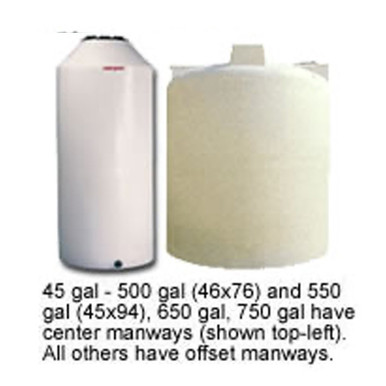
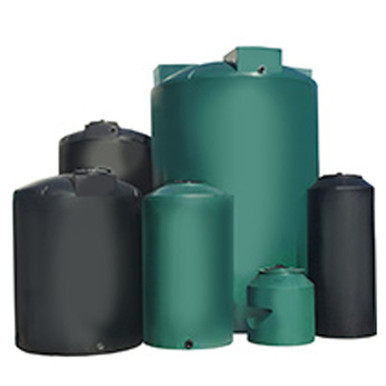
The fixed installation. Vertical, horizontal leg, or cone-bottom polyethylene rotomolded shell, set on a foundation pad and plumbed in. Permanent piece of infrastructure.
- Capacity range: 50 gallon to 16,500+ gallon (commodity rotomolded ceiling); larger via FRP, steel, or concrete.
- Footprint: dedicated pad. Norwesco MPN 41464 (100 gallon black vertical) is 23 inches diameter × 63 inches tall. A 2,500 gallon vertical is approximately 95 inches diameter.
- Move method: crane / boom truck for placement; not designed to relocate after install.
- Stack: none. Each tank gets its own footprint.
- Use case: bulk storage that doesn't move, central distribution point, primary chemistry storage, water reserves, fertilizer bulk.
- Code: ASTM D1998 (polyethylene), site-specific permitting for petroleum (NFPA 30, UL-142), groundwater (state UST/AST programs), wastewater (state on-site septic codes).
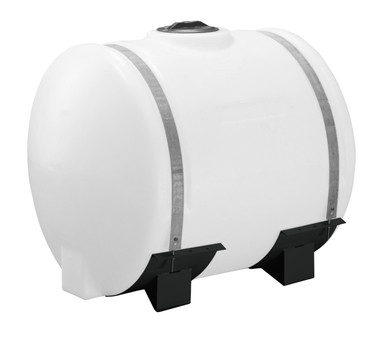
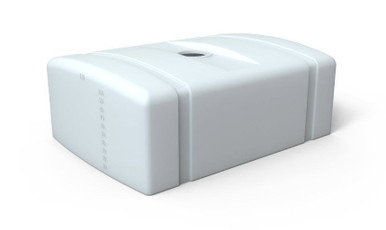
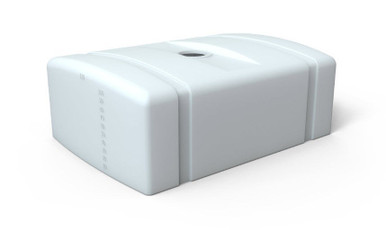
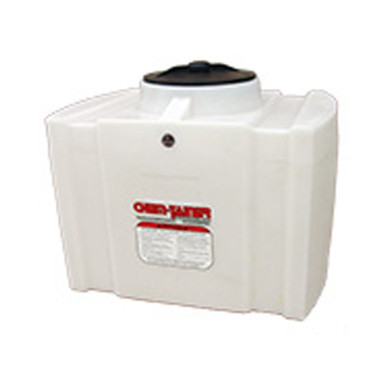
- OneSource SKUs (representative): Norwesco MPN 41464 (100 gallon vertical black, $393.86 list), MPN 41861 (100 gallon vertical white, $319.99 list), MPN 60204 (100 gallon applicator saddle tank, $347.00 list), MPN 44963 (100 gallon portable loaf utility tank, $324.72 list); Snyder, Chem-Tainer, Enduraplas, Bushman ship comparable tanks across the full capacity range.
Specialty Portable Tank (50 - 1,650 gallons)
The bridge between drum and stationary: skid-mounted hauling tanks, applicator saddle tanks, loaf-utility tanks. Designed for transport but not at IBC tote scale.
- Capacity range: 50 to 1,650 gallon.
- Footprint: low-profile, often saddle-shaped or D-shaped to fit truck beds and skid frames.
- Move method: truck-bed transport, occasional crane lift. Not pallet-handled.
- Stack: none.
- Use case: water haul (rural delivery), agricultural application (sprayer fill, fertilizer placement), construction water, fire-suppression reserve on remote site.
- Code: DOT-49-CFR-178 for hazmat-certified hauling; manufacturer NSF / certifications for potable water.
- OneSource SKUs (representative): Norwesco MPN 60204 (100 gallon applicator saddle), MPN 44963 (100 gallon loaf utility), full hauling and saddle product lines from Norwesco / Snyder / Enduraplas spanning 35 to 1,650 gallon.
The Selection Matrix: Six Decision Drivers
Driver 1: Movement frequency
| Movement pattern | Form factor |
|---|---|
| Daily by hand or hand-truck | Drum (5-55 gallon) |
| Daily by forklift, intra-facility | Cube (60-180 gallon) |
| Weekly by truck, multi-site | IBC tote (275-550 gallon) |
| Monthly by truck (specialty haul) | Specialty portable / saddle (100-1,650 gallon) |
| Never (fixed installation) | Stationary tank (any capacity) |
Driver 2: Throughput and refill cadence
If a 1,000-gallon-per-month consumption rate is served by 18 drum deliveries per month, the operator pays for 18 freight events. The same 1,000-gallon throughput served by one 1,000-gallon stationary tank delivered quarterly costs 1 freight event per quarter. Drum cycling cost dominates capital cost above approximately 2,000 gallons per month total throughput.
Rule of thumb breakpoints:
- Under 200 gallon / month: drums or 60-gallon cubes
- 200-1,000 gallon / month: 275-gallon IBC tote, refilled or swapped at supplier
- 1,000-5,000 gallon / month: 1,000-2,500 gallon stationary tank with bulk refill
- Above 5,000 gallon / month: 2,500-10,000 gallon stationary tank with scheduled bulk delivery
Driver 3: Site footprint constraints
Drums and IBC totes stack vertically; stationary tanks consume floor area in single layers. A 1,500-gallon stationary tank occupies ~50 sq ft of floor. Six 275-gallon IBC totes (1,650 gallons total) on a 2-high stack occupy ~26 sq ft. The same throughput with cubes stacks tighter still. For tight indoor mechanical rooms or warehouse storage, the cube/tote stack often wins on site economics regardless of throughput math.
Driver 4: Distribution model and supplier integration
If your supplier ships your liquid in a re-usable IBC tote and takes the empty back, you pay zero for the container — only the contents and the freight differential. This is the model for sodium hypochlorite, polymer, surfactant, and many specialty chemistry. In that case, the buying decision is forced into the IBC form factor regardless of throughput. Verify with your supplier before specifying anything else.
Conversely, bulk supplier-shipped tank trucks (4,000-7,000 gallons per delivery) need a stationary receiving tank. The economics flip toward bulk when delivery freight per gallon falls below the IBC-cycle freight per gallon.
Driver 5: Regulatory packaging code
If the liquid is hazmat-classified (per 49 CFR Subchapter C), the container itself must carry a UN/DOT marking certifying the design has passed drop, leakproofness, hydrostatic, and stack tests. Bulk stationary tanks are not UN/DOT-marked because they don't ship loaded. IBC totes ARE UN/DOT-marked for re-use. Drums are UN/DOT-marked for shipment.
If your operation receives hazmat in a re-usable container and does NOT re-ship, you have form-factor flexibility (transfer to whatever storage the site needs). If you receive AND re-ship the same container, you are locked into a UN/DOT-marked form factor (drum or IBC).
Driver 6: Capital and asset depreciation
Drum cost per gallon is highest — $5-15 per gallon for plastic drums. IBC totes are mid — $1.50-4.00 per gallon (rebottles cheaper than full-cage replacements). Stationary tanks lowest — $0.30-1.50 per gallon for HDPE 1,000-5,000 gallon range; XLPE adds 30-60%; stainless multiplies 5-10x.
| Form factor | Capacity range | Typical $/gallon | Asset life |
|---|---|---|---|
| Poly drum (55 gal) | 55 gal | $5-15 | 5-15 cycles re-use |
| Cubetainer (120 gal) | 120 gal | $3-6 | 10+ years |
| IBC tote HDPE (275 gal) | 275 gal | $1.50-4.00 | 5-15 cycles or 10+ years stationary |
| IBC stainless Supertainer | 245 gal | $15-30 | 25+ years |
| Stationary HDPE tank | 100-2,500 gal | $0.50-2.00 | 15-25 years |
| Stationary HDPE tank | 2,500-10,000 gal | $0.30-0.80 | 15-25 years |
| Stationary XLPE chemistry tank | 1,000-6,000 gal | $0.80-2.50 | 7-25 years (chem-dependent) |
Worked Decisions
Case 1: Diesel exhaust fluid (DEF) for a small fleet shop
Consumption: 100 gallons / month. Movement: dispense at the truck bay, refill from supplier. Site: 20 sq ft available in mechanical room.
Recommendation: 80 or 120-gallon DEF Cubetainer. Fluidall MPN 1032101N95401 (80 gallon DEF) or MPN 1032201N95402 (120 gallon DEF) both purpose-built for DEF dispense with NSF-compatible buttress bungs and pallet base for forklift handling. Drum is too small (refill weekly); IBC tote oversized (4-month inventory at consumption rate); stationary tank wasted capital for low volume.
Case 2: Sodium hypochlorite 12.5% for water treatment plant
Consumption: 800 gallons / month. Movement: stationary feed; supplier ships in totes and takes empty back.
Recommendation: 275-gallon stackable IBC tote with XLPE rebottle for life. Snyder Cagebuster MPN 6998601B97204 (275 gal HDPE Cagebuster) for general bleach service or Chem-Tainer MPN 275REBOTTLE for replacement-bottle-only logistics. Two totes provide 30-day inventory with rotation. The supplier-supplied IBC model removes container capital from the buyer entirely.
Case 3: Water hauling for rural property
Consumption: 1,500 gallons per delivery, weekly. Movement: pickup-truck transport from town to property.
Recommendation: 1,000 to 1,650-gallon hauling tank from the Norwesco / Enduraplas hauling line, mounted on truck bed or trailer. Specifically NOT a stationary tank (won't move) and NOT IBC totes (multiple totes increases freight events; tote stacking on a pickup truck is unstable).
Case 4: Bulk caustic 50% NaOH for pretreatment
Consumption: 6,000 gallons / month. Movement: bulk delivery from chemical distributor.
Recommendation: 5,000 to 6,000-gallon Snyder XLPE stationary tank. Bulk delivery economics favor large stationary tank; chemistry (50% NaOH at 1.53 SG) requires XLPE; supplier delivery cycle (every 30 days) maps to stationary inventory. IBC tote model would require 22 IBC handlings per month — unacceptable freight and labor cost.
Case 5: Engine oil for industrial maintenance shop
Consumption: 600 gallons / month across multiple grades.
Recommendation: mix. 1-2 stationary 250-gallon tanks for the high-volume single grade (motor oil); 6-10 cubetainers for specialty grades (gear oil, hydraulic, ATF). The form factor is set by SKU diversity, not aggregate volume.
Case 6: 55-gallon drum is the right answer (yes, sometimes)
When the chemistry is specialty (small annual usage), the supplier ships only in drums (no IBC option), the operator dispenses by pump from the drum directly into machinery, and total annual usage is under 1,000 gallons — drums win. Don't over-engineer; a $300 drum on a dolly is the right tool for a 200 gallon / year operation.
Common Form-Factor Mistakes
Mistake 1: Buying a 1,000-gallon stationary tank for occasional use
A stationary tank that empties once a quarter and sits 2/3 full of stagnant water grows biofilm and (if chemistry) loses concentration to volatilization or photolysis. Match the tank size to the turnover, not to the consumption peak.
Mistake 2: Stacking IBC totes without checking the manufacturer rating
Not all IBC totes are 2-high or 3-high stack-rated when full. The Excalibur, Megatainer, and Cagebuster product lines have specific full-stack ratings; commodity rebottle IBCs may not. Always check the manufacturer datasheet before stacking full totes.
Mistake 3: Pumping from a bottom-outlet drum without breather venting
A sealed 55-gallon drum draws vacuum on pump-out and the head implodes inside seconds. Vent the bung opposite the pump pickup, or use a vented drum cap. Same vacuum-collapse failure mode as full-size tanks, just on a smaller scale.
Mistake 4: Hand-truck moving a full 55-gallon drum on slope
A full 55-gallon water drum weighs 460 lb. Tipping recovery on a slope requires two people and a drum dolly designed for the load. Many forklift / drum-attachment alternatives are safer and faster.
Mistake 5: Forklifting a non-pallet-base IBC tote
Standard IBC totes have integrated pallet bases or steel cage feet engineered for forklift fork insertion. Specialty totes without pallet base must be moved on a transport pallet. Forking the tote shell directly damages the bottom and voids the warranty.
Mistake 6: Using a cube on dispense duty when a stationary tank would serve
A 120-gallon cube in dispense rotation that empties weekly is asking for refill labor cost. A 250-gallon stationary tank with bulk refill is half the per-gallon cost and a quarter of the labor.
Mistake 7: Buying steel where polyethylene serves
The Snyder MPN 6984000B51318 (245 gallon stainless Supertainer) is a $7,000+ asset; an HDPE 245-gallon tote is under $500. Stainless is required for chloride-tolerant chemistry, food-grade service, or pharma — not for general industrial. Don't pay 14x for capability you don't need.
Quick-Pick Reference
| Use case | Best form factor | Representative SKU |
|---|---|---|
| Specialty chemistry, < 200 gal / month | 55-gal poly drum | TH55DRUM (Chem-Tainer) |
| DEF for fleet shop | 80-120 gal DEF Cubetainer | 1032101N95401 / 1032201N95402 (Fluidall) |
| Engine / hydraulic oil distribution | 120-180 gal Cubetainer | 1032200N95401 / 1032303N95401 (Fluidall) |
| Bulk chemistry, supplier IBC model | 275 / 330 gal IBC tote | 6998300B97204 / 6510101B96002 (Snyder) |
| Replacement IBC bottle only | 275 / 330 rebottle | 275REBOTTLE / 330REBOTTLE (Chem-Tainer) |
| Stainless tote, food / pharma | 245 gal stainless Supertainer | 6984000B51318 (Snyder) / 373402 (Fluidall) |
| Bulk distribution, 550 gal stack-friendly | 550 gal Megatainer | 6230000B97202 / 6230001B97202 (Snyder) |
| Rural water haul | 100-1,650 gal portable hauling | Norwesco / Enduraplas hauling line |
| Stationary water reserve | 500-5,000 gal vertical HDPE | Norwesco MPN 41464 (100 gal sample) |
| Bulk caustic / aggressive chemistry | 1,500-6,000 gal vertical XLPE | Snyder XLPE stationary line |
Internal Resources
- Tank Material Selection
- Tank Plumbing System Design
- Aboveground vs Belowground Storage Engineering
- Lead Time and Logistics
- Freight Cost Estimator
- Contact OneSource
Source Citations
- 49 CFR Subchapter C — Hazardous Materials Regulations
- 49 CFR 178.500 — Standards for Non-Bulk Performance-Oriented Packagings (NPP)
- 49 CFR 178.510 — Steel Drums
- 49 CFR 178.518 — Plastic Drums
- 49 CFR 178.700-819 — Intermediate Bulk Container Standards
- ASTM D1998 — Standard Specification for Polyethylene Upright Storage Tanks
- NSF/ANSI 61 — Drinking Water System Components
- NFPA 30 — Flammable and Combustible Liquids Code
- OneSource Plastics master catalog data, dated 2026-03-26 snapshot (9,419 products)
Related chemical compatibility resources
For deeper engineering specifications on the chemicals discussed above, see our chemical-compatibility pillars:
- DEF (Diesel Exhaust Fluid) — storage compatibility, recommended resin grade, fittings, secondary containment.
- Sodium Hypochlorite — storage compatibility, recommended resin grade, fittings, secondary containment.
- Sodium Hydroxide — storage compatibility, recommended resin grade, fittings, secondary containment.
Recommended Tanks for This Guide
Live pricing, updated automatically · estimate freight to your ZIP.