Polyethylene Tank UV Degradation: Outdoor Service-Life Prediction Using ASTM D4329 Fluorescent UV and ASTM D2565 Xenon-Arc Test Methods
An outdoor polyethylene tank looks the same on day one and day 3,650. The chemistry of the resin is changing the entire time. Ultraviolet photons in the 290 to 400 nanometer band crack the carbon-hydrogen bonds in the polyethylene backbone, free radicals form, and the polymer slowly oxidizes from the outer surface inward. Eventually wall thickness loses tensile integrity, the tank cracks under hydrostatic load, and a 2,500 gallon water release happens with no warning. The question every operator should be asking is not whether UV is degrading the tank, but how fast. The answer comes from two ASTM accelerated weathering test methods: ASTM D4329 (fluorescent UV lamp) and ASTM D2565 (xenon-arc lamp). Both produce service-life prediction data, both have specific limitations, and both are used by the major rotomolded polyethylene tank manufacturers including Norwesco, Snyder Industries, Chem-Tainer, Bushman, and Enduraplas to certify tank shells for outdoor service.
This guide walks the test methodology, the math that translates accelerated chamber hours into real-world service years, the difference between fluorescent UV and xenon-arc results, and how OneSource Plastics Engineering applies the data when specifying a tank for a Phoenix dairy versus a Maine bait shop. The goal is service life prediction with a defensible engineering basis, not marketing fluff.
The UV Degradation Mechanism in Polyethylene
Polyethylene (HDPE and XLPE) is a saturated hydrocarbon polymer with a chemical structure of -(CH2-CH2)n- in long chains. The C-H bond dissociation energy is approximately 99 kcal/mol. UV photons in the 290 nm band carry approximately 99 kcal/mol of energy. This is not a coincidence. UV radiation has the exact energy required to cleave C-H bonds in polyethylene. The mechanism unfolds in three stages:
Stage 1 - Initiation: A UV photon strikes the polyethylene surface and breaks a C-H bond, creating a free radical (R*). The hydrogen atom is gone; the carbon now has an unpaired electron and is reactive.
Stage 2 - Propagation: The free radical reacts with atmospheric oxygen (O2) to form a peroxy radical (R-O-O*). The peroxy radical then abstracts a hydrogen from a nearby C-H bond, creating a hydroperoxide (R-O-O-H) and a new free radical. The new radical reacts with oxygen, abstracts another hydrogen, and the cycle continues. One initial UV photon can drive thousands of subsequent reactions through this autoxidation cascade.
Stage 3 - Chain Scission: The hydroperoxides decompose into carbonyl groups (C=O) and alkoxy radicals. Chain scission occurs - the long polyethylene molecule breaks into shorter pieces. Wall thickness measured by ultrasonic gauge stays constant for years; molecular weight measured by gel permeation chromatography drops continuously from year one. Tensile strength, elongation at break, and impact resistance all decline. Eventually the tank fails when local stress exceeds the now-degraded local strength.
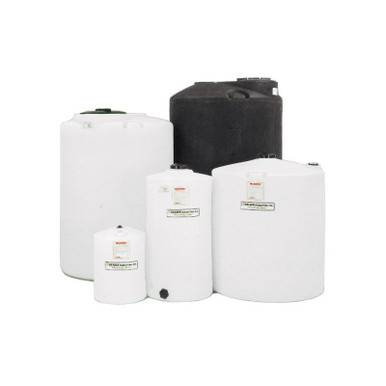
UV stabilizers slow this process. The two main families are carbon black (a UV blocker that absorbs photons before they reach the polymer) and HALS (hindered amine light stabilizers, which interrupt the free radical cascade). Carbon black at 2 to 3 percent loading provides excellent UV protection - black tanks have the longest outdoor service life. HALS provides good protection at much lower loading (0.1 to 0.5 percent) but does not block visible light, allowing translucent or pigmented tanks to retain their color. White tanks with HALS perform better than uncolored polyethylene but worse than carbon-black tanks. Translucent tanks with HALS have the shortest service life because they have neither carbon black nor sufficient HALS loading to compensate.
ASTM D4329: Fluorescent UV Lamp Apparatus
ASTM D4329 is the standard practice for accelerated weathering of plastics using fluorescent UV lamps. The test apparatus is a chamber containing fluorescent tubes (typically UVA-340 or UVB-313 lamps), a temperature-controlled black panel, and a spray system for water exposure. Specimens are mounted on a rotating drum and cycled through alternating periods of UV irradiation and water spray (or condensation).
The two main lamp types under D4329:
- UVA-340: Peak emission at 340 nm, spectrum closely matches the short-wavelength end of natural sunlight. Best simulation of real outdoor UV. Most polyethylene tank certifications use UVA-340 lamps because the spectrum match avoids artifacts.
- UVB-313: Peak emission at 313 nm, includes wavelengths shorter than what reaches Earth's surface. More aggressive than natural sunlight, faster correlation degradation, but can produce damage modes that do not occur in real service. Used for rapid screening, not service-life prediction.
A standard D4329 cycle runs 8 hours of UV at 60 to 70 deg C followed by 4 hours of condensation at 50 deg C. Total cycle time is 12 hours and one chamber-day equals two full cycles. Specimens are inspected for color change (delta E per ASTM E308), gloss retention (ASTM D523), tensile strength (ASTM D638), and elongation at break. Polyethylene tank manufacturers typically run D4329 to 1,000, 2,000, or 5,000 hours, then characterize the property retention.
ASTM D2565: Xenon-Arc Lamp Apparatus
ASTM D2565 covers xenon-arc accelerated weathering of plastics intended for outdoor service. The light source is a xenon-arc lamp filtered through borosilicate or quartz filters to closely match the natural sunlight spectrum from 295 nm to the visible range. Compared to fluorescent UV, xenon-arc produces a more accurate full-spectrum simulation including visible and near-infrared wavelengths. The trade-off is cost - xenon-arc chambers run higher capital and operating cost than fluorescent UV chambers, and lamp life is shorter.
D2565 cycles typically run continuous xenon-arc irradiance at 0.35 W/m2/nm at 340 nm, with a cycle of 102 minutes UV followed by 18 minutes of UV plus water spray. Black panel temperature is held at 63 to 65 deg C. Total irradiance is calibrated to match a global solar reference per ASTM G177.
For polyethylene tanks, D2565 is generally considered the superior service-life prediction test because the full-spectrum match means visible and IR-induced thermal degradation effects are also captured. Carbon black absorbs across the entire UV-visible-IR spectrum, so D2565 captures the full protective benefit. Fluorescent UV under D4329 only stresses the UV band and may understate the value of pigments that protect across a broader range.
Practices G151, G154, and G155 - The Underlying Framework
Both D4329 and D2565 reference the umbrella ASTM Practices G151, G154, and G155:
- ASTM G151 - General principles for non-metallic materials in accelerated weathering devices. Specifies how to report exposure conditions, how to measure irradiance, and how to interpret results.
- ASTM G154 - Operating procedures specifically for fluorescent UV lamp apparatus. D4329 references G154 for setup and calibration.
- ASTM G155 - Operating procedures specifically for xenon-arc lamp apparatus. D2565 references G155 for setup and calibration.
The G-series practices set the engineering rigor for accelerated weathering. The D-series practices apply that framework to specific material classes (D4329 and D2565 for plastics). Reading both is required for anyone interpreting test reports from tank manufacturers.
The Acceleration Factor: Chamber Hours to Real-World Years
The hard question every engineer wants answered: if a tank passes 5,000 hours in a D4329 chamber, how many years of real outdoor service does that equal?
The honest answer is "it depends, but here is the methodology." The acceleration factor (AF) is the ratio of accelerated UV exposure to natural UV exposure. For a fluorescent UV chamber running UVA-340 at 0.89 W/m2/nm at 340 nm, the irradiance is approximately 5 to 7 times the average natural sunlight irradiance at 340 nm in the continental US. Average daytime UV exposure in the continental US is approximately 6 to 8 MJ/m2 per year of UV in the 295 to 400 nm band, depending on latitude and cloud cover.
For a chamber running 24 hours per day at 5x natural irradiance:
- Chamber hours per year of natural exposure: 8,760 / 5 = 1,752 hours
- 5,000 chamber hours / 1,752 hours per year = 2.85 years natural exposure equivalent
That is the simple math. The real math is more complex because:
- Natural exposure includes night (no UV) and seasonal variation. Phoenix has higher UV flux than Seattle.
- Acceleration factor is wavelength-dependent. A 5x acceleration at 340 nm may be 8x at 320 nm or 3x at 380 nm.
- Temperature effects compound. Higher chamber temperature accelerates oxidation kinetics; real outdoor temperature varies seasonally.
- Moisture cycling in the chamber may not match real-world rain patterns.
The defensible engineering rule of thumb: 1,000 chamber hours under D4329 with UVA-340 lamps approximates 6 to 12 months of natural Florida exposure, or 12 to 24 months of natural Pacific Northwest exposure. ASTM G177 provides the reference solar spectrum for converting chamber irradiance to natural-exposure equivalent.
Property Retention Targets for Tank-Grade Polyethylene
What does "passing" the D4329 or D2565 test mean for tank service life? The major rotomolded polyethylene tank manufacturers target the following property retention thresholds:
- Tensile strength retention >= 50% of original after 5,000 hours D4329 UVA-340. Below 50%, the tank wall has lost too much load-bearing capacity for safe long-term hydrostatic service.
- Elongation at break retention >= 30% of original after 5,000 hours. Elongation drops faster than tensile strength under UV; this is the more sensitive failure indicator.
- Notched Izod impact strength retention >= 25% of original after 5,000 hours. Impact resistance loss is the precursor to brittle cracking.
- Surface chalking per ASTM D4214 not exceeding rating 6 (slight chalking) after 5,000 hours. Heavy chalking indicates surface oxidation has propagated significantly into the wall.
- Color change (delta E) per ASTM E308 not exceeding 5.0 after 5,000 hours for pigmented tanks; not specified for natural/translucent.
A tank that passes all five thresholds at 5,000 hours D4329 typically delivers 15 to 20 years of outdoor service in the continental US. A tank that fails one or more thresholds at 5,000 hours typically delivers 8 to 12 years before requiring replacement.
Color Selection and Latitude: The Engineering Reality
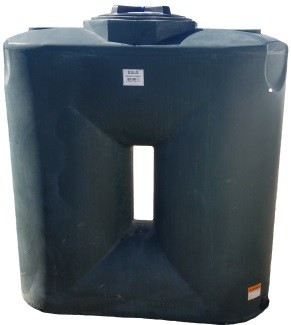
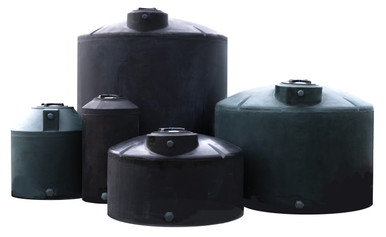
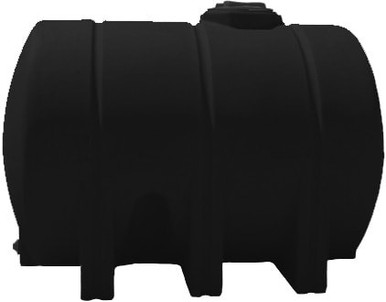
Carbon-black tanks (2 to 3 percent carbon black loading) provide the longest UV-stabilized service life. The carbon-black particles absorb UV and dissipate the energy as heat before it can reach the polymer chain. The trade-off is that black tanks absorb solar IR and run 15 to 25 deg F hotter than white tanks in direct sun. For chemical service where elevated temperature accelerates chemistry-induced degradation (sodium hypochlorite is the classic example), black tanks may give shorter chemistry service life despite longer UV service life.
White tanks (TiO2 pigmented) reflect 75 to 85 percent of incident solar IR, run cooler, and provide adequate UV protection through HALS additives. White is the engineering default for most chemical service in warm climates.
Translucent tanks (no pigment, HALS only) allow visual level reading but have the shortest UV service life. Translucent tanks should be specified for indoor service, shaded outdoor service, or short-service-life applications (under 5 years). For full-sun outdoor service in Arizona, Texas, or Florida, translucent tanks lose 50 percent of tensile strength in approximately 3 to 5 years versus 15 to 20 years for white or black equivalents.
Latitude adjustment: solar UV flux at 30 deg N latitude (Phoenix, Houston, Jacksonville) is approximately 1.5 times the flux at 45 deg N latitude (Minneapolis, Seattle, Portland). Tank service life roughly inverts the ratio - a tank rated 15 years in Minnesota delivers approximately 10 years in Phoenix. Specify color and material with latitude in mind.
OneSource Tank Selection by UV Exposure Class
Recommended tank specifications by service environment:
- Continuous indoor service: Any color, any rotomolded HDPE or XLPE tank from the catalog. UV is not a service-life driver indoors. Norwesco N-40146 1500 gallon vertical liquid storage tank works in any indoor application.
- Shaded outdoor service: White or black tanks preferred; translucent acceptable. Norwesco N-41822 1500 gallon underground multi-use tank is shaded by burial.
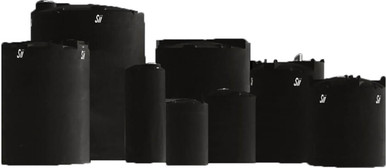
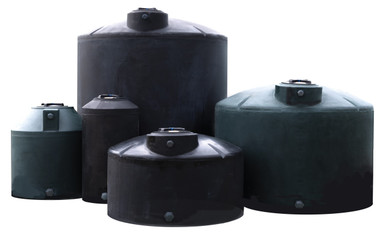
- Full-sun outdoor service, northern latitudes (above 40 deg N): White or black; UV-stabilized HDPE adequate. Enduraplas EP-TLV02100BK 2100 gallon black water storage tank is engineered for this exposure.
- Full-sun outdoor service, southern latitudes (below 35 deg N): Black preferred; white acceptable with HALS package. Enduraplas EP-TLV03000BK 3000 gallon black water tank or Norwesco-equivalent black tanks are the durability choice.
- Full-sun outdoor service, high-altitude (above 5,000 ft): Black mandatory; UV intensity is significantly higher at altitude. Carbon black is the only pigment package proven to handle Denver, Albuquerque, and Cheyenne sun.
Test Report Reading Guide
When you request a UV test report from a tank manufacturer, look for:
- Test method citation: ASTM D4329 or D2565, with revision year (e.g., D4329-21).
- Lamp type: UVA-340, UVB-313, or xenon-arc with filter type.
- Total exposure hours: 1,000, 2,000, 5,000, or 10,000 hours.
- Properties measured: Tensile strength (D638), elongation at break (D638), notched Izod impact (D256), gloss (D523), color (E308), chalking (D4214).
- Property retention values: Numerical values at each exposure interval, not just pass/fail statements.
- Statistical confidence: Minimum of 5 specimens per condition, mean and standard deviation reported.
Reports that omit any of these elements are not engineering-grade documentation. OneSource Plastics will not certify a tank for long-service outdoor application without a complete D4329 or D2565 report from the manufacturer.
Field Inspection Cadence for Outdoor Polyethylene Tanks
Lab data sets the expected service life. Field inspection catches deviation from expected. Recommended cadence:
- Annual visual inspection for surface chalking, color fading, and stress whitening at fittings. Baseline at year 1 to track change.
- Year 5 ultrasonic wall thickness measurement at 8 to 12 random sample points. Compare to original wall thickness; document any thinning.
- Year 10 destructive sample test if economically justified. Cut a 2 inch coupon from a non-load-bearing wall section, run tensile testing per ASTM D638, compare to baseline. This is invasive but provides definitive remaining-life data.
- Year 12 onward annual inspection cadence with decision criteria for replacement at year 15 to 20 depending on test results.
Internal Linking and Further Reading
For detailed wall-thickness erosion data across the 0 to 30 year service curve, see the UV degradation wall thickness erosion guide. For UV stabilizer chemistry deep dive, see the HALS vs carbon black vs translucent resin guide. For latitude-specific color selection, see UV-resistant color selection by latitude. For the complete chemical compatibility ecosystem, the chemical compatibility hub covers HDPE and XLPE chemistry envelopes for the major industrial chemistries. For state-specific regulatory context, see the state regulations hub.
Pricing and Procurement
OneSource Plastics ships UV-stabilized rotomolded polyethylene tanks from Norwesco, Snyder Industries, Chem-Tainer, Bushman, and Enduraplas. Black tanks (carbon-black UV package) for full-sun outdoor service in the 1,500 to 10,000 gallon class are listed from $895 for the smaller class up to $8,500 for the 10,000 gallon class. White tanks (HALS-stabilized) typically run 5 to 10 percent below black in the same gallon class. Translucent (natural HDPE, HALS only) tanks list 10 to 15 percent below white. LTL freight is quoted separately to your ZIP via the freight estimator; freight typically runs $300 to $1,500 depending on tank size and origin-destination geography.
For UV service-life consultation on a specific tank application, latitude, and chemistry, call OneSource Plastics at 866-418-1777. We will run the ASTM D4329 or D2565 test data from the manufacturer against your installation environment and recommend the color and material specification that delivers the longest defensible service life. The test data exists; using it correctly is what separates a 20-year tank from a 7-year tank.
Recommended Tanks for This Guide
Live pricing, updated automatically · estimate freight to your ZIP.