Tank Mobile Service Trailer Engineering: Skid-Mount vs Trailer-Mount vs Pickup-Bed Selection
Mobile water and chemistry hauling is engineering before it is logistics. The wrong tank-on-vehicle pairing produces slosh-induced steering loss, axle overload, frame fatigue, brake fade on grade, hose-coupling damage from G-shock, and DOT compliance violations that compound across mileage. The right pairing produces a 10-15 year service asset that pays for itself by Year 2 in eliminated freight charges, reduced site downtime, and the operator efficiency of a tool that goes where the work is.
Three mounting strategies cover virtually every mobile-tank application below 1,650 gallons: skid-mount in a flatbed or service-truck bed, trailer-mount on a single-axle or dual-axle bumper-pull or gooseneck, and pickup-bed-only mount with internal tie-down to the bed rails. Each has a discrete capacity envelope, a discrete vehicle pairing, a discrete DOT classification, and a discrete failure mode when over-loaded.
The Three Mounting Architectures
Pickup-Bed Mount (35-325 gallons)
The simplest and lightest configuration. A flat-bottom or saddle-shaped HDPE tank sits in the pickup-bed, secured by ratchet straps to the bed-rail tie-downs, with hose and fittings exiting via the tailgate or side. No tongue, no axle, no separate brakes - the host pickup carries everything.
- Capacity envelope: 16 to 325 gallons (water weight 133 to 2,710 lb).
- Host vehicle: 1/2-ton (F-150 / Silverado 1500) up to 200 gallon water; 3/4-ton (F-250 / Silverado 2500) up to 325 gallon water.
- Capacity-to-payload check: water weighs 8.34 lb/gal. A 200-gallon water load plus tank dry weight of ~50 lb plus fittings/hose ~30 lb = 1,748 lb cargo. F-150 STX payload spec is 1,400-2,200 lb depending on trim. Check the door-jamb sticker, not the brochure spec.
- DOT class: non-CDL provided GVWR stays under 26,001 lb (combined tractor+trailer).
- Tank requirements: baffles required above 100 gallon to prevent slosh-induced steering loss; flat or saddle bottom for low CG; strap channels molded into shell.
Representative SKUs: Norwesco MPN 44853 (16 gallon flat bottom utility tank), MPN 44854 (20 gallon flat bottom), MPN 44873 (35 gallon flat bottom utility), MPN 44963 (100 gallon portable loaf utility, $324.72 list), MPN 60204 (100 gallon applicator saddle tank, $347.00 list), MPN 40327 (300 gallon horizontal elliptical cradle), MPN 40328 (500 gallon horizontal elliptical cradle - only with 1-ton or larger).
Skid-Mount in Flatbed or Service Truck Body (200-1,650 gallons)
The skid-mount tank is a flat-bottom or D-shaped tank fitted to a steel or aluminum skid frame with integrated forklift channels, lift eyes, and tank-saddle straps. The skid drops into a flatbed body, service-truck dump bed, or dedicated chassis-cab fleet body. Skids transfer between vehicles - the tank moves with the work, the chassis stays at the yard.
- Capacity envelope: 200 to 1,650 gallons (water weight 1,668 to 13,761 lb).
- Host vehicle: 1-ton flatbed (F-350) for 300-500 gallon. Class 4-5 (F-450/F-550) for 500-1,000 gallon. Class 6-7 (F-650/F-750) for 1,000-1,650 gallon.
- Capacity-to-payload check: a 1,000-gallon water skid weighs ~125 lb tank + ~600 lb skid + 8,340 lb water = 9,065 lb. F-550 cab-chassis GVWR is 19,500 lb; subtract 9,500 lb chassis weight, leaving 10,000 lb payload. 1,000 gal fits, 1,500 gal forces upgrade to F-650.
- DOT class: CDL Class B required when vehicle GVWR exceeds 26,001 lb.
- Tank requirements: baffles mandatory; sump bottom for full drain; lift eyes load-rated for full water weight; ASTM D1998 wall thickness rating; 4-point or 8-point strap pattern molded into skid frame.
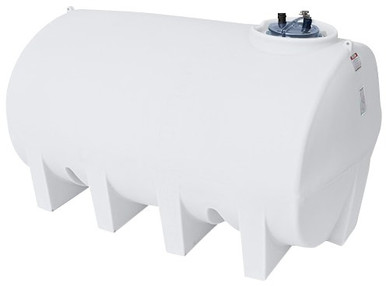
Representative SKUs: Enduraplas MPN THD00400KBK (400 gallon sump-bottom transport tank with frame, black), MPN THD01010K-BLK (1,010 gallon horizontal sump-bottom skid-mounted tank, black), MPN THD01600KBK (1,600 gallon horizontal skid-mounted tank with sump, black). Norwesco horizontal cradle and elliptical-leg series cover comparable capacity bands without integrated skid - require field-fabricated frame.
Trailer-Mount (300-1,650 gallons, occasionally to 3,000)
The trailer-mount configuration places the tank on a dedicated bumper-pull or gooseneck trailer. The trailer carries axle, suspension, electric or hydraulic brakes, lights, and fenders. The host vehicle only provides the tow connection and the tongue weight.
- Capacity envelope: 300 to 1,650 gallons on single-axle bumper-pull; 1,000 to 3,000 gallons on dual-axle bumper-pull or gooseneck.
- Host vehicle: 1/2-ton tow up to 300 gallon water (5,000 lb GVWR trailer); 3/4-ton up to 1,000 gallon (10,000 lb); 1-ton dual rear wheel up to 1,650 gallon (14,000 lb GVWR); class 4-5 chassis-cab gooseneck up to 3,000 gallon water.
- Capacity-to-tongue-weight check: 10-15% of trailer GVWR transfers to tongue. A 13,761-lb water load on a 14,000 lb trailer GVWR puts 1,400-2,100 lb on the hitch. F-250 hitch class V is rated 1,800 lb tongue weight; F-350 dual rear wheel handles 2,500 lb.
- DOT class: non-CDL provided combined GVWR (truck + trailer) under 26,001 lb. 14,000-lb water trailer behind 7,000-lb F-150 = 21,000 lb combined - non-CDL OK. 14,000-lb water trailer behind 13,000 lb F-450 = 27,000 lb combined - CDL Class A required because truck-and-trailer combo crosses 26,001 lb threshold AND trailer alone exceeds 10,000 lb.
- Trailer requirements: electric brake on every axle (49 CFR 393.42), brake-away cable, breakaway battery, DOT side-marker lights, 7-pin connector, fenders covering tire, mud flaps required on Class 6+, slosh baffle inside tank, tank-to-trailer mounting per ASTM D1998 frame interface.
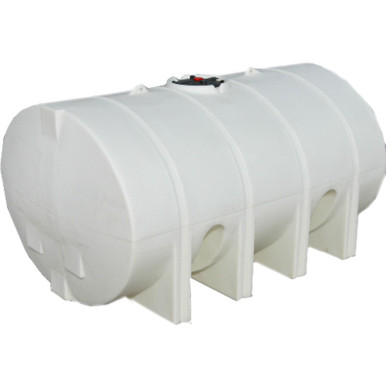
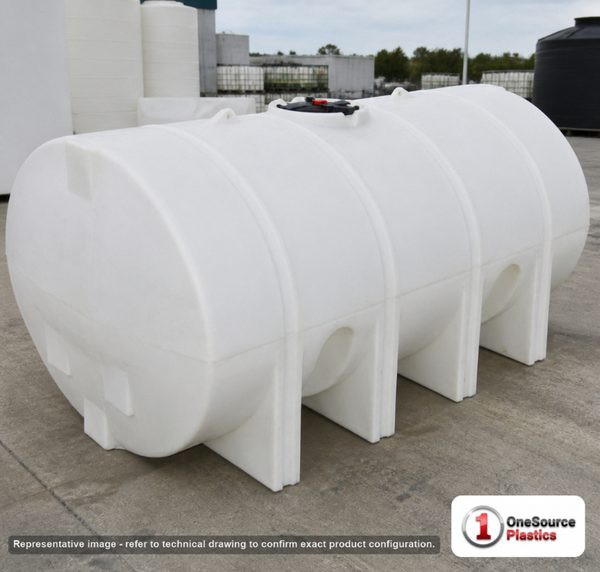
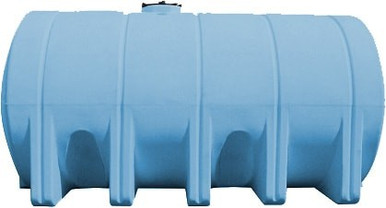
Representative SKUs (tank only, mate to trailer): Norwesco MPN 40775 (2,035 gallon HDPE horizontal elliptical leg tank, black), MPN 41294 (2,635 gallon HDPE horizontal elliptical leg, black), MPN 40283 (2,635 gallon HDPE horizontal elliptical leg, blue), MPN 40328 (500 gallon horizontal elliptical cradle), MPN 44936 (1,050 gallon portable loaf utility tank, white).
Slosh Engineering: The Hidden Killer
An unbaffled tank slug-loading at half capacity transfers up to 35% of the water mass into a single inertial event during a hard turn or panic stop. A 1,000-gallon trailer at 50% fill (4,170 lb water) can transfer 1,460 lb of dynamic load to one side of the trailer in 0.5 seconds. This dynamic load:
- Lifts inside-turn axle off the road (jackknife risk on bumper-pull).
- Overstresses tank wall on the impact side (rotomolded HDPE wall yields at ~3,000 psi peak hoop stress; slug load can exceed this on thin-wall builds).
- Couples to driver vehicle through tongue, causing involuntary steering input.
- Repeated cycle = strap fatigue, mount-bolt elongation, and frame crack.
Three baffle types address this:
- Vertical wave-suppression baffles - integrated rotomolded vertical walls inside tank that reduce front-back slosh. Standard on Enduraplas DOT-rated transport tanks.
- Horizontal slosh baffles - perforated horizontal plates that slow vertical fluid acceleration during pavement transitions.
- Sump-bottom geometry - the bottom converges to a low-point outlet, eliminating residual slosh during drain. Critical for application equipment that wants full tank emptying without leaving 5-15 gallons of stagnant water.
For any transport application above 200 gallons, baffles are not optional - they are the difference between a safe asset and a liability. The Enduraplas MPN THD00400KBK and MPN THD01010K-BLK both ship with integrated baffle structure built into the rotomold.
DOT 49 CFR 393 Compliance Quick Reference
| Requirement | Reference | When triggered |
|---|---|---|
| Brakes on every axle | 49 CFR 393.42 | Trailer GVWR > 3,000 lb |
| Breakaway cable + battery | 49 CFR 393.43 | Brake-equipped trailer |
| Side-marker lights | 49 CFR 393.11 | Trailer length > 30 ft (water trailers usually exempt) |
| Tie-down minimum | 49 CFR 393.130 | Cargo (skid) on flatbed - 1 strap per 10 ft length, min 2 |
| Tie-down WLL aggregate | 49 CFR 393.106 | Sum of strap WLL >= 50% cargo weight |
| CDL Class A | 49 CFR 383.91 | Combined GVWR > 26,001 lb AND trailer GVWR > 10,000 lb |
| CDL Class B | 49 CFR 383.91 | Single vehicle GVWR > 26,001 lb |
| Hazmat endorsement | 49 CFR 383.93 | Any hazmat-classified content |
Capacity-to-Vehicle Decision Matrix
| Capacity | Water weight | Mounting | Min vehicle | License |
|---|---|---|---|---|
| 35-100 gal | 292-834 lb | Pickup-bed | 1/2-ton pickup | Class C (regular) |
| 100-300 gal | 834-2,502 lb | Pickup-bed or trailer | 3/4-ton pickup | Class C |
| 300-500 gal | 2,502-4,170 lb | Skid in 1-ton bed or trailer | F-350 or 1-ton bumper-pull | Class C |
| 500-1,000 gal | 4,170-8,340 lb | Skid in F-450/F-550 or trailer | F-450 / 1-ton DRW + 14k trailer | Class C (combined < 26k) |
| 1,000-1,650 gal | 8,340-13,761 lb | Skid in F-650 or trailer | F-550/F-650 or 1-ton + 14k trailer | CDL B (truck) or A (combo) |
| 1,650-3,000 gal | 13,761-25,020 lb | Trailer (gooseneck or dual-axle) | Class 4-5 chassis-cab + gooseneck | CDL A typical |
Worked Selection Examples
Example 1: Rural Property Water Haul - 200 Gallons
Property owner hauls drinking water 12 miles from town, twice per week. F-150 4x4 with 1,800 lb payload. Best fit: Norwesco MPN 44963 (100 gallon loaf utility, $324.72). Two of these in the bed = 200 gallon total, 1,668 lb water + 100 lb dry tank weight + fittings = 1,800 lb. Below F-150 payload limit. Dual-tank approach gives flexibility (one tank for drinking, one for irrigation) and slosh isolation.
Example 2: Lawn Care Service - 300 Gallons Mobile Sprayer
F-350 with custom service body. Operator wants quick swap between water spray and weed-killer service. Skid-mount Enduraplas MPN THD00400KBK (400 gallon sump bottom transport with frame). The 400-gallon capacity gives 25% buffer over the 300-gallon nominal load. Frame integrates forklift channels for skid swap between trucks. Sump-bottom drain leaves zero residual chemistry between fluids.
Example 3: Concrete Cure Water - 1,000 Gallon Construction Site Service
Concrete contractor needs water on remote pour sites for cure spray and equipment cleanup. F-550 chassis cab. Best fit: Enduraplas MPN THD01010K-BLK (1,010 gallon horizontal sump-bottom skid-mounted, black). F-550 carries 12,000 lb in body; 1,010 gal water = 8,423 lb + skid 600 lb = 9,023 lb load. Within payload. Black HDPE service-life advantage in unsheltered job-site staging.
Example 4: Fire Department Mobile Reserve - 1,650 Gallons Tanker Trailer
Volunteer fire department, dual-axle bumper-pull water tender. Norwesco MPN 40775 (2,035 gallon HDPE horizontal elliptical leg, black) on a custom 14,000-lb GVWR dual-axle trailer with electric brakes. Filled to 1,650 gal (13,761 lb water + 250 lb tank) = 14,011 lb tank+water on a 14,000 lb GVWR trailer. Need to bump trailer to 16,000 lb GVWR for safety margin. Tow vehicle: F-450 dual rear wheel; combined GVWR = 14,000 truck + 16,000 trailer = 30,000 lb -> CDL Class A required.
Example 5: Field-Service Truck for Industrial Maintenance
Service tech needs 100 gal of clean water + 50 gal cleaning solution + tool box. F-250 service body. Norwesco MPN 60204 (100 gallon applicator saddle tank, $347.00) bolted forward of axle for trailer-tongue analog effect, plus a 30-gallon drum for cleaner. Saddle tank bolts to bed-rails using factory channel pattern; CG stays low, no driver impact under braking.
Common Mistakes
Mistake 1: Specifying capacity in payload terms instead of GVWR
"My F-350 says 4,000-lb payload" describes cargo capacity in the bed, not the trailer. A 14,000-lb water trailer doesn't sit in the bed - it sits on the hitch. Combined GVWR is the binding constraint, not bed payload.
Mistake 2: Using a flat-bottom tank in a trailer mount
Flat-bottom tanks sit best in flatbeds where the entire base is supported. On a trailer with limited support area, flat-bottom tanks need a full sub-floor between tank and trailer deck. Most trailer-rated tanks ship D-shaped or elliptical-leg for distributed point loading on 4-6 saddle cradles.
Mistake 3: Ignoring slosh baffles below 200 gal because "it's just water"
A 100-gallon unbaffled tank in pickup-bed steering at 35 mph through a roundabout transfers ~80 lb of inertial force into the bed wall on each lane change. Over 1,000 cycles, this fatigues the strap channels. Baffles add 8-12% to tank cost; they extend tank life by 2-3x.
Mistake 4: Tow rating without considering brake performance
F-150 might be rated to tow 11,000 lb on level ground, but stopping a 1,000-gallon water trailer (10,000 lb gross) on a 6% downgrade at 55 mph requires brake authority the F-150 doesn't have. Check brake-controller torque rating, not just tow rating.
Mistake 5: Skipping breakaway battery on water trailer
A water trailer is unloaded as far as DOT inspection cares, BUT the trailer GVWR (not actual load) determines breakaway requirement under 49 CFR 393.43. A 14,000-lb GVWR trailer needs a breakaway battery and cable even if it's running half empty. Inspection writes the ticket on the GVWR plate.
Mistake 6: Forklift slot misalignment when transferring skid between trucks
Standard pallet jack opening is 27.5 inches between forks. Skid frames spec at 26.5 inches centered. A 1.5-inch fork misalignment torques the skid frame. Always confirm skid forklift channel dimension matches your fleet equipment.
Internal Resources
- Container vs Tank Form Factor Guide
- State Regulations Hub
- California Tank Regulations
- Texas Tank Regulations
- Chemical Compatibility Library
- Tank Sizing Calculator
- Freight Cost Estimator
- Custom Tank Fabrication Hub
Source Citations
- 49 CFR 383 - Commercial Driver's License Standards
- 49 CFR 383.91 - Commercial Motor Vehicle Groups (Class A, B, C)
- 49 CFR 393.11 - Lighting Devices and Reflectors
- 49 CFR 393.42 - Brakes Required on All Wheels
- 49 CFR 393.43 - Breakaway and Emergency Braking
- 49 CFR 393.106 - Working Load Limit / Cargo Securement
- 49 CFR 393.130 - Heavy Vehicles, Equipment, and Machinery / Tie-Down Requirements
- ASTM D1998-21 - Standard Specification for Polyethylene Upright Storage Tanks
- NSF/ANSI 61 - Drinking Water System Components
- OneSource Plastics master catalog data, 2026-03-26 snapshot (9,419 SKUs)
Recommended Tanks for This Guide
Live pricing, updated automatically · estimate freight to your ZIP.