Tank Operating Temperature Engineering: Cold vs Hot vs Ambient Service Limits by Material
Operating temperature is the second most-misunderstood spec on a polyethylene tank purchase order, behind only specific gravity. Buyers see a 1.9 SG rating on a Norwesco vertical and assume the tank works at any temperature. It does not. Polyethylene shifts mechanical properties dramatically across the -40 deg F to +140 deg F range that industrial tanks routinely encounter, and crossing the wrong threshold shaves 30 to 80 percent off design life or causes outright field failure. This guide walks the temperature-vs-material decision matrix so the tank you buy survives the climate, the chemistry, and the fluid temperature you actually run.
OneSource Plastics ships polyethylene rotomolded tanks (HDPE, XLPE, modified polyolefin), polyethylene IBC totes and cubetainers, stainless 304 / 316L specialty totes, and we coordinate FRP and lined-steel fabrication through the Specialty & Metal Fabrication hub. Material choice maps directly to operating temperature window. The decision is rarely just chemistry; it is chemistry-at-temperature.
The Five Temperature Bands
Band 1: Sub-Freezing Service (below 32 deg F / 0 deg C)
Cold storage of antifreeze, brine, methanol blends, fuel-additive packages, agricultural liquid fertilizer in unheated barns. Polyethylene retains tensile strength down to its brittleness point, but impact resistance falls sharply. ASTM D746 (Brittleness Temperature by Impact) typically reports HDPE around -100 deg F brittleness with notched impact much earlier; XLPE retains ductility deeper into the cold range due to crosslinks resisting crack propagation.
- HDPE rotomolded: usable but impact-sensitive below 0 deg F; never bang or drop a half-frozen HDPE tank in winter.
- XLPE rotomolded: better cold ductility; preferred for chemistry tanks left outdoors above the 36th parallel.
- FRP: no temperature degradation in cold; resin choice (vinyl ester vs isophthalic) sets the chemistry window.
- 304 / 316L stainless: zero issue at sub-freezing; austenitic stainless retains ductility through cryogenic.
- Carbon steel: watch for ductile-to-brittle transition; ASTM A516 Grade 70 with proper Charpy impact testing required for sub-zero.
Band 2: Cold-Climate Outdoor Ambient (32 - 60 deg F)
Default winter / shoulder-season range across the northern U.S. Polyethylene tanks engineered for ASTM D1998 service handle this band easily. The chemistry decision dominates; temperature is not the limiting factor.
Band 3: Standard Industrial Ambient (60 - 100 deg F)
The design point for ASTM D1998 polyethylene rotomolded tanks. Specific gravity ratings (typically 1.5, 1.7, 1.9, 2.0 SG) on Norwesco / Snyder / Chem-Tainer datasheets assume this band. Tank wall thickness math, hydrostatic head calculations, and field-load engineering all reference this bracket.
Band 4: Warm Service (100 - 140 deg F)
This is where most tank purchases go wrong. Manufacturer data shows polyethylene wall stress capacity drops roughly linearly with temperature. By 120 deg F a 1.9 SG-rated HDPE tank is closer to a 1.5 SG tank in real load-bearing capacity. Norwesco's published ESCR data and Snyder's XLPE temperature-derating tables both show 30-50 percent capacity loss at 120 deg F vs 73 deg F baseline. This is the band where:
- Hot-water tanks for car wash recycle and parts-washer fluid run.
- Solar pre-heat tanks reach during summer in the Southwest.
- Black-pigmented outdoor tanks in Phoenix, Yuma, El Centro, McAllen reach skin temperatures of 140-160 deg F under July sun.
- Process condensate, blowdown, and warm chemistry feeds enter storage.
For sustained service in this band, derate SG aggressively, switch to XLPE, or move to FRP with appropriate vinyl-ester resin.
Band 5: Hot Service (above 140 deg F)
Past the practical limit for rotomolded HDPE. XLPE manufacturers publish brief excursion tolerance to ~150 deg F but not sustained service. Above 140 deg F sustained, the engineering choices are:
- FRP: vinyl-ester resin systems handle 180-220 deg F sustained depending on chemistry.
- Lined steel: rubber lining (40-80 mils butyl or chlorobutyl) extends carbon-steel service into chemistry; baked-phenolic lining handles solvent service.
- Stainless 304 / 316L: ASME Section VIII pressure vessels rated to 800+ deg F. Specialty & Metal Fabrication territory.
- Polypropylene: selectively, for solvent service to ~200 deg F where chemistry compatible.
Specific Material-vs-Temperature Engineering
HDPE (High-Density Polyethylene) - ASTM D1998 Type II
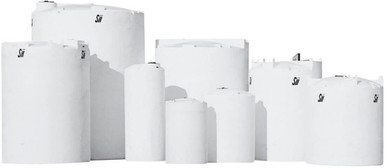
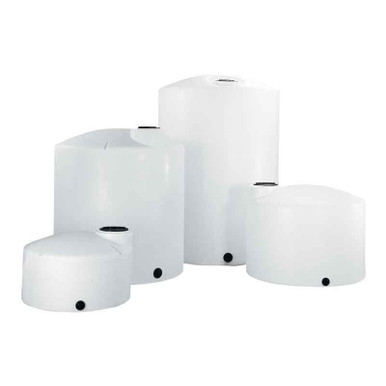
Norwesco and Snyder commodity vertical tanks (Norwesco MPN 41464 100-gallon vertical, Snyder MPN 1000VLPC 1,000-gallon, Snyder MPN 2500VLPC 2,500-gallon, etc.) are typically Type II HDPE per ASTM D1998. Density 0.94-0.95 g/cm3. Temperature behavior:
- Recommended sustained: 32-100 deg F.
- Allowable continuous: -20 to +120 deg F with SG derating.
- Maximum brief excursion: +140 deg F.
- Brittleness onset: approximately -76 deg F per ASTM D746 (varies by resin grade).
- Heat distortion temperature (HDT) at 66 psi: ~158-180 deg F per ASTM D648.
XLPE (Crosslinked Polyethylene)
Snyder XLPE tanks (Snyder MPN 1000XLP, MPN 1500XLPDS, MPN 2500XLPDS) and Chem-Tainer XLPE chemistry tanks. Crosslink network resists creep and stress-cracking at elevated temperature.
- Recommended sustained: 32-110 deg F for full SG rating.
- Allowable continuous: -40 to +140 deg F with derating.
- Maximum brief excursion: +150 deg F.
- Cold ductility: better than HDPE; preferred for outdoor northern installations and chemistry that occasionally cold-soaks.
- Stress-crack resistance: ESCR per ASTM D1693 effectively infinite for crosslinked resin.
Polypropylene Random Copolymer (PPR)
Used in selective IBC totes, drum closures, and process containers. Higher temperature ceiling than HDPE but lower impact strength.
- Recommended sustained: 32-180 deg F.
- Maximum brief excursion: +200 deg F.
- Brittleness: notably colder-fragile than HDPE; not for outdoor sub-freezing service.
FRP (Fiberglass Reinforced Plastic)
Per ASTM D3299 (filament-wound) and ASTM D4097 (contact-molded). Resin choice sets the temperature window:
- Isophthalic polyester: 0-180 deg F service.
- Vinyl ester: -40 to +220 deg F sustained; preferred for hot oxidizing service.
- Bisphenol-A epoxy: to 250 deg F with appropriate hardener.
Carbon Steel
Per API 650 (atmospheric storage tanks) for ambient service; ASME Section VIII Division 1 for pressure vessels. Temperature concerns:
- Sub-zero ductility: ASTM A36 plate inadequate below 0 deg F without Charpy verification; use A516 Grade 70 with low-temp impact testing.
- Hot service: creep onset around 700 deg F for plain carbon; requires pressure-vessel Code Case approval.
- Lining temperature limits: butyl rubber to 180 deg F, chlorobutyl to 220 deg F, baked phenolic to 220 deg F.
Stainless 304 / 316L
Austenitic stainless. ASME Section VIII Div 1 service from -325 deg F to +800 deg F sustained. The Snyder MPN 6984000B51318 245-gallon stainless Supertainer is the IBC-scale version of this material. For tank-scale stainless, see our 304 vs 316/316L stainless selection guide, or request a quote through our certified steel fabrication team.
The SG-vs-Temperature Derating Trap
Manufacturer datasheets publish specific gravity ratings at 73 deg F (ASTM standard test temperature). The same tank at 120 deg F handles less load. Snyder's published derating table (paraphrased; consult manufacturer data for the specific tank):
| Service temperature | HDPE SG capacity | XLPE SG capacity |
|---|---|---|
| 73 deg F (baseline) | 1.9 SG (full) | 1.9 SG (full) |
| 100 deg F | ~1.7 SG | ~1.85 SG |
| 120 deg F | ~1.4 SG | ~1.7 SG |
| 140 deg F | ~1.0 SG (water only) | ~1.4 SG |
| 150 deg F | Not recommended | ~1.2 SG (brief) |
Real-world implication: a 1,500-gallon Norwesco HDPE tank rated 1.9 SG at 73 deg F holds 50 percent caustic (1.53 SG) at 73 deg F with margin, but the same chemistry at 120 deg F (which can happen during summer in an uninsulated outdoor tank in Texas) is operating right at the wall-stress limit. That tank needs to be XLPE, or insulated and shaded, or downsized in fill height.
Real Failure Modes by Temperature
Failure 1: Black HDPE tank in Phoenix summer
Black-pigmented outdoor HDPE absorbs solar radiation. A 1,500-gallon HDPE tank in direct July sun in Phoenix, surface temperature 145-160 deg F, internal liquid temperature 120-130 deg F. Wall stress capacity at that temperature is 60 percent of nameplate. If the chemistry is heavy (1.7+ SG), the tank fails by hoop-stress wall bulge or stress-crack at fitting penetrations within 12-36 months. Solution: white pigment, or shade structure, or XLPE upgrade.
Failure 2: Brine tank in Minnesota January
20 percent calcium chloride brine for road treatment, stored outdoors uninsulated. Liquid freezes around the wall at -10 deg F ambient. Ice expansion (8 percent volumetric) loads the tank wall. HDPE at -10 deg F has reduced impact resistance; a small impact (handling, plow strike) cracks the cold tank shell. Field reports of HDPE tank cracking on Minnesota DOT brine yards confirm the failure mode. Solution: XLPE rotomold, insulated tank wrap, or recess installation below frost line.
Failure 3: Hot caustic feed to an HDPE polishing tank
50 percent NaOH dosed at 130 deg F into a polishing tank. Operator specified HDPE based on chemistry compatibility (HDPE handles 50 percent NaOH at 73 deg F). At 130 deg F the wall stress capacity is half. Within 18 months: stress-crack at the fill nozzle, fitting pull-out at the manway. Solution: XLPE for the polish tank, or move to vinyl-ester FRP.
Failure 4: Sub-zero antifreeze tote drop
HDPE drum or IBC at -20 deg F dropped from forklift height. Brittle fracture on impact. Per ASTM D746, the impact-onset temperature is well below brittleness, so handling impact at low temperature is the dominant failure mode. Solution: warmed handling area, or XLPE alternative, or stainless 304 IBC for the cold-storage application.
Operating Window Decision Matrix
| Operating temperature | Default material | Better-but-pricier |
|---|---|---|
| -40 to 0 deg F sustained | XLPE rotomold | Stainless 304 |
| 0 to 60 deg F | HDPE rotomold | XLPE |
| 60 to 100 deg F (ASTM D1998 design point) | HDPE rotomold (full SG rating) | XLPE for aggressive chemistry |
| 100 to 120 deg F | XLPE rotomold (with derate) | FRP iso-resin |
| 120 to 140 deg F | XLPE (heavy derate) or FRP iso | FRP vinyl-ester |
| 140 to 180 deg F | FRP vinyl-ester | Lined steel / stainless |
| 180 to 220 deg F | FRP vinyl-ester / lined steel | Stainless 304 / 316L |
Mitigation Tactics: Buying Time at Marginal Temperatures
Tactic 1: Pigment selection
White and natural-pigmented HDPE absorb 50-60 percent less solar load than black. For outdoor tanks in southern latitudes, white pigment buys 15-25 deg F of effective wall temperature reduction at zero added cost. Norwesco MPN 41861 (100 gal vertical white) vs MPN 41464 (100 gal vertical black): same chemistry tank, very different summer performance.
Tactic 2: Shade structure
Simple over-tank shade canopy or building enclosure prevents solar gain. 25-50 deg F reduction in tank skin temperature in southern climates. Cost: $500-3,000 for a 1,500-gallon tank shade.
Tactic 3: Insulation jacket + heat trace
For cold-climate tanks holding above-freezing chemistry, foam insulation (R-7 to R-14) plus self-regulating heat trace cable maintains 40-70 deg F internal temperature through northern winters. Cost: $2,000-8,000 for a 1,500-gallon tank.
Tactic 4: Internal heat exchanger
Submerged steam coil or electric immersion heater raises stored fluid temperature for cold-process applications, or pulls heat for hot-process cooling. Engineering depth required; consult Specialty & Metal Fabrication.
Tactic 5: Material upgrade
The cheapest mitigation is often picking the right material at procurement. XLPE costs 30-60 percent more than HDPE; that premium is far less than the cost of a tank replacement at year 5. FRP tank costs 2-4x rotomold; for chemistry above 130 deg F sustained, it's still cheaper than the alternative of replacing a failing rotomold tank twice.
Field Verification Checklist
- Measure or estimate the worst-case sustained operating temperature, not the average.
- If the tank is outdoors in southern latitude, add 30-50 deg F to ambient air temperature for skin temperature on dark-pigmented tanks.
- Cross-reference manufacturer SG-vs-temperature derating curve, not just the headline SG rating.
- For cold service, confirm the resin grade has documented impact data at the design low temperature.
- For hot service above 100 deg F sustained, default to XLPE; above 140 deg F default to FRP or lined steel.
- Confirm fitting and gasket materials handle the operating temperature too (EPDM softens above 250 deg F; PTFE fine to 500 deg F).
- Document the operating temperature on the asset tag; future operators won't read the original spec.
Internal Resources
- Tank Material Selection: HDPE vs XLPE vs Steel vs FRP
- Tank Hot-Water Storage Temperature Engineering
- Cold Climate Tank Field Performance HDPE vs XLPE
- Tank Insulation R-Value vs Climate Zone
- Tank Heat Trace + Insulation Cost-Benefit by Climate Zone
- Tank Polyethylene Resin Density Decoded
- Freight Cost Estimator
- Contact OneSource
Source Citations
- ASTM D1998 - Standard Specification for Polyethylene Upright Storage Tanks
- ASTM D638 - Tensile Properties of Plastics (resin baseline at 73 deg F)
- ASTM D746 - Brittleness Temperature of Plastics by Impact
- ASTM D648 - Heat Deflection Temperature
- ASTM D1693 - Environmental Stress-Cracking of Ethylene Plastics (ESCR)
- ASTM D3299 - Filament-Wound Glass-Fiber-Reinforced Thermoset Resin Tanks
- ASTM D4097 - Contact-Molded Glass-Fiber-Reinforced Thermoset Resin Tanks
- ASTM A516 / A516M - Pressure Vessel Plate, Carbon Steel, Moderate and Lower Temperature Service
- API 650 - Welded Tanks for Oil Storage (atmospheric)
- ASME Boiler and Pressure Vessel Code, Section VIII Div 1 - Pressure Vessels
- Manufacturer published derating tables (Norwesco / Snyder / Chem-Tainer)
Recommended Tanks for This Guide
Live pricing, updated automatically · estimate freight to your ZIP.