
Jacketed & Agitated Tanks
Jacketed & Agitated Tanks
A jacketed, agitated tank is the workhorse of nearly every process plant, combining controlled heat transfer with controlled mixing in one vessel. Getting the jacket, the agitator, and the baffles matched to the product is what separates a tank that performs from one that fights you.
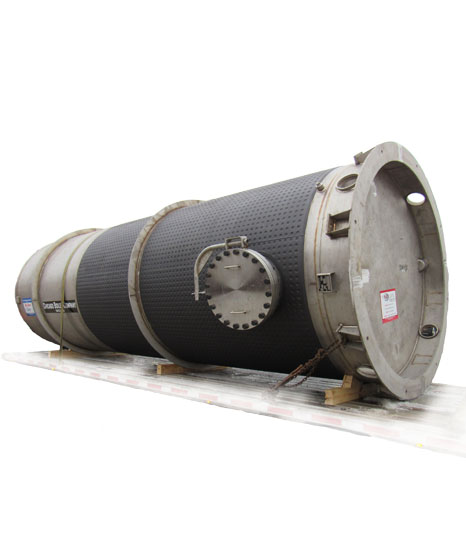
The most versatile vessel in the plant
Heat a product, cool it, dissolve a solid into it, keep a suspension uniform, blend two streams, hold a reaction at temperature: all of these jobs are done in a jacketed, agitated tank. It is the most flexible piece of process equipment because it bundles two independent capabilities, heat transfer through a jacket and motion through an agitator, into a single vessel that can be tuned to a wide range of duties. Designing one well means treating the jacket and the agitator as a system, not as separate add-ons.
The reason it is worth understanding the design in depth is that these tanks are rarely off-the-shelf. The combination of product viscosity, batch size, thermal duty, and cleaning requirement is specific to each process, so the vessel is configured rather than catalog-picked. The variables that matter most are the jacket construction, the agitator and impeller, the baffling, the bottom geometry, and the surface finish, and they all influence one another. A change in one, such as switching to a more viscous product, ripples into the others by demanding a different impeller and possibly a different jacket strategy to keep heat transfer up.
Jacket types and heat transfer
The jacket is a second skin around the tank wall through which a heating or cooling medium flows, transferring heat through the wall to the product. There are three common constructions, each with a different balance of cost, heat-transfer rate, and pressure capability.
Conventional jacket
A conventional or full jacket is an outer shell spaced off the tank wall, creating an annular gap that the medium fills. It is simple and inexpensive and offers a large heat-transfer area, but the open annulus gives low fluid velocity, which limits the heat-transfer coefficient unless baffles or agitation nozzles are added to direct flow. It is well suited to steam, where condensation does the work, and to lower-pressure service. Because the annular volume is large, a conventional jacket also holds a lot of medium, which slows the system's thermal response and can make rapid temperature swings harder to achieve compared with the smaller-volume designs.
Dimple jacket
A dimple jacket is a thin outer sheet spot-welded to the tank wall in a regular pattern of dimples, forming many small flow channels. The dimples force turbulent flow at high velocity, which gives excellent heat transfer with a relatively small medium volume and lower weight than a conventional jacket. Dimple jackets handle moderate pressure and are a popular choice for glycol cooling and hot-water heating.
Half-pipe jacket
A half-pipe jacket is pipe cut in half lengthwise and welded in a helical coil around the tank. It is the strongest construction, handling high pressure and high-temperature steam, and the confined flow path gives high velocity and strong heat transfer. It is the most expensive to fabricate but is the choice when the medium is high-pressure steam or hot oil.
| Jacket type | Heat transfer | Pressure capability | Relative cost |
|---|---|---|---|
| Conventional | Moderate (low velocity) | Low to moderate | Lowest |
| Dimple | High (turbulent channels) | Moderate | Moderate |
| Half-pipe | High (confined flow) | High | Highest |
Selecting the agitator
The agitator does the mixing, and its selection follows the process goal and the fluid. The first question is whether the duty is flow-controlled or shear-controlled. Blending, heat transfer at the wall, and solids suspension are flow duties that want high pumping with gentle shear. Emulsifying, dispersing powders, and breaking droplets are shear duties that want high local velocity at the impeller.
- Hydrofoil impellers generate strong axial flow with low shear and low power draw, ideal for blending thin liquids, suspending settling solids, and promoting wall heat transfer.
- Pitched-blade turbines give a mix of axial and radial flow, a good general-purpose choice that balances pumping and moderate shear.
- Flat-blade or Rushton turbines produce radial flow and high shear, used for gas dispersion and demanding mixing.
- Anchor and close-clearance impellers sweep the wall at low speed for viscous products that would simply not move under a small high-speed impeller.
Viscosity drives much of this choice. Thin, water-like fluids respond to small, fast, high-flow impellers; thick pastes and gels need large, slow, close-clearance designs that physically move the whole batch. The agitator is also defined by its mounting, most often a top-entry drive, and by its speed, which a variable-frequency drive lets the operator tune to the batch.
Power, speed, and the power number
Behind the impeller selection sits a simple but important relationship. The power an impeller draws scales with fluid density, the cube of rotational speed, and the fifth power of impeller diameter, modified by a dimensionless power number that characterizes the impeller type. Radial turbines have high power numbers and pull a lot of power for their size; hydrofoils have low power numbers and move large volumes efficiently. The practical consequence is that you generally get better mixing for the energy by using a larger, slower, efficient impeller than a small, fast one, particularly for blending and solids suspension. For shear-dominated duties the logic inverts, because high tip speed at the impeller is the goal rather than gentle bulk turnover.
Single versus multiple impellers
Tank geometry guides how many impellers are needed. A short, squat tank where liquid height is roughly equal to diameter is usually well served by a single impeller. Tall tanks, where the liquid height is well over the diameter, develop poorly mixed zones away from a single impeller, so two or more impellers spaced up the shaft are used to keep the whole column in motion. Stacking impellers also lets the designer combine functions, for example a hydrofoil up high for bulk turnover and a higher-shear impeller down low near a difficult-to-disperse addition.
Why baffling matters
Without baffles, a top-mounted agitator tends to spin the entire liquid mass as a rotating body. This creates a central vortex, draws air into the product, and produces almost no top-to-bottom turnover, so mixing and heat transfer suffer even though the motor is working. Baffles, typically four flat vertical plates standing off the wall, interrupt that rotation and convert swirl into vertical turnover.
Baffling transforms agitator performance: it deepens the active mixing zone, eliminates the vortex, and lets the impeller deliver its rated pumping into real top-to-bottom motion. The exceptions are very viscous fluids, where wall-scraping anchors are used and baffles are unnecessary, and certain low-shear sanitary mixes that use offset or angled mounting instead of baffles. For most agitated tanks, however, baffles are not optional, they are what make the agitator earn its power.
Bottom geometry, fittings, and finish
An agitated tank is more than its jacket and shaft. The bottom geometry has to suit both the agitator and the discharge: a dished or sloped bottom helps the lowest impeller sweep product and lets the tank drain, while a steep cone is chosen when solids settle and must be funneled out. The impeller sits close enough to the bottom to keep that region in motion, because a stagnant zone beneath the lowest impeller is where solids settle and product is left behind.
Fittings and nozzles also belong in the design conversation. Inlet, outlet, vent, sample, instrument, and CIP connections must be placed where they do not foul the impeller or create dead legs. In sanitary service these are hygienic tri-clamp connections, and they, the baffles, and the agitator shaft are all designed so the interior drains freely and cleans completely. The surface finish is matched to the duty as well, with smoother polished interiors specified where cleanability is critical and a mill finish acceptable for general chemical or storage duty.
Defining the duty before specifying the tank
Because so many variables interact, a jacketed, agitated tank is best specified by starting from the process duty rather than from a tank size. The key inputs are the batch volume and fill range, the product's viscosity and how that viscosity changes with temperature or processing, the thermal task expressed as a required heat-up or cool-down time and the available heating and cooling media, and the mixing objective, whether that is gentle blending, solids suspension, or high-shear dispersion. Cleaning requirements and any pressure or vacuum conditions round out the picture.
With those inputs defined, the design choices fall into place in a coherent order. The thermal duty and media set the jacket type, the mixing objective and viscosity set the impeller style and the need for baffles, the batch geometry sets the number of impellers and the tank proportions, and the cleaning and product-contact requirements set the bottom geometry, fittings, and finish. Approached this way, the finished vessel is a balanced system in which each element supports the others, rather than a tank to which heating and mixing were added as afterthoughts.
Designing the jacket and agitator as one system
The two halves of the vessel interact. Good agitation drives product against the wall, which raises the effective heat-transfer coefficient on the product side of the jacket; a well-chosen hydrofoil can substantially improve heating and cooling rates. Conversely, a poorly mixed tank will heat unevenly and develop hot or cold zones at the wall. When the duty is defined, the product viscosity, the batch volume, the required heat-up or cool-down time, and the mixing goal, the jacket type and the agitator can be specified together so the finished vessel performs as a balanced whole rather than a tank with mismatched parts.
Frequently asked questions
- Which jacket type gives the best heat transfer?
- Dimple and half-pipe jackets generally outperform a conventional jacket because they confine the medium into high-velocity, turbulent channels. Half-pipe is the strongest and handles high-pressure steam, while dimple offers excellent transfer at lower weight and cost. A conventional jacket can still perform well with steam or with added flow direction.
- How do I choose between an axial-flow and a radial-flow impeller?
- Choose axial flow, such as a hydrofoil, when the goal is blending, solids suspension, or wall heat transfer, because it pumps efficiently with low shear. Choose radial flow, such as a flat-blade turbine, when you need high shear for gas dispersion or intensive mixing. Pitched-blade turbines offer a balance of both.
- Why does an agitated tank need baffles?
- Baffles stop the liquid from spinning as a solid mass, which would create a central vortex, entrain air, and prevent vertical turnover. By interrupting the swirl, baffles convert rotational motion into top-to-bottom mixing, deepen the active zone, and let the impeller deliver its full pumping capacity. They dramatically improve both mixing and heat transfer.
- Can one jacketed tank both heat and cool a product?
- Yes. By routing different media through the same jacket, such as steam or hot water to heat and chilled water or glycol to cool, a single jacketed tank can manage an entire thermal cycle. The jacket construction must suit the most demanding medium, which is why high-pressure steam service often calls for a half-pipe jacket.
Scope your custom build
Send us your volume, service chemistry, dimensions, and finish or code requirements. We return a full engineering package, firm lead time, and a fixed quote — freight quoted separately to your ZIP.
Request a Custom QuoteCall 866-418-1777