Atmospheric Vent Capacity Calculations for Polyethylene Storage Tanks: API 2000 Worked Examples for Thermal Inbreathing, Liquid-Movement Outbreathing, and Combined Sizing on 1500 to 10000 Gallon Verticals

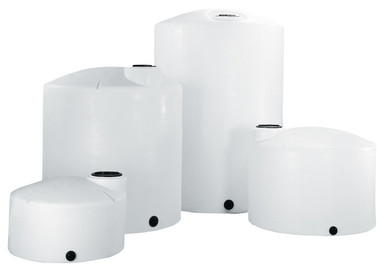
Vent sizing on polyethylene storage tanks is the engineering calculation that gets cut to two lines on most installation drawings: vent diameter X inches, vent height Y feet above grade. The calculation behind the two lines is the API Standard 2000 vent sizing methodology, which separates total vent flow into thermal effects (inbreathing during cooling, outbreathing during heating) and liquid-movement effects (outbreathing during fill, inbreathing during pumpout). For atmospheric storage tanks below 0.5 psig design pressure - which covers essentially every polyethylene rotomolded tank - API 2000 prescribes a specific calculation that determines whether a 2-inch vent, a 3-inch vent, or a 4-inch vent is the right answer for a given tank size and operating profile.
Undersized vents do not announce their failure mode. They quietly pull a vacuum on the tank during pumpout (which can collapse polyethylene tanks at 4-6 inches of water column negative pressure), or they push the tank wall outward during a fast fill (which can rupture fittings or split seams), or they restrict normal thermal breathing during diurnal swings (which fatigues the wall over years until it fails by stress cracking). This guide walks through API 2000 vent sizing with three worked examples on 1,500-, 5,000-, and 10,000-gallon vertical polyethylene tanks. Reference standard: API Standard 2000, Venting Atmospheric and Low-pressure Storage Tanks, 7th Edition. Supporting standards: NFPA 30 for flammable liquid service, OSHA 1910.106 for federal storage rules, and ASME PVHO-1 for pressure vessel cases that fall outside API 2000 scope.
1. The API 2000 Framework: Inbreathing, Outbreathing, and Total Capacity
API 2000 separates vent flow into four cases:
- Thermal inbreathing: air flowing INTO the tank as the headspace cools (overnight, after rain, during sudden weather change). The thermal inbreathing rate scales with tank volume to roughly the 0.7 power and depends on the maximum design temperature differential.
- Thermal outbreathing: air flowing OUT of the tank as the headspace heats (morning sun on a tank, summer afternoon). Thermal outbreathing is generally smaller than inbreathing because air can warm faster than it can cool through the tank wall.
- Liquid-movement inbreathing: air flowing INTO the tank as liquid is pumped out. The rate equals the maximum liquid pumpout flow rate corrected for the temperature and pressure of the displacement air.
- Liquid-movement outbreathing: air flowing OUT of the tank as liquid is pumped in. The rate equals the maximum fill flow rate plus an evaporation contribution for volatile liquids.
The total vent sizing requirement is the larger of (inbreathing thermal + inbreathing liquid-movement) versus (outbreathing thermal + outbreathing liquid-movement) - the combination that drives the largest single instantaneous flow. For most polyethylene tanks in non-volatile service (water, brine, dilute chemicals), the dominant case is inbreathing during pumpout combined with thermal inbreathing during a cooling event, which together set the minimum vent area. For volatile liquid service, outbreathing during fill combined with thermal outbreathing during heating can dominate.
2. The Thermal Inbreathing Formula and Its Inputs
API 2000 Table 4 (in 7th Edition) gives thermal inbreathing capacity in normal cubic meters per hour as a function of tank volume in cubic meters. For a 1,500-gallon (5.68 m3) tank, the thermal inbreathing requirement is 25 NM3/h. For a 5,000-gallon (18.93 m3) tank, the requirement is 80 NM3/h. For a 10,000-gallon (37.85 m3) tank, the requirement is 140 NM3/h. These values cover non-volatile (high flash point) liquid service and assume a maximum design liquid temperature of 25 deg C; corrections for higher operating temperatures are available in the appendices.
Conversion to standard cubic feet per hour (SCFH) at 60 deg F and 14.7 psia: multiply NM3/h by 39.6 to get SCFH approximately. Thus 25 NM3/h equals roughly 1,000 SCFH; 80 NM3/h equals roughly 3,200 SCFH; 140 NM3/h equals roughly 5,600 SCFH.
The thermal inbreathing values assume an uninsulated tank with surface area to volume ratio in the typical industrial range. For tanks that are insulated or buried, the cooling rate is much slower and the thermal inbreathing requirement drops accordingly. API 2000 provides reduction factors but they are conservative; insulated tanks are typically sized to 50 percent of the unmodified table value, and buried tanks to 25 percent. Standard polyethylene tanks installed above grade with no insulation use the full table values.
The thermal outbreathing case is generally smaller than inbreathing because air can heat faster than the headspace can cool. API 2000 Table 5 gives thermal outbreathing as approximately 60 percent of thermal inbreathing for non-volatile service.
3. The Liquid-Movement Inbreathing and Outbreathing Calculation
The liquid-movement inbreathing rate equals the maximum pumpout flow rate. If a tank has a 100-gpm pumpout pump as the maximum withdrawal device, the inbreathing requirement during that pumpout is 100 gpm equivalent of air, or approximately 800 SCFH at 60 deg F. If multiple pumpout paths exist - a 100-gpm transfer pump plus a 50-gpm dispensing pump that can run simultaneously - the inbreathing requirement is the sum, 150 gpm equivalent or 1,200 SCFH.
The liquid-movement outbreathing rate equals the maximum fill rate plus an evaporation contribution. For non-volatile liquids (water, brine), the evaporation contribution is negligible and the outbreathing rate equals the fill rate. For volatile liquids (DEF, methanol, hydrocarbon distillates), API 2000 prescribes an evaporation factor that increases the outbreathing rate by 50-100 percent depending on liquid vapor pressure.
The maximum fill rate for a polyethylene tank is typically set by the delivery method. A bulk truck delivery can transfer at 200-400 gpm depending on the truck pump and the receiving tank's vent capacity. A field-supply pump may run at 50-100 gpm. A gravity fill from an elevated tank may run at 10-20 gpm. The vent must be sized for the worst-case scenario expected during operation.
4. Worked Example A: 1,500-Gallon Vertical Tank, Water Service
Tank: Norwesco N-40146 1,500-gallon vertical. Service: water (non-volatile, low vapor pressure). Operating temperature: 50-90 deg F. Maximum fill rate: 250 gpm bulk truck delivery. Maximum pumpout rate: 50 gpm transfer pump.
Step 1. Thermal inbreathing per API 2000 Table 4: 25 NM3/h equivalent to 1,000 SCFH or 16.5 SCFM.
Step 2. Thermal outbreathing per API 2000 Table 5: 60 percent of inbreathing equals 600 SCFH or 10 SCFM.
Step 3. Liquid-movement inbreathing during pumpout: 50 gpm equivalent equals 400 SCFH or 6.7 SCFM.
Step 4. Liquid-movement outbreathing during fill: 250 gpm equivalent equals 2,000 SCFH or 33.4 SCFM. Evaporation correction for water: negligible.
Step 5. Combined total cases:
- Inbreathing total = thermal in + liquid-movement in = 16.5 + 6.7 = 23.2 SCFM. This case occurs during pumpout coinciding with overnight cooling.
- Outbreathing total = thermal out + liquid-movement out = 10 + 33.4 = 43.4 SCFM. This case occurs during fill coinciding with morning heating.
Step 6. Vent sizing. The dominant case is outbreathing at 43.4 SCFM. API 2000 includes vent flow capacity tables that relate vent diameter to flow at various pressure differentials. For an atmospheric polyethylene tank with a maximum allowable internal pressure of 0.5 inches of water column (typical rotomolded tank rating) and a maximum allowable vacuum of 1 inch of water column, the practical vent flow capacity is governed by 0.5 inch w.c. or less driving force.
From API 2000 Annex C vent flow tables: a 2-inch (DN50) atmospheric vent passes approximately 60 SCFM at 0.5 inch w.c. driving force. A 3-inch (DN80) vent passes 150 SCFM. A 4-inch (DN100) vent passes 280 SCFM.
The 2-inch vent passes 60 SCFM, which exceeds the 43.4 SCFM requirement with 38 percent margin. The 2-inch vent is acceptable. With safety factor of 25 percent typical for engineered systems, the result is the same. Result: 2-inch vent diameter, terminating at minimum 12 ft above grade per NFPA 30 and OSHA 1910.106 separation requirements.
5. Worked Example B: 5,000-Gallon Vertical Tank, Sodium Hypochlorite Service
Tank: Norwesco N-40164 5,000-gallon vertical. Service: 12.5 percent sodium hypochlorite. Operating temperature: 60-95 deg F. Maximum fill rate: 350 gpm bulk truck delivery. Maximum pumpout rate: 100 gpm transfer pump.
Step 1. Thermal inbreathing: 80 NM3/h equivalent to 3,200 SCFH or 53 SCFM.
Step 2. Thermal outbreathing: 60 percent equals 1,920 SCFH or 32 SCFM.
Step 3. Liquid-movement inbreathing during pumpout: 100 gpm equivalent equals 800 SCFH or 13.3 SCFM.
Step 4. Liquid-movement outbreathing during fill: 350 gpm equivalent equals 2,800 SCFH or 46.7 SCFM. Evaporation correction for sodium hypochlorite at 12.5 percent: significant chlorine vapor evolution during fill agitation. API 2000 prescribes a 1.5x correction for hypochlorite service. Corrected: 70 SCFM.
Step 5. Combined cases:
- Inbreathing total = 53 + 13.3 = 66.3 SCFM.
- Outbreathing total = 32 + 70 = 102 SCFM.
Step 6. Vent sizing. Outbreathing at 102 SCFM is the dominant case. From API 2000 Annex C: 2-inch vent passes 60 SCFM (insufficient); 3-inch vent passes 150 SCFM (acceptable with 47 percent margin). The 3-inch vent is the right size.
However, sodium hypochlorite service introduces a corrosion consideration on the vent material. Chlorine vapor attacks aluminum, brass, and bare steel vents. The vent material specification for sodium hypochlorite service is PVC or PP-pure with stainless steel mesh insect screen (316L grade, not 304 - the residual chloride attacks 304 stainless over time). The vent termination height is 12 ft above grade per NFPA 30 with additional 5 ft of horizontal separation from any HVAC intake to prevent chlorine vapor entrainment into the building ventilation system.
6. Worked Example C: 10,000-Gallon Vertical Tank, Diesel Fuel Service
Tank: Norwesco N-43128 10,000-gallon vertical. Service: diesel fuel (Class II combustible liquid per NFPA 30, flash point 100-200 deg F). Operating temperature: 50-100 deg F. Maximum fill rate: 500 gpm bulk truck delivery. Maximum pumpout rate: 200 gpm transfer pump.
Step 1. Thermal inbreathing: 140 NM3/h equivalent to 5,600 SCFH or 93 SCFM.
Step 2. Thermal outbreathing: 60 percent equals 3,360 SCFH or 56 SCFM.
Step 3. Liquid-movement inbreathing during pumpout: 200 gpm equivalent equals 1,600 SCFH or 26.7 SCFM.
Step 4. Liquid-movement outbreathing during fill: 500 gpm equivalent equals 4,000 SCFH or 66.7 SCFM. Evaporation correction for diesel: minor (Class II flash point above ambient), 1.1x. Corrected: 73 SCFM.
Step 5. Combined cases:
- Inbreathing total = 93 + 26.7 = 119.7 SCFM.
- Outbreathing total = 56 + 73 = 129 SCFM.
Step 6. Vent sizing. Outbreathing at 129 SCFM is dominant. From API 2000 Annex C: 3-inch vent passes 150 SCFM. Margin is only 14 percent - tight for diesel service where any vent restriction (insect nest, ice, water in the vent line) cuts capacity. Step up to 4-inch vent passing 280 SCFM with 117 percent margin. The 4-inch vent is the right size for this application.
Additional considerations for diesel service:
- Class II flammable rating drives flame arrestor requirement on the vent termination per NFPA 30 Section 21.3.6. Detonation arrestor type for tank truck loading service.
- OSHA 1910.106 requires vent termination at minimum 12 ft above grade and 5 ft from any opening into a building.
- Polyethylene tank for diesel service requires confirmation of compatibility with the specific diesel additive package; some low-sulfur diesel formulations attack standard HDPE over years of contact. XLPE Captor double-wall is a common upgrade for diesel service to provide secondary containment plus better compatibility margin.
- Static electricity considerations from the prior NFPA 77 article apply: diesel is a Class II combustible (flash point 100-200 deg F) but can become a Class I hazard if heated above flash point in summer. Bonding and grounding installation is required regardless.
7. Failure Modes from Undersized Vents
The documented failure modes when vents are undersized:
- Tank wall collapse during pumpout. An undersized vent cannot admit replacement air at the rate liquid leaves the tank. Internal pressure drops below atmospheric, and the polyethylene wall buckles inward. Catalog vertical tanks typically rate 0.5 to 1 inch of water column negative pressure as the maximum allowable; undersized vents readily generate 3-6 inches w.c. negative during fast pumpout.
- Fitting failure during fast fill. An undersized vent cannot exhaust displacement air at the fill rate. Internal pressure rises above atmospheric, and the weakest fitting becomes the relief path. The fitting fails by gasket extrusion or thread stripping; the resulting spill is the visible incident.
- Vacuum-induced cracking on diurnal cycling. Even a slightly undersized vent fatigues the tank wall over years of cycling. The wall flexes inward during overnight cooling and outward during morning heating; over 5-10 years of cycling at 1,000 cycles per year, the flex amplitude accumulates as stress-corrosion cracking at fitting penetrations. The crack propagates slowly until a leak develops in service.
- Vent obstruction by insects, ice, or debris. Even a properly sized vent can fail by obstruction. Mud daubers build nests in vent terminations. Ice forms in vent risers during winter. Algae grows on vent screens during wet seasons. The obstruction reduces effective vent capacity and recreates the undersized-vent failure modes. Mitigation: 316 stainless mesh screen, weather hood preventing ice formation, monthly inspection during warm season.
- Improper vent location. A vent that terminates inside a building, or below the tank fill level, or near an HVAC intake, creates secondary failure modes that are not vent-sizing related but follow the same incident pattern. NFPA 30 and OSHA 1910.106 prescribe minimum termination heights and separation distances; follow them.
8. Vent Hardware Specification Checklist
For any new polyethylene tank vent specification:
- Calculate combined inbreathing and outbreathing requirements per API 2000 worked examples above.
- Apply 25 percent safety factor on the dominant case (typical engineering practice).
- Select vent diameter from API 2000 Annex C flow tables for the available driving pressure.
- Specify vent material compatible with stored chemical: PVC for sodium hypochlorite, PP-pure for caustic, stainless 316L for general service, PVDF for highly corrosive.
- Specify 316 stainless mesh insect screen at vent termination, sized to prevent insect entry without restricting flow more than 5 percent.
- For Class I and Class II flammable service, specify flame arrestor (deflagration or detonation type per NFPA 30) at the vent termination.
- Specify weather hood to prevent ice formation and direct rain entry during operation.
- Specify vent termination height per NFPA 30 and OSHA 1910.106: minimum 12 ft above grade for Class I; minimum 8 ft above grade for non-flammable service; minimum 5 ft horizontal from HVAC intake or any opening into a building.
- Document the vent calculation in the tank installation drawing for AHJ review.
- Inspect vent quarterly during warm season for obstruction; annually verify capacity by pressure-differential measurement during a controlled fill cycle.
9. Brand Notes for Vent Hardware
The five-brand catalog vent fittings:
- Norwesco standard vents: 2-inch and 3-inch atmospheric vents available as factory fittings on vertical tanks. 4-inch vents available on tanks 5,000 gallons and larger.
- Snyder Captor double-wall: integrated 3-inch vent on the primary tank with secondary containment annulus venting separately. SII-5490000N42 1,550 gallon and similar SKUs.
- Enduraplas standard vents: 2-inch and 3-inch atmospheric vents factory installed; 4-inch optional. EP-THV02500FG 2,500 gallon.
- Chem-Tainer standard vents: 2-inch standard with 3-inch upgrade; specify at quote.
- Bushman standard vents: 2-inch and 3-inch standard with chemical-compatible PVC or PP-pure available on request.
OneSource Plastics quotes complete vent packages including flame arrestor, mesh screen, weather hood, and chemical-compatible vent material per the API 2000 calculation above. Reference list pricing on a 1,500-gallon Norwesco vertical with standard 2-inch vent starts at $1,895; vent upgrades and flame arrestors add 50-200 dollars depending on size and material. LTL freight to your ZIP is quoted via the freight estimator or by phone at 866-418-1777.
For complementary reading on related topics, see our DEF cold-weather management guide for vent freezing considerations, and the chemical compatibility hub for vent material selection ahead of corrosive chemical service.
Recommended Tanks for This Guide
Live pricing, updated automatically · estimate freight to your ZIP.