Chemical Compatibility Pre-Qualification Testing for Polyethylene Tanks via ASTM D543: Immersion Test Methodology, Specimen Preparation, Property-Change Acceptance Criteria, and Why Generic Compatibility Charts Sometimes Get It Wrong
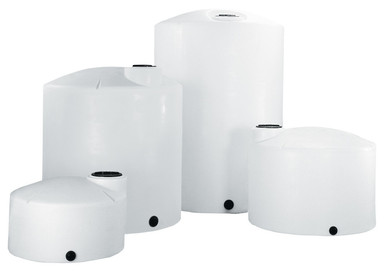
The chemical compatibility chart that the tank manufacturer publishes — the matrix of chemicals down the rows, polyethylene grades across the columns, color-coded ratings of "compatible / limited / not recommended" in the cells — is the first reference any process engineer looks at when specifying a tank for a new chemical service. It is also the reference that has produced the largest single category of polyethylene tank failures investigated in the field forensic literature. The chart is correct in expectation but wrong in detail; the actual chemical mix, temperature, concentration, and additive package in a specific application may behave differently from the generic rating. The remedy is the pre-qualification immersion test that verifies compatibility for the specific application before the production tank is ordered.
This article walks the engineering of chemical compatibility pre-qualification testing for polyethylene bulk tanks per ASTM D543 (Standard Practices for Evaluating the Resistance of Plastics to Chemical Reagents). The references are ASTM D543-21 (the current revision of the immersion-test standard), ASTM D638 (tensile-property testing), ASTM D790 (flexural property testing), the polyethylene tank manufacturer technical bulletins from Norwesco, Snyder, Chem-Tainer, Enduraplas, and Bushman, and field forensic data from chemical-tank failures where generic compatibility chart ratings did not match the actual application performance. The objective is the test methodology that gives the process engineer real evidence — not just a vendor-published rating — for the specific chemical-tank pairing under consideration.
1. Why Generic Compatibility Charts Are Sometimes Wrong
The compatibility chart published by a tank manufacturer or a polymer supplier is built from a baseline test condition that does not necessarily match a specific application. The published rating typically assumes:
- The chemical at a specified concentration — usually a reference concentration like 50 percent for sulfuric acid, 12.5 percent for sodium hypochlorite, 100 percent for solvents. An application running at a different concentration may behave differently.
- A specified test temperature — typically 73 F for room-temperature ratings and 122 F for elevated-temperature ratings. An application at intermediate or higher temperatures has no published rating and must be inferred or tested.
- The pure chemical in question — without the additive packages, surfactants, stabilizers, dyes, or process contaminants present in the actual application. The additive package can dominate the polymer-degradation chemistry in some cases.
- Static immersion conditions — without the mechanical stress, thermal cycling, UV exposure, or abrasion present in field service. The combined-stress condition can accelerate degradation by orders of magnitude relative to the static-immersion baseline.
The compatibility chart rating is a useful starting point, not a final answer. For high-value, high-consequence, or unusual chemical applications, the pre-qualification test verifies the rating against the actual application conditions before the production tank is committed.
2. The ASTM D543 Test Standard
ASTM D543 establishes the standard practice for evaluating the resistance of plastic materials to chemical reagents by immersion. The test produces quantitative property changes that the engineer compares against acceptance criteria for the application. The standard specifies:
- Specimen preparation: standard test specimens cut from the polymer of interest in the form specified by the property test that will be measured (tensile bar per ASTM D638 for tensile testing, flexural bar per ASTM D790 for flexural testing, or dimensional plaque for weight-change and dimensional-change measurement).
- Reagent preparation: the chemical reagent at the concentration, temperature, and additive composition representative of the application. The reagent volume must be at least 8 times the specimen volume, with the actual volume specified per ASTM D543 Section 9.4.
- Immersion condition: typically static immersion at controlled temperature (73 F, 122 F, or other application-specific temperature) for a specified duration (7 days, 30 days, or longer for accelerated-aging studies).
- Property measurement: mass change, dimensional change, hardness change, and tensile/flexural strength change measured before and after immersion. The percentage change is the test result.
- Acceptance criteria: application-specific. The standard provides typical thresholds (e.g., less than 10 percent mass change, less than 25 percent strength reduction) but does not mandate specific limits.
The full test protocol with sample preparation, immersion, property measurement, and reporting takes 4-8 weeks for a single specimen-and-reagent pairing. The cost is in the $1,500-5,000 range per specimen-and-reagent pairing depending on which property tests are included.
3. Specimen Preparation From the Production Tank Material
The pre-qualification test is most useful when the specimens are prepared from the same polyethylene resin and the same processing as the production tank. The manufacturer-supplied resin samples from a non-tank source may not match the production tank in crystallinity, additive package, or rotational-molding-induced stress state.
- Specimens cut from a representative production tank or production reject: the most representative source. The polymer has the same processing history (rotational molding cycle, cooling schedule, residual stress) as the production tank that will see service. Some manufacturers will provide test plaques on request for this purpose.
- Specimens cut from a manufactured test plaque using the production resin and processing: the second-best source. The plaque is rotomolded with the same resin and the same cycle but in a controlled flat geometry that simplifies specimen cutting. Available on special order from some suppliers.
- Specimens from the resin manufacturer's test program: the third option. The polymer matches the resin grade but may not match the production tank's exact processing. Adequate for first-pass screening but less representative for production decision-making.
For an application where the chemistry is at the boundary of polyethylene compatibility — strong oxidizers, aromatic solvents, hot caustic, or any chemical with limited literature data — the specimen source matters. Test the production-equivalent material if at all possible.
4. Property Tests That Matter for Tank Service
ASTM D543 allows the engineer to measure any property change that matters for the application. The most relevant property tests for polyethylene bulk tank service:
- Mass change (percent gain or loss): directly indicates polymer-chemical interaction. Mass gain indicates absorption of the chemical into the polymer matrix (plasticization, swelling). Mass loss indicates extraction of polymer additives (antioxidants, stabilizers, processing aids) into the chemical. Either direction beyond a few percent is a warning sign.
- Dimensional change (percent length, width, or thickness): indicates swelling or shrinkage. Greater than roughly 3 percent dimensional change is typically considered marginal for tank service; greater than 5 percent is a fail for most applications.
- Tensile strength and tensile yield (per ASTM D638): the structural property that determines whether the tank wall maintains the design load capacity over service life. A 25 percent reduction in tensile strength after 30-day immersion is the typical fail threshold for high-consequence applications.
- Flexural strength and flexural modulus (per ASTM D790): the structural property that governs tank-shell resistance to buckling and concentrated loads at fitting bosses. Used as a complement to the tensile test for tank-shell-applicable property assessment.
- Hardness (Shore D or Rockwell): a quick screening test that indicates surface-property change. Greater than 5-point Shore D reduction often indicates plasticization that will progress to deeper structural compromise over time.
- Visual inspection: documented surface appearance change — discoloration, surface crazing, blistering, or deformation. Often the first warning of incipient incompatibility before quantitative property changes become apparent.
For most polyethylene tank applications, the minimum useful test panel is mass change, dimensional change, and tensile strength after 30-day immersion. The optional additions (flexural, hardness, visual) provide additional confidence at marginal cost.
5. Test Temperature Selection
The immersion test temperature should bracket the actual application temperature with appropriate margin. Three test conditions are commonly used:
- Room temperature (73 F): the baseline test condition. Establishes the polymer-chemical interaction at the expected nominal application temperature for ambient-temperature service.
- Elevated temperature (122 F): the standard accelerated-aging condition. The Arrhenius-temperature acceleration factor for most polymer-chemical interactions is approximately 2-4x per 18 F (10 C) temperature increase, so a 122 F test (49 F above room) accelerates aging by roughly 4-16x relative to room-temperature service.
- Application-specific temperature: for applications running at non-standard temperatures (cold storage at 40 F, warm-process at 100 F, hot-process at 140 F or higher), the test should be run at the actual application temperature plus a margin to account for excursions.
The accelerated-aging interpretation requires care. The Arrhenius acceleration factor is a rule of thumb that holds within a limited temperature range; near the polymer melting transition or near solvent boiling points, the temperature dependence becomes non-linear and the acceleration factor breaks down. The conservative approach is to run the test at the application temperature directly rather than relying on the acceleration factor.
6. Test Duration and Time-Resolved Property Measurement
The standard ASTM D543 test duration is 7 days for screening and 30 days for definitive evaluation. For tank applications with multi-year service life, longer tests provide additional confidence:
- 7-day immersion: screens out gross incompatibilities (severe swelling, cracking, dissolution). A polymer that fails at 7 days is unfit for any service in the test reagent.
- 30-day immersion: the standard test duration. Captures most of the polymer-chemical equilibration with reasonable confidence in the steady-state property values.
- 90-day immersion: the extended test duration for high-consequence applications. Detects slow-developing degradation that the 30-day test misses, particularly oxidation effects in hypochlorite and peroxide service.
- 180-day or longer immersion: the long-term aging study. Used for design-life-predictive testing where the engineer needs evidence that the polymer survives the design service life with margin. Costly but justified for high-value installations.
The time-resolved approach measures properties at intermediate durations (typically 7, 14, 30, 60, 90 days) to characterize the equilibration rate. A polymer that loses 5 percent of its tensile strength in the first 30 days and then stabilizes is fit for service; a polymer that continues to lose strength linearly through 90 days will eventually fail and is unfit for long-term service in the test reagent.
7. Reagent Composition Matching
The pre-qualification test is most useful when the test reagent matches the actual application chemistry, including additive packages, contaminants, and concentration. Some application categories where reagent matching is essential:
- Sodium hypochlorite at trade strength (12.5 percent) with stabilizer: the reagent should include the actual stabilizer package (sodium hydroxide, sodium silicate, or proprietary mix) at the application concentration. The stabilizer chemistry affects the polymer interaction more than the bulk hypochlorite concentration in some cases.
- Sulfuric acid at non-standard concentrations: sulfuric acid behavior shifts dramatically across the concentration range. The 50 percent and 98 percent concentrations are often listed in compatibility charts; intermediate concentrations (60-80 percent) and dilute concentrations (under 30 percent) have substantially different polymer interactions and should be tested at the actual application concentration.
- Mixed-chemical solutions: formulated chemical products with multiple active ingredients (cleaners, scale inhibitors, biocides, polymer-flocculants) should be tested as the formulated mixture, not as the individual components. The synergistic interactions can produce different polymer responses than the individual ingredients suggest.
- Process-contaminated streams: the application stream may include process contaminants (oils, surfactants, dissolved metals, organic intermediates) that are not part of the published chemical specification. The test reagent should match the as-applied composition, not the as-spec composition.
The reagent-matching requirement is what most often distinguishes a useful pre-qualification test from a generic compatibility-chart confirmation. The engineering effort to characterize the actual application stream is worth the cost when the consequences of compatibility failure are material.
8. Acceptance Criteria for the Application
ASTM D543 produces percentage property changes; the engineer applies application-specific acceptance criteria to convert the data into a fit/unfit decision. The criteria depend on the consequences of polymer degradation:
- High-consequence applications (chemical bulk storage, tanks above habitable space, tanks containing hazardous chemistries): tight acceptance criteria. Less than 3 percent mass change, less than 2 percent dimensional change, less than 15 percent tensile strength reduction, no visible surface cracking or blistering after 30-day immersion. Multi-year service life requires 90-day or longer testing with the same criteria.
- Standard industrial applications (chemical day tanks, water-treatment chemical storage, agricultural chemical tanks): moderate acceptance criteria. Less than 5 percent mass change, less than 3 percent dimensional change, less than 25 percent tensile strength reduction, no gross visible damage after 30-day immersion.
- Low-consequence applications (water tanks, dilute chemical storage, short-service-life tanks): relaxed acceptance criteria. Less than 10 percent mass change, less than 5 percent dimensional change, less than 35 percent tensile strength reduction, no gross visible damage after 30-day immersion.
The acceptance criteria are best documented in the procurement specification before the test begins, so the test result is interpreted against pre-specified thresholds rather than rationalized after the fact.
9. Tank Selection That Supports Pre-Qualification Testing
The pre-qualification test is most useful when the candidate tank vendors can supply the polymer specimens or test plaques for the testing program. The procurement conversation should include:
- Specification of the polymer grade and the rotational-molding cycle: documented in the procurement package so the test specimens match the production tank.
- Vendor commitment to supply test specimens: typically a small fee or a specimen drawn from a production tank or test plaque. Most polyethylene tank suppliers will support pre-qualification testing for high-value procurements.
- Documentation of the test protocol and acceptance criteria: the procurement specification includes the planned test reagent, temperature, duration, and acceptance thresholds so the vendor understands the qualification basis.
- Sequenced procurement: the production tank is not ordered until the pre-qualification test is complete and passes. The qualification testing is part of the procurement schedule.
For high-value and high-consequence chemical tank installations, the pre-qualification test cost ($5,000-15,000 for a complete property panel) is small relative to the procurement cost and trivial relative to the consequence cost of an in-service failure.
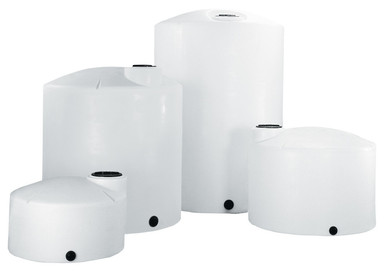
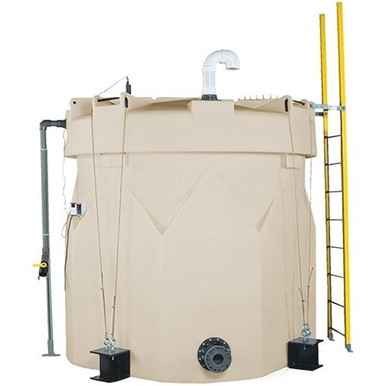
- Reference N-40164 5000 gallon vertical and N-43128 10,000 gallon vertical for the bulk-storage end of the catalog where pre-qualification matters most.
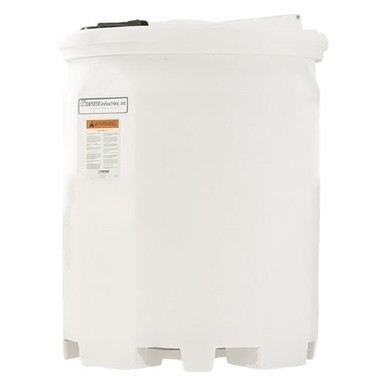
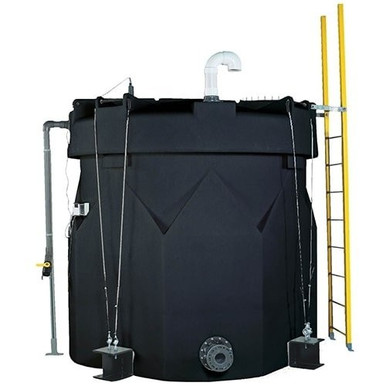
- Reference SII-1006600N42 10,000 gallon Snyder XLPE Captor for double-wall containment applications where the polymer compatibility of both walls (primary and secondary) matters.
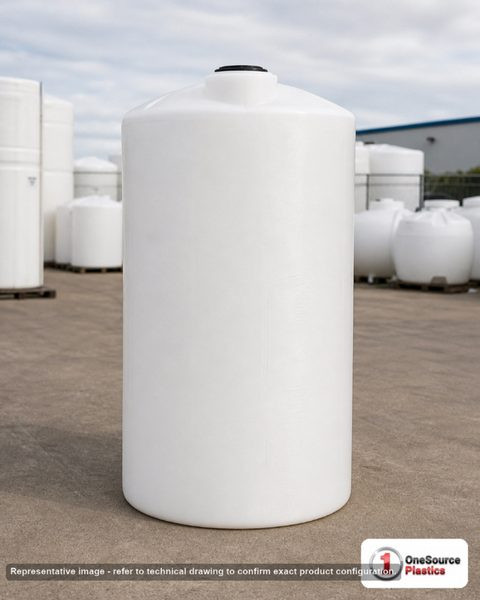
- Reference N-41867 25 gallon for the laboratory and small-batch end where pre-qualification is often run on the small tank itself before scaling to production.
List pricing on the BC product page is the starting point; LTL freight to your ZIP and the pre-qualification testing program are quoted separately. Reference the freight estimator or call 866-418-1777 to coordinate the qualification scope.
10. The Engineering Discipline Conclusion
Chemical compatibility pre-qualification testing is the engineering discipline that converts a vendor compatibility chart from a starting reference into actual evidence for the specific application. The ASTM D543 immersion test, with property measurement before and after exposure, gives the process engineer the data needed to commit a polyethylene tank to a specific chemical service with documented confidence.
The procurement rule: for high-value, high-consequence, unusual, or marginal-rating chemical applications, run the pre-qualification test before ordering the production tank. The test cost is trivial relative to the consequence of a compatibility failure. The vendor compatibility chart is a starting point, not a final answer.
OneSource Plastics ships the polyethylene tanks across all 5 brands — Norwesco, Snyder, Chem-Tainer, Enduraplas, Bushman — and supports pre-qualification testing through specimen supply and resin documentation when the application warrants it. List pricing by SKU is on the product page; LTL freight to your ZIP is quoted separately via the freight estimator or by phone at 866-418-1777. For related chemical compatibility resources see the chemical compatibility hub with 100+ pillar pages on specific chemicals and recommended tank materials.
Recommended Tanks for This Guide
Live pricing, updated automatically · estimate freight to your ZIP.