Cross-linked at 1.9 specific gravity: 10,000 gallons rated to 140 F / 60 C
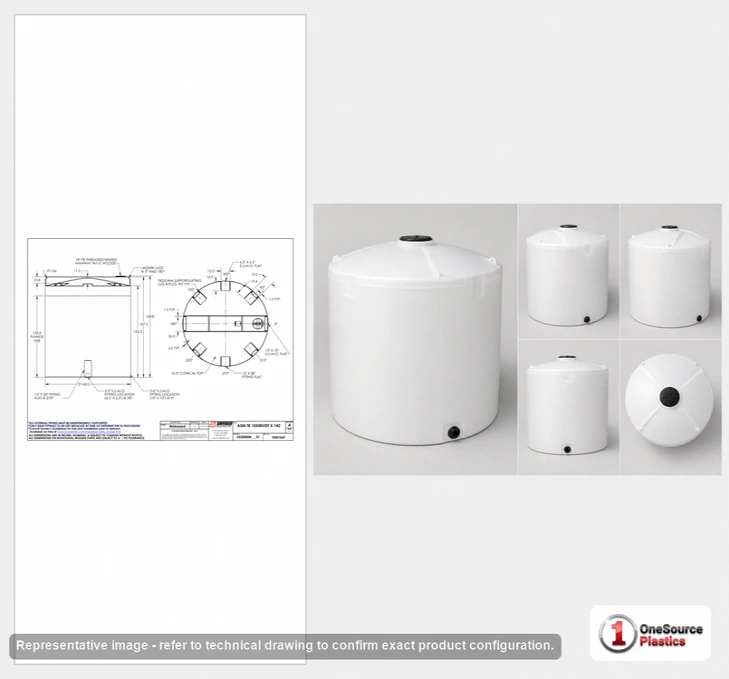
The Snyder SII-1006600N42 is a 10,000 gallon Captor double wall liquid storage tank in white cross-linked polyethylene: an inner tank inside an outer containment shell, 142 inches across and 226 inches tall, listed at 7,400 pounds empty and 7,400 pounds to ship, molded at Lincoln, Nebraska. Two figures on this sheet set it apart from the linear tanks beside it. It is rated at a specific gravity of 1.9, which is where the 158,460 pound maximum contents figure comes from against 83,400 pounds for 10,000 gallons of water at 8.34 pounds per gallon, and its service limit is 140 F / 60 C. Access is an 18 inch threaded vented manway, and the sheet gives a 3 year warranty. Freight is class OVS. No outlet and no inlet fitting is published, so this page asserts neither.
Buying on a purchase order? Request a written quote and we will return it with freight to your ZIP; card buyers add the 10000 gallon tank to the cart above.
One plant, one lane, and why a cross-linked shell travels the same way
This tank comes out of Lincoln, Nebraska, and the first thing worth saying is that the material makes no difference at all to the logistics. Cross-linked or linear, it is the same 142 inches of diameter and the same 226 inches of height at class OVS, which is eleven feet ten inches across and eighteen feet ten inches tall, and that shape is what the carrier prices: a permitted, routed load whose schedule depends on a permit and, on some lanes, an escort. So plan the delivery on the envelope and the weight, 7,400 pounds, rather than on the specification of the wall. What the wall does change is what the tank can be asked to hold once it is standing there, and that is where this part number earns its place. Where the site is, matters twice over. Lincoln is a short lane for a Plains or Midwest plant and a long one from either coast, so book the tank and the lifting equipment together, and be honest about the approach: the gate, the turn, the overhead lines and the ground the trailer has to sit on while the tank comes off. And the pad has to be finished, cured and level before the truck is booked, not after, because a rotationally molded floor bears on the whole surface it touches and nothing else. Set 83,400 pounds of water, or up to 158,460 pounds of contents at this tank's rating, onto a slab with a hollow in it and the hollow becomes the bearing point for the life of the installation. Pour it flat, pour it wider than the 142 inch base, and drain the surround so that wash-down water and rain leave the pad rather than working under it. Leave room to walk the whole way round, because a double wall is only worth buying if the outer shell can be inspected, and that includes the side facing the building. The other number to settle before the order is freeboard, since the usable volume of a contained tank is not the nameplate figure once the liquid is heavier than water and warms through the day; the Captor double wall freeboard sizing guide works that out honestly, and it matters more here than on the lower-rated tanks because the liquids this shell is bought for are the dense ones. What a contained installation has to do to satisfy the site's own containment rules is set out in the Captor double wall containment walkthrough. Confirm the volume in the tank sizing calculator and take the reserve and headspace from the tank sizing guide.
The cross-linked Captor against the linear ones on this sheet
| Part | Gallons | Diameter x height | Empty weight |
|---|---|---|---|
| SII-1006600N42 (this tank, cross-linked, 1.9 specific gravity) | 10000 | 142 x 226 in | 7400 lb |
| 1006600N30 (same shell, same listed weight) | 10000 | 142 x 226 in | 7400 lb |
| 1006600N40 (same shell, lighter on the sheet) | 10000 | 142 x 226 in | 6400 lb |
| 1006600N46 (same shell, lighter on the sheet) | 10000 | 142 x 226 in | 6400 lb |
| 1006400N46 (smaller, same base, shorter) | 8700 | 142 x 197 in | 5000 lb |
| 1031100N30 (larger, same base, taller) | 12500 | 142 x 274 in | 9500 lb |
Every row in this table is the same 142 inch base and every 10,000 gallon row is the same 226 inch height, so the envelope is not the decision. The decision is the wall, and this is the one page in the family where the wall is cross-linked polyethylene rather than a linear resin. Two figures on this sheet follow from that and they are the whole reason to specify this part number. The first is the rating: a specific gravity of 1.9, and 158,460 pounds of maximum contents as the arithmetic of that rating against the capacity, where the linear part numbers in this same envelope are rated lower and carry a lower contents figure on their own sheets. That is the difference between a tank sized for a dense liquid and one that is not, and it is not an option you can add later. The second is temperature: a service limit of 140 F / 60 C, where the linear tanks beside it publish a lower one. A higher limit sounds academic until the product arrives warm off a tanker, sits in a yard in July, or comes off a process that has not fully cooled. Set against those, the weights on the sheet are almost incidental: this tank is listed at 7,400 pounds, two of the linear part numbers at 6,400 pounds, and the sheet explains none of that. The size steps behave as they do across the whole family. The 8,700 gallon 1006400N46 holds the base and comes down to 197 inches at 5,000 pounds when height is the constraint; the 12,500 gallon 1031100N30 holds the base and goes to 274 inches at 9,500 pounds when concrete is the constraint. Tell us the liquid, its density and the hottest it ever is, and the row follows from the answers.
Ready to choose a row? Add the 10000 gallon tank to your cart above with freight quoted to your ZIP, or 866-418-1777 will confirm it against the site first.
The manway is the only opening the sheet publishes
- Access and filling: an 18 inch threaded vented manway, and that is the entire fitting list this sheet gives. It is the fill point and the inspection port, and it sits at the top of a shell eighteen feet ten inches tall, so fixed access with a rail is part of the installation. Bring the fill down to a coupling at working level rather than lifting a hose over the wall, and run the fill line down inside the body so the product does not free-fall onto the surface.
- Venting, and why it matters more on a warm liquid: the manway is vented and the vent path stays clear. A tank that takes a warm charge and then cools breathes hard, and a tank drawn on through a blocked vent pulls its own wall in. On a shell this size that is not a field repair.
- The headspace: with a service limit of 140 F / 60 C this tank is bought for hotter duties, and heat is exactly what makes the vapour space above the liquid the hardest-working part of the wall. It is also the zone a liquid-side inspection misses entirely. The vapour-saturated headspace wall thickness guide sets out what happens there and how the wall is sized for it, and it should shape the inspection plan before the first fill.
- What the sheet does not publish: no outlet and no inlet. Said plainly, because a guess printed here would be a number your drawing then has to work around. Fittings on a contained tank are specified against the liquid, the duty and the containment arrangement, and confirmed in writing with the order.
- Nothing is cut in the field. Every penetration through the inner tank has to be made without compromising the outer containment shell, which is why the fitting schedule belongs to the tank order and not to a site decision with a hole saw.
- The annulus: the space between inner tank and outer shell is what you are buying, so it is monitored, readable and reachable without moving a pipe rack.
- Rating and warranty: specific gravity 1.9, 158,460 pounds of maximum contents as the arithmetic of that rating against the capacity, a 3 year warranty, and the 140 F / 60 C limit above. No margin beyond those figures is claimed.
Downstream, the rules do not change because the wall is cross-linked: a flexible connector at the first joint of every line, valves carried on their own supports off the pad, no rigid run bolted between a wall bracket and a polyethylene shell that moves with temperature and load, and a kerb or bollards keeping traffic away from the base. Where the product is one that gases off, plan the vent and the overflow route together, and plan both before the first fill rather than after the first surprise.
Heavier and hotter liquids, inside a containment the site can inspect
This part number exists for the duties the lighter-rated tanks in the same shell cannot take. Dense process liquids and concentrated solutions at a water or wastewater plant, a mine, a mill, a chemical or fertilizer distributor or a processor, where the specific gravity of the product is the number that drives the tank choice. A receiving tank that takes a tanker load of a heavy solution and feeds a process or a day tank. A product that arrives warm, or a tank that stands in an open yard in a hot climate, where a service limit of 140 F / 60 C rather than the lower figure on the linear sheets is what makes the installation honest. An outdoor site where a concrete berm would fill with rain and have to be emptied and tested before it could ever do its job, so the containment is bought with the tank instead. And any plant that has concluded that a monitored annulus it can walk past every morning is worth more than a civil structure it has to maintain. Two things are worth stating without decoration. A double wall contains what leaves the inner tank; it does not make a liquid safe to handle, and the fittings, gaskets, valves and monitoring around it are what turn a contained tank into a contained installation. And the compatibility of your specific product with a cross-linked wall at your actual temperature is a question to settle in writing before the order, not after the first delivery of liquid.
Lincoln, Nebraska at 7,400 pounds, and the pad poured before the truck
The sheet gives class OVS at 142 by 142 by 226 inches and 7,400 pounds, molded at Lincoln, Nebraska. The freight cost estimator prices the lane to your ZIP, and the listed price is before freight. Treat the delivery as a scheduled operation rather than a drop: the route walked for height and width, the stop identified, the machine confirmed at better than 7,400 pounds, slings long enough to pass under the body, and nobody putting a hook anywhere near the manway. Set it on the finished, cured pad in one lift, level, in full contact and clear all the way round, and take the photographs then, because the outer shell is easiest to inspect on the day it arrives. Then fill it with clean water before any product goes near it and hold that fill, watching the base, the pad edge and the annulus; a contained tank that starts talking to you during a water fill is a conversation with the manufacturer, while one that starts during a chemical fill is a cleanup. Keep the water test results, the delivery paperwork and the shell's serial number together in one file from the first day. Leave room to walk all the way around it; the side of the tank nobody can see is the side that leaks.
Freight and documents
Ships from: Lincoln, NE. LTL freight is quoted to your ZIP with the freight cost estimator or by phone at 866-418-1777. The listed price is before freight.
Technical drawing (PDF) for Snyder Industries 1006600N42.
See this tank
Interactive 3D model with live fill. This tank has an interactive 3D model built to its manufacturer dimensions. Rotate it, and set a fill level to see how much liquid it holds at any height. Open the 3D view on the product photo above. Download the 3D model (GLB).
Product video. Watch the Snyder Industries 10,000 Gallon XLPE Captor Double Wall Liquid Storage Tank - 1.9 specific gravity video (73 seconds) with dimensions, fittings and shipping notes.
Ready to order?
Add it to your cart at the top of this page, get LTL freight to your ZIP, request a written quote, or call 866-418-1777. The listed price is before freight.