HDPE Tank Wall Thickness at the Vapor-Saturated Headspace: Where Premature Failures Originate, Why Liquid-Side Inspection Misses Them, and the ASTM D1998 Sizing Logic That Operators Need to Understand
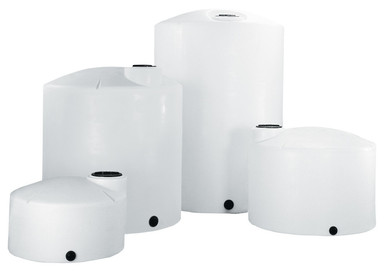
The headspace of a chemical storage tank is the volume above the liquid level. It is where vapor accumulates, where vent hardware lives, where the dome geometry transitions from cylindrical sidewall to dome curve, and where the wall thickness on a rotomolded polyethylene tank is structurally minimized because the engineering load case is hoop stress from the liquid and the headspace sees no liquid head. The headspace is also where most premature failures on aggressive-chemistry tanks originate, because vapor-phase chemistry attacks the wall on a different schedule than liquid-phase chemistry, and the inspection regime that operators run on the liquid side does not catch the headspace deterioration until it is well advanced. This article walks the engineering rationale, the failure modes, and the inspection adjustments needed for headspace-active service.
References: ASTM D1998 Standard Specification for Polyethylene Upright Storage Tanks (current edition is D1998-19); ASTM D1693 Standard Test Method for Environmental Stress-Cracking of Ethylene Plastics; ASTM D2513 Standard Specification for Polyethylene Gas Pressure Pipe (the parent specification for HDPE hoop-stress design); the Poly Processing Company technical bulletins on vapor-phase chemical attack; and OSHA 1910.106 atmospheric storage tank guidance. The hoop-stress and wall-thickness numbers below are calculated per ASTM D1998 §6 and verified against published manufacturer wall thickness tables for Norwesco, Snyder, Chem-Tainer, and Enduraplas vertical tanks.
1. Why Headspace Wall Thickness Is Lower Than Sidewall Wall Thickness
ASTM D1998 §6 specifies wall thickness as a function of liquid head and tank diameter, using the hoop-stress formula t = (rho * g * h * D) / (2 * S), where t is the required wall thickness, rho is the liquid density, g is gravity, h is the liquid head above the section, D is the tank diameter, and S is the design hoop-stress allowable (typically 600 psi at 100 degrees F for standard polyethylene per ASTM D1998 Type I). The thickness scales linearly with liquid head: zero head means zero required thickness, full-tank head means the maximum required thickness at the floor.
The rotational molding process delivers a wall thickness that varies with the engineered profile but is not perfectly continuous. Manufacturers grade the thickness in three or four steps: a thicker bottom region carrying the full hoop load, a transitional middle, a thinner upper region, and the thinnest dome. The dome is dimensionally smaller in radius than the sidewall, which compounds the thickness reduction; combined with the lower liquid head, the dome can be 30-50 percent of the floor wall thickness. On a typical 1,500-gallon vertical, the floor might be 0.45 inches thick and the dome apex 0.20 inches.
This is correct engineering. The dome does not need the same wall thickness as the floor for hoop-stress reasons. Specific gravity 1.0 water at 60 inches of head generates 26 psi hydrostatic pressure at the floor and 0 psi at the surface; the dome above the surface sees no liquid load and the wall thickness can be reduced. The cost and weight savings from the graduated wall thickness make polyethylene tanks economically competitive with steel.
The catch: hoop stress is not the only structural load on the wall, and chemistry attack is not driven by hoop stress at all. Vapor phase chemical attack on a thin dome wall progresses faster than equivalent liquid phase attack on a thicker floor wall, simply because the diffusion path through the wall is shorter. The wall thickness that is correct for hoop loading is not necessarily correct for chemistry-attack longevity.
2. Vapor Phase Chemistry vs Liquid Phase Chemistry
The chemistry behavior in the headspace differs from the chemistry behavior in the liquid in several important ways:
- Vapor concentration scales with vapor pressure, not liquid concentration. A 12.5 percent sodium hypochlorite solution has a much lower aqueous concentration than its vapor-phase chlorine partial pressure suggests; the chlorine vapor in the headspace can be at orders-of-magnitude higher activity than the dissolved chloride in the liquid.
- Vapor mobility delivers chemistry to the wall surface continuously. Liquid-phase chemistry attacks at the liquid-wall interface and is then partially neutralized by reaction products, by polymer surface depletion, and by diffusion. Vapor-phase chemistry attacks at the headspace wall and is constantly replenished from the bulk vapor; the wall sees a fresh flux of attacking chemistry per unit time.
- Headspace temperature can run hotter than liquid temperature. Solar gain on a dome under summer conditions raises the dome temperature 20-50 degrees F above the liquid temperature. Reaction rates approximately double per 18 degrees F (Q10 = 2 rule of thumb for chemistry kinetics). The headspace wall sees both higher chemistry concentration and higher temperature than the liquid wall.
- UV exposure on the dome adds photo-oxidative attack. The dome is the most-illuminated surface; UV degrades polyethylene chains directly and accelerates oxidative degradation. Liquid surface attenuates UV penetration; the dome interior sees the full UV through the translucent wall.
The combined effect: for chemistries with significant vapor pressure (sodium hypochlorite, hydrogen peroxide, anhydrous ammonia, methanol, methyl ethyl ketone, formaldehyde, sulfur dioxide, hydrogen sulfide), the dome and upper sidewall fail before the liquid-contact wall in essentially every documented field case. The published Poly Processing analysis of hypochlorite tank failures attributes the majority of catastrophic failures to crown and upper-sidewall deterioration that liquid-side inspection had not detected.
3. Where the Vapor-Phase Failure Is Most Likely
The headspace failure modes do not distribute evenly. The high-probability zones:
- Dome apex and the surrounding 30-degree cone. Highest UV exposure, lowest wall thickness, highest temperature in summer service. First to show yellowing on hypochlorite tanks.
- Vent hardware penetrations. The vent fitting accumulates condensate from the cyclic temperature swings; the condensate concentrates the chemistry above the bulk vapor pressure and attacks the polymer at the fitting interface. Vent fittings on hypochlorite tanks routinely fail before any other location.
- Manway flange and gasket interface. The manway gasket compresses the polymer below the dome surface; the compression creates a stress concentration that accelerates ESC under chemistry attack. Manway leaks on hypochlorite tanks track to gasket-stress ESC at the flange.
- Liquid-vapor interface band. The narrow band of wall that is alternately wetted and exposed during fill cycles sees the worst of both worlds: liquid-phase chemistry during fills, condensate concentration during drain cycles, freeze-thaw if the tank is outdoors. Premature failure here is documented in cold-climate hypochlorite installations.
- Dome ports for level instrumentation. Radar, ultrasonic, and float-type level transmitters all penetrate the dome; the penetration interface gets the same combined-attack exposure as the vent.
The implication for inspection: if the headspace is the vapor-active zone for the chemistry, the inspection regime should weight headspace inspection heavier than liquid-side inspection by 2-3x. Most operators do the opposite, because the liquid is what they see when they open the manway.
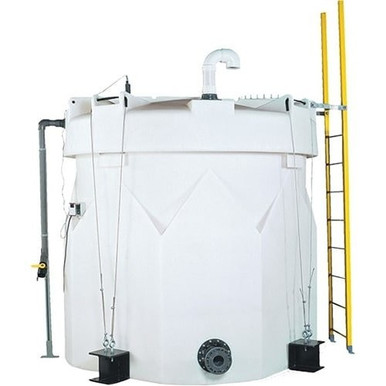
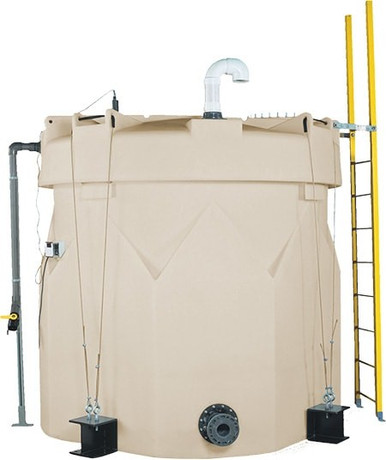
The Snyder SII-5490000N42 1,550 gallon double-wall XLPE uses cross-linked polyethylene which dramatically extends headspace service life on vapor-active chemistries; the cross-link density resists vapor diffusion and chain scission. The SII-5990102N42 1,000 gallon double-wall shares the chemistry. For high-volume hypochlorite service, XLPE is the practical answer to the headspace problem.
4. Inspection Discipline Adjusted for Headspace Priority
The inspection procedure for vapor-active chemistry tanks differs from the standard liquid-tank inspection in specific ways:
Manway inspection from above. Open the manway and look upward into the dome interior. The dome interior is what sees the vapor; this is the inspection target. Look for yellowing, browning, chalking, or surface deformation. Compare against installation-date photographs if available.
Vent fitting close inspection. Remove the vent at the documented inspection cadence and inspect the threaded interface, the gasket, and the fitting body. Replace gaskets at any sign of polymer degradation. Replace the entire vent assembly if any cracking or chalking is visible.
Dome surface inspection from outside. Walk around the tank and look at the dome from a low angle that catches grazing light. Surface deformation, dimpling, or color changes are visible from outside on translucent tanks; pigmented tanks require closer inspection.
UV light inspection of dome from inside. The 365 nm UV-A inspection technique applies particularly well to the dome because the wall is thin and the lighting geometry is favorable. Subsurface crazes appear as bright lines.
Wall thickness measurement at the apex. Ultrasonic wall-thickness gauging at three points around the apex (north, south, east-west) measures actual wall remaining vs nameplate. Apex thickness loss over 20 percent triggers immediate engineering review.
The inspection equipment is modest. UT thickness gauge runs 800-2500 dollars; UV-A flashlight under 100 dollars; magnifying loupe under 50 dollars. The labor per tank is 30-60 minutes. The cadence for vapor-active chemistry should be 6 months minimum, monthly during the second half of expected service life.
5. Vapor-Side Service-Life Math by Chemistry
The expected service-life behavior for common vapor-active chemistries on linear polyethylene tanks (LDPE/HDPE) and on cross-linked polyethylene tanks (XLPE):
- Sodium hypochlorite 12.5 percent: linear PE service life 36-60 months with first headspace yellowing at 12-18 months. XLPE service life 60-120 months with delayed yellowing at 24-36 months.
- Hydrogen peroxide 35 percent: linear PE service life 24-36 months; XLPE 48-72 months. Headspace failure at vent fittings dominates.
- Anhydrous ammonia / aqueous ammonia 30 percent: ammonia attacks polymer slowly compared to oxidizers; service life on linear PE 96-144 months for aqueous ammonia, dome failure rare.
- Methanol, ethanol, isopropanol: alcohols cause stress whitening and ESC initiation but oxidative damage is minimal. Linear PE service life 60-120 months on aliphatic alcohols.
- Sulfuric acid 93 percent: headspace mist attack at the liquid-vapor interface; linear PE service life 24-48 months. XLPE 48-96 months.
- Hydrochloric acid 32 percent: headspace HCl gas attack on metal fittings is more concerning than polymer attack; linear PE service life 60-120 months but stainless fittings degrade in 12-24 months.
- Sodium hydroxide 50 percent: caustic chemistry has minimal vapor pressure; headspace is not the limiting factor. Linear PE service life 120+ months.
The numbers above are approximate ranges from manufacturer field-failure databases and published case studies. They are not warranties; actual service life depends on temperature, fill cycle frequency, ventilation, ambient conditions, and inspection discipline. The numbers do support the general principle that vapor-active chemistries warrant XLPE specification and shortened replacement cadences relative to non-vapor-active service.
6. Vent Sizing as a Headspace Mitigation
The vent size affects headspace chemistry in two ways. First, a properly sized vent prevents pressure or vacuum buildup during fill and drain cycles that would otherwise mechanically stress the dome. Second, a properly sized vent permits adequate purge flow through the headspace under thermal cycling, which limits the residence time of vapor at the wall and reduces the cumulative exposure.
API 2000 sets the engineering basis for normal venting (thermal breathing) and emergency venting (fire-case relief) on aboveground tanks. For atmospheric polyethylene tanks, normal venting requirements scale with tank diameter and fill/drain rate; a 1,500-gallon vertical with 100 GPM fill rate needs approximately 3-inch normal venting per API 2000 §4.3.2. Emergency venting for fire case scales with the wetted-wall area; the same 1,500-gallon vertical at 64 square feet of wetted wall needs approximately 6-8 inch emergency venting for a fire-case relief.
The headspace-chemistry mitigation argument: oversize the normal vent by 50-100 percent over the API 2000 minimum to support a small thermal-cycling purge flow. The added cost is 50-150 dollars in fitting hardware; the benefit is reduced vapor residence time and longer headspace service life. This is a low-cost engineering decision that operators should specify at order entry on any vapor-active chemistry tank.
For complementary detail on the vent sizing methodology itself, see our API 2000 vent sizing article. The headspace-management argument from this article complements the pressure-management argument from the vent-sizing article.
7. Replacement Decision Triggers Specific to Headspace
The replacement decision flowchart for headspace-driven failure modes:
Continue service: Dome surface uniform color, no measurable wall thinning, vent fitting and gasket in good condition, age below 50 percent of brand-spec service life on the chemistry.
Increased inspection (quarterly): First yellowing visible at dome interior, vent gasket showing surface deformation, age 50-75 percent of brand-spec.
Plan replacement (90-180 days): Yellowing transitioning to brown, surface chalking inside dome, wall thickness loss measurable at apex, vent fitting body degradation. Begin replacement procurement.
Immediate take-out-of-service: Visible cracking at dome or vent, leak around vent that does not respond to gasket replacement, wall-thickness loss over 30 percent at apex, manway flange ESC initiation. Drain-down before replacement.
The Norwesco N-40146 1,500 gallon is a common service-life-replacement pattern for fertilizer and water service where vapor activity is low. The Snyder Captor SII-5490000N42 1,550 gallon is the chemistry-driven upgrade for hypochlorite, peroxide, or other vapor-active chemistries.
8. Specifying for Headspace Longevity at Order Entry
The specifications that pay back in extended headspace service life on a new tank order:
- XLPE wall material if the chemistry has any vapor activity. The cross-linked grades cost 20-40 percent more than linear PE but routinely deliver 1.5-3x service life on vapor-active chemistries.
- White or pigmented exterior to limit UV-driven temperature rise. A white tank in summer service runs 15-25 degrees F cooler than a translucent tank, which reduces vapor-phase reaction rates and extends service life on vapor-active chemistries.
- Oversized normal vent (1.5-2x API 2000 minimum) to support thermal-cycling purge.
- Stainless or chemical-resistant vent and manway hardware matched to the vapor chemistry. Steel vents on hypochlorite tanks fail in 12-24 months; SS316 or PVC equivalents last the tank life.
- Dome ports for inspection access in addition to instrumentation ports. A dedicated 4-inch inspection port for borescope or UV-A access pays for itself the first time a non-destructive inspection avoids a confined-space entry.
The total upcharge on a new tank for full headspace-longevity specification is typically 200-600 dollars on a 1,500-gallon SKU. The expected service-life extension is 30-100 percent on vapor-active chemistries. The economic case is overwhelming for any tank that will see vapor-active chemistry over multi-year service.
9. Brand-by-Brand Headspace Configuration Notes
- Norwesco linear PE for water and non-aggressive chemistry: standard dome thickness adequate; standard vent acceptable. Reference: N-40635 3,000 gallon, N-41500 1,000 gallon.
- Norwesco linear PE for fertilizer: ammonia volatility minimal; standard configuration adequate. Reference: N-40146 1,500 gallon.
- Snyder Captor XLPE double-wall for hypochlorite, peroxide, vapor-active chemistry: specify XLPE, white exterior, oversized vent, SS316 vent hardware. Reference: SII-5490000N42 1,550 gallon, SII-5990102N42 1,000 gallon.
- Snyder waste oil double-wall: hydrocarbon vapor activity moderate; standard PVC vent adequate, watch for permeation effects rather than chain scission. Reference: SII-5740102N95703 275 gallon.
- Enduraplas vertical for industrial: available in pigmented exteriors; specify oversized vent for vapor-active service. Reference: EP-THV02500FG 2,500 gallon.
- Chem-Tainer HDPE vertical for general industrial: standard HDPE adequate for low-vapor service; XLPE upgrade available for hypochlorite. Reference: TC6446IA 500 gallon.
- Bushman water service: headspace activity is essentially zero on potable water; standard configuration is adequate. Reference: BM-WW-1500-GL-NAT 1,500 gallon.
OneSource Plastics quotes vapor-active chemistry tanks with XLPE wall specification, white exterior pigmentation, oversized vent, and chemistry-matched fitting hardware as the standard package. List pricing on a 1,500-gallon Snyder Captor double-wall in hypochlorite-ready spec runs $5,800 and up depending on configuration. LTL freight to your ZIP is quoted via the freight estimator or by phone at 866-418-1777.
For complementary reading, see our rotational seam inspection article for the wall-side inspection methodology, and our HDPE permeation article for the chemistry-loss-through-wall analysis that complements the headspace-failure analysis.
Recommended Tanks for This Guide
Live pricing, updated automatically · estimate freight to your ZIP.