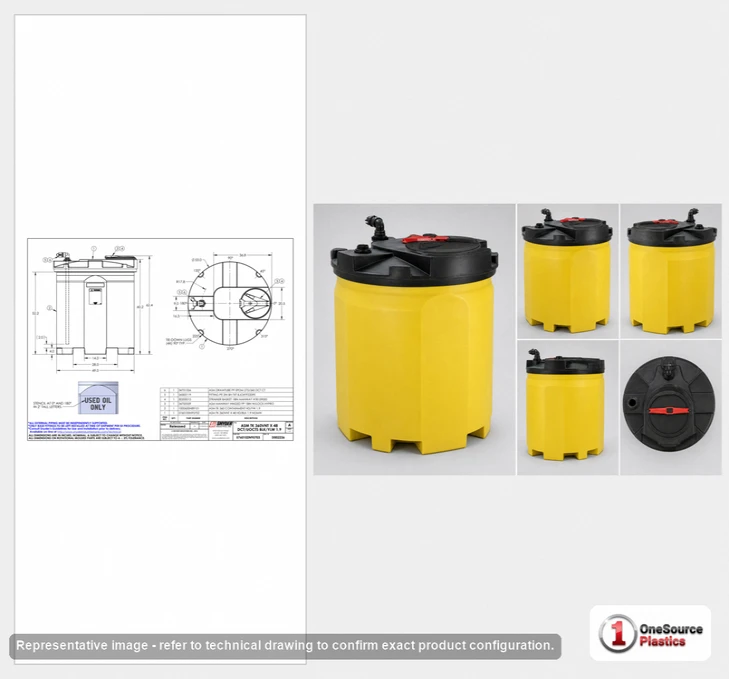
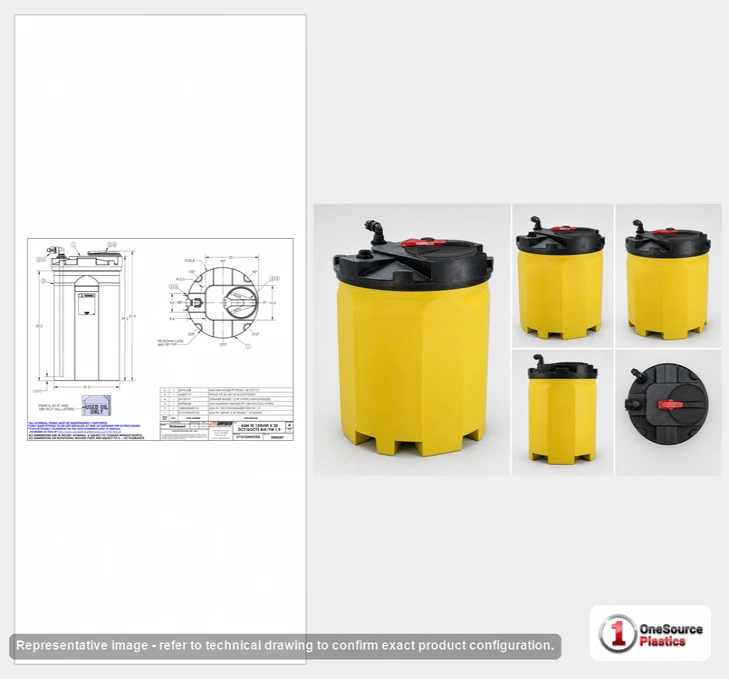
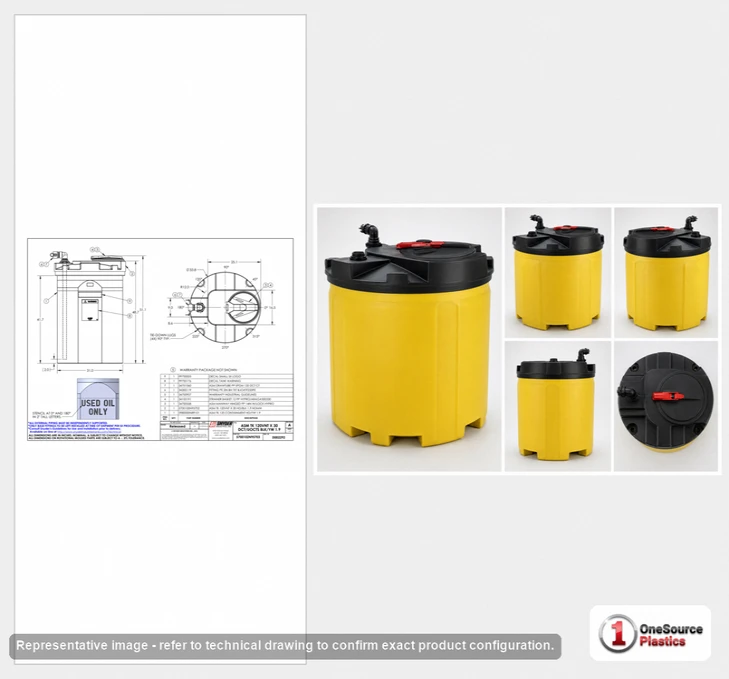
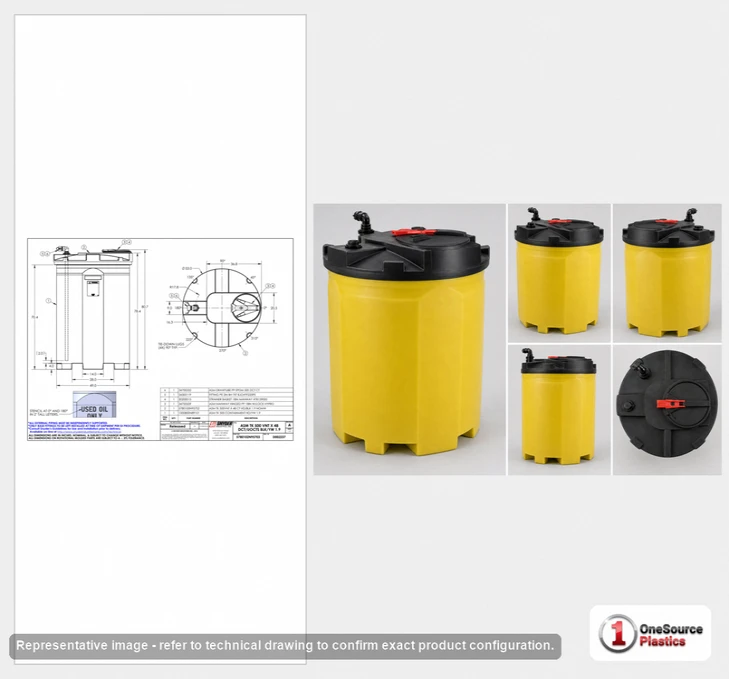
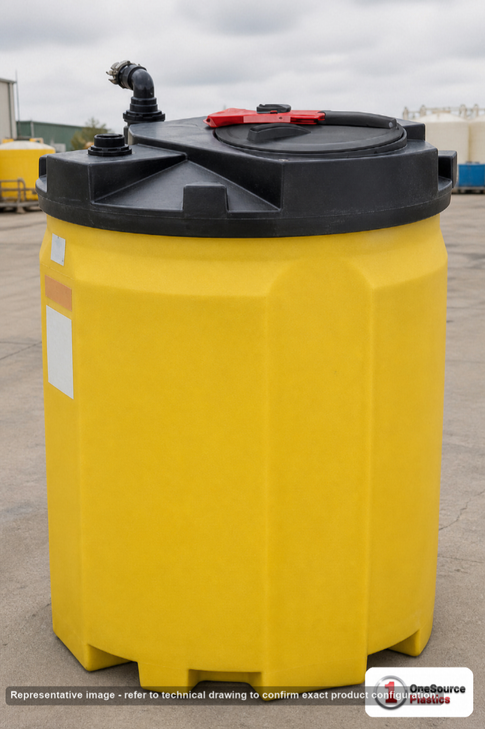
A 275 gallon double wall waste oil tank with a lockable lid and a camlock draw
The Snyder 5740102N95703 is built for one job: collecting used oil in a shop until the hauler comes. It is a 275 gallon double wall tank in yellow high density linear polyethylene, 47 inches across and 63 inches tall, 200 pounds empty, rated for a specific gravity of 1.9. The outer wall is the secondary containment, so it stands on a shop floor without a berm. The lid is an 18 inch hinged, lockable manway with a strainer basket, and the outlet is a 2 inch male camlock on an internal draw pipe, which is exactly the connection a vacuum truck wants.
Want it on your site? Get LTL freight to your ZIP, add it to your cart above, or call 866-418-1777 and a tank specialist will confirm the fit.
Why the details are the product
- The strainer basket in the manway catches filters, rags and gasket scraps before they reach the tank, which is what keeps the draw pipe from plugging on pickup day.
- The lock on the lid is a compliance detail as much as a security one: an open used-oil tank is a spill waiting for a bumped bucket.
- The internal draw pipe means the hauler connects at the camlock and pulls from the bottom without opening the lid or lifting a hose over the rim.
- Yellow resin is the conventional color for used oil in a shop, so nobody mistakes it for fresh product or coolant.
- The 2 inch inlet takes a drain funnel or a pump-over line from a drain cart.
Containment rules it answers
Used oil in a shop lands under SPCC rules once the site's total oil storage crosses the threshold, and a double wall tank is the simplest way to satisfy the containment requirement without pouring a curb. The SPCC 40 CFR 112 compliance walkthrough maps the rule onto a double wall poly tank, the 110 percent containment comparison sets it against a UL 142 steel tank, and for a facility that manages the oil as hazardous waste the RCRA 40 CFR 264.193 secondary containment guide covers leak detection in the interstitial space. Freeboard is the number to size the fill schedule to: the freeboard sizing guide shows how much of the 275 gallons is usable.
What it weighs full
At water density the tank holds 2,294 pounds; at its 1.9 rating it is built for 4,358 pounds of contents, which used oil will never approach, so the rating is margin rather than a limit you will meet. On a slab that is a non-issue; on a mezzanine, check the point-load rating for 47 inches of footprint. Service temperature is 120 F / 48 C, so hot drain oil should cool in the drain cart before it goes in. Three year warranty.
Three sizes of the same tank
| Part | Gallons | Diameter x height | Empty weight |
|---|---|---|---|
| 5710102N95703 | 150 | 34 x 62 in | 110 lb |
| 5740102N95703 (this tank) | 275 | 47 x 63 in | 200 lb |
| 5760102N95703 | 360 | 53 x 63 in | 234 lb |
All three stand roughly the same height, so the choice is floor space against pickup frequency: the 150 gallon tank fits a two-bay shop that gets pumped monthly, the 360 gallon tank is 6 inches wider than this one and buys a fleet shop several more weeks between haulers. Size the tank to the hauler's minimum pickup with the tank sizing calculator and the tank sizing guide.
Picked the 275 gallon tank? Add it to your cart above; freight is quoted to your ZIP before you pay anything.
Freight
LTL freight, NMFC 156600-03, 200 pounds shipping at 47 by 47 by 63 inches; the freight cost estimator quotes your ZIP and the listed price is before freight. Two people can set it in place with a hand truck. Put it where the vacuum truck can reach the camlock with a hose, not where the tank is convenient to fill.
Chemicals this resin is rated for, with the fitting and gasket to order
These are the chemicals listed for this tank at the concentrations shown. Each links to the full compatibility page; confirm your exact concentration and temperature there or in the chemical compatibility database before ordering.
- Sulfuric Acid (98%, CPVC fittings, Viton gaskets)
- Hydrochloric Acid (37%, PVC, Viton)
- Phosphoric Acid (85%, PVC, Viton)
- Hydrogen Peroxide (50%, PVC, Viton)
- Sodium Hypochlorite (under 16.5%, PVC, Viton)
- Ferric Chloride (50%, PVC, EPDM)
- Aluminum Sulfate (50%, PVC, EPDM)
- Ethylene Glycol (100%, PVC, EPDM)
- Peracetic Acid (30%, 316SS, Aflas), and
- Potassium Hydroxide (saturated, PVC, EPDM), among others on our full
- DEF (32.5%) and
- urea solution (50%) on 316SS fittings with EPDM gaskets - a common fleet and fluid-handling use. Note that the as-shipped 2 in PE bulkhead and PP manway
Freight and documents
Ships from: Marked Tree, AR. LTL freight is quoted to your ZIP with the freight cost estimator or by phone at 866-418-1777. The listed price is before freight.
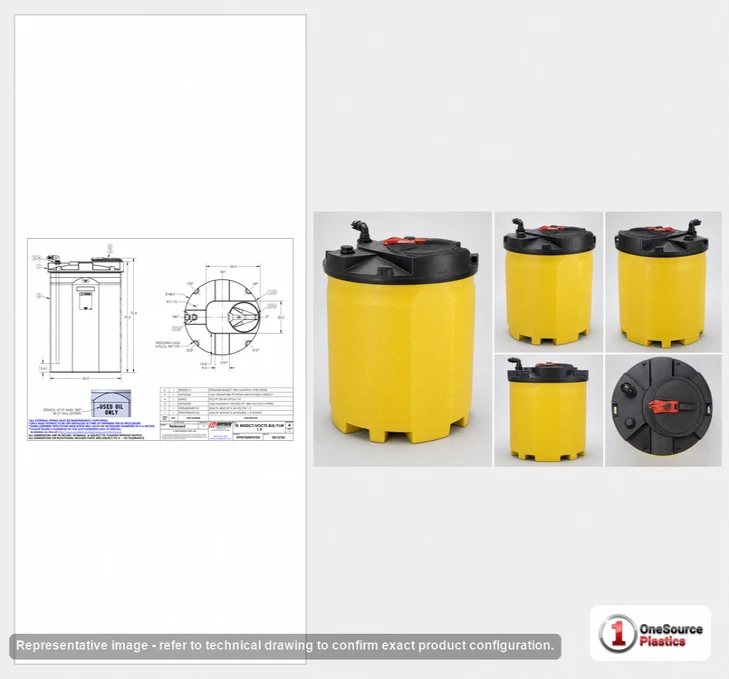
Technical drawing (PDF) for Snyder Industries 5740102N95703.
See this tank
Interactive 3D model with live fill. This tank has an interactive 3D model built to its manufacturer dimensions. Rotate it, and set a fill level to see how much liquid it holds at any height. Open the 3D view on the product photo above. Download the 3D model (GLB).
Product video. Watch the Snyder Industries 275 Gallon Plastic Vertical Double Wall Waste Oil Tank in Yellow video (67 seconds) with dimensions, fittings and shipping notes.
Ready to order?
Add it to your cart at the top of this page, get LTL freight to your ZIP, or call 866-418-1777. The listed price is before freight.