Tank Color Coding for Industrial Service: ANSI Z535 vs OSHA 1910.144 vs Custom Color-by-Chemistry
Industrial tanks in service hold chemistries that range from harmless rinse water to fatal anhydrous ammonia. The visual system that lets a forklift driver, a fire responder, or a plant operator instantly identify what's in a tank — and what hazard it represents — is a stack of three overlapping standards: ANSI Z535 (safety colors and labels), OSHA 29 CFR 1910.144 (color identification of physical hazards), and the ASME A13.1 piping color system that has informally been adopted as the de facto color-by-chemistry convention in many process plants. This pillar walks the three standards, where they overlap, where they conflict, and how to specify a tank-color and label scheme that is both compliant and operationally useful on Norwesco, Snyder, Bushman, Chem-Tainer, and Enduraplas tanks.
Reference codes: ANSI Z535.1 (Safety Colors), ANSI Z535.4 (Product Safety Signs and Labels), ANSI Z535.5 (Safety Tags and Barricade Tapes), OSHA 29 CFR 1910.144 (Specifications for Accident Prevention Signs and Tags — Color Identification), OSHA 29 CFR 1910.1200 (Hazard Communication / GHS labeling), ASME A13.1 (Scheme for the Identification of Piping Systems), International Fire Code (IFC) Section 5003.5 (Hazardous Materials Identification), 49 CFR Part 172 (DOT Hazard Class Labeling for transport), and NFPA 704 (Standard System for the Identification of the Hazards of Materials for Emergency Response).
The Three Color Systems
| Standard | Scope | Mandatory? | Where Applied |
|---|---|---|---|
| OSHA 29 CFR 1910.144 | Workplace physical hazard identification | Yes (federal) | Tank itself, hazard zones |
| ANSI Z535 family | Safety signs, colors, labels | Industry default; OSHA-acceptable | Tank labels, warning signs |
| ASME A13.1 | Piping (informally extended to tanks) | Industry default for chemistry | Tank body color, piping |
| NFPA 704 diamond | Emergency response identification | Required by IFC + most local codes | Tank-mounted placard |
| GHS / OSHA HazCom 2012 | Workplace hazard communication | Yes (federal) | Tank label with pictograms |
OSHA 1910.144: The Federal Color Code
OSHA 29 CFR 1910.144 sets the binding federal color identification rule. Three colors are explicitly assigned:
- Red: fire protection equipment and apparatus, danger signs, emergency stop buttons, containers of flammable liquids (Class IA / IB).
- Yellow: caution / physical hazards; striking-against, stumbling, falling, tripping, "caught in between" hazards. Most chemistry-storage installs use yellow striping or yellow tank base for trip / strike hazards in the area.
- Other (per ANSI Z535): OSHA explicitly defers to ANSI Z535 for sign and label color and design.
1910.144 is the floor — the minimum required. It does not assign chemistry-specific colors. That's where ANSI Z535 and ASME A13.1 fill in.
OSHA 1910.144 application to tanks
- Diesel / gasoline / Class IA-IB flammable liquid tank: red body color or red-marked exterior is the OSHA expectation.
- Tanks holding physical hazard chemistry (caustic, acid, oxidizer): yellow striping at base or yellow caution signage at perimeter.
- Other chemistry tanks: no OSHA-mandated body color; ANSI Z535 / ASME A13.1 conventions used.
ANSI Z535: The Industry Sign / Label Standard
The Z535 color hierarchy
| Color | Signal Word | Meaning | Tank Application |
|---|---|---|---|
| Safety Red | DANGER | Will result in death / severe injury | Lethal chemistry: anhydrous ammonia, hydrofluoric, fuming sulfuric, hydrogen cyanide |
| Safety Orange | WARNING | Could result in death / severe injury | Concentrated acids and bases, oxidizers, severe-hazard chemistry |
| Safety Yellow | CAUTION | Could result in moderate injury | Industrial chemistry, dilute acids/bases, sanitizers at use-strength |
| Safety Green | SAFETY / FIRST AID | Safety equipment, first aid, exits | Eyewash / shower, first aid station, evacuation route |
| Safety Blue | NOTICE | Equipment use / maintenance information | Process information, lockout point identification |
| Black / White / Gray | Information / instruction | Wayfinding, contact info | Tank ID number, capacity, MFR / serial |
Z535 specifies the hex / Pantone values precisely; for example Safety Red is approximately Pantone 186 C (#C8102E), Safety Yellow Pantone 116 C (#FFCD11). For tank labels, use Z535-compliant printed labels rather than field-painted approximations.
Z535 sign panel construction
A compliant tank warning panel has:
- Signal-word panel (top): DANGER (red), WARNING (orange), CAUTION (yellow), or NOTICE (blue), with the signal word in white block letters.
- Pictogram (left): standardized icon for the hazard class.
- Message panel (right or below): hazard text, consequence, avoidance instruction.
- Optional GHS pictograms if HazCom 2012 applies.
ASME A13.1: The Piping Color Code (Adopted to Tanks)
ASME A13.1 is technically a piping standard. Most plants extend it to tanks because it gives a chemistry-grouping logic that the safety standards don't:
| Tank / Piping Color | Service Class | Examples |
|---|---|---|
| Yellow body / black letters | Flammable / oxidizing materials | Diesel, gasoline, peroxide, nitric acid |
| Orange body / black letters | Toxic / corrosive | Sulfuric, hydrochloric, sodium hydroxide |
| Red body / white letters | Fire-protection materials | Fire-suppression water, foam concentrate |
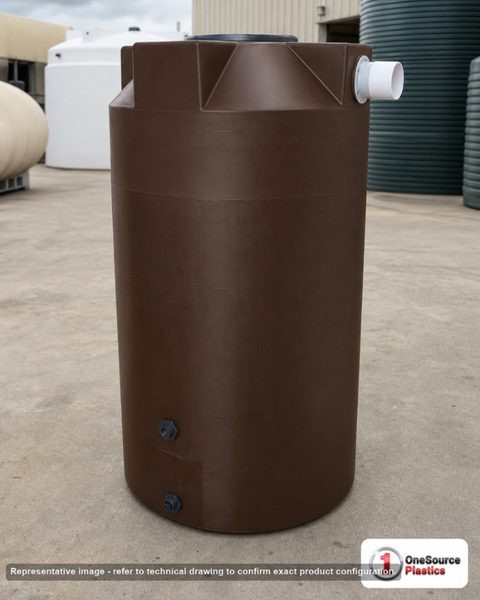
| Brown body / white letters | Combustible / petroleum | Heating oil, lubricant, hydraulic fluid |
| Blue body / white letters | Compressed air / inert gas (where stored) | Compressed-air receiver, nitrogen |
| Green body / white letters | Other water (non-fire, non-potable) | Process water, cooling water, irrigation |
| Black body / white letters | Sanitary / sewer | Septic effluent, sanitary sewage |
| White body / blue or black letters | Potable water / NSF 61 | Drinking water, food-grade |
Custom Color-by-Chemistry: When Plants Build Their Own
Many plants build a custom color scheme that goes deeper than ASME A13.1 because they have many tanks of similar service class that need to be distinguishable. Common custom schemes:
- Blue: caustic / alkaline. 50% NaOH, 45% KOH, NH4OH 28%.
- Red: acid. Sulfuric, hydrochloric, nitric, phosphoric.
- Yellow: oxidizer. Hypochlorite, peroxide, peracetic.
- Green: water. Process water, RO product, soft water.
- White: potable / NSF 61.
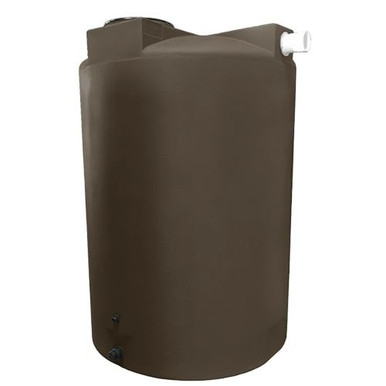
- Tan / brown: petroleum / diesel.
- Black: waste / drain / sanitary.
- Purple: urea / DEF / fertilizer.
- Silver / gray: inert.
This custom scheme isn't a standard but it's industry-common. Document the scheme in writing, post placards explaining the code at every plant entry, and train every new hire on it. Otherwise the code is meaningless.
The custom scheme caveat
If your plant uses a custom scheme that conflicts with ASME A13.1 or OSHA 1910.144, you must over-label every tank with the federal-mandated identification. Color is a secondary identifier; the primary is the printed text label per HazCom 2012.
The Required Tank Label Stack
Every tank in service must carry, at minimum, this label stack:
- Product name (text): chemical name as it appears on the SDS. Plain English; no abbreviations.
- NFPA 704 diamond: emergency-response identification. Health (blue), Flammability (red), Instability (yellow), Special hazard (white). Required by IFC Section 5003.5.
- OSHA HazCom 2012 / GHS pictograms: the GHS hazard pictograms (skull-and-crossbones, corrosive, oxidizer, etc.) per 29 CFR 1910.1200. Workplace label requirements.
- Signal word: DANGER or WARNING per Z535.
- Hazard statement: the GHS hazard statements (H-codes, e.g. H314 "Causes severe skin burns and eye damage").
- Precautionary statement: the GHS precautions (P-codes).
- Tank ID number: facility-unique tank identifier. Cross-references SPCC plan, P&ID, asset register.
- Capacity: nominal gallons.
- Manufacturer / serial / date of manufacture: per ASTM D1998.
- Emergency contact phone: 24/7 number for spill response.
Label material specification
- Outdoor UV-rated polyester or vinyl.
- Acid / alkaline / solvent-resistant adhesive matched to chemistry.
- Letter height per ANSI Z535.4: minimum 1-inch text on tanks under 1,000 gallon, 2-inch text on tanks 1,000-5,000 gallon, 3-inch text on tanks above 5,000 gallon.
- Replace labels on first sign of fading, peeling, or chemistry attack — typically 3-5 years on outdoor tanks.
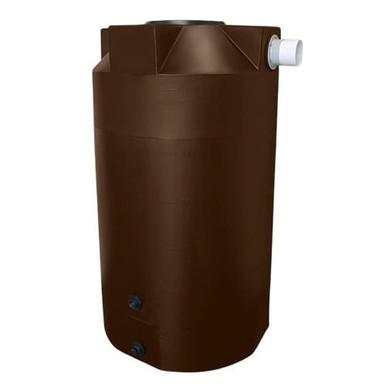
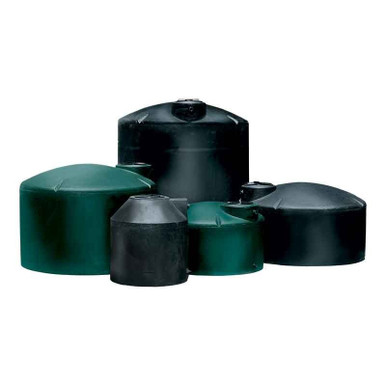
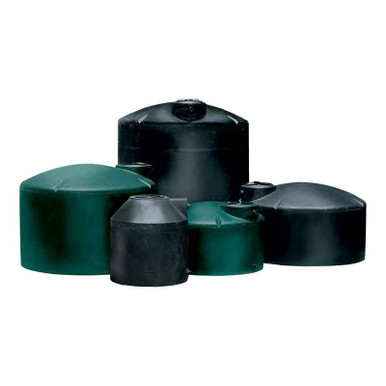
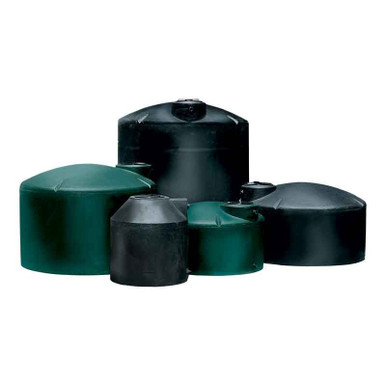
Tank Body Color: Norwesco / Snyder / Bushman Stock Options
Manufacturer stock colors:
- Natural / translucent: Norwesco standard for water service. Allows visual level check. Translucent tanks need opaque cover or interior baffle if algae control is required.
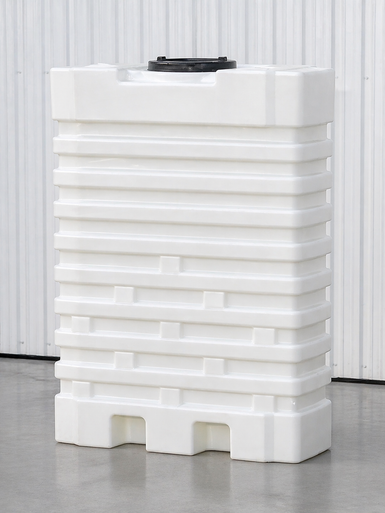
- White: NSF 61 potable, food grade; lowest UV absorption of opaque colors.
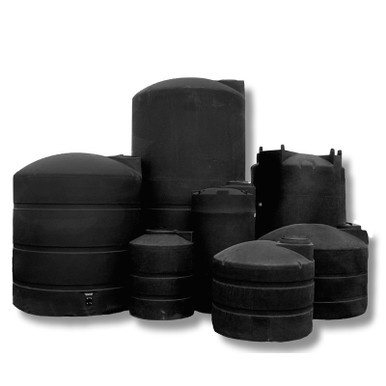
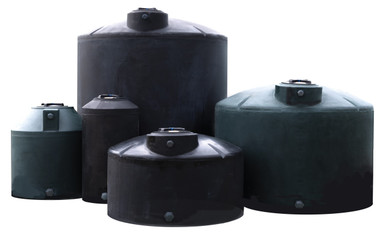
- Black: standard for water-haul, agricultural; opaque (no algae growth).
- Yellow: common for diesel, fertilizer, hazard-coded chemistry (matches ASME A13.1 yellow).
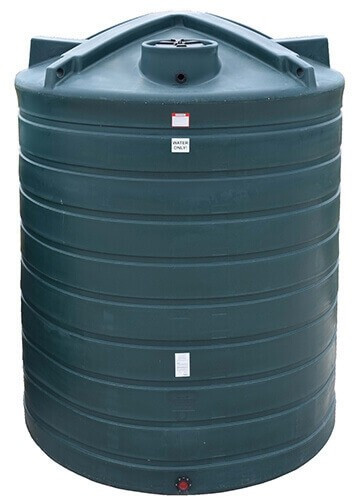
- Green: potable / process water, often for residential use, low visual conspicuity.
- Red: fire-protection water, fuel storage; matches OSHA 1910.144.
- Blue: common for caustic, urea / DEF, marine.
- Custom-color: available from most manufacturers at premium with minimum-quantity. Typical premium $200-1,500 per tank, MOQ 5-25 units.
Color-fastness considerations
Pigment loading affects UV stabilization. Pigmented poly tanks (any color) hold up to UV better than natural / translucent. Black is the most UV-stable color due to carbon-black pigment. White and bright colors are less UV-resistant and may need refresh painting at 10-15 years.
Specifying Color for a New Tank
The decision sequence:
- Is OSHA 1910.144 mandating a specific color for this chemistry? (Class IA-IB flammable liquid → red is the OSHA expectation.) Yes → use mandated color.
- Does the plant have a custom color-by-chemistry scheme? Yes → match scheme, document in tank specification.
- Does ASME A13.1 give a default for this service class? Yes → default to that color unless plant scheme overrides.
- Does the chemistry require translucent / opaque? (Translucent for visual level on water; opaque for algae control on chemistry / water with biofilm risk.)
- Is there UV exposure / climate sensitivity? (Hot / arid → white or black for thermal management; algae-prone → opaque.)
- Are labels visible from required viewing distance? (ANSI Z535.4 letter height per tank size.)
NFPA 704 Diamond — The Emergency Response Layer
NFPA 704 (the "fire diamond") is the firefighter's interpretation tool. Required by International Fire Code Section 5003.5 for any storage above the threshold quantity. Four numbered sections:
- Blue (left): Health hazard. 0 (no hazard) to 4 (lethal).
- Red (top): Flammability. 0 (will not burn) to 4 (extreme flammability).
- Yellow (right): Instability / reactivity. 0 (stable) to 4 (may detonate).
- White (bottom): Special hazard. W (water-reactive), OX (oxidizer), SA (simple asphyxiant), or COR (corrosive).
Diamond should be visible from minimum 100 feet for tanks 5,000+ gallon, with backing color contrast that survives faded paint.
Common Color-Coding Mistakes
Mistake 1: Color-only identification, no text label
HazCom 2012 violation. Color is secondary; text label is primary. Color alone never sufficient.
Mistake 2: Custom scheme without plant-wide documentation
Operators in different shifts assign different colors. Document custom scheme on a posted color chart at every entry and in employee training.
Mistake 3: Stock yellow tank holding water
ASME A13.1 yellow is reserved for flammable / oxidizing. Water in a yellow tank confuses fire response. Use white or green for water; blue for caustic; yellow for diesel / oxidizer.
Mistake 4: Faded / peeling labels not replaced
OSHA inspector will note label legibility on walk-through. Replace at first sign of fading.
Mistake 5: Missing NFPA 704 diamond
IFC Section 5003.5 requires the diamond for chemistry storage above threshold quantity. Local fire marshal will fail final inspection without it.
Mistake 6: Letter height too small for viewing distance
ANSI Z535.4 letter height: minimum 1-inch on small tanks, scales up. Hold a meter stick at 50 feet — if you can't read the label, neither can the responder.
Mistake 7: Wrong adhesive for chemistry
Standard label adhesive fails on caustic, solvent, or acid spray. Specify chemistry-resistant adhesive or use printed-on-tank decals.
Mistake 8: Translucent tank holding photo-degrading chemistry
Sodium hypochlorite, peroxide, certain organics degrade in light. Specify opaque or covered tank for any photo-sensitive chemistry.
Internal Resources
- Tank Cleaning + Maintenance Protocols
- Tank Plumbing System Design
- Multi-Tank Manifold Design
- Tank Weather Protection
- Chemical Compatibility Database
- Sodium Hypochlorite Storage
- Sulfuric Acid Storage
- Freight Cost Estimator
Source Citations
- ANSI Z535.1 — Safety Colors
- ANSI Z535.4 — Product Safety Signs and Labels
- ANSI Z535.5 — Safety Tags and Barricade Tapes
- OSHA 29 CFR 1910.144 — Specifications for Accident Prevention Signs and Tags
- OSHA 29 CFR 1910.1200 — Hazard Communication (HazCom 2012 / GHS)
- ASME A13.1 — Scheme for the Identification of Piping Systems
- NFPA 704 — Standard System for the Identification of the Hazards of Materials for Emergency Response
- International Fire Code (IFC) Section 5003.5 — Hazardous Materials Identification Signs
- 49 CFR Part 172 — DOT Hazardous Materials Table and Communications
- Globally Harmonized System (GHS) of Classification and Labelling of Chemicals — UN Rev 9
- Norwesco / Snyder / Bushman color stock specifications
Recommended Tanks for This Guide
Live pricing, updated automatically · estimate freight to your ZIP.