Tank Color Selection: Translucent White vs Opaque White vs Black vs Green by Use Case
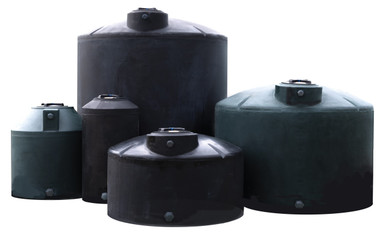
Tank color is not aesthetic. It is engineering. The pigment package on a polyethylene tank determines UV transmission, internal algae growth, wall temperature under solar load, NSF 61 listing, and chemistry compatibility for light-sensitive product. Picking the wrong color costs you replacement tanks at 5-8 years instead of 18-25, biological contamination of stored water, accelerated chemistry degradation, or warranty exclusion when the manufacturer reads your install photos.
This guide walks the four primary tank colors offered across Norwesco, Snyder, Chem-Tainer, Enduraplas, and Bushman, with the engineering case for each. We cite ASTM D1998 (rotomolded polyethylene tank specification), NSF/ANSI 61 (drinking water components), and reference real SKUs from the OneSource Plastics catalog of 9,419 industrial tanks. Color performance numbers come from manufacturer published data and resin TDS.
The Four Color Families
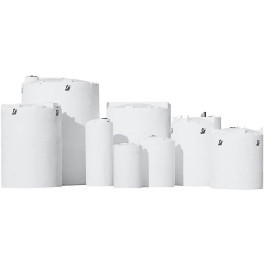
1. Translucent natural / translucent white
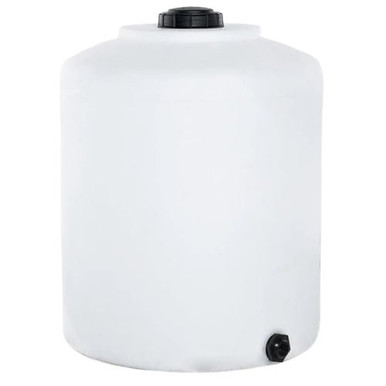
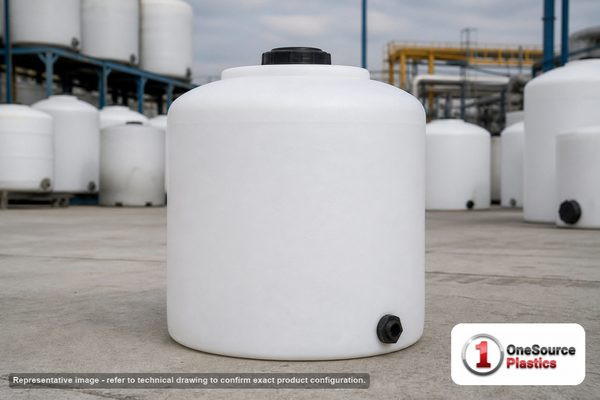
Unpigmented or lightly stabilized polyethylene. Wall transmits visible light. Allows level visibility from outside without a sight tube. UV transmission is highest of any color — typically 30-60% UV pass-through depending on wall thickness. Algae bloom risk in any potable or process water service exposed to ambient light. Common on small residential potable, indoor process tanks, and DEF tanks where contamination visibility matters.
2. Opaque white / natural-white
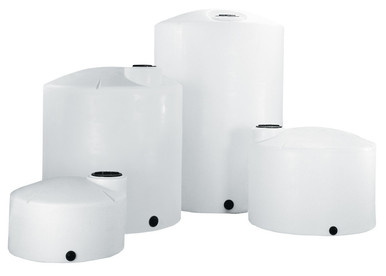
Pigmented polyethylene with white masterbatch (typically titanium dioxide). UV transmission cut to 5-15% range. Surface reflects solar heat — wall temperature stays within 5-10F of ambient even under direct sun. Algae risk significantly reduced vs translucent but not eliminated. Standard color for NSF 61 potable water tanks and outdoor agricultural water tanks where heat absorption matters.
3. Black
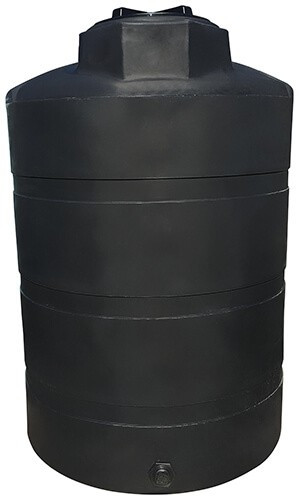
Pigmented with carbon black (typically 2-3% by weight). UV transmission essentially zero — carbon black is the most effective UV blocker available in polyethylene. Wall absorbs solar heat — surface temperature can run 30-50F above ambient under direct summer sun. No algae growth (no light penetration). Default color for outdoor stock water, industrial wastewater, and any application where light transmission is unwanted.
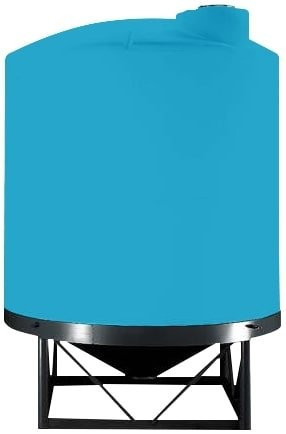
4. Green / dark earth tones
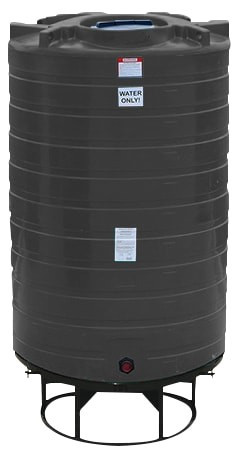
Pigmented polyethylene typically with phthalo green or chrome oxide green. UV transmission low (5-10%) similar to other dark colors. Solar absorption similar to black but slightly lower. Aesthetic role at residential and rural sites — green tanks blend into landscape better than black or white. Some industrial sites specify green for visual conformity with other site equipment.
UV Transmission and Algae Risk
The single biggest operational difference between colors is what happens to water that sits inside.
Why translucent water tanks grow algae
Algae (chlorophyta, cyanobacteria) require light, water, nutrients, and temperature above 50F. Outdoor translucent water tanks satisfy all four within hours of installation. Algae populations can reach visible green tinge in 5-10 days after first fill, full bloom in 3-4 weeks. Once established, biofilm at the wall and bottom is difficult to eliminate without full chlorination cycles.
Why opaque white reduces but does not eliminate
Titanium dioxide cuts UV-A and UV-B sharply. Visible light still penetrates 5-15%. Algae growth is slower (3-6 month bloom vs 3-week bloom) but not eliminated. NSF 61 potable use typically pairs opaque white tanks with chlorinated municipal water that suppresses biological growth chemically. Stock water and rainwater catchment in opaque white sees occasional bloom in warm months.
Why black eliminates
Zero light penetration means no photosynthesis means no algae. Black tanks store water for years without biological growth. The trade is solar heat absorption — water in a black tank under summer sun in Phoenix or Houston can hit 100-120F at the top of the water column. For stock water this is acceptable; for chemistry feed water or potable, the temperature rise is a problem.
Why green is the aesthetic compromise
Dark green provides nearly black-equivalent algae prevention with slightly less solar absorption and visual integration with rural and residential settings. Engineering performance tracks black; aesthetic performance differs.
Wall Temperature Under Solar Load
Surface temperature data, polyethylene tank, July midday, 100F ambient, full sun:
| Color | Sun-side wall surface | Shade-side wall surface | Top of water column (full tank) |
|---|---|---|---|
| Translucent natural | 110-120F | 100-105F | 95-105F |
| Opaque white | 105-115F | 100-103F | 90-100F |
| Light tan / beige | 115-125F | 100-105F | 95-105F |
| Dark green | 130-145F | 100-108F | 100-115F |
| Black | 140-160F | 100-110F | 105-120F |
The data: white tanks in 100F ambient run 5-15F warmer at the wall than ambient air. Black tanks run 40-60F hotter at the sun-side wall and 5-20F warmer at the top of the water column. The wall temperature drives the chemistry rate; the bulk fluid temperature drives operational temperature.
Chemistry Rate and Color
Chemistry degradation is temperature-dependent. The Arrhenius rule of thumb: rate roughly doubles for every 18F (10C) temperature rise. Stored chemistry inside a tank lives at the bulk fluid temperature; chemistry near the wall sees the wall surface temperature briefly during draindown and refilling.
Sodium hypochlorite 12.5%
Hypochlorite degrades chemically (loss of available chlorine) at a rate roughly proportional to temperature. At 70F bulk fluid, the half-life of 12.5% bleach is ~60-70 days. At 90F bulk fluid, half-life drops to ~25-35 days. At 110F (black tank in Phoenix sun), half-life is under 14 days. The operating cost of frequent rotation plus the polymer degradation cost combine to make black hypochlorite tanks a poor choice in hot climates.
Hypochlorite color recommendation: opaque white or natural-white XLPE tank, ideally indoors or shaded. Outdoor installation should use white only.
Sulfuric acid (any concentration)
Sulfuric acid is thermally stable; color does not affect chemistry rate. Color affects vapor pressure and the wall stress at high temperature. Black tanks run hotter at the wall and may exceed XLPE rated continuous service. White preferred for outdoor sulfuric.
Sodium hydroxide 50%
NaOH is thermally stable but has solubility-temperature inversion: at high concentration, low temperature drops solubility and crystallization can plug fittings. NaOH 50% storage in cold-climate outdoor service should default to black to absorb solar heat (or insulate / heat trace). In hot climate, color matters less.
Diesel and petroleum products
Petroleum is thermally stable across the polyethylene service range. Color does not materially affect product quality. Black is conventional for diesel ASTs; white is used where vapor pressure management matters (gasoline AST in hot climate prefers white to limit vapor evolution).
DEF (urea 32.5%)
DEF degrades thermally — urea hydrolysis accelerates above 86F (30C) and crystallization occurs at low temperature (-11F / -23C is the crystallization point). DEF tanks are typically white opaque to limit solar absorption while maintaining ISO 22241 contamination control. Black DEF tanks are uncommon and may exceed ISO 22241 storage temperature recommendations.
NSF 61 and Color
NSF/ANSI 61 certification depends on the resin formulation and pigment package. Common patterns:
- Natural-white (no added pigment beyond base resin) is widely NSF 61 listed.
- Opaque white with NSF-listed pigment package is widely available.
- Black HDPE NSF 61 listings exist but are less common; carbon black grades must be food-contact qualified.
- Colored tanks (green, blue) typically not NSF 61 listed; pigment chemistry usually disqualifies.
For potable water service, default to natural or opaque white NSF 61 listed product. SKU examples: N-41527 (Norwesco 300 gal natural-white NSF 61), Bushman natural-white potable tanks across the WW series, Snyder NSF 61 listings on select models. Black for potable is rare and usually special-order.
UV Service Life by Color
UV-driven oxidative degradation determines tank service life on outdoor installations. Color is the primary UV defense layer; the resin formulation and antioxidant package supplement it. Approximate service life curves under outdoor exposure:
| Color | Northern US (Minnesota, Montana) | Mid US (Kansas, Tennessee) | Southern US (Arizona, Texas) |
|---|---|---|---|
| Translucent natural | 8-12 yr | 5-9 yr | 3-7 yr |
| Opaque white | 15-25 yr | 12-20 yr | 10-18 yr |
| Light green / tan | 20-30 yr | 15-25 yr | 12-20 yr |
| Dark green | 25-35 yr | 20-30 yr | 15-25 yr |
| Black | 25-35+ yr | 20-30+ yr | 18-28 yr |
Black is the longest-life outdoor color. Carbon black absorbs UV before it can reach the polyethylene chains, eliminating photo-oxidation as a degradation mechanism. The trade is thermal stress — black tanks in extreme southern climates lose some of the life advantage to thermal cycling and high wall temperature accelerating chemistry. See our UV Degradation guide for the full thickness-erosion model.
Worked Examples
Case 1: 1,500-gallon outdoor stock water, central Texas farm
Service: stock water, full sun, no chemistry stress. Black HDPE preferred. Algae prevention is the operational driver; UV protection is the lifetime driver. Wall temperature under sun runs hot but stock water at 105-110F is acceptable. Service life 20-25 years. SKU: EP-TLV01500BK or N-41464.
Case 2: 2,500-gallon NSF 61 potable, Arizona residential
Service: potable water, full sun, NSF 61 required. Opaque white NSF 61. Wall temperature stays modest, NSF certification preserved, algae growth limited by chlorination + opaque pigment. Service life 15-20 years in Arizona sun. SKU: Norwesco or Bushman natural-white NSF 61 product.
Case 3: 1,500-gallon outdoor sodium hypochlorite 12.5% feed, Phoenix
Service: oxidative chemistry, full sun, hot ambient. Opaque white XLPE. Polymer family handles chemistry; white color minimizes solar absorption. Black tank in this service halves chemistry lifetime; outdoor white tank with shade structure halves it again. Service life 7-10 years on chemistry side; tank lifetime not the limiting factor.
Case 4: 5,000-gallon outdoor diesel AST, fleet yard
Service: diesel storage, full sun, SPCC compliance. Black HDPE. Diesel is thermally stable; UV protection drives lifetime. Black is conventional and the longest-life choice. Wall temperature high but diesel quality unaffected. Service life 20-25 years.
Case 5: 300-gallon DEF tank, indoor mechanical room
Service: DEF storage, indoor climate-controlled, ISO 22241 compliance. Opaque white or natural-white. Color is for contamination visibility (see-through level indication helpful) and for ISO 22241 thermal management. Indoor environment removes UV concern. Service life 15-20 years.
Case 6: 1,000-gallon residential rainwater, suburban backyard
Service: rainwater catchment, full sun, aesthetic constraints. Dark green. Engineering performance close to black; visual integration with landscape is an HOA / spouse driver in many residential installations. Service life 18-25 years. SKU: Bushman or Norwesco green rainwater catchment product.
Common Color-Selection Mistakes
Mistake 1: Translucent natural for outdoor potable or stock water
The number-one outdoor tank failure pattern. Algae bloom within weeks; biofilm contamination by month two; replacement or chlorine-shock decontamination by year one. Translucent is for indoor or shaded service only. Outdoor water = white minimum, black or green preferred.
Mistake 2: Black for hypochlorite or hot chemistry
Solar absorption raises chemistry temperature; chemistry rate doubles every 18F; service life halves. Black hypochlorite tanks in hot climates fail at 12-18 months. Use white for any oxidative or thermally sensitive chemistry outdoors.
Mistake 3: Color-matching to brand without engineering review
Many farms specify all green tanks for visual consistency. Green is acceptable for water and benign service but may not be NSF 61 listed for potable, and does not provide the same outdoor UV protection as black for the longest-life applications. Verify the engineering case behind the aesthetic preference.
Mistake 4: Assuming NSF 61 covers all colors
Pigment chemistry often disqualifies NSF 61 listing even when the base resin is NSF-listed. For potable, verify the specific tank/color combination is NSF 61 listed before specifying.
Mistake 5: Forgetting the color affects internal inspection
Translucent and natural-white allow some internal visibility from outside (level visible, gross debris visible). Black and dark green are completely opaque — internal inspection requires opening the manway and inserting a light. For tanks that need frequent visual inspection (food processing, batch chemistry), white preferred.
Mistake 6: Ignoring climate when selecting from catalog
Black is the best UV defense; black is a poor choice for hot-climate chemistry. Opaque white is the best NSF 61 default; opaque white algae-resists less than black. The right color is the intersection of climate, chemistry, regulation, and operations — not a single answer.
Color Selection Quick-Reference
| Application | Color | Reason |
|---|---|---|
| Outdoor stock water | Black | UV durability + algae prevention |
| Outdoor potable (NSF 61) | Opaque white | NSF 61 listing + heat reflection |
| Outdoor rainwater catchment | Black or dark green | Algae prevention + UV durability |
| Outdoor hypochlorite chemistry | Opaque white XLPE | Heat reflection extends chemistry life |
| Indoor potable | Natural or opaque white | NSF 61 listing + level visibility |
| Indoor process tank | Translucent or natural white | Visual level inspection |
| DEF (indoor or outdoor) | Opaque white | ISO 22241 thermal + visibility |
| Diesel AST (outdoor) | Black | Conventional, longest UV life |
| Gasoline AST (outdoor, hot climate) | Opaque white | Vapor pressure management |
| NaOH 50% outdoor cold climate | Black | Solar gain prevents crystallization |
| Underground / buried | Black or dark | No UV concern; manufacturer default |
| Residential aesthetic-driven | Dark green | Near-black engineering with visual integration |
Internal Resources
- UV Degradation Curve
- Polymer Selection Guide
- DEF Storage Tank Selection
- Tank Insulation and Heat Tracing
- Plastic Tank Failure Mode Analysis
- Chemical Compatibility Database
- Freight Cost Estimator
- Contact OneSource — color and resin consultation, NSF 61 verification, climate-specific specification
Source Citations
- ASTM D1998 — Standard Specification for Polyethylene Upright Storage Tanks
- ASTM D2565 — Standard Practice for Xenon-Arc Exposure of Plastics Intended for Outdoor Applications
- ASTM G154 — Standard Practice for Operating Fluorescent UV Lamp Apparatus for Exposure of Plastic Materials
- NSF/ANSI 61 — Drinking Water System Components: Health Effects
- ISO 22241 — Diesel Exhaust Fluid AUS 32 Specification
- Manufacturer technical data sheets: Norwesco, Snyder Industries, Chem-Tainer, Enduraplas, Bushman Equator
- Resin manufacturer pigment compatibility data: LyondellBasell, ExxonMobil, INEOS
- OneSource Plastics master catalog data, dated 2026-03-26 snapshot (9,419 cataloged products)
Related chemical compatibility resources
For deeper engineering specifications on the chemicals discussed above, see our chemical-compatibility pillars:
- DEF (Diesel Exhaust Fluid) — storage compatibility, recommended resin grade, fittings, secondary containment.
- Sodium Hydroxide — storage compatibility, recommended resin grade, fittings, secondary containment.
- Sodium Hypochlorite — storage compatibility, recommended resin grade, fittings, secondary containment.
- Sulfuric Acid — storage compatibility, recommended resin grade, fittings, secondary containment.
Recommended Tanks for This Guide
Live pricing, updated automatically · estimate freight to your ZIP.