Tank Concrete Pad vs Pavement vs Compacted Gravel: Foundation Engineering by Capacity
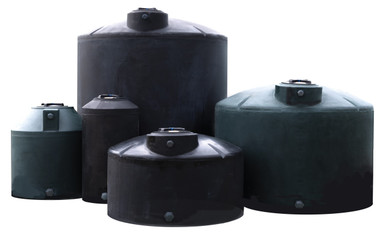
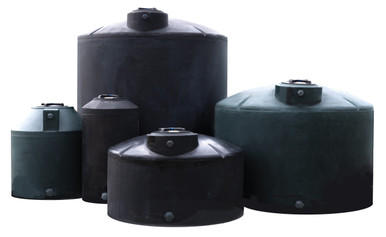
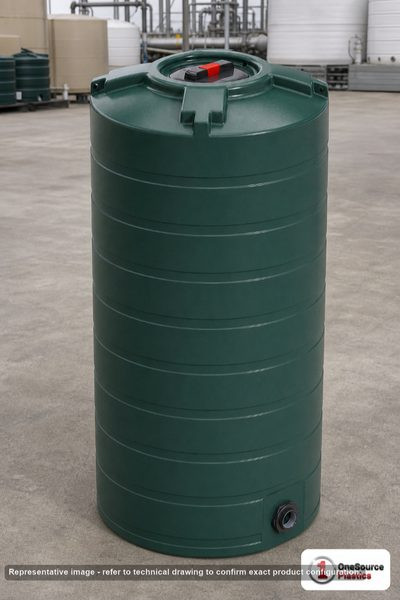
The foundation under a polyethylene tank is the single biggest source of slow, expensive, hidden failure. A 5,000-gallon vertical Norwesco MPN 40941 (white) full of water exerts approximately 4.6 psi static pressure across an 11-foot diameter footprint - roughly equivalent to a 41,700-pound point load when integrated over the base. If the foundation cannot distribute that load uniformly, the tank base flexes, the wall develops bending stress at the chime (where wall meets bottom), the seam between rotomolded base and sidewall sees cyclic strain, and over 5-15 years a stress-crack develops, water finds the crack, and the tank slowly seeps. The leak is not visible until the soil under the tank turns to mud.
This guide walks the foundation engineering decision: when to use concrete pad, when asphalt pavement is acceptable, when compacted gravel is the correct choice, and the specific capacity-and-content combinations that mandate each. The references: ACI 318-19 Building Code Requirements for Structural Concrete, IBC 2021 Chapter 18 Soils and Foundations, ASTM D1556 / D6938 (sand-cone and nuclear gauge soil density measurement), and manufacturer-published install-base requirements from Norwesco, Snyder, Chem-Tainer, Enduraplas, and Bushman.
Three Foundation Types, Three Failure Modes
Compacted Gravel (most common, often the right answer)
Properly engineered compacted-gravel base consists of 4-6 inches of crushed stone (typically Number 57 stone or Number 4 stone, ASTM D448) compacted to 95% Standard Proctor density (ASTM D698) over a prepared subgrade. The advantages are real:
- Drainage: water passing through tank fittings or condensation under the tank drains through the gravel without saturating subgrade soil.
- Frost-heave tolerance: coarse gravel pumps water during freeze-thaw cycles without lifting the tank uniformly.
- Settlement uniformity: properly compacted gravel deflects elastically under load. The tank base settles uniformly rather than along a shear surface.
- Cost: $300-1,500 per pad vs $2,000-8,000 for poured concrete depending on capacity.
The failure mode: differential settlement. If subgrade soil is non-uniform (clay pocket on one side, sand on the other), gravel transmits the differential to the tank base and the tank tilts. Over 6-24 months, the tilt accumulates and the tank wall develops bending stress.
Concrete Pad (the high-capital, high-capacity choice)
Properly engineered concrete pad: 6-10 inches of f'c >= 4,000 psi concrete on 4-6 inches of compacted aggregate base, reinforced with #4 or #5 rebar in 12-inch grid pattern, sloped 1/8-inch per foot for drainage to perimeter. Cost: $5-15 per square foot installed, depending on regional labor and rebar specification.
- Distributes load evenly: rebar grid provides flexural strength that spreads point loads from tank chime across the entire pad.
- Anchor-bolt-ready: seismic anchoring (ASCE 7-22 SDC D-F) requires concrete with embedded or post-installed anchors. Gravel doesn't take anchors.
- Inspection-friendly: visible pad face = visible cracks, settlements, drainage paths. Easier to maintain.
- Long service life: 30-50 years before pad replacement; 50+ years if drainage is well-designed.
The failure mode: pad cracking from inadequate sub-base. Concrete is brittle in tension; if the pad is poured directly on uncompacted soil, the pad cracks, water finds the crack, freeze-thaw widens the crack, and the failure cascades to the tank.
Asphalt Pavement (the wrong answer most of the time, but sometimes acceptable)
Asphalt pavement is hot-mix bituminous concrete typically 2-4 inches thick on compacted aggregate base. It is NOT a tank foundation in the structural sense, but it is the most common surface tank installers encounter on existing commercial sites.
- Acceptable for: tanks under 1,500 gallons, indoor and partial-shade locations, applications with low chemistry hazard, sites where existing pavement is well-drained and undamaged.
- NOT acceptable for: tanks above 1,500 gallons, full-sun outdoor exposure (asphalt softens above 130F surface temperature), seismic anchoring (no through-bolt anchorage in 3-inch asphalt), hazmat storage with secondary containment requirements.
- Cost workaround: for marginal cases, install a poured concrete pad ON TOP of the existing pavement. The pavement becomes the base; the concrete becomes the structural foundation. Adds $2-5 per sq ft over a fresh pour.
Failure mode: rutting. Asphalt under sustained point load creeps. A 1,500-gallon tank base on asphalt depresses the pavement 0.5-1.5 inches over 12-24 months in hot climate. The tank tilts, the wall flexes, the chime cracks.
Capacity-Driven Foundation Selection Matrix
| Tank Capacity | Bearing Pressure | Compacted Gravel | Concrete Pad | Asphalt Pavement |
|---|---|---|---|---|
| 100-500 gal | ~1.5-3 psi | YES (4 in NUM57) | YES (4 in) | OK (existing only) |
| 500-1,500 gal | ~2-4 psi | YES (6 in NUM57) | YES (6 in) | MARGINAL |
| 1,500-2,500 gal | ~3-5 psi | YES (6 in NUM57) | YES (6 in) | NO |
| 2,500-5,000 gal | ~4-6 psi | YES (8 in NUM57) | PREFERRED (8 in) | NO |
| 5,000-10,000 gal | ~5-8 psi | OK if engineered | PREFERRED (8-10 in) | NO |
| 10,000+ gal | ~7-12 psi | NOT recommended | REQUIRED (10 in + #5 rebar) | NO |
Geotechnical Bearing Pressure: The Math
For a flat-bottom vertical tank, average bearing pressure on the foundation is:
P = W / A
Where W is total weight (tank + contents) and A is footprint area. For Norwesco MPN 40941 (5,000 gal vertical, white, 1,800-lb dry, 142-inch diameter):
- Water weight: 5,000 gal x 8.34 lb/gal = 41,700 lb
- Tank weight: 1,800 lb
- Total: 43,500 lb
- Footprint area: pi x (71)^2 = 15,836 sq in = 109.97 sq ft
- Bearing pressure: 43,500 / 15,836 = 2.74 psi (39.5 lb/sq ft)
That is the AVERAGE bearing pressure. The peak pressure at the tank chime can be 1.5-2.5x average due to wall-bottom geometry. So design bearing pressure for foundation = 2.74 x 2 = 5.5 psi (792 lb/sq ft).
Soil allowable bearing pressures (per IBC 2021 Table 1806.2):
- Crystalline bedrock: 12,000+ psf (no concern for any tank)
- Sedimentary rock / well-graded gravel: 4,000-8,000 psf
- Sandy gravel / gravel: 3,000-5,000 psf
- Sand (medium-dense): 2,000-4,000 psf
- Stiff clay: 2,000-4,000 psf
- Medium clay: 1,500-3,000 psf
- Soft clay / silt: 1,000 psf or less - PROBLEM SOIL, requires soil improvement
Even soft clay (1,000 psf = 6.94 psi allowable) handles the 5.5 psi design pressure of a 5,000-gallon tank. The bearing pressure is rarely the binding constraint - DIFFERENTIAL settlement is. That's why uniform compaction matters more than absolute load capacity.
Subgrade Preparation: The 80% That Matters
Whether you choose gravel, concrete, or asphalt, subgrade preparation determines outcome:
- Strip topsoil and organic material: remove 6-12 inches of topsoil and any vegetation. Organic material decomposes and creates voids.
- Identify problem soil: if the subgrade is soft clay, peat, or fill of unknown composition, dig deeper or import structural fill. A geotechnical investigation costs $500-2,000 and prevents $20,000+ of foundation rebuilding.
- Compact subgrade: 95% Standard Proctor density on cohesive soils; 95% Modified Proctor on granular fill. Use vibratory plate compactor on tank-pad-sized projects (under 200 sq ft); use ride-on roller for larger pads.
- Verify density: ASTM D6938 nuclear gauge or ASTM D1556 sand-cone test. Cost: $200-500 per test. Do this BEFORE you place gravel or concrete.
- Drainage: slope subgrade 1-2% AWAY from tank center to perimeter. Install perimeter drain (4-inch perforated PVC in stone wrap) where surface drainage is poor.
Gravel Pad Specifications by Capacity
100-1,500 gallon (Norwesco MPN 41464, MPN 41500, MPN 41861, MPN 41465)
- Pad thickness: 4-6 inches of compacted Number 57 crushed stone (3/4" max aggregate)
- Pad diameter: tank diameter + 12 inches minimum (6 inches outside tank base on every side)
- Compaction: 95% Standard Proctor
- Subgrade: 6-inch stripped, compacted to 95%
- Drainage: 1% slope to perimeter
1,500-3,000 gallon (Norwesco MPN 41514, MPN 47109, MPN 42382, MPN 45246, MPN 43808, MPN 40627)
- Pad thickness: 6 inches of compacted Number 57 crushed stone
- Pad diameter: tank diameter + 24 inches
- Compaction: 95% Standard Proctor
- Subgrade: 12-inch stripped, compacted to 95% with vibratory plate compactor
- Drainage: 1% slope, perimeter drain in poor-drainage soils
- Geotechnical investigation: recommended if subgrade soil is unknown or visibly variable
3,000-10,000 gallon (Norwesco MPN 42044, MPN 40941, MPN 41375, MPN 42315, MPN 47618)
- Pad thickness: 8 inches of compacted Number 57 crushed stone OR 6 inches concrete (preferred) on 4-inch aggregate base
- Pad diameter: tank diameter + 36 inches
- Compaction: 95% Modified Proctor
- Subgrade: 18-inch stripped, compacted with ride-on roller
- Drainage: perimeter drain mandatory
- Geotechnical investigation: REQUIRED unless soil-bearing capacity is documented
- P.E. stamped foundation drawing: required in most AHJs
10,000+ gallon (Norwesco MPN 47638)
- Concrete pad: 10 inches f'c >= 4,000 psi with #5 rebar 12-inch o.c.
- Pad diameter: tank diameter + 48 inches
- Aggregate base: 6 inches of compacted Number 57 stone under concrete
- Subgrade: 24-inch stripped, compacted to 98% Modified Proctor
- Drainage: perimeter drain + sub-pad drain manifold
- Geotechnical investigation: REQUIRED including soil-borings to 10 ft depth
- P.E. stamped foundation drawing: REQUIRED
Concrete Pad Specifications
For tanks above 5,000 gallons or for any tank requiring seismic anchoring (SDC D-F):
- Concrete strength: f'c minimum 4,000 psi at 28 days. ACI 318-19 minimum for foundation slabs in tank applications.
- Reinforcement: #4 rebar 12-inch o.c. each way for tanks 1,500-5,000 gal; #5 rebar 12-inch o.c. each way for 5,000-10,000 gal; #5 rebar 8-inch o.c. for >10,000 gal.
- Cover: minimum 3 inches concrete cover on rebar where pad bottom contacts earth (ACI 318-19 Section 20.5.1).
- Aggregate base: 4-6 inches of compacted Number 57 or Number 4 stone, 95% Modified Proctor.
- Vapor barrier: 6-mil polyethylene under aggregate base if subgrade is moisture-prone.
- Curing: 7 days minimum wet cure or curing-compound application (ACI 308R).
- Joint pattern: contraction joints at 12-15 ft spacing on pads >150 sq ft. Tooled or saw-cut to 1/4 of pad depth.
Foundation Cost Reference (typical 2026 USD)
| Tank Size | Gravel Pad | Concrete Pad | Asphalt-on-Concrete |
|---|---|---|---|
| 500 gal | $300-600 | $800-1,800 | $1,200-2,500 |
| 1,500 gal | $700-1,500 | $1,800-4,000 | $2,500-5,500 |
| 2,500 gal | $1,200-2,500 | $2,800-6,000 | $3,800-7,500 |
| 5,000 gal | $2,200-4,500 | $4,500-9,500 | $6,000-13,000 |
| 10,000 gal | N/A (concrete only) | $8,000-18,000 | N/A |
Regional variation is significant. The Sun Belt (TX, AZ, FL) tends 15-25% lower than the Northeast (MA, NY, NJ); concrete labor in the Bay Area runs 35-50% premium over interior California.
Common Foundation Mistakes
Mistake 1: Pour concrete directly on dirt
Without aggregate base, the slab cracks within 1-3 freeze-thaw cycles. The crack pattern radiates from drainage paths under the slab. Repair: cut and re-pour. Prevention: 4-inch minimum aggregate base.
Mistake 2: Skip subgrade compaction
Loose subgrade compresses 1-3 inches under sustained tank load over 6-24 months. Differential settlement = tank tilt = chime cracking. Repair: drain and re-level. Prevention: compaction test BEFORE backfill.
Mistake 3: Pad too small relative to tank diameter
Tank base extends right to pad edge. Edge load concentrates at the pad-to-soil interface, soil punches out from under the edge, and the tank tilts outward. Prevention: pad diameter 12-48 inches larger than tank diameter, scaled to capacity.
Mistake 4: Place tank on uneven concrete
Concrete pad cured with high spots or trowel marks creates point loads on the tank base. The chime cracks at the high point. Prevention: float and trowel the pad to level (1/8-inch tolerance over 10 ft) or use a sand bed under the tank to fill irregularities.
Mistake 5: Asphalt for >1,500 gal in hot climate
Asphalt below the tank reaches 130-150F surface temperature in Sun Belt summer. The pavement softens, the tank base compresses into the asphalt, the tank tilts. Prevention: don't use asphalt for tanks above 1,500 gal regardless of climate; for hot climate, use concrete only.
Mistake 6: No drainage from under the tank
Condensation, fitting drips, and rain over time saturates soil under the tank. Saturated soil loses bearing capacity, and the tank settles unevenly. Prevention: 1-2% slope on subgrade, perimeter drain in poor-drainage soils, vapor barrier under aggregate base.
Mistake 7: Skip the geotech
For tanks above 2,500 gallons or in any expansive-clay area, a soil investigation is cheap insurance. $500-2,000 saves $5,000-50,000 in foundation rebuild over the tank's service life.
Foundation Inspection Checklist
- Subgrade inspection: verify no organic material, no soft spots, no standing water in excavation.
- Compaction test: ASTM D6938 nuclear gauge OR ASTM D1556 sand-cone. Document.
- Aggregate gradation: Number 57 stone or specified equivalent. Reject if visibly contaminated with fines.
- Aggregate compaction: 95% Standard or Modified Proctor as specified.
- Concrete (if applicable): verify mix ticket f'c and air-entrainment matches spec; 4 cylinders per 50 cu yd for compressive testing.
- Rebar placement: spacing per drawing, 3-inch cover from earth, ties at intersections.
- Pad surface: trowel-finish to 1/8-inch tolerance over 10 ft; slight slope 1/8-inch per foot to drain.
- Drainage: verify perimeter drain (where required) flows.
- Cure: 7-day wet cure on concrete; protect from heavy load until 7-day strength achieved.
- P.E. stamp: stamped drawing for tanks above 1,500 gal in SDC D-F or above 5,000 gal anywhere.
Internal Resources
- Earthquake Anchoring Engineering
- Hurricane Tie-Down Engineering
- Aboveground vs Belowground Engineering
- Form Factor Selection
- State Regulations Hub
- California Tank Regulations
- Tank Sizing Calculator
- Freight Cost Estimator
Source Citations
- ACI 318-19 - Building Code Requirements for Structural Concrete
- ACI 318-19 Section 20.5.1 - Concrete Cover for Reinforcement
- ACI 308R-16 - Guide to External Curing of Concrete
- IBC 2021 Chapter 18 - Soils and Foundations
- IBC 2021 Table 1806.2 - Presumptive Load-Bearing Values of Soils
- ASTM D448-12 - Standard Classification for Sizes of Aggregate for Road and Bridge Construction
- ASTM D698-12 - Standard Test Methods for Laboratory Compaction (Standard Proctor)
- ASTM D1557-12 - Modified Proctor Compaction
- ASTM D1556-15 - Sand-Cone Density Test
- ASTM D6938-17 - Nuclear Gauge Density Test
- ASTM D1998-21 - Standard Specification for Polyethylene Upright Storage Tanks (manufacturer foundation requirements referenced)
- OneSource Plastics master catalog data, 2026-03-26 snapshot (9,419 SKUs)
Recommended Tanks for This Guide
Live pricing, updated automatically · estimate freight to your ZIP.