Tank Inventory Gauging for Small Fleet Operations: Hand-Tape Versus Ultrasonic Versus Radar Level Measurement, Accuracy and Repeatability Across Methods, and the Operational Discipline That Closes Inventory Reconciliation
Tank inventory gauging is the operational discipline of measuring how much chemistry is in each tank at a defined cadence and reconciling the measurements against deliveries, withdrawals, and inventory records. For small fleet operators with five to fifty tanks, the gauging method choice has real consequences for inventory accuracy, labor cost, safety exposure, and the discipline that supports chemistry quality and regulatory compliance. The three primary gauging methods are hand-tape (manual measurement with a calibrated tape and gauge stick), ultrasonic level (continuous or on-demand non-contact measurement using sound-wave time-of-flight), and radar level (continuous or on-demand non-contact measurement using microwave time-of-flight).
This article walks the engineering and operational comparison among the three gauging methods for polyethylene tank fleets across the 5-brand catalog of Norwesco, Snyder, Chem-Tainer, Enduraplas, and Bushman. The discussion covers measurement accuracy, repeatability, installation effort, operational discipline, and the inventory reconciliation discipline that closes the loop between gauging measurements and chemistry usage. List pricing on each tank product page; LTL freight quoted to your ZIP via the freight estimator or by phone at 866-418-1777.
1. The Inventory Gauging Problem in Small Fleet Operations
Small fleet operations (typically 5-50 tanks) face inventory gauging challenges different from large refineries or chemical plants:
- Multiple chemistries across the fleet. A small fleet typically holds 4-12 different chemistries across the tank set. Each chemistry has different specific gravity, different vapor pressure characteristics, and different gauging requirements. The gauging method must work across the chemistry range.
- Lower individual tank turnover than refineries. Small fleet tanks may turn inventory weekly to monthly rather than daily. The gauging cadence is correspondingly weekly to monthly rather than continuous. Lower cadence makes manual methods practical that would not work for high-frequency operations.
- Capital constraint relative to large operations. A small fleet operator typically cannot justify continuous monitoring instrumentation on every tank. The capital decision favors lower-cost methods (hand-tape, on-demand ultrasonic) over higher-cost methods (continuous radar with networked SCADA integration).
- Labor pattern of designated tank operator. A small fleet typically has one or two designated tank operators handling all gauging. The operator schedules gauging rounds at defined intervals and reconciles inventory at end of shift or end of week. The labor pattern allows gauging discipline that would not scale to larger fleets without continuous instrumentation.
- Reconciliation against delivery and withdrawal records. Inventory accuracy is verified by comparing measured inventory change against the integrated delivery (additions) and withdrawal (subtractions) records. Significant deviations indicate measurement error, leak, or unrecorded chemistry movement. The reconciliation discipline is the value-add of gauging.
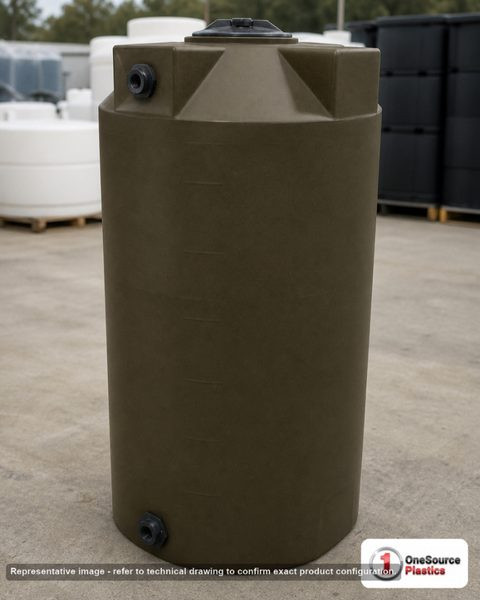
- Reference fleet tank. Reference N-40164 5000 gallon Norwesco vertical as the typical small-fleet tank where gauging method decisions are most consequential. Larger and smaller tanks in the fleet present similar gauging considerations at scaled magnitudes.
The small fleet gauging problem is well-defined. The method choice and the operational discipline together determine inventory accuracy.
2. Hand-Tape Gauging Method Engineering
Hand-tape gauging is the traditional manual method:
- The hand-tape and gauge stick. A hand-tape is a calibrated steel or fiberglass tape (typically 1/8-inch wide, 50-100 foot long, graduated in feet, inches, and 1/8-inch increments) on a reel. A gauge stick (a separate accessory) is a graduated stick used to support the tape and ensure it reaches straight to the chemistry surface. The tape carries a plumb bob or weighted end that touches the chemistry surface.
- Reading the tape. The operator lowers the tape from the tank top access (typically through the manway or a dedicated gauging port) until the plumb bob touches the chemistry surface. The tape graduation read at the gauging port datum gives the chemistry depth from the gauging port to the chemistry surface; subtracted from the total tank height gives the chemistry depth above the tank bottom; multiplied by the tank cross-section area gives the chemistry volume.
- Accuracy and repeatability of hand-tape. The graduations support 1/8-inch reading resolution. The plumb bob touch is the largest measurement uncertainty: typical operator-to-operator variation is 1/4 to 1/2 inch on still chemistry, larger on agitated chemistry. Repeatability for a single operator is typically 1/4 inch. Accuracy on a 102-inch diameter 5,000 gallon tank is approximately 25-50 gallons per measurement.
- Capital cost of hand-tape gauging. A quality hand-tape and gauge stick set costs $50-$150. The investment is one-time per fleet (the same tape works on all tanks). The accessory cost (gauging chart for each tank, weatherproof recording log, calibration thermometer) is $50-$200 per tank. Total fleet cost for hand-tape gauging is typically $500-$2,000 across 10-20 tanks.
- Operational time per gauging round. A typical fleet operator gauges 5-10 tanks in a 2-hour round including travel between tank locations. The per-tank time is 10-20 minutes including ladder access, gauging, and recording. The round produces a complete inventory snapshot at the end. The cumulative gauging labor is typically 10-20 hours per week for a 20-tank fleet at weekly cadence.
- Safety exposure of hand-tape. The operator climbs to the tank top, opens the gauging port, lowers the tape, reads the measurement, closes the port, and descends. Each round involves multiple ladder climbs and confined-space proximity at the tank top. Fall protection is required (per OSHA requirements above 4-foot height in general industry). Vapor exposure during port-open events is a chemical safety consideration; required PPE depends on the chemistry.
Hand-tape gauging is the lowest capital cost method with adequate accuracy for most small fleet applications. The labor cost over the service life and the safety exposure are the dominant total-cost factors.
3. Ultrasonic Level Gauging Method Engineering
Ultrasonic level gauging uses time-of-flight sound waves through the tank vapor space to measure chemistry surface distance:
- Ultrasonic transducer mounted at the tank top. A transducer is mounted at a fixed location on the tank dome typically through a dedicated 2-inch or 3-inch fitting. The transducer emits an ultrasonic pulse downward, the pulse reflects off the chemistry surface, and the transducer measures the round-trip time. The time multiplied by the speed of sound in the vapor space gives the surface distance from the transducer face.
- Accuracy and repeatability of ultrasonic. Industrial ultrasonic level transmitters specify accuracy typically 0.25 percent of full scale. On a 12-foot tank, that is approximately 1/2 inch accuracy. Repeatability is typically 0.1 percent (about 0.15 inches). The accuracy on a 5,000 gallon tank is approximately 50 gallons per measurement, comparable to hand-tape but without the operator-to-operator variation.
- Vapor space effects on ultrasonic. The ultrasonic measurement assumes a stable speed of sound in the vapor space. Temperature variation, vapor composition (chemistry vapor versus air mix), and vapor pressure all affect the speed of sound. For chemistries with significant vapor pressure (ammonia, hypochlorite, peroxide), the vapor effects can introduce 1-3 percent additional measurement error. Temperature compensation in the transmitter improves but does not eliminate the vapor effect.
- Foam and surface turbulence effects. Ultrasonic measurement requires a flat reflective surface. Foam, agitated surface, or turbulent fill-in creates variable reflection that the transmitter may register as noise or a wandering measurement. The technology is best for tanks at rest; tanks during fill or recirculation may show measurement instability.
- Capital cost of ultrasonic per tank. A quality ultrasonic level transmitter for industrial chemistry service costs $700-$2,500 per tank including transmitter, mounting, and basic display. Networked installation with central display adds $1,500-$5,000 per fleet. Total fleet cost for ultrasonic gauging on 20 tanks is typically $20,000-$50,000.
- Operational benefit of continuous ultrasonic. Once installed, ultrasonic provides continuous level measurement without operator intervention. Inventory snapshots are available on demand from the central display. Manual rounds are no longer required for inventory verification. The labor savings is the dominant operational benefit; payback over hand-tape labor cost is typically 2-4 years for an active fleet.
Ultrasonic level gauging trades capital for labor savings and continuous availability. The technology is mature and widely deployed for small fleet operations where the capital is justifiable.
4. Radar Level Gauging Method Engineering
Radar level gauging uses microwave time-of-flight rather than sound:
- Radar transmitter mounted at the tank top. Similar mounting to ultrasonic but using a microwave horn antenna or guided-wave probe rather than an ultrasonic transducer. The radar emits microwave pulses downward, the pulses reflect off the chemistry surface, and the time-of-flight gives the surface distance.
- Accuracy and repeatability of radar. Industrial radar level transmitters specify accuracy typically 0.05-0.1 percent of full scale. On a 12-foot tank, accuracy is approximately 0.1-0.2 inches. The accuracy is 3-5 times better than ultrasonic on the same tank. Volume accuracy on a 5,000 gallon tank is approximately 5-15 gallons per measurement.
- Vapor space immunity advantage. Microwave propagation is essentially immune to the vapor space effects (temperature, composition, pressure) that affect ultrasonic. Radar accuracy is consistent across chemistry vapor pressures and temperature ranges. This is the dominant technical advantage of radar over ultrasonic for chemistry tanks with high vapor pressure.
- Foam tolerance differences. Radar handles surface foam better than ultrasonic in most cases. Microwave reflection from foam is weaker than from chemistry surface; radar transmitters discriminate against foam reflection through signal-strength filtering. Severe foam can still confuse radar but the tolerance is higher than for ultrasonic.
- Capital cost of radar per tank. Industrial radar level transmitters cost $1,500-$5,000 per tank for typical chemistry service. Premium radar with high-resolution accuracy costs $3,500-$8,000. Total fleet cost for radar gauging on 20 tanks is typically $40,000-$120,000.
- Reference Snyder Captor for advanced gauging integration. Reference SII-1006600N42 10000 gallon Snyder XLPE Captor double-wall as a typical premium tank where radar gauging integration is common. Premium tanks for high-value chemistry justify the radar capital; the inventory accuracy improvement is consequential at high chemistry value per gallon.
Radar level gauging is the highest capital cost and highest accuracy method. The technology is justified by chemistry value, vapor pressure characteristics, or regulatory accuracy requirements that exceed ultrasonic capability.
5. Method Comparison Matrix
The three methods compare across the engineering and operational dimensions:
- Capital cost per tank. Hand-tape: $50-$150 (one-time fleet investment). Ultrasonic: $700-$2,500 per tank. Radar: $1,500-$5,000 per tank. Capital ratio is approximately 1:20:50 in favor of hand-tape.
- Annual labor cost per tank. Hand-tape: 30-50 hours per year per tank for weekly gauging. Ultrasonic: 0-2 hours per year per tank for occasional verification. Radar: 0-2 hours per year per tank for occasional verification. Labor ratio favors continuous methods 15-25 to 1.
- Accuracy per measurement. Hand-tape: 25-50 gallons on 5000 gallon tank. Ultrasonic: 25-100 gallons (vapor pressure dependent). Radar: 5-15 gallons. Accuracy ratio favors radar 2-5 to 1 over hand-tape.
- Continuous availability. Hand-tape: only at gauging round time. Ultrasonic and radar: continuous on demand from central display. Continuous availability is the operational advantage of instrumented methods.
- Vapor pressure sensitivity. Hand-tape: insensitive to vapor pressure. Ultrasonic: 1-3 percent error per high vapor pressure chemistry. Radar: insensitive to vapor pressure. Hand-tape and radar are the preferred methods for high-vapor-pressure chemistry.
- Operator safety exposure. Hand-tape: confined-space proximity, vapor exposure, fall hazard at every round. Ultrasonic and radar: zero ongoing safety exposure after installation. Continuous methods eliminate the routine safety risk.
- Maintenance requirement. Hand-tape: tape calibration verification annually, gauge stick condition. Ultrasonic and radar: transmitter calibration annually, transducer or antenna condition. Maintenance burden is similar in absolute hours; for instrumented methods the work is at the transmitter rather than at the tank top.
The comparison matrix supports the method selection decision based on the small fleet operational constraints and economic priorities.
6. Hybrid and Tiered Approaches for Small Fleets
Operational practice often uses tiered or hybrid approaches:
- Hand-tape primary, ultrasonic on critical tanks. Most fleet tanks use hand-tape gauging at weekly cadence; the 2-3 highest-value or highest-risk tanks have ultrasonic continuous monitoring. The capital is minimized while still providing continuous awareness on the critical inventory.
- Ultrasonic primary, hand-tape as backup verification. Mature fleet operations use ultrasonic continuous monitoring as primary inventory tracking with monthly hand-tape verification as cross-check. The hand-tape verification catches drift in the ultrasonic instrument and provides regulatory-grade documented measurement.
- Radar on regulated tanks, ultrasonic on operational tanks. Some chemistry tanks (hypochlorite for water treatment, some pharma feedstocks) have regulatory inventory accuracy requirements that ultrasonic cannot meet. Those tanks use radar; the operational tanks use ultrasonic. The capital is allocated to where regulation requires it.
- Phased deployment over multi-year capital plan. Small fleet operators often phase the transition from hand-tape to instrumented gauging across 3-5 years. New tanks are specified with instrumented gauging at installation; existing tanks retrofit at end of major maintenance cycles. The phased approach manages capital flow.
- Reference smaller-volume tank for hand-tape primary. Reference N-44800 Norwesco 100 gallon doorway water tank as a small-volume tank where hand-tape gauging is universally adequate; instrumented methods would be over-investment for the volume and the chemistry value.
- Reference larger tank for instrumented gauging. Reference N-43128 10000 gallon Norwesco vertical as a typical volume where ultrasonic or radar gauging is commonly justified by the chemistry value and the labor cost differential against hand-tape.
The hybrid approaches give small fleet operators the operational flexibility to optimize capital allocation across the fleet rather than deploying a single method uniformly.
7. Inventory Reconciliation Discipline
The gauging method is only the measurement step. Inventory reconciliation closes the loop:
- Define the inventory accounting period. Daily, weekly, or monthly accounting periods are typical for small fleet operations. Each accounting period has a starting inventory, ending inventory, and integrated deliveries and withdrawals during the period. The reconciliation balances the inventory equation.
- Reconciliation equation. Ending inventory equals starting inventory plus deliveries minus withdrawals. Any deviation between measured ending inventory and calculated ending inventory is the unreconciled variance. The variance is the gauge of measurement accuracy and operational discipline.
- Tolerance for unreconciled variance. Small variance (less than 1-2 percent of throughput) is the typical measurement uncertainty noise. Larger variance triggers investigation: review delivery records, withdrawal records, gauging measurement quality, and possible chemistry leak or unrecorded movement.
- Documentation standard. Each gauging measurement is documented in a tank inventory log including date, time, method, operator, raw measurement, and calculated volume. The log is the audit trail for regulatory compliance and the diagnostic resource for variance investigation.
- Cross-checking with second method. When variance exceeds tolerance, cross-check the gauging by alternative method (hand-tape if instrumented method is primary; instrumented if hand-tape is primary). The cross-check distinguishes measurement error from real chemistry movement variance.
- Process for variance investigation. Investigation typically reviews delivery and withdrawal records first (most common variance source is record error); then re-gauges the tank with operator quality control (second most common is gauging error); then escalates to leak investigation if records and re-gauging are clean. The investigation produces a root-cause finding and corrective action.
The reconciliation discipline is the value-add of gauging beyond the simple measurement number. The discipline produces inventory accuracy and the early indicators of operational problems.
8. The Gauging Method Selection Conclusion
Small fleet tank inventory gauging has three engineered methods (hand-tape, ultrasonic, radar) with different capital cost, labor cost, accuracy, and operational characteristics. The method selection for any specific fleet considers the capital constraint, the labor pattern, the chemistry vapor pressure characteristics, and the regulatory accuracy requirements. Most small fleet operations use hybrid or tiered approaches combining hand-tape on most tanks with instrumented gauging on the highest-value or highest-risk tanks. The reconciliation discipline that closes the loop between gauging measurements and inventory records is the operational practice that produces real inventory accuracy.
OneSource Plastics ships polyethylene tanks across the 5-brand catalog (Norwesco, Snyder, Chem-Tainer, Enduraplas, Bushman) with gauging port options that support hand-tape access and instrumented level transmitter mounting. The tank selection for any specific fleet operation considers the planned gauging method as one factor among the chemistry compatibility, volume requirements, and operational practices. List pricing on each product page; LTL freight to your ZIP via the freight estimator or by phone at 866-418-1777. For related tank operational engineering see secondary containment requirements and tank specification sheet reading.
Recommended Tanks for This Guide
Live pricing, updated automatically · estimate freight to your ZIP.