Tank Vent Engineering: PVRV vs Free Vent vs Conservation Vent Sizing Math
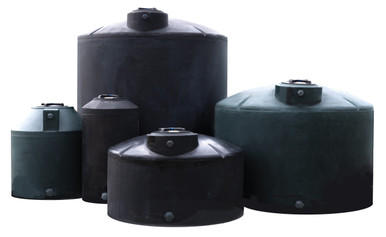
Tank vent failure is the most violent and most preventable failure mode in industrial storage. A vacuum-collapsed 2,500 gallon polyethylene tank takes about thirty seconds to implode from operator-initiated pump-out with insufficient inlet vent capacity. A pressure-bulged tank from rapid fill takes about the same. Both are catastrophic, and both are documented as the leading single failure mode in field-service incident reports across Norwesco, Snyder, Chem-Tainer, Enduraplas, and Bushman polyethylene-tank populations. This pillar walks the actual sizing math, distinguishes the three major vent classes (atmospheric / free vent, pressure-vacuum relief vent or PVRV, and conservation vent), and tells you which to specify by service.
The reference standards are NFPA 30 Chapter 21 (aboveground tanks for flammable and combustible liquids), API 2000 (Venting Atmospheric and Low-Pressure Storage Tanks - the canonical vent-sizing methodology for petroleum service), ASTM D1998 Section 8 (polyethylene-tank venting requirements), OSHA 29 CFR 1910.106 (flammable liquid storage), and ISO 28300 (venting of atmospheric and low-pressure storage tanks - the international companion to API 2000). Real catalog SKUs cited: Norwesco MPN 63485 (16-inch lid and ring with blue snap-in vent), MPN 60367 (16-inch non-vented lid with collar), MPN 63679 (22-inch lid and collar with air vent), Snyder MPN 34701295 (14-inch threaded non-vented manway), MPN 34700558 (14-inch PP vented hinged manway with lock), and MPN 373402 (350 gallon side-drain SS 304 LiquiTote with 3-inch fusible vent).
The Three Vent Classes
| Vent Class | Set Pressure | Function | Typical Service |
|---|---|---|---|
| Free vent (atmospheric) | 0 psi (open to atmosphere) | Continuous equalization | Water, non-volatile, non-hazardous |
| Pressure-Vacuum Relief Vent (PVRV) | +0.5 to +2.5 oz/in² / -0.5 to -1.0 oz/in² | Holds tank slightly pressurized; relieves on excursion | Petroleum, volatile organic liquids |
| Conservation vent | +0.25 to +1.0 oz/in² / -0.25 to -0.75 oz/in² | Reduces vapor loss while permitting atmospheric breathing | Volatile liquids with vapor-recovery economics |
Atmospheric vents have zero set pressure - the tank breathes freely with the atmosphere through a screened opening. PVRVs and conservation vents both hold a small positive or negative pressure inside the tank to either reduce vapor loss (conservation vent on a volatile liquid saves significant money over a year) or to allow regulated venting under code (PVRV is the NFPA 30-compliant device for petroleum aboveground tanks). The three are NOT interchangeable; specifying a free vent on a gasoline tank violates NFPA 30, and specifying a PVRV on a water tank wastes money and creates spurious alarms.
The Sizing Math: Why Vents Are Sized for Worst-Case, Not Average
The fundamental rule from API 2000 and NFPA 30 Section 21.4: vent capacity must equal or exceed the maximum normal in-breathing rate plus the maximum thermal in-breathing rate, and must equal or exceed the maximum normal out-breathing rate plus the maximum thermal out-breathing rate. For polyethylene atmospheric tanks under ASTM D1998, the rule simplifies to: vent area at minimum equal to the largest of (a) inlet pipe cross-section, (b) outlet pipe cross-section, (c) the volumetric breathing equivalent of any pump-driven flow.
API 2000 normal venting calculation (out-breathing on fill)
Required out-breathing capacity in cubic feet per hour = max fill rate (gpm) × 8.02 (the conversion factor from gallons of fill to cubic feet of displaced air at atmospheric pressure). A 200 gpm tank-truck offload requires 1,604 SCFH out-breathing capacity. A 50 gpm chemical-feed pump fill requires 401 SCFH.
API 2000 normal venting calculation (in-breathing on draw)
Required in-breathing capacity in cubic feet per hour = max draw rate (gpm) × 8.02 + thermal in-breathing rate from API 2000 Table 2. A 100 gpm pump-out requires 802 SCFH in-breathing capacity from the pump alone. Thermal in-breathing on a 5,000 gallon tank exposed to a 30°F temperature swing adds approximately 600 SCFH per API 2000 Table 2. Total: 1,402 SCFH minimum vent capacity.
NFPA 30 emergency venting (fire-exposure scenario)
Emergency vent sizing in cubic feet per hour per NFPA 30 Section 21.4.3.2: based on the wetted surface area of the tank exposed to fire. The formula varies by tank size, but for a 5,000 gallon vertical tank with approximately 250 sq ft wetted surface, NFPA 30 Table 21.4.3.2 specifies approximately 504,000 SCFH emergency vent capacity. This is two to three orders of magnitude larger than normal venting and CANNOT be served by the same atmospheric vent - emergency venting is a separate device (typically a weight-loaded emergency vent or a frangible roof seam on field-built steel tanks; for polyethylene, a separate fusible-link vent or a manway designed to lift under fire-exposure pressure).
Free Vent (Atmospheric) Sizing Tables
| Tank Capacity | Min Free Vent Diameter (water) | Max Fill / Draw Rate Supported | Catalog Example |
|---|---|---|---|
| Under 500 gallon | 2 inch | ~50 gpm | Lid vent acceptable |
| 500 - 1,500 gallon | 3 inch | ~100 gpm | Norwesco MPN 63485 (vented lid) |
| 1,500 - 5,000 gallon | 4 inch | ~200 gpm | Norwesco MPN 63679 (22-inch with vent) |
| 5,000 - 12,000 gallon | 6 inch | ~450 gpm | Engineered vent assembly |
| Above 12,000 gallon | Engineered (usually 8+ inch) | 800+ gpm | PVRV per API 2000 |
The catalog SKUs listed are real OneSource Plastics inventory. Norwesco MPN 63485 (16-inch lid and ring with blue snap-in vent) provides the integrated vented manway for 500-1,500 gallon tanks. Norwesco MPN 63679 (22-inch lid and collar with air vent) handles the 1,500-5,000 gallon class. For tanks where the manway is non-vented (Norwesco MPN 60367 16-inch non-vented lid, Snyder MPN 34701295 14-inch non-vented threaded manway), install a separate dedicated vent bulkhead at the high point.
PVRV (Pressure-Vacuum Relief Vent) Sizing
Why PVRV exists
NFPA 30 Section 21.4.2 requires that aboveground tanks storing Class I (flammable, flash point under 100°F) or Class II (combustible, flash point 100-140°F) liquids be equipped with venting that limits both pressure and vacuum to within the design rating of the tank. A free vent satisfies this only if the vent is large enough to hold pressure / vacuum below 1 psi during all credible fill / draw events including fire exposure. For most petroleum service, the more economical solution is a PVRV that opens at a small set pressure (typically 1-2 oz/in² positive, 0.5-1 oz/in² negative) and otherwise holds the tank closed - reducing fugitive vapor emissions and meeting EPA Method 21 leak-detection requirements under 40 CFR 60 Subpart Kb.
PVRV sizing methodology
API 2000 Section 4 provides the formula. The required relief capacity in SCFH = (gallons displaced per hour during max event) × 8.02 × correction factor for vapor density. For petroleum products with vapor specific gravity ~3.0, the correction factor is approximately 1.7. A PVRV must be sized so that the set pressure is not exceeded by more than 10% under maximum credible fill rate (per API 2000 Section 5.1) and so that the set vacuum is not exceeded by more than 10% under maximum credible draw rate plus thermal in-breathing.
For polyethylene tanks, PVRV is rare because the tank itself is rated for atmospheric service only - typically less than 0.5 psi internal design pressure. Specifying a PVRV with a set pressure higher than the tank rating defeats the purpose. PVRV on PE is appropriate only when the tank is specifically rated for low-pressure operation (some Snyder Captor double-wall tanks have a 1 psi rating; check the OEM data sheet for any specific SKU).
PVRV maintenance
PVRVs require periodic seat-leakage testing per API 2000 Section 6 - typically every 12 months for Class I service, every 24 months for Class II. The leak rate is measured by sealing the vent and pressurizing to 90% of set pressure; acceptable leakage is less than 5 SCFH for a 4-inch valve. A failed PVRV either leaks vapor continuously (fails open) or fails to relieve at set pressure (fails closed and over-pressurizes the tank). Both modes require valve replacement.
Conservation Vent Sizing
What it is
A conservation vent is a low-set-pressure PVRV designed primarily to reduce vapor loss from volatile liquids during normal thermal cycling. Set pressures are typically 0.25-1.0 oz/in² positive and 0.25-0.75 oz/in² negative. The economic case is straightforward: a 10,000 gallon gasoline tank with a free vent loses 0.1-0.3% of contents per year to evaporative emission; a conservation vent reduces that loss by 90-95%. On gasoline at $3.50/gallon, a 10,000 gallon tank with conservation venting saves $315-945/year in evaporative loss, plus reduces VOC emissions for SIP (State Implementation Plan) compliance under 40 CFR 51.
Conservation vent sizing
The same API 2000 methodology applies, but the set pressures are lower. The vent must be larger in cross-section than a higher-set PVRV to relieve the same volumetric flow at the lower set pressure differential. Rule of thumb from API 2000 Table 4: conservation-vent area ≈ 1.5x equivalent PVRV area for the same relief capacity.
When to specify conservation venting
- Gasoline aboveground tanks where evaporative loss exceeds maintenance-cost-justified threshold (typically tanks over 5,000 gallon).
- VOC-regulated zones where SIP requires controlled venting on volatile organic storage.
- Methanol, ethanol, denatured alcohol, and similar low-flash-point liquids where vapor loss has economic and safety implications.
- Solvents (acetone, toluene, MEK) where occupational exposure limits under 29 CFR 1910.1000 are tightened.
Vent Sizing for Polyethylene Tanks Specifically
ASTM D1998 Section 8 is the polyethylene-specific guidance. Key rules:
- Polyethylene atmospheric tanks are rated for less than 0.5 psi (typically 0.25 psi) internal design pressure. Vent capacity must hold internal pressure below this rating during ALL credible fill events.
- The vent area must equal or exceed the largest pipe penetration on the tank (inlet, outlet, drain). Undersizing the vent relative to the inlet creates a pressure-failure scenario; undersizing relative to the outlet creates a vacuum-collapse scenario.
- Lid-mounted atmospheric vents (such as the snap-in vent on Norwesco MPN 63485) are acceptable for tanks under 1,500 gallon with fill rates under 100 gpm. Above this, install a dedicated vent bulkhead.
- Multiple tanks on a common vent header must each have a vacuum breaker; vacuum on one tank can otherwise collapse another through the shared header.
Worked Example: 3,000 Gallon Sodium Hypochlorite Feed Tank
Service: 3,000 gallon Snyder XLPE chemical tank storing 12.5% sodium hypochlorite. Fill rate: 200 gpm from delivery truck offload. Draw rate: 30 gpm from chemical feed pump. Operating temperature: 60-90°F outdoor.
- Out-breathing requirement (fill): 200 gpm × 8.02 = 1,604 SCFH
- In-breathing requirement (draw): 30 gpm × 8.02 = 241 SCFH
- Thermal in-breathing (ASTM D1998 Section 8.2 reference): approximately 350 SCFH for 3,000 gallon tank with 30°F daily swing
- Combined in-breathing requirement: 241 + 350 = 591 SCFH
- Governing case: out-breathing at 1,604 SCFH
- Vent area required: per API 2000 Figure 6, a 4-inch atmospheric vent passes approximately 4,000 SCFH at less than 1 oz/in² differential. 4-inch satisfies the requirement with margin.
- Specification: Norwesco MPN 63679 (22-inch lid with built-in vent) on the top, plus a separate 4-inch atmospheric vent bulkhead with insect screen and weather cap. Sodium hypochlorite is not flammable; PVRV is not required. Free vent is correct for this service.
Worked Example: 2,500 Gallon Diesel Aboveground
Service: 2,500 gallon polyethylene aboveground diesel tank, fleet refueling. Fill rate: 100 gpm from delivery truck. Draw rate: 25 gpm peak from refueling dispenser. Outdoor location, 0-100°F annual swing.
- Combustibility class: diesel is Class II combustible (flash point 125-180°F per ASTM D93). NFPA 30 Section 21.4.2 applies. PVRV with emergency vent is required.
- Normal out-breathing: 100 gpm × 8.02 × 1.7 (vapor SG correction) = 1,363 SCFH
- Normal in-breathing: 25 gpm × 8.02 + 220 SCFH thermal = 421 SCFH
- PVRV sizing: 3-inch PVRV with 2 oz/in² pressure / 0.5 oz/in² vacuum set, sized for 2,000 SCFH per API 2000 Figure 6 - satisfies normal venting.
- Emergency vent sizing (NFPA 30 Section 21.4.3.2): 2,500 gallon vertical tank with ~150 sq ft wetted surface = approximately 312,000 SCFH emergency vent capacity from NFPA 30 Table 21.4.3.2.
- Specification: 3-inch PVRV for normal venting + separate emergency vent device (frangible-disc or weight-loaded emergency vent rated 350,000+ SCFH). For polyethylene, the practical solution is to verify that the OEM tank is NFPA 30-compliant for the service - many polyethylene atmospheric tanks are NOT rated for diesel; specify a Snyder waste-oil family unit such as MPN 5740102N95703 or a specifically NFPA-30-listed double-wall.
Vent Termination and Hardware
- Termination height: per NFPA 30 Section 21.4.5, vent outlet at minimum 12 feet above grade for outdoor petroleum tanks; per OSHA 29 CFR 1910.106, at least 5 feet above any building opening within 5 feet horizontally.
- Termination orientation: turn-down or weather cap to keep precipitation out of the vent line.
- Insect / debris screen: required on atmospheric vents per ASTM D1998 Section 8.3 - 1/4-inch mesh stainless or copper. The screen must be inspectable and cleanable; clogged screens have caused vacuum collapse.
- Flame arrester: required on Class I (flammable) tank vents per NFPA 30 Section 21.4.6. NOT required on Class II combustible vents unless required by local code.
- Heat-traced vent line: required in freezing climates for any liquid that can condense in the vent line and freeze. Common failure on caustic soda and process-water tanks in northern installations.
Common Vent Mistakes
Mistake 1: Sizing for average flow
Tank trucks offload at 200-300 gpm peak even when the average daily flow is 5 gpm. Size for the peak event.
Mistake 2: Using inlet pipe size as vent size
The vent must equal or exceed inlet diameter. Equal is not safe; aim for one pipe size larger.
Mistake 3: Specifying free vent on petroleum service
NFPA 30 Section 21.4 requires PVRV for Class I and Class II liquids. Free vent on diesel service is a code violation.
Mistake 4: Skipping the emergency vent
NFPA 30 Section 21.4.3 requires emergency venting separately from normal venting. The normal PVRV cannot serve both purposes.
Mistake 5: Manifold venting without vacuum breakers
Two tanks on a common vent header: vacuum on one collapses the other. Install vacuum breakers per API 2000 Section 5.4.
Mistake 6: Clogged vent screen
Insect-screen accumulation reduces vent area. Inspect every 6 months per ASTM D1998. Replace at first sign of degradation.
Mistake 7: Vent line freezing
Condensation freezes inside the vent line on caustic soda or process-water service in cold climates. Heat-trace the vent line in any installation where ambient drops below freezing.
Mistake 8: Flame arrester on free vent without rating verification
Flame arresters reduce effective vent area significantly (typically 40-60% reduction in flow capacity). Re-size the vent area accordingly when adding a flame arrester.
Internal Resources
- Tank Plumbing System Design
- Tank Fitting & Bulkhead Sizing Guide
- Plastic Tank Failure Mode Analysis
- Insulation & Heat Tracing
- Multi-Tank Manifolding Engineering
- Chemical Compatibility Database
- Freight Cost Estimator
Source Citations
- NFPA 30 - Flammable and Combustible Liquids Code, Chapter 21 (Sections 21.4, 21.4.2, 21.4.3, 21.4.5, 21.4.6)
- API Standard 2000 - Venting Atmospheric and Low-Pressure Storage Tanks (Sections 4, 5, 6; Tables 2, 4; Figure 6)
- ASTM D1998 - Standard Specification for Polyethylene Upright Storage Tanks (Section 8: Fittings, Support, Venting)
- ASTM D93 - Standard Test Methods for Flash Point by Pensky-Martens Closed Cup Tester
- OSHA 29 CFR 1910.106 - Flammable Liquids
- OSHA 29 CFR 1910.1000 - Air Contaminants (occupational exposure limits)
- EPA 40 CFR 60 Subpart Kb - Standards of Performance for Volatile Organic Liquid Storage Vessels
- EPA 40 CFR 51 - State Implementation Plans
- EPA Method 21 - Determination of Volatile Organic Compound Leaks
- ISO 28300 - Petroleum, petrochemical and natural gas industries - Venting of atmospheric and low-pressure storage tanks
- OneSource Plastics master catalog data, dated 2026-03-26 snapshot (9,419 products)
Related chemical compatibility resources
For deeper engineering specifications on the chemicals discussed above, see our chemical-compatibility pillars:
- Sodium Hypochlorite — storage compatibility, recommended resin grade, fittings, secondary containment.
- Sodium Hydroxide — storage compatibility, recommended resin grade, fittings, secondary containment.
- Methanol — storage compatibility, recommended resin grade, fittings, secondary containment.
- Ethanol — storage compatibility, recommended resin grade, fittings, secondary containment.
Recommended Tanks for This Guide
Live pricing, updated automatically · estimate freight to your ZIP.