
Batch Solvent Recovery Stills
Batch Solvent Recovery Stills
A batch still turns spent, contaminated solvent back into a clean working fluid. Done right, it pays for itself in months while shrinking your hazardous waste stream.
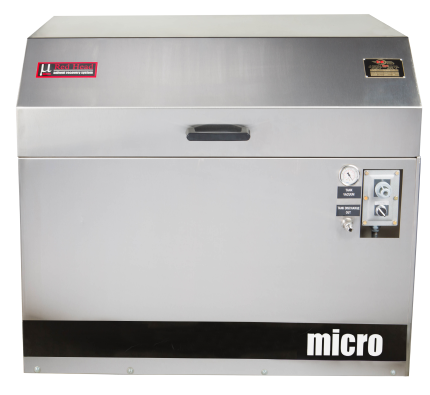
What a batch solvent recovery still does
A batch still is the simplest form of distillation equipment: a single charge of dirty solvent is heated until the solvent evaporates, the vapor is condensed back to liquid, and the clean distillate is collected separately from the non-volatile residue left behind. It exploits a basic physical fact, that a solvent and the contaminants dissolved or suspended in it usually boil at very different temperatures. Paints, resins, oils, metal fines, and dissolved solids stay in the boiling vessel while the volatile solvent leaves as vapor.
The term batch means the process runs one charge at a time. You fill the vessel, run the still until recovery slows or the residue is concentrated, then drain the residue, clean out, and start again. This is the right approach for the intermittent, mixed, and relatively small volumes that most cleaning, coating, and finishing operations generate. A continuous column makes sense only when you have a steady, high-volume feed of consistent composition.
The core components
Every batch still shares the same anatomy regardless of size:
- Boiling vessel (reboiler): the heated chamber that holds the solvent charge. Heat is most often supplied by a thermal-oil jacket, steam, or a hot-water bath rather than a direct flame, because gentle, distributed heating avoids scorching residue onto the wall and keeps surface temperatures below the autoignition point of flammable vapor.
- Vapor path: the route the rising vapor takes from the vessel to the condenser. In a simple still this is short and offers little separation; that is acceptable when you are recovering a single solvent from non-volatile dirt.
- Condenser: a heat exchanger, usually water- or refrigerant-cooled, that turns vapor back into liquid. Condenser duty must match the boil-up rate, or vapor escapes uncondensed.
- Receiver: the collection vessel for clean distillate, often with a sight glass so the operator can watch recovery progress.
How relative volatility drives the separation
The reason a still works at all is relative volatility, the ratio of how readily two components vaporize at a given temperature. When the solvent is far more volatile than the soils it carries, the vapor is almost pure solvent and a single, simple boil gives a clean product. This is the easy case and covers most spent cleaning and thinning solvents, where the contaminants are essentially non-volatile.
The job gets harder when you need to separate two solvents from each other, because their volatilities are closer together. A simple batch still cannot make a sharp split between two miscible solvents in one pass; that requires a fractionating column with reflux, covered in the companion article on continuous distillation. Many recovery problems, though, are solvent-from-dirt rather than solvent-from-solvent, and those are exactly what the batch still is built for.
Atmospheric versus vacuum operation
A batch still can run at atmospheric pressure or under vacuum, and the choice has real consequences. At atmospheric pressure the still is simpler and cheaper, and for stable, lower-boiling solvents it works well. But pulling a vacuum on the vessel lowers the temperature at which the solvent boils, which brings two benefits: it lets you recover higher-boiling solvents without reaching damaging temperatures, and it reduces the risk of scorching heat-sensitive residue onto the wall. The trade is added complexity, a vacuum pump, vacuum-tight construction, and a condenser sized for the lower-pressure vapor. As a rule, the higher the solvent's boiling point and the more heat-sensitive the contaminants, the more a vacuum option earns its place. For the most heat-sensitive and high-boiling streams the design crosses over into wiped-film and short-path evaporation, covered in a companion article.
Heating, agitation, and heat transfer
How heat gets into the charge governs both run time and cleanout. Jacketed heating with thermal oil, steam, or a water bath spreads heat over a large surface and keeps any single point from overheating. As the charge concentrates into a thick residue, heat transfer naturally falls off, because viscous bottoms move sluggishly against the hot wall and tend to form an insulating film. Some batch stills add a slow agitator or wiper to keep the bottoms moving, which maintains heat transfer, shortens the run, and reduces the baked-on layer that makes cleanout difficult. For thin, free-flowing charges with non-fouling soils, a plain jacketed vessel is enough; for sticky or polymer-laden feeds, mechanical assistance pays off.
Residue handling
What remains in the vessel at the end of a run, the still bottoms, is the concentrated waste: pigment, polymer, oil, and the small fraction of solvent that clings to it. Managing this residue is half the design problem. Thick, sticky, or thermoplastic residues will harden onto a hot wall and become difficult to remove, so several strategies are used:
- Disposable liners or bags inside the vessel let the operator lift out the cooled residue rather than scraping a fixed wall.
- Heated discharge keeps tar-like residue flowable so it drains while still warm.
- Scraper or wiper elements on more advanced units keep the heat-transfer surface clear, which both improves heat transfer and eases cleanout.
Even after recovery, the residue is usually still a regulated waste, but its volume is a small fraction of the original spent solvent. That volume reduction is where much of the economic and environmental benefit comes from: you are paying to dispose of a few percent of what you used to ship out.
Flammable-solvent safety
Most recoverable solvents are flammable liquids, and a still deliberately creates vapor near its boiling point, so safety is not optional. The governing principle is to keep ignition sources away from a vapor space that may be within the flammable range. Practical measures include indirect heating that keeps surfaces below autoignition temperature, vapor-tight construction, electrical equipment rated for the hazardous area, bonding and grounding to dissipate static, and, for the most volatile solvents, inerting the vapor space with nitrogen so there is too little oxygen to support combustion.
| Design feature | Why it matters |
|---|---|
| Indirect (jacketed) heating | Keeps wall temperature below solvent autoignition; prevents scorching |
| Vapor-tight enclosure | Keeps flammable vapor contained and prevents air ingress |
| Bonding and grounding | Dissipates static charge generated by liquid transfer |
| Nitrogen inerting | Lowers oxygen below the level needed to support combustion |
| Hazardous-rated electrics | Removes electrical arcs as an ignition source in the vapor zone |
Common solvents and what to expect
Batch recovery is applied across a wide range of organic solvents, and a few qualitative patterns hold regardless of the specific chemical. Lower-boiling solvents recover quickly and at modest temperature, so they are the easiest and most energy-efficient to reclaim, and they typically run well at atmospheric pressure. Higher-boiling solvents need more heat or a vacuum assist, take longer per batch, and demand more care to avoid scorching the residue. Solvents carrying dissolved polymer or resin produce sticky, sometimes hardening bottoms that drive the choice toward disposable liners or wiped designs, while solvents carrying only fine particulate or simple oils leave a more manageable sludge.
The other variable is how the solvent will be reused. A solvent destined for a coarse cleaning or degreasing step tolerates a lower-purity reclaim and can be recovered with a simple single boil. A solvent that must return to a more demanding duty may need a sharper separation, careful end-of-run control to avoid carrying over heavy ends, or even a finishing pass. Matching the rigor of the recovery to the demands of the reuse, rather than chasing maximum purity for its own sake, is what keeps a batch recovery operation both effective and economical. As a general rule, the cleaner you need the reclaim, the more energy and time each batch will cost, so it is worth defining the real reuse requirement before specifying the still.
Reclaim versus disposal economics
The case for on-site recovery rests on a simple comparison. Every gallon of solvent you reclaim is a gallon you do not buy new and a gallon you do not pay to haul away as hazardous waste. Both of those are recurring costs, and both tend to rise over time. A batch still converts most of a spent-solvent stream back into usable product and leaves only a concentrated residue to dispose of, so it attacks purchase cost and disposal cost at the same time.
Whether recovery makes sense depends on solvent volume, the unit cost of the virgin solvent, local disposal rates, and how clean the reclaimed solvent needs to be for reuse. Operations with steady solvent throughput and high-purity-of-use tolerance for reclaimed material typically see the strongest case. Recovered solvent does not always have to match virgin purity, either; many cleaning and pre-wash steps tolerate reclaimed solvent perfectly well, reserving virgin material for the final, critical step.
Beyond the direct purchase-and-disposal arithmetic, on-site recovery brings benefits that are real even if harder to put a single number on. Reclaiming solvent in-house reduces dependence on outside waste haulers and the scheduling and liability that come with shipping hazardous material off site. It shrinks the quantity of regulated waste an operation generates, which can ease reporting burdens and reduce a facility's overall hazardous-waste profile. And it keeps a valuable working fluid under the operator's control rather than paying twice, once to buy and once to discard. These factors often tip a borderline case toward recovery once they are weighed alongside the obvious cost savings.
Frequently asked questions
- What kinds of solvents can a batch still recover?
- Batch stills suit common organic solvents where the contaminants are far less volatile than the solvent itself, such as paint thinners, degreasers, and many cleaning solvents carrying pigment, oil, resin, or solids. Because the soils stay in the boiling vessel while the solvent vaporizes, the separation is clean and reliable. The harder case is separating two miscible solvents from each other, which needs a fractionating column rather than a simple batch still.
- How pure is the recovered solvent?
- When the contaminants are non-volatile, a single batch distillation yields solvent that is largely free of them, often clean enough for direct reuse. Purity depends on how cleanly the solvent separates from any co-volatile components and on how the run is ended. Many shops reuse reclaimed solvent for early cleaning steps and reserve virgin solvent for final, purity-critical work.
- How is the leftover residue handled?
- The still bottoms are the concentrated, non-volatile waste left after the solvent has boiled off. They are usually still a regulated waste but represent a small fraction of the original volume, so disposal cost drops sharply. Disposable liners, heated discharge, or wiper elements make it easier to remove sticky or hardening residue from the vessel.
- Are solvent recovery stills safe given that most solvents are flammable?
- They can be operated safely when designed for flammable service. Key measures include indirect heating that keeps surfaces below the solvent's autoignition temperature, vapor-tight construction, hazardous-area-rated electrical equipment, bonding and grounding against static, and nitrogen inerting of the vapor space for the most volatile solvents. The goal is to keep every potential ignition source away from any vapor that could be in the flammable range.
Scope your custom build
Send us your volume, service chemistry, dimensions, and finish or code requirements. We return a full engineering package, firm lead time, and a fixed quote — freight quoted separately to your ZIP.
Request a Custom QuoteCall 866-418-1777