
Continuous Distillation Columns
Continuous Distillation Columns
When you need to split solvents from each other at high purity and high volume, a continuous fractionating column is the tool. Reflux and theoretical stages do the work.
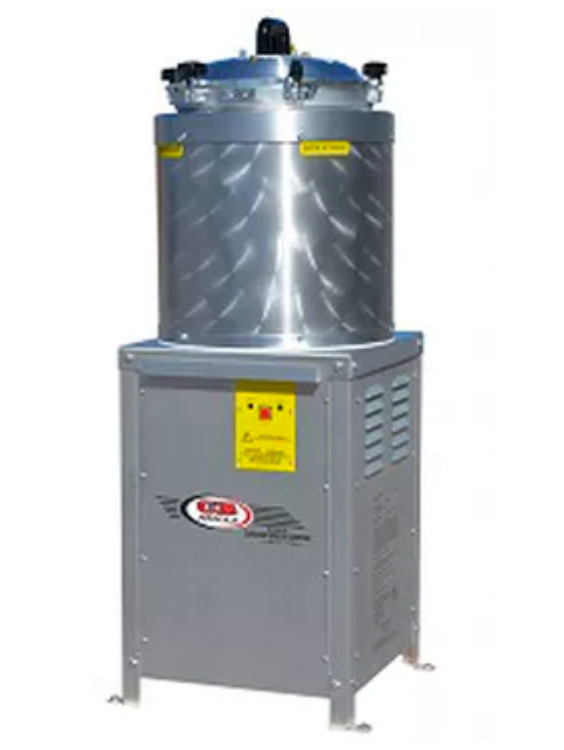
Batch versus continuous, and why it matters
A batch still processes one charge at a time and is ideal for intermittent volumes and solvent-from-dirt separations. A continuous distillation column does something different: it accepts a steady feed, runs around the clock, and continuously delivers a purified overhead product and a separate bottoms product. The trade is flexibility for performance. A column is less forgiving of changing feed composition, but for a consistent, high-volume stream it separates more sharply, uses energy more efficiently per unit recovered, and needs far less operator attention per gallon.
The key capability a column adds is the ability to separate two or more miscible solvents from each other, not just solvent from non-volatile dirt. Two solvents with similar boiling points cannot be cleanly split in a single evaporation; they require many successive vaporization-and-condensation steps stacked in series. A fractionating column provides exactly that, in one vertical vessel.
How a fractionating column works
Picture the column as a tall vessel with a heat source at the bottom and a cooler at the top. The reboiler at the base boils the liquid, sending vapor up the column. The condenser at the top turns the rising vapor back to liquid. A portion of that condensed liquid is returned to the top of the column as reflux, and it flows downward, meeting the upward-rising vapor on each internal contacting device.
At every level of the column, descending liquid and ascending vapor exchange material. The more volatile component preferentially evaporates into the vapor and travels up; the less volatile component preferentially condenses into the liquid and travels down. Repeated over many stages, this counter-current contact concentrates the light component at the top and the heavy component at the bottom, achieving a separation no single boil could.
Theoretical stages, plates, and packing
The separating power of a column is measured in theoretical stages (also called theoretical plates). One theoretical stage is one ideal step of vapor-liquid equilibrium. A separation that needs high purity between two close-boiling solvents may require many stages; an easy separation needs few. Designers translate the required number of stages into real hardware in two main ways:
- Trays (plates): horizontal decks spaced up the column, each holding a layer of liquid through which vapor bubbles. Each tray approximates one equilibrium stage. Trays handle a wide range of flow rates, tolerate fouling reasonably well, and make it straightforward to add side draws.
- Packing: structured or random material that creates a large wetted surface for continuous vapor-liquid contact rather than discrete steps. Packing offers low pressure drop and high efficiency per unit height, which is valuable for vacuum service and heat-sensitive products.
| Property | Trayed column | Packed column |
|---|---|---|
| Contacting | Discrete stages on each tray | Continuous over wetted surface |
| Pressure drop | Higher | Lower |
| Best for | Wide flow range, side draws, fouling service | Vacuum service, high efficiency per height, heat-sensitive feeds |
| Turndown | Generally good | Sensitive to liquid distribution |
A useful shorthand is HETP, the height of packing equivalent to one theoretical plate. Lower HETP means more separating power packed into less column height. For trays, the equivalent idea is tray efficiency, since a real tray rarely achieves a full ideal stage.
Feed point, rectifying and stripping sections
A continuous column is fed somewhere in its middle, and that feed point divides the column into two cooperating zones. Above the feed is the rectifying section, where rising vapor is progressively enriched in the light component by contact with the descending reflux. Below the feed is the stripping section, where descending liquid is progressively stripped of its light component by vapor boiling up from the reboiler. The light product leaves overhead, the heavy product leaves as bottoms, and the feed is introduced where its composition best matches the liquid already in the column. Placing the feed at the wrong height forces the column to work harder than it should and degrades the separation, so feed location is a genuine design parameter, not an afterthought.
The reflux ratio and minimum stages
Two limiting cases bound every column design and explain the central trade-off. At total reflux, all overhead is returned and none is drawn as product; this gives the sharpest possible separation and therefore the minimum number of stages needed, but it produces nothing. At minimum reflux, the column is run as lean as physically possible while still making spec; this needs the fewest energy units of reboil per unit of product but requires an infinite number of stages to actually achieve. Real columns operate between these extremes, typically at a reflux ratio set somewhat above the minimum. Pushing toward total reflux buys purity at the cost of energy; pushing toward minimum reflux saves energy but demands more stages and leaves less margin. Choosing the operating reflux ratio is the heart of balancing capital cost (column height and stage count) against operating cost (reboiler energy).
Relative volatility and azeotropes
How many stages a separation needs comes down to relative volatility, the ratio of the components' tendencies to vaporize. When relative volatility is large, the components separate easily and few stages suffice. When it approaches one, the components behave almost identically and the column needs many stages and high reflux, which is expensive.
In the worst case the relative volatility reaches one at a particular composition: an azeotrope, a mixture that boils as if it were a single pure substance and cannot be separated further by ordinary distillation at that pressure. Many common solvent-water and solvent-solvent pairs form azeotropes. Getting past one requires a change in approach, such as operating the column at a different pressure where the azeotropic composition shifts, or adding a third component or a drying step to break the azeotrope. Recognizing an azeotrope early prevents the costly mistake of specifying a purity that simple distillation can never reach.
Operating pressure as a design lever
The pressure a column runs at is not just a safety setting; it shapes the separation itself. Lowering pressure (running under vacuum) lowers boiling temperatures, which protects heat-sensitive products and can shift an azeotrope to a more workable composition, at the cost of larger-diameter equipment because vapor occupies more volume at low pressure. Raising pressure does the opposite, allowing smaller equipment and the use of cooling water on the condenser even for lighter components, but at higher temperatures. Some difficult separations are solved with two columns at different pressures in series, exploiting the fact that an azeotrope's composition moves with pressure so that what one column cannot separate, the next, at a different pressure, can. Choosing pressure therefore ties together product stability, equipment size, utility availability, and the very feasibility of the separation.
The reboiler and condenser as the column's engine
It is tempting to focus on the column internals, but the reboiler and condenser are what actually drive the separation, and they often dominate both energy use and reliability. The reboiler supplies the heat that generates the upward vapor flow; without enough reboil there is no separation no matter how many trays are installed. It is usually a heat exchanger fed by steam or hot oil, and its duty must be matched to the desired vapor rate at the chosen reflux ratio. Because the reboiler concentrates the heaviest material at the highest temperature in the system, it is also where fouling and thermal degradation are most likely, so its design has to suit the bottoms it will handle.
The condenser at the top removes heat to turn overhead vapor back into liquid, supplying both the product draw and the reflux. Its capacity must keep pace with the boil-up rate, or vapor escapes uncondensed and the column floods its overhead. The choice of coolant, cooling water for higher-boiling overheads, chilled fluid for lighter ones, follows directly from how volatile the light product is. Together the reboiler and condenser set the column's throughput envelope: the column internals decide how sharp the separation is, but the heat exchangers decide how much material can flow through while that separation holds.
When continuous beats batch
Continuous columns earn their added complexity under a specific set of conditions:
- Steady, high-volume feed: a column running continuously amortizes its capital and startup energy across far more product than an intermittent batch unit.
- Consistent feed composition: a column is tuned for a feed; large swings in composition disturb the separation, whereas a batch still simply takes whatever it is charged.
- Solvent-from-solvent separation: when you must split two or more miscible solvents at high purity, the many stages of a column are essentially required.
- Energy efficiency at scale: per gallon recovered, a well-designed continuous column generally uses energy more efficiently than repeated batch cycles.
Conversely, low or irregular volumes, frequently changing solvent mixes, and simple solvent-from-dirt jobs favor a batch still. Many operations run both: a batch still for mixed, intermittent waste and a continuous column for a single high-volume stream.
Frequently asked questions
- What is the difference between a batch still and a continuous column?
- A batch still processes one charge at a time and is best for intermittent volumes and separating solvent from non-volatile contaminants. A continuous column accepts a steady feed and runs around the clock, delivering purified overhead and bottoms products at once. Continuous columns separate close-boiling solvents from each other far more sharply but need consistent feed and high volume to justify their complexity.
- What does reflux do in a distillation column?
- Reflux is the portion of condensed overhead liquid returned to the top of the column rather than taken as product. As it flows down against the rising vapor, it provides the repeated vapor-liquid contact that sharpens the separation. Higher reflux improves purity but increases energy use, so the reflux ratio is the main lever for balancing product quality against operating cost.
- Should I choose trays or packing?
- Trays give discrete equilibrium stages, handle a wide range of flow rates, tolerate fouling, and make side draws easy, which suits many industrial separations. Packing provides continuous contact with low pressure drop and high efficiency per unit height, making it the choice for vacuum service and heat-sensitive feeds. The right pick depends on the separation difficulty, operating pressure, and how clean the feed is.
- What is an azeotrope and why does it matter?
- An azeotrope is a specific mixture composition that boils as though it were a single pure substance, so ordinary distillation cannot separate it further at that pressure. Many solvent-water and solvent-solvent pairs form azeotropes, which caps the purity a simple column can reach. Getting past one requires changing the operating pressure, adding a separating agent, or using a drying step, so it must be identified before purity targets are set.
Scope your custom build
Send us your volume, service chemistry, dimensions, and finish or code requirements. We return a full engineering package, firm lead time, and a fixed quote — freight quoted separately to your ZIP.
Request a Custom QuoteCall 866-418-1777