
Closed-Loop Solvent Recovery
Closed-Loop Solvent Recovery
A closed-loop system captures solvent vapor, condenses it, and feeds it straight back into the process, all without venting to atmosphere. Less loss, less emission, less waste.
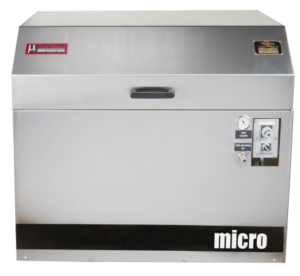
What closed-loop recovery means
In an open process, solvent is used, becomes contaminated or evaporates, and leaves the system, as waste to be hauled away or as vapor lost to the atmosphere. A closed-loop solvent recovery system breaks that one-way flow. Instead of letting solvent escape, the system captures it, cleans or condenses it, and returns it to the process to be used again. The solvent circulates within a sealed boundary rather than being consumed and discarded.
The concept applies whether the loss path is liquid contamination or vapor emission. A still or evaporator that distills dirty solvent and returns the clean distillate to the process is a closed loop on the liquid side. A vapor-capture system that condenses fugitive vapor and recovers it is a closed loop on the gas side. Many real installations do both, sealing the entire solvent path so that little leaves except the small concentrated residue at the end.
How the loop works
A closed-loop package combines familiar components into a sealed circuit:
- Capture: solvent vapor or spent liquid is collected at its source rather than allowed to escape, through sealed vessels, enclosed transfers, and vapor pickup points.
- Separation: a still or evaporator distills the volatile solvent away from contaminants, the heart of the loop. The clean solvent leaves as vapor; the dirt stays behind as residue.
- Condensation: a condenser, often water- or refrigerant-cooled, turns the recovered vapor back to clean liquid.
- Storage and return: the condensed solvent collects in a receiver and is returned to service, closing the loop.
Because the path is sealed, the system also manages its own vapor space. Pressure and vacuum are controlled, and any non-condensable gases are handled deliberately rather than vented uncontrolled. This sealed, managed character is what distinguishes a closed loop from a simple open still that recovers solvent but still loses vapor around the edges.
The role of the condenser and non-condensables
The condenser is the gatekeeper of a closed loop. Whatever vapor it fails to condense either escapes the boundary or builds pressure, so its capacity sets the ceiling on recovery. Sizing condenser duty to the boil-up rate, and using chilled coolant for the more volatile solvents, is what turns a nominally closed system into an actually closed one. Even so, real streams carry small amounts of gases that will not condense at practical temperatures, such as air drawn in during transfers or light decomposition gases. A well-designed loop manages these non-condensables deliberately, holding them until they can be handled, rather than letting them force open a vent that would also carry solvent vapor away. Controlling non-condensables is often the difference between a system that recovers most of its solvent and one that quietly leaks value.
Liquid-side versus vapor-side loops
It helps to think of a closed loop as having two halves that can each be sealed. The liquid side is the path of spent solvent from the process to the still and clean solvent back again; sealing it means enclosed transfers and tanks so contaminated and reclaimed solvent never sit open. The vapor side is the path of any solvent that evaporates during use, drying, or transfer; sealing it means capturing that vapor and routing it to a condenser instead of letting it drift off. A simple recovery still typically closes only the liquid side and leaves the vapor side open, which is why it still loses solvent and emits vapor. A true closed-loop system closes both, which is what gives it both the higher recovery rate and the lower emissions that justify its added cost.
Emissions control
A major driver for closed-loop systems is reducing emissions of volatile organic compounds. Solvent vapor that escapes to atmosphere is both a regulated emission and a direct economic loss, you are literally watching purchased material evaporate. By condensing and recovering that vapor instead of venting it, a closed loop cuts fugitive and process emissions at the same time as it cuts solvent purchases.
The qualitative benefit is straightforward: less solvent crosses the system boundary in any form. That means a smaller emission footprint, a smaller hazardous-waste stream, and less exposure for workers to solvent vapor. These benefits compound, since the same sealing that recovers solvent value also keeps vapor out of the workplace air.
This alignment of interests is worth dwelling on, because it is rare. In many process decisions, cost savings and environmental performance pull against each other. Closed-loop recovery is an exception: the engineering that captures the most solvent value, sealing the path and condensing the maximum amount of vapor, is exactly the engineering that minimizes emissions and workplace exposure. There is no trade-off to manage between recovering more and emitting less; they are the same objective. That is a strong reason the approach has become standard wherever flammable or volatile solvents are used in quantity.
Safety with flammable solvents
Most recoverable solvents are flammable, and a closed loop deliberately keeps solvent vapor enclosed, so the system must be engineered to prevent a flammable atmosphere from finding an ignition source. The sealed design is actually an advantage here, because it gives clear control over the vapor space, but that control must be used correctly.
| Hazard | Control approach |
|---|---|
| Flammable vapor in the enclosure | Inert the vapor space with nitrogen to keep oxygen below combustion-supporting levels |
| Ignition from hot surfaces | Indirect heating held below solvent autoignition temperature |
| Ignition from static | Bonding and grounding of all solvent-wetted equipment |
| Ignition from electrical arcs | Electrical equipment rated for the hazardous classified area |
| Overpressure | Pressure relief and vapor-space pressure control |
Inerting deserves emphasis. By blanketing the sealed vapor space with nitrogen, the system holds the oxygen concentration too low to support combustion regardless of how much solvent vapor is present. Combined with indirect heating, bonding, hazardous-rated electrics, and proper relief, this lets a closed loop handle flammable solvents safely.
Where closed-loop systems are applied
The closed-loop principle shows up across a broad range of solvent-using operations, and the common thread is always the same: a process that consumes solvent in quantity and would otherwise lose it to contamination or evaporation. Parts cleaning and degreasing lines generate steadily contaminated solvent that a sealed recovery loop returns to service. Coating, printing, and finishing operations release solvent vapor during application and drying that a vapor-capture loop condenses and reclaims. Extraction and processing operations send solvent-rich streams to recovery and feed the reclaimed solvent straight back to the next batch. In each case the loop converts what was a one-way consumption into a circulating inventory.
What ties these applications together technically is that they all benefit from sealing both the liquid and vapor paths and from the same safety discipline for flammable service. The scale and the specific hardware differ, a small enclosed still in one case, a large continuous package with vapor capture in another, but the underlying design intent is identical: keep the solvent inside the boundary, condense everything you can, and let out only the small concentrated residue. Recognizing this shared pattern makes it easier to evaluate any solvent-using process for closed-loop potential: look for where solvent leaves the boundary, as liquid waste or as vapor, and ask whether that path can be sealed and routed back through a condenser.
The economics
Closed-loop recovery improves on a simple still by reducing losses at every stage, not just at the distillation step. The economic logic stacks up three ways:
- Lower purchase cost: recovered solvent replaces virgin solvent, and a sealed loop recovers more of it because less is lost to vapor and open transfers.
- Lower disposal cost: what leaves the system is only a small, concentrated residue rather than a large volume of spent solvent.
- Lower emissions and compliance burden: capturing vapor instead of venting it reduces regulated emissions and the associated reporting and control obligations.
The strongest cases are operations with significant, steady solvent throughput, high virgin-solvent cost, meaningful disposal expense, and emission concerns, since a closed loop addresses all of those at once. The investment is larger than a bare still, but so is the share of solvent value it recaptures.
Frequently asked questions
- What makes a system 'closed-loop' rather than just a recovery still?
- A closed-loop system keeps the solvent enclosed through its entire path, use, capture, distillation, condensation, and return, so very little escapes as vapor or open-transfer loss. A simple recovery still distills dirty solvent but may still lose vapor around unsealed transfers and fittings. The sealed boundary is what defines the closed loop and is what drives both the higher recovery rate and the lower emissions.
- How does closed-loop recovery reduce emissions?
- By capturing solvent vapor and condensing it back to liquid instead of venting it, the system keeps volatile organic compounds from reaching the atmosphere. The same sealing that recovers solvent value also keeps vapor out of the workplace and out of regulated emission streams. The result is a smaller emission footprint, a smaller waste stream, and reduced worker exposure, all from the same enclosed design.
- Is a closed-loop system safe with flammable solvents?
- Yes, when properly engineered, and the sealed design actually aids safety by giving clear control of the vapor space. The central measure is inerting that space with nitrogen so oxygen stays below the level needed to support combustion. This is combined with indirect heating below the autoignition temperature, bonding and grounding against static, hazardous-area-rated electrical equipment, and proper pressure relief.
- When is closed-loop recovery worth the investment?
- It pays off best for operations with steady, significant solvent use, high virgin-solvent cost, meaningful disposal expense, and emission concerns, because a sealed loop attacks all of those at once. It recovers more solvent than a bare still, shrinks the waste stream to a small residue, and cuts regulated emissions. The capital cost is higher than a simple still, but so is the proportion of solvent value it recaptures.
Scope your custom build
Send us your volume, service chemistry, dimensions, and finish or code requirements. We return a full engineering package, firm lead time, and a fixed quote — freight quoted separately to your ZIP.
Request a Custom QuoteCall 866-418-1777