
Ethanol Recovery for Extraction
Ethanol Recovery for Extraction
Ethanol extraction works only if you get the ethanol back. Falling-film and rotary evaporation reclaim it efficiently so it can be reused, batch after batch.
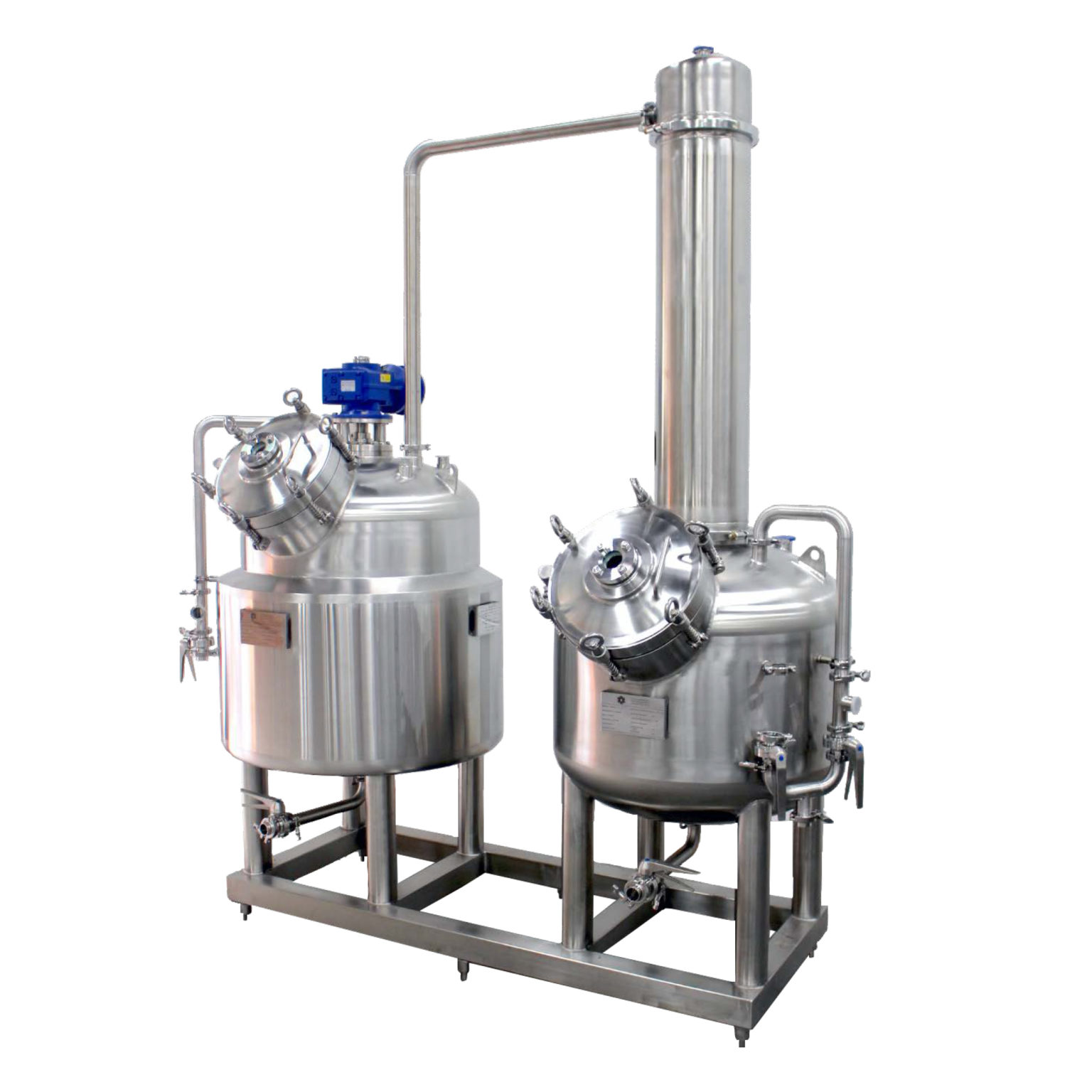
Why ethanol recovery is central to extraction
Ethanol is a widely used solvent for botanical extraction because it dissolves a broad range of target compounds, is comparatively benign, and is readily available. But extraction uses ethanol in large volume relative to the amount of product it pulls out: a batch of extract leaves behind a stream that is mostly ethanol with the dissolved botanical material in it. Separating that ethanol back out, cleanly and efficiently, is not an afterthought; it is what makes the whole process economical and practical.
Recovery serves three goals at once. It isolates the concentrated extract by removing the solvent that carried it. It reclaims the ethanol so it can be reused on the next batch instead of being purchased anew. And it keeps a large volume of flammable solvent contained and accounted for rather than lost or vented. Recovery rate, the fraction of input ethanol you get back as reusable solvent, is therefore one of the most important performance numbers in an extraction operation.
The physics of separating ethanol
Ethanol is far more volatile than the heavy botanical compounds dissolved in it, so the separation is fundamentally favorable: heat the stream and the ethanol evaporates while the extract stays behind. The challenges are doing it gently enough to protect heat-sensitive botanical compounds, doing it fast enough to keep up with extraction throughput, and capturing essentially all of the ethanol vapor so it can be reused.
This is why gentle, high-surface-area evaporation under reduced pressure is preferred. Operating under vacuum lowers the temperature at which ethanol boils, protecting the delicate extract from thermal degradation, while a thin, large-area film of liquid gives the high evaporation rate needed for throughput. Two evaporator types dominate, at different scales.
Rotary evaporation
A rotary evaporator (rotovap) spins a flask of the ethanol-rich solution in a heated bath under vacuum. The rotation continuously coats the flask wall with a thin, renewing film, maximizing the evaporating surface and preventing localized overheating. Ethanol vapor is drawn off, condensed, and collected for reuse, while the concentrated extract remains in the flask. Rotary evaporation is gentle, precise, and well suited to smaller batches, development work, and finishing steps where control matters more than volume.
Falling-film evaporation
A falling-film evaporator is the high-throughput workhorse for continuous ethanol recovery. The ethanol-rich feed is distributed as a thin film flowing down the inside of heated tubes; the large heated surface and thin film drive rapid evaporation. Ethanol vaporizes and is condensed and collected, while the concentrated stream exits the bottom. Because feed flows through continuously, a falling-film unit recovers ethanol at far higher rates than a batch rotovap and is the standard choice once volume grows beyond what flask-scale equipment can handle.
The key to a falling-film unit is even distribution. The feed must wet every tube uniformly as a continuous film; if a section of a tube runs dry, that area stops contributing to evaporation and can let the product bake on. Good distributor design, the right feed rate, and gentle heating therefore matter as much as the raw heated area. Done well, the falling film gives an extremely high evaporation rate at a low temperature difference, which means ethanol comes off quickly without the extract ever getting hot. This combination of high throughput and gentle conditions is precisely what production-scale extraction needs, and it is why falling-film recovery is the backbone of larger operations.
Cold versus warm operation
Extraction itself is often run cold, sometimes well below room temperature, to keep unwanted heavy material from dissolving into the ethanol in the first place and to protect delicate target compounds. Recovery, by contrast, must add heat to drive off the ethanol, but it does so gently and usually under vacuum so the temperature stays low. Understanding this hot-cold rhythm helps in sizing equipment: the recovery step has to remove all the ethanol that the extraction step put into solution, so its capacity must be matched to how much solvent the extraction uses, not to how much product is ultimately recovered. Because extraction is solvent-heavy, the recovery system is frequently the larger and more energy-intensive part of the line.
| Property | Rotary evaporation | Falling-film evaporation |
|---|---|---|
| Operation | Batch, flask-scale | Continuous, tube bundle |
| Throughput | Lower | High |
| Best fit | Small batches, R&D, finishing | Production-scale recovery |
| Film formation | Rotation coats the flask wall | Liquid falls as a film down heated tubes |
| Control granularity | High, precise per batch | Steady-state, set-and-run |
Recovery rate, reuse, and the ethanol-water limit
The value of recovery depends on how much ethanol comes back and how reusable it is. A well-run evaporation step recovers the large majority of the ethanol fed to it, and that reclaimed ethanol can generally be returned to extraction directly. Maximizing recovery rate means capturing as much vapor as possible, which depends on adequate condenser capacity and a vapor-tight system, the same principles that govern any closed-loop recovery.
One physical limit is worth understanding: ethanol and water form an azeotrope, a fixed composition that boils as a single substance, so ordinary distillation cannot dry ethanol past that point. For most extraction reuse this does not matter, because the recovered ethanol is reused as a working solvent rather than required to be anhydrous. But it does mean that if very dry ethanol is needed, simple evaporation alone will not reach it, and an additional drying step is required.
Reuse also brings a quality consideration: each cycle of extraction and recovery can carry over trace material, so reclaimed ethanol may slowly accumulate non-volatile residue or pick up co-extracted compounds over many passes. In practice this is managed by monitoring the reclaimed solvent and periodically refreshing or polishing it, much as a closed-loop solvent system manages the gradual build-up of contaminants. For most working uses the recovered ethanol performs indistinguishably from virgin material; the discipline is simply to watch for drift rather than assume infinite reuse without checking.
Why recovery rate drives the whole operation
In extraction, the economics live or die on how much ethanol comes back. Because each batch uses far more solvent than the mass of product it yields, even a small shortfall in recovery rate, a few percent of ethanol not reclaimed per pass, adds up quickly into a large and recurring cost when multiplied across many batches. That lost ethanol has to be purchased again, and if it left as vapor it is also a regulated emission and a workplace exposure. A high recovery rate therefore does triple duty: it holds down solvent purchase cost, it keeps emissions and exposure low, and it keeps the process predictable because the working ethanol inventory does not silently drain away.
Achieving a high recovery rate comes down to the same fundamentals that govern any closed-loop recovery: capture all the vapor and condense it completely. That means condenser capacity matched to the boil-up rate, cold enough coolant to condense the ethanol fully, a vapor-tight system so nothing escapes uncondensed, and management of any non-condensable gases so a vent does not have to be opened that would also carry ethanol away. When these are in place, an evaporation step returns the large majority of its ethanol as clean, reusable solvent, and the recovery loop becomes a quiet, efficient backbone rather than a source of loss.
Throughput and safety
Throughput is about matching recovery capacity to extraction capacity. If the evaporator cannot keep pace with how fast extraction produces ethanol-rich solution, the recovery step becomes the bottleneck for the entire operation. Sizing condenser duty, heated surface area, and vacuum capacity to the expected feed rate is therefore central to system design.
Safety is non-negotiable because ethanol is a flammable liquid handled in large volume, with vapor generated deliberately during evaporation. The same flammable-liquid disciplines that apply to any solvent recovery apply here:
- Indirect heating kept below the autoignition temperature, never a direct flame near vapor.
- Vapor-tight, enclosed handling so flammable vapor is contained and recovered rather than allowed to accumulate.
- Bonding and grounding of all equipment to dissipate static from liquid transfer.
- Hazardous-area-rated electrical equipment in any space where flammable vapor may be present.
- Inerting of vapor spaces with nitrogen where appropriate, to keep oxygen below combustion-supporting levels.
Frequently asked questions
- Why is ethanol recovery so important in extraction?
- Extraction uses a large volume of ethanol relative to the product it yields, so the post-extraction stream is mostly solvent. Recovering that ethanol isolates the concentrated extract, reclaims the solvent for reuse on the next batch, and keeps a large volume of flammable liquid contained. Because so much ethanol is in play, the recovery rate strongly drives both the economics and the safety of the operation.
- What is the difference between rotary and falling-film evaporation for ethanol recovery?
- Rotary evaporation spins a flask of solution under vacuum and is a precise, gentle, batch-scale method well suited to small runs, development, and finishing. Falling-film evaporation flows feed continuously as a thin film down heated tubes, achieving far higher throughput for production-scale recovery. Many operations use rotary units at small scale and switch to falling-film units once volume grows.
- Can recovered ethanol be reused, and how dry is it?
- Yes, a well-run evaporation step recovers the large majority of the ethanol, and that reclaimed solvent can generally be returned directly to extraction. Because ethanol and water form an azeotrope, ordinary evaporation cannot dry ethanol past a fixed limit, but for reuse as a working solvent that is usually fine. If anhydrous ethanol is required, an additional drying step beyond simple evaporation is needed.
- What safety measures apply to ethanol recovery?
- Ethanol is a flammable liquid handled in large volume with vapor generated during evaporation, so it requires full flammable-liquid controls. These include indirect heating below the autoignition temperature, vapor-tight enclosed handling, bonding and grounding against static, hazardous-area-rated electrical equipment, and nitrogen inerting of vapor spaces where appropriate. The vapor-tight design that maximizes recovery also keeps flammable vapor contained, so safety and recovery reinforce each other.
Scope your custom build
Send us your volume, service chemistry, dimensions, and finish or code requirements. We return a full engineering package, firm lead time, and a fixed quote — freight quoted separately to your ZIP.
Request a Custom QuoteCall 866-418-1777