Above-Ground vs Below-Ground Potable Storage: NSF/ANSI 61 Considerations
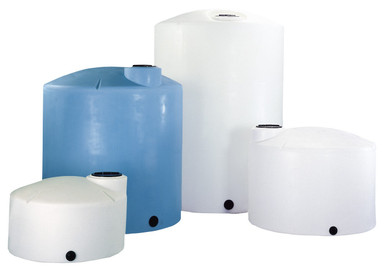
Potable water storage is the most heavily regulated tank service in the polyethylene catalog. The federal hook is the Safe Drinking Water Act and its lead-content limits under the Reduction of Lead in Drinking Water Act (RLDWA, codified at 42 USC 300g-6). The certification mechanism is NSF/ANSI/CAN 61, a public-consensus standard administered by NSF International, which sets minimum criteria for materials in contact with drinking water. Both above-ground and below-ground tanks must meet NSF/ANSI 61 for the resin and any internal coating, but the rest of the engineering — siting, freight, cold-weather behavior, anchorage — diverges substantially. This guide walks the orientation choice the way a public water system or rural well operator should walk it, with real OneSource SKUs.
NSF/ANSI 61 in plain language
NSF/ANSI/CAN 61 establishes health-effects criteria for "materials, components, products, and systems in contact with drinking water." The standard tests for migration of contaminants from the wetted surface into the water column under defined conditions of pH, contact time, and surface-area-to-volume ratio. The standard does not certify the tank as a finished assembly unless every wetted component (resin, gaskets, fittings, coatings, sealants) is individually NSF 61 listed. As Poly Processing's compliance documentation flatly states: if the tank is certified but the fittings and accessories are not, then the storage system is not NSF/ANSI 61 certified.
Two practical implications for tank specification:
- Resin listing alone is not enough. The tank must be assembled with NSF 61 listed gaskets, bulkhead fittings, vents, and any internal coating. Replacing a fitting with a non-listed equivalent during field service voids the system listing.
- Vapor zone counts. NSF 61 certification covers all surfaces in contact with the water — including the vapor space above the maximum fill line. Chlorine, chloramine, and ozone all migrate readily from solution into the headspace and back, so the dome interior matters as much as the wetted shell.
Above-ground potable: the default for small systems
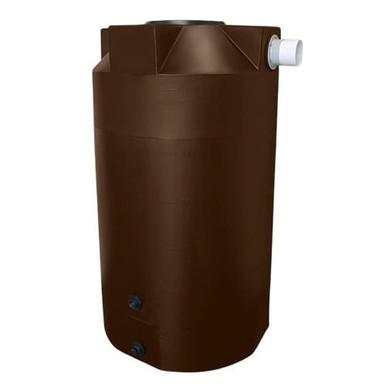
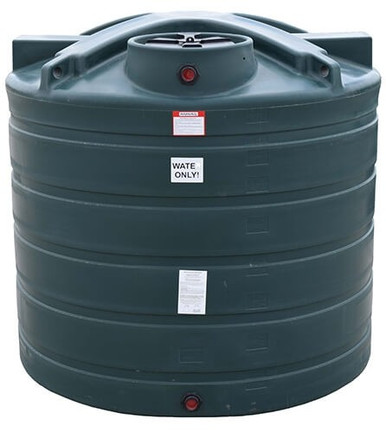
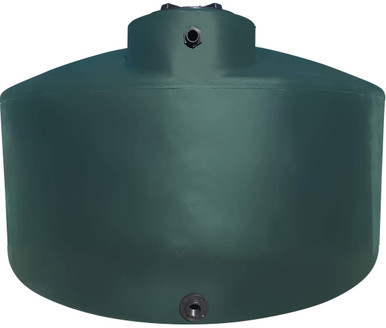
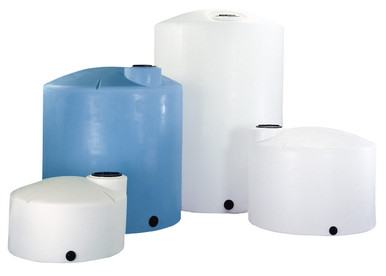
For small public water systems (PWS) and rural water service, above-ground polyethylene storage is the default. The Norwesco and Snyder white and natural-pigment HDPE upright water tank lines carry NSF/ANSI 61 listings on the resin grade. Real catalog SKUs:
- Norwesco MPN 41500 — 1,000 gallon vertical, 64" x 80", water duty, listed at $1,699.00. Common rural water reserve.
- Norwesco MPN 42382 — 2,500 gallon vertical, 102" x 79", white, water/light liquid, listed at $2,999.00.
- Snyder MPN 32541 — 1,500 gallon vertical water-duty, listed at $1,784.37.
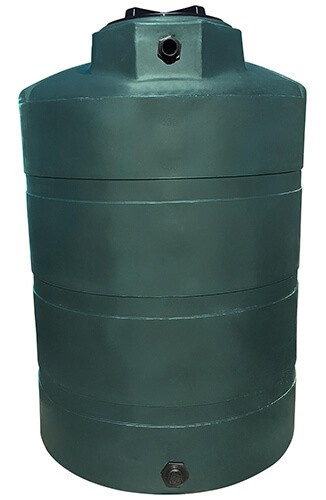
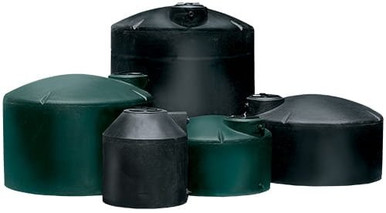
- Snyder MPN 32561 — 2,500 gallon vertical, green, listed at $2,345.84. Green pigment is common in rural-water installations for visual blending.
Above-ground configuration advantages:
- Inspection and maintenance. Visual external inspection on every walk-down. Hatch access for internal cleaning and disinfection per AWWA C652 (Disinfection of Water-Storage Facilities) is straightforward.
- Lower install cost. Pad, anchor, plumb, fill. No excavation. No backfill engineering.
- Easy decommissioning. Drain, disconnect, lift. Resale or repurpose path is intact.
Above-ground configuration challenges:
- UV exposure. Translucent or natural-pigment tanks degrade faster outdoors. Black tanks resist UV but raise water temperature in solar-loaded climates. White tanks balance both but show algal growth more visibly.
- Freeze risk. Above-ground tanks freeze at the wall first. Insulation wrap, heat trace, or shelter is often required north of USDA Zone 6.
- Vandalism and contamination ingress. Roof and hatch security become operational concerns.
For freeze protection see Freeze Protection for Polyethylene Tanks. For UV behavior across latitudes see Above-Ground Storage Tank UV Degradation.
Below-ground potable: the constrained alternative
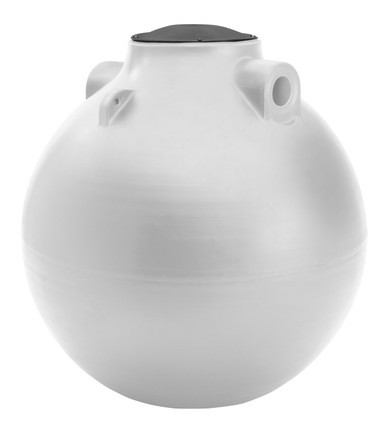
Below-ground (cistern-style) polyethylene potable storage is a niche but legitimate option, primarily where above-ground siting is constrained — visual covenants in suburban developments, freeze-zone applications where burying below frost line is cheaper than active heat, or rural well systems integrated into a buried distribution network. Below-ground polyethylene tanks must be specifically engineered for burial. Standard above-ground tanks cannot be buried — they will collapse under earth and groundwater pressure.
The engineering distinction:
- Above-ground tanks are designed for hydrostatic load from the inside (water pressing out) under ASTM D1998-19.
- Below-ground tanks must resist hydrostatic and earth load from the outside (soil and groundwater pressing in). This is a fundamentally different structural problem requiring rib reinforcement, thicker shells, and explicit burial-rated engineering.
OneSource focuses primarily on above-ground stationary storage; for below-ground potable cistern applications, the catalog directs buyers to engineered burial-rated SKUs and to professional installation. Burial siting must comply with the local plumbing code, with water-supply separation distances from septic and sewer infrastructure (typically 50 to 100 feet, jurisdiction-dependent), and with the same NSF/ANSI 61 resin and component requirements as above-ground.
Cold-weather siting: above vs below frost line
The frost line varies from roughly 6 inches in the deep South to 100 inches in northern Minnesota and Maine. Above-ground potable tanks in cold climates require:
- Insulation wrap (R-10 minimum for sustained sub-freezing exposure) or rigid foam panels around the tank exterior.
- Heat trace cable on the supply and return plumbing.
- Recirculation through the tank to prevent stagnation freeze in the bottom dome.
- A heated shelter in extreme zones (interior Alaska, northern Minnesota, North Dakota above the 47th parallel).
Below-ground tanks below the local frost line (usually 36 to 60 inches in the contiguous US) avoid freeze risk from soil temperature alone. The tradeoff: excavation and engineered burial-rated tank cost. Breakeven against above-ground-with-insulation typically lands somewhere between 1,000 and 5,000 gallons depending on local excavation rates and energy costs for heat trace.
For state-resolved cold-weather guidance see Minnesota, North Dakota, Wisconsin, and Alaska.
AWWA cross-references
NSF/ANSI 61 is the materials-and-health standard. The American Water Works Association (AWWA) publishes the operational standards that complement it:
- AWWA C652 — Disinfection of Water-Storage Facilities. The post-installation chlorination procedure (typically 50 ppm free chlorine for 24 hours, with neutralization before discharge) before placing a tank into potable service.
- AWWA M42 — Steel Water Storage Tanks (revised edition). Although focused on steel, it codifies inspection cadence and operational practices that translate directly to polyethylene.
- AWWA D101 and D110 — Concrete water storage tanks. Relevant when a polyethylene-vs-concrete decision is on the table for larger municipal applications.
For potable compliance walkthrough see our NSF 61 / Lead-Free / California AB1953 blog.
Lead content and California AB1953
The federal Reduction of Lead in Drinking Water Act caps lead content of wetted-surface materials at 0.25 percent (a weighted average across wetted components). California's AB1953 codifies this limit at the state level and requires NSF/ANSI 372 certification on top of NSF 61 for any wetted brass or bronze fittings. In practice: when specifying potable storage tanks for service in California, verify that the bulkhead fittings, valves, and any wetted brass components carry both NSF 61 and NSF 372 listings. Polyethylene resin itself contains zero lead, but the metallic accessories on the tank can fail the lead limit if the supplier substitutes a non-listed component.
For California-specific compliance see California Tank Regulations.
Vent screening and sanitary design
Both above-ground and below-ground potable tanks require sanitary vent screening to prevent insect and small-animal ingress. The 10 States Standards (Recommended Standards for Water Works, 2022 edition) Section 7.0 — Finished Water Storage — calls for #24 mesh screen on atmospheric vents, downturned vent outlets, watertight access hatches with overlapping flanges, and labeled tanks identifying potable service. These are standard fitments on Norwesco and Snyder potable-listed SKUs but always verify on the as-shipped configuration.
For overflow and drain protections see Tank Plumbing System Design.
Maintenance cadence
Public water system reserve tanks are typically inspected annually and disinfected on a five-year cycle (more frequently if a contamination event triggers re-disinfection). Above-ground polyethylene tanks should be drained, brushed, rinsed, and disinfected per AWWA C652 every five years. Below-ground tanks follow the same cadence but require confined-space-entry permitting per OSHA 29 CFR 1910.146 — adding meaningfully to the maintenance cost.
This is one of the quietly important differentiators. Above-ground maintenance is simpler and cheaper over a 20-year life. For small systems where the maintenance budget is constrained, the cost-per-cleaning advantage of above-ground compounds.
For tank cleaning and maintenance protocols see Plastic Tank Cleaning and Maintenance Schedule. For LOTO and confined-space entry see LOTO Procedures.
Catalog price points side-by-side
Real listed prices on water-duty above-ground potable tanks at OneSource (freight quoted separately to ZIP):
- 1,000 gallon vertical: $1,339.00 to $1,499.99 depending on color and SG rating.
- 1,500 gallon vertical: $1,496.99 to $1,679.99.
- 2,500 gallon vertical: $1,990.00 to $2,700.00 depending on color and dimensional pattern.
- 5,000 gallon vertical: prices vary by SKU; see catalog.
Below-ground tanks at equivalent capacity typically run two to three times the listed price of above-ground equivalents because of the burial-rated engineering, before factoring excavation and backfill. The breakeven analysis usually favors above-ground for small water systems, with below-ground winning only where above-ground siting is impossible or where freeze prevention costs exceed excavation costs.
For the freight quote use the live Freight Cost Estimator or call (866) 418-1777.
Permitting timelines and AHJ coordination
Permit lead times for potable water storage installation vary widely. A single-family rural-well replacement tank typically requires only a plumbing permit from the county building department and is reviewed in days, not weeks. A small public water system tank addition is reviewed by the state primacy agency under the Safe Drinking Water Act program and may require sanitary survey approval, plan-and-spec review, and AWWA C652 disinfection records before placement into service. Typical timelines run two weeks to six months depending on state and complexity. Coordinate the permit submittal early; ordering a tank that arrives ahead of permit approval is a common scheduling failure.
For state permitting timelines see Tank Permitting Lead Time by State.
Sizing the storage volume
The right tank capacity for a potable system is set by three independent demands stacked on top of each other:
- Daily Operational Storage (DOS). Average daily demand multiplied by a turnover safety factor. For a single-family rural well system this is often two to three days of average daily use (roughly 100 to 150 gallons per person per day under federal household-use estimates). For a small community system this is roughly 25 to 50 percent of the average daily demand.
- Fire Storage (FS). Required only where the public water system supplies fire flow. Sized per the local fire marshal and the applicable building code (typically International Fire Code Appendix B for fire-flow demand and Appendix C for hydrant spacing).
- Emergency Storage (ES). Reserve for source outages, pump failures, or contamination response. Often sized at 24 to 72 hours of average daily demand depending on backup source availability.
The Ten States Standards Section 7 — Finished Water Storage — provides the regulatory frame for community systems. Single-family rural wells default to operator judgment plus state plumbing-code minimums.
Disinfection and contact time
Storage tanks contribute contact time (CT) to the disinfection budget. CT is concentration of disinfectant residual multiplied by contact time in minutes. Surface Water Treatment Rule (40 CFR 141 Subpart H) compliance for systems treating surface water requires demonstrated CT against Giardia and viruses; ground-water systems under the Ground Water Rule (40 CFR 141 Subpart S) carry similar but less stringent CT obligations.
Tank geometry matters here. A vertical 2,500-gallon tank with a properly designed inlet baffle delivers higher hydraulic efficiency than a poorly baffled rectangular below-ground cistern. Short-circuiting in below-ground rectangular cisterns is a recurring water-quality finding. If you specify below-ground, specify a vertical or strongly baffled cistern, not an unstructured rectangle.
Decision summary
- Above-ground potable: default for small public water systems and rural service. Lower install cost, simpler maintenance, well-understood NSF/ANSI 61 compliance path. Watch UV exposure in southern climates and freeze in northern climates.
- Below-ground potable: niche, legitimate where siting constraints rule out above-ground or where deep frost makes burial cheaper than active heat. Requires burial-rated tank engineering, professional installation, and more rigorous confined-space maintenance.
- Both routes: verify NSF/ANSI 61 listing on the resin AND on every wetted fitting. AWWA C652 disinfection before placing into service. AWWA M42 inspection cadence. State-specific augmentations (California AB1953, others).
For the full water-tank product family browse Water Tanks. For state-by-state regulation pillars use State Tank Regulations.
One closing note on certification authenticity
The NSF/ANSI 61 mark is verifiable. Every certified product appears in the NSF certification database (searchable by manufacturer and product line). Before locking specification on any potable storage tank — ours, a competitor's, or one offered through a contractor channel — confirm the listing in the NSF database. The certification appears under the resin grade for the rotomolded shell, separately under the fittings, gaskets, and any internal coating. A tank advertised as "NSF 61 compatible" without a database listing is not certified. The same verification step protects against substitution during service: if a fitting is replaced after twenty years of service, confirm the replacement carries its own NSF 61 listing before placing the tank back into potable service.
Recommended Tanks for This Guide
Live pricing, updated automatically · estimate freight to your ZIP.