Sight-Glass and Sight-Tube Level Indication on Polyethylene Storage Tanks: Material Compatibility With Common Stored Chemistries, UV Degradation Behavior in Outdoor Service, and the Freeze-Protection Engineering That Keeps Tube Lines From Bursting
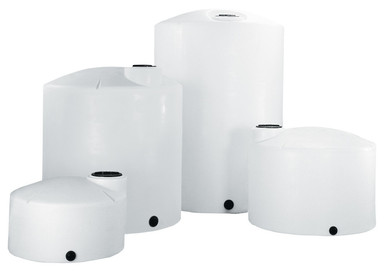
The external sight-tube is one of the simplest and most reliable level-indication options for polyethylene storage tanks. A clear or translucent tube plumbed to the tank at top and bottom, isolated by valves at each end, communicates the tank's liquid level by hydrostatic equilibrium — the level in the tube matches the level in the tank, give or take a small surface-tension correction in narrow tubes. The simplicity is the strength. There is no electronics, no power requirement, no calibration drift, and no failure mode beyond the obvious (broken tube, frozen contents, plugged isolation valve).
The simplicity is also the weakness. The sight tube is the smallest-diameter component connected to the tank, and it is the component most exposed to UV degradation, freeze risk, mechanical impact, and chemistry-incompatibility failures. A poorly specified sight tube fails in 1-3 years; a well-specified sight tube survives the life of the tank. This article walks the engineering — the material-compatibility selection, the UV behavior of clear plastics in outdoor service, the freeze-protection requirements for tube lines, and the procedure that keeps the tube isolated and serviceable. References cited include the manufacturer technical bulletins from Norwesco, Snyder, Chem-Tainer, Enduraplas, and Bushman on accessory sight-gauge installation; ASTM D1693 (environmental stress cracking of polyethylene), ASTM G154 (UV exposure testing); and the chemistry-compatibility tables published by the resin manufacturers for clear plastics including PVC, polycarbonate, acrylic, and PFA.
1. The Sight-Tube Topology and Why It Matters
The standard external sight-tube assembly comprises four components plumbed to the tank: a top isolation valve at the upper tank fitting, a bottom isolation valve at the lower tank fitting, the clear or translucent tube itself between the two valves, and the connecting fittings at each end (typically threaded compression or barbed). The bottom valve is at or near the tank outlet level; the top valve is at or near the maximum operating level; the tube spans the operating range plus a small dead-zone above and below.
The hydrostatic principle: when both isolation valves are open, the liquid in the tube settles to the same elevation as the liquid in the tank. The operator reads the level off a scale graduated on the tube or on a marker board behind it. The accuracy is roughly plus-or-minus 1 percent of full scale for a properly designed tube of reasonable diameter (3/8 inch and larger).
The failure modes of this simple topology are surprisingly numerous:
- Chemistry attacks the tube material. The tube clouds, embrittles, or cracks. Eventually it ruptures.
- UV attacks the tube material. The tube yellows, becomes opaque, or develops surface micro-cracks that progress to fracture.
- The tube freezes. The narrow column of liquid in the tube freezes before the tank itself does because the thermal mass is much smaller. Freezing expands and bursts the tube.
- Mechanical impact (a forklift, a falling tool, a clumsy operator) breaks the tube. The tube is the most exposed and least protected element of the tank installation.
- Sediment plugs the bottom isolation valve or the tube itself. The reading goes static; the operator does not realize there is a fault until the tank overflows or runs dry.
- The isolation valves are left closed accidentally. The tube continues to display the level it had when the valves closed; the operator reads a stale value.
Engineering the sight tube means designing against each of these failure modes. Material selection addresses chemistry and UV. Heat tracing or insulation addresses freeze. Physical guards address mechanical impact. Sediment-friendly geometry addresses plugging. Procedural lockouts address the closed-valve case.
2. Material Compatibility — Which Clear Plastics Survive Which Chemistries
The sight tube must be compatible with the tank chemistry, the tank concentration, and the tank temperature. The common clear-plastic options for sight tubes:
- Clear PVC. Excellent compatibility with water, brine, dilute acids (sulfuric, hydrochloric to roughly 30 percent), dilute caustics, and most fertilizers. Poor compatibility with strong oxidizers (concentrated nitric, peroxide), aromatic and chlorinated solvents, and concentrated caustic above 40 percent. Operating temperature limit roughly 140 F. The most common sight-tube material for general industrial service.
- Polycarbonate. Excellent impact resistance, slight better optical clarity than PVC. Compatible with neutral and dilute acid/base service, water, hydrocarbons. Incompatible with strong caustic (rapid hydrolysis), aromatic solvents, and ammonia. Operating temperature to 240 F. Common in food and water service where impact risk is high.
- Acrylic (PMMA). Good optical clarity, lower impact resistance than polycarbonate. Compatible with water, dilute acids, and many neutral chemistries. Incompatible with most solvents and strong oxidizers. Operating temperature limit 180 F. Used in low-stress decorative applications more than in industrial sight-tubes.
- PFA (perfluoroalkoxy fluoropolymer) tubing. Translucent rather than transparent, but compatible with virtually all chemistries including strong acids, strong caustics, and oxidizers. Operating temperature to 500 F. The premium choice for aggressive chemistries; cost is 5-10x clear PVC.
- FEP (fluorinated ethylene propylene) tubing. Translucent. Compatibility comparable to PFA but with lower temperature ceiling (400 F). Less expensive than PFA.
- Borosilicate glass. Optical clarity is excellent and chemistry compatibility is broad (compatible with most acids except hydrofluoric, most solvents, and most non-extreme chemistries). Brittle; impact-prone. Used with armor cages in industrial service. Cost and installation complexity exceed plastic options.
The selection matrix in summary: water and dilute chemistry, clear PVC; food-grade or impact-prone, polycarbonate; aggressive chemistry, PFA; demanding optical or temperature service, borosilicate. The tube manufacturer's compatibility chart is the authoritative reference for any specific chemistry; do not extrapolate from a generic table for novel chemistries.
3. The UV Degradation Behavior of Clear Plastics in Outdoor Service
Clear plastics outdoors are uniquely vulnerable to UV. The polyethylene tank itself is pigmented, often with carbon black or with UV stabilizers; the clear sight tube has no such protection (because it must remain optically transparent). UV exposure breaks polymer chains, generates surface oxidation, and progressively degrades both the optical clarity and the mechanical strength.
The observed UV-degradation timeline by material:
- Clear PVC, unstabilized: visible yellowing within 1-2 years of full sun exposure; brittleness onset at 3-5 years; structural failure at 5-7 years. Most off-the-shelf PVC sight tubes are this grade.
- Clear PVC, UV-stabilized industrial grade: minimal yellowing through 5-7 years; structural failure delayed to 10-15 years. Available from industrial-fluid-systems suppliers but typically not from general-purpose plumbing channels.
- Polycarbonate, standard grade: yellowing within 2-3 years; surface micro-cracking after 5 years; structural failure at 7-10 years.
- Polycarbonate, UV-stabilized: good through 10-15 years.
- Acrylic: the most UV-stable of the conventional clear plastics; minimal degradation through 15-20 years.
- PFA / FEP: essentially UV-inert; performance lifetime is set by chemistry attack, not UV.
- Borosilicate glass: UV-inert.
The engineering response: outdoor sight tubes should be specified UV-stabilized or shielded. Shielding can be passive (a UV-blocking sleeve over the tube, leaving viewing windows) or by location (mounting the tube on the north side of the tank, in a cabinet, or under a sun shade). The shielding cost is small relative to the cost of a tube replacement every 2-3 years.
An undocumented but common installation technique: wrapping the sight tube in clear UV-blocking film (the kind used for window protection). The film transmits visible light but blocks 99 percent of UV. A 2-foot wrap of automotive UV film extends an off-the-shelf clear PVC sight tube's outdoor life from 5 years to 12-15 years. The cost is roughly $5 of film per tube.
4. Freeze Protection — The Failure Mode That Kills Sight Tubes in Cold Climates
The sight tube is a low-thermal-mass appendage to a high-thermal-mass tank. The tank takes hours of subfreezing weather to begin to ice; the sight tube takes minutes. A 3/8-inch sight tube containing static water at 32 F ambient air begins to freeze within 30-45 minutes; full bursting pressure within 90 minutes. The bursting tube spills the entire isolated section onto the tank pad, which is a trivial volume but which is also slippery, evidence of a failure, and a maintenance call-out on a cold morning.
Freeze-protection options for sight-tube assemblies:
- Heat tracing. A self-regulating heat-trace cable wrapped around the tube and the connecting lines, set to maintain the tube above 40 F at design ambient. The trace power is low (5-10 W per linear foot is sufficient for a 3/8-inch tube in any cold climate). The control thermostat is typically on the trace itself or on a tank-side ambient sensor.
- Insulation jacket. A foam or fiberglass insulation sleeve over the tube, with a clear strip aligned for the sight reading. The insulation alone delays freezing but does not prevent it indefinitely; an unheated insulated tube freezes in 4-6 hours of subfreezing weather rather than 30 minutes. Combined with heat tracing, it cuts the tracing power requirement by 60-70 percent.
- Bottom-blowdown procedure. Open a small drain on the bottom-isolation valve before any forecast hard freeze, drain the tube, and close the isolation valves. The tube returns to service when the cold passes by re-opening the valves and allowing it to fill. This is a procedural rather than equipment solution and works well in occasional-cold environments.
- Air-purge backup. A check valve at the top of the tube admits air when the tube drains. The tube becomes empty rather than holding a column of liquid that can freeze. This is appropriate only if the application can tolerate periods without a level reading.
- Indoor relocation. If the freeze-protection effort exceeds the value of the external tube, the level-indication function moves indoors via a different technology (electronic level, radar, or float switch).
The standard-of-care for a cold-climate outdoor tank is heat-traced and insulated sight tubes. The hardware cost is roughly $200-400 per tube installed. The cost of a single ruptured tube event (cleanup, replacement, service call) typically exceeds this in the first occurrence.
5. Tube Geometry — Diameter, Length, and the Reading-Accuracy Tradeoff
The sight-tube diameter affects both the reading accuracy and the freeze risk. A larger tube has a slower-responding level (more thermal mass, more inertia), better reading accuracy from a distance (the meniscus is more visible), and higher freeze resistance (more water to freeze before the tube cracks). A smaller tube has faster response, lower freeze resistance, and lower reading accuracy from a distance.
Standard size selections:
- 1/4-inch tube: use only for very small tanks (under 50 gallons) or where space is constrained. Freeze risk is high; reading accuracy is poor at any distance.
- 3/8-inch tube: the most common size. Acceptable for tanks 50-2,000 gallons. Reading distance to roughly 10-15 feet for a graduated scale.
- 1/2-inch tube: better visibility from greater distance. Slightly slower response. Common for tanks 2,000-10,000 gallons.
- 3/4-inch and 1-inch tubes: heavy-duty industrial service. Visible from 25-50 feet. Lower freeze risk. Higher cost. Common on bulk tanks above 10,000 gallons.
The tube length is set by the tank's vertical operating range plus a small dead-zone above (1-2 inches above maximum level for visual confirmation when full) and below (1-2 inches below minimum level for confirmation when empty). The tube is graduated either by markings printed on a separate scale board behind the tube, or by direct etching on the tube itself, or by ruler-style stickers. The graduations should be in actual gallons or percent-full units, not arbitrary inches; the conversion is done at fabrication time using the tank's surface-area chart.
6. Isolation Valve Selection and the Closed-Valve Stale-Reading Failure
The isolation valves at the top and bottom of the sight tube serve two functions: they isolate the tube from the tank for service, replacement, or cleaning; and they isolate the tube from the tank if the tube ruptures, preventing tank contents from spilling. The valve selection should reflect both functions:
- Top isolation valve. Typically a quarter-turn ball valve, 1/2-inch nominal, in a chemistry-compatible material (PVC, CPVC, or stainless steel). The valve handle should be visible from the tank-monitoring station so that operators can verify it is open at a glance.
- Bottom isolation valve. Same type and size as the top, with one critical addition: a small drain port on the tube side of the valve allows the tube to be drained without opening the tank. This drain is essential for sediment-clearing and for freeze-protection bottom-blowdown.
- Tube-rupture safety. The bottom isolation valve must be readily reachable in an emergency. If a sight tube ruptures, the operator's first action is to close the bottom valve, isolating the tank from the spilling tube. A valve that requires a ladder, key, or tool to operate creates a dangerous response delay.
- Lockable open position. For tanks where stale-reading risk is high (single-shift operations, infrequent inspection), the isolation valves can be lockable in the open position so that they are not accidentally closed and forgotten. The lockout reverses for service.
The procedural lockout is the protection against the stale-reading failure mode. Without procedural reinforcement, the sight tube reads the level at the moment the valve last closed; an operator unaware of the closed-valve condition will trust this stale reading until the tank overflows or empties unexpectedly.
7. Alternatives to External Sight Tubes — When the Engineering Goes the Other Way
External sight tubes are the right choice when chemistry compatibility, low-maintenance simplicity, and the absence of power are valued. They are not always the right choice. Alternatives to consider:
- Float-switch level indication. A float in the tank actuates one or more discrete switches at fixed levels (low-low, low, high, high-high). Reliable, rugged, no UV exposure. Provides discrete points rather than continuous reading.
- Ultrasonic non-contact level transmitter. A transmitter mounted at the top of the tank measures distance to liquid surface by acoustic time-of-flight. Continuous reading. Requires power. Sensitive to tank-roof geometry, dust, and foam.
- Radar level transmitter. Higher accuracy than ultrasonic. Less sensitive to environmental conditions. Higher cost.
- Hydrostatic pressure transmitter. A pressure sensor at the bottom of the tank converts hydrostatic pressure to liquid level via the chemistry's specific gravity. Accurate and reliable. Requires correction if specific gravity changes over the tank's service.
- Magnetic level indicator (MLI) with magnet float. A float with embedded magnets travels in a chamber alongside the tank; a flag indicator on the outside of the chamber tracks the float position. Common on petrochemical and aggressive-chemistry tanks. No clear-plastic exposure to UV or chemistry.
The selection between sight tube and alternative depends on the tank's value, the chemistry, the climate, the operator's preference, and the available budget. For a 1,000-gallon water tank in a temperate climate with infrequent operator interaction, a sight tube is appropriate. For a 10,000-gallon hazardous-chemistry tank in a cold climate with continuous monitoring requirements, an MLI or radar transmitter is the better engineering choice.
8. Tank Selection That Aligns With Sight-Tube Installation
The polyethylene tank must support the sight-tube installation with appropriate fittings at the right elevations. Design considerations:
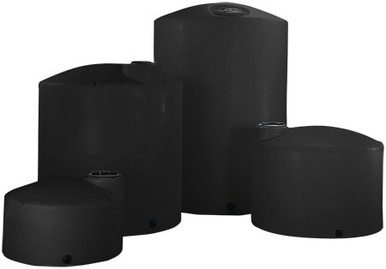
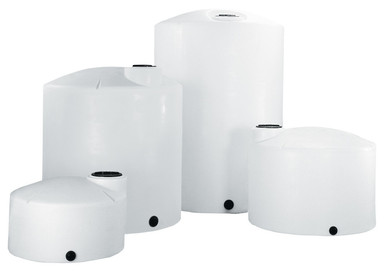
- Bottom outlet at or below the minimum operating level, with a side-fitting option above for the bottom-of-tube connection. Reference N-40164 5,000 gallon Norwesco vertical which has standard bottom-outlet bulkhead fittings for the sight-tube bottom connection plus side-wall fitting positions for the sight-tube top.
- Top fitting accessible without a ladder for service. Reference N-40178 2,100 gallon Norwesco vertical at moderate height where the top sight-tube connection is reachable from a standard 6-foot stepladder.
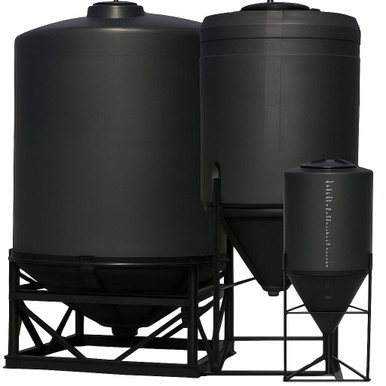
- Cone-bottom tanks with integrated sight-port positioning. Reference N-43852 1,000 gallon 45-degree cone bottom with bulkhead fittings positioned for clean bottom-of-cone tube connection, where the sight tube reads through the operating range above the cone.
The fitting positions on the tank should be specified at order time when possible; some manufacturers offer custom fitting locations as a no-charge option, others charge a small fee. The cost of a properly positioned fitting is an order of magnitude less than the cost of a retrofit.
9. Inspection, Maintenance, and the Service-Life Expectations
The sight-tube assembly has its own inspection cadence:
- Daily visual. The operator confirms the level reading is consistent with the day's operations — incoming volume matches the rise, outgoing matches the fall. A static reading despite known activity flags the closed-valve or plugged-tube condition.
- Monthly tube clarity check. Look for sediment in the bottom of the tube, visible degradation of the tube material (yellowing, cloudiness, surface cracks), and proper level response when valves are cycled.
- Annual full inspection. Bottom-blowdown to clear any sediment. Test isolation valves for leak-tight closure. Inspect heat-trace and insulation for damage. Evaluate tube material for end-of-life replacement scheduling.
- Replacement at end-of-service-life. The tube material has a finite service life. Clear PVC outdoor: 5-7 years if unprotected, 12-15 if shielded or wrapped. PFA or borosilicate: typically the life of the tank. Plan replacement before failure.
The annual full inspection is also the opportunity to update the level scale graduations. Tank settling, foundation movement, or tank deformation over years can shift the actual level relationship slightly; recalibrating the scale against a known volume restores reading accuracy.
10. The Engineering Conclusion
Sight-tube level indication is a simple, reliable, low-cost level-reading option that earns its place on the majority of polyethylene storage tank installations. The success of the installation depends on engineering choices that are easy to skip — material compatibility with the actual chemistry, UV protection in outdoor service, freeze protection in cold climates, and procedural reinforcement against the closed-valve stale-reading failure. The installer who selects PVC because it is on the truck, runs unprotected tube in the sun, and treats the bottom-blowdown valve as a one-time installation feature is building a tube that will fail in 2-3 years. The installer who matches material to chemistry, shields against UV, traces and insulates against freeze, and walks the tube on a defined inspection cadence is building a tube that lasts the life of the tank.
OneSource Plastics ships polyethylene storage tanks across all 5 brands — Norwesco, Snyder, Chem-Tainer, Enduraplas, Bushman — with bulkhead-fitting positions documented for sight-tube installation and accessory pricing for sight-tube assemblies on most stocking units. List pricing is on the product page; LTL freight to your ZIP is quoted separately via the freight estimator or by phone at 866-418-1777. For related content see tank plumbing system design walkthrough and winter freeze-protection guide.
Recommended Tanks for This Guide
Live pricing, updated automatically · estimate freight to your ZIP.