Tank-Bottom Drain Valve Selection for Polyethylene Storage Tanks: Full-Port Ball vs Butterfly vs Knife-Gate Engineering Tradeoffs, Solids-Handling Service Behavior, and the Cv-Versus-Closure-Reliability Math That Drives the Choice
The bottom drain valve is the single hardest-working component on a tank installation. It opens against the full hydrostatic head of the tank, closes against that same head plus any sediment, dirt, or solids that have settled to the bottom, and is expected to seal drop-tight on every cycle. The valve choice between full-port ball, butterfly, and knife-gate is not interchangeable; each design has a specific service envelope where it is the right answer and a wider service envelope where it is the wrong answer. The wrong choice produces a valve that leaks after 50 cycles, fails to close around solids, or chokes flow to a degree that makes scheduled drainage operationally impractical.
This article walks the engineering tradeoffs. The references are MSS SP-72 (ball valve specification), MSS SP-67 (butterfly valves), MSS SP-81 (knife-gate valves for slurry service), API 6D (pipeline valves), and the chemistry-and-pressure compatibility tables published by the major industrial valve manufacturers. The objective is the field-grade selection that pairs the right valve type with the actual tank-service conditions.
1. The Tank-Drain Valve Service Envelope
Before selecting a valve type, the service envelope must be defined. The relevant parameters:
- Static hydrostatic head. A 10-foot-tall tank exerts roughly 4.3 psi at its bottom outlet for water-density chemistry; higher specific gravities scale linearly. A 20-foot tank with a 1.4 specific gravity chemistry exerts roughly 12 psi. The valve must seal against this head when closed and pass flow against it when open.
- Cycle frequency. A water-storage drain valve might cycle a few times per year. A batch-process drain valve might cycle 2-5 times per shift. Cycle count drives wear-life selection.
- Closure-reliability requirement. A valve that handles a hazardous chemistry must close drop-tight on every cycle. A water-tank drain valve can tolerate occasional weep without consequence. The reliability requirement determines whether redundant closure (a second valve in series) is necessary.
- Solids content. Tanks holding suspensions, sediments, or precipitating chemistries accumulate solids at the bottom. The valve must close around these solids without trapping them. Solids tolerance varies dramatically by valve type.
- Flow rate requirement. A 1,000-gallon tank that needs to drain in 10 minutes requires a flow rate of 100 gpm; a 10,000-gallon tank that drains in 30 minutes requires 333 gpm. The valve flow coefficient (Cv) plus the line size set the achievable flow rate.
- Operating temperature. The valve material must be rated for the operating chemistry temperature. Ambient water service is forgiving; high-temperature process service narrows the material options.
- Operator-interface requirements. Manual quarter-turn lever, gear actuator, pneumatic actuator, electric actuator. Drives the valve cost and complexity.
With these parameters defined, the valve-type selection becomes a structured comparison rather than a default choice based on what the local supplier stocks.
2. Full-Port Ball Valves — The Default for Most Polyethylene Tank Service
The full-port ball valve has a spherical closure element with a through-bore equal to (or very close to) the connecting pipe inside diameter. When the valve is open, flow is essentially unobstructed; when the valve is closed, the ball rotates 90 degrees and the bore is perpendicular to the flow, with the chemistry trapped in the ball cavity sealed against the body by elastomeric seats.
The advantages of full-port ball valves for tank-drain service:
- Highest Cv among quarter-turn valves. A 4-inch full-port ball valve has Cv of roughly 800-1,200 depending on manufacturer. Flow restriction is minimal; achieved flow rate is essentially what the line and the tank head support.
- Drop-tight closure with proper elastomer. PTFE-seated ball valves seal to ANSI Class VI shut-off (essentially zero leakage at full operating pressure). EPDM and Viton seats give Class IV (low but measurable leakage acceptable for non-hazardous service).
- High cycle life. 100,000+ cycles for a properly maintained metal-bodied valve with PTFE seats; 50,000+ cycles for a thermoplastic-bodied valve. Far exceeds the typical tank-drain cycle requirement.
- Wide chemistry compatibility. Body materials available in PVC, CPVC, polypropylene, PVDF, and metal alloys; seat materials in PTFE, RTFE, EPDM, Viton, FFKM, and others. Nearly any chemistry has a compatible ball-valve construction.
- Wide pressure and temperature envelope. Schedule 80 PVC ball valves rated to 150 psi at ambient, derating to 50 psi at 140 F. Schedule 80 CPVC similar but to 180 F. Metal-bodied valves to 600+ psi.
- Visible position indication. Lever handle aligns with flow direction. Operator confirms valve state at a glance.
The disadvantages of full-port ball valves:
- Cavity-trap volume. When closed, the ball cavity holds a small volume of chemistry. After draining, that cavity volume can dribble out the next time the valve opens — a minor cleanliness issue in food and pharmaceutical service.
- Solids tolerance is limited. Hard solids (sand, grit, crystals) wedge between ball and seat and prevent drop-tight closure. The ball-valve solids envelope is roughly fine particulates only; anything coarser than 200-mesh creates seat-damage risk.
- Stem leakage failure mode. The ball is sealed by stem packing; over high cycle count and aggressive chemistries, the packing can fail. Modern designs use spring-loaded packing or live-loaded designs to mitigate this.
- Operating torque. Quarter-turn ball valves require relatively high torque, especially as size increases. A 4-inch valve typically needs a multi-turn gear actuator for reliable manual operation.
The full-port ball valve is the right answer for most water and chemistry tank-drain applications under 6-inch line size, with low solids content, where the cycle count is below 10,000 lifetime, and where drop-tight closure matters.
3. Butterfly Valves — When Size and Cost Drive the Choice
The butterfly valve has a disc closure element that rotates 90 degrees inside the flow path. When open, the disc is parallel to flow with a small obstruction at the disc face; when closed, the disc is perpendicular and seals against an elastomeric seat in the body bore.
The advantages of butterfly valves for tank-drain service:
- Significant cost advantage at large size. Above 6-inch line size, a butterfly valve costs 30-60 percent less than an equivalent ball valve. The cost advantage increases with size; a 10-inch butterfly might cost $400-800 while a 10-inch full-port ball is $2,000-4,000.
- Compact face-to-face dimension. Wafer-style butterfly valves have very short face-to-face length, useful where pipe runs are tight.
- Low operating torque. Below 100 ft-lb for a 6-inch wafer butterfly with elastomer seat, much less than the equivalent ball valve. Manual operation is feasible up to 8-10 inch sizes; larger valves use gear actuators.
- High cycle life. 100,000+ cycles with proper maintenance.
- Acceptable solids tolerance. The disc seal is on its edge against the body bore; small solids tend to be displaced rather than wedged. Better than ball-valve solids tolerance for fine-particulate chemistries.
The disadvantages of butterfly valves:
- Significant Cv reduction at full open. The disc obstructs flow even when fully open. A 4-inch butterfly has Cv of roughly 200-400 versus 800-1,200 for an equivalent ball valve. Drainage operations take 2-3x longer for the same line size.
- Limited shutoff class. Standard elastomer-seated wafer butterfly valves achieve ANSI Class IV at best; high-performance triple-offset designs reach Class VI but at materially higher cost (and lose the cost advantage). For drop-tight closure, butterfly valves are typically not the engineering choice.
- Disc protrusion when closed. The closed disc protrudes into the line on both sides. In a piping configuration with a downstream pipe rapidly tapering away from the valve, the disc may interfere. Butterfly valves require sufficient downstream clearance.
- Pressure-rating limits at large size. Wafer butterfly valves are typically rated to 150 psi or 175 psi class; lugged designs to higher pressures. Tank-drain service is usually well below these limits, but the rating must be checked.
- Elastomer seat wear. The disc rubs the seat through every cycle; aggressive chemistries or solids accelerate seat wear. Replacement seats are typically 30-50 percent of new-valve cost.
Butterfly valves are the right answer for large tank-drain applications (6-inch and larger), where cost matters, and where ANSI Class IV closure is acceptable. They are not the right answer for hazardous-chemistry drop-tight service or for high-cycle precision-flow applications.
4. Knife-Gate Valves — The Solids-Service Specialty Choice
The knife-gate valve has a flat, blade-like gate that rises perpendicular to flow when open and lowers across the flow path when closed. The gate typically has a sharpened or angled bottom edge that cuts through accumulated solids during closure. The body has a packing gland around the gate stem with no seat in the flow path; sealing occurs as the gate descends into a wedge-shaped seat cavity.
The advantages of knife-gate valves for tank-drain service:
- Highest solids tolerance of common valve types. The gate cuts through solids on closure; settled sediment, fibrous material, and even some viscous slurries can be accommodated. Knife-gate valves are the standard choice for slurry, paper-pulp, and waste-handling service.
- Full-port through-bore when open. No flow obstruction; Cv comparable to full-port ball valves.
- Compact design at large size. Knife-gate face-to-face length is short, similar to wafer butterfly. Useful in tight installations.
- Capable of throttling. Unlike ball or butterfly valves which are nominally on/off, a knife-gate can be partially closed for flow control without significant cavitation or noise.
- Open-position visibility. The gate position is visible externally; operator confirms valve state directly.
The disadvantages of knife-gate valves:
- Stem packing leakage is the dominant failure mode. The stem passes through a packing gland that must accommodate the gate's vertical travel. Aggressive chemistries attack the packing; high cycle counts wear it. Stem-leak rates of a few drops per hour are common in service. For drop-tight or hazardous applications this is a problem.
- Larger height envelope than ball or butterfly. The fully open gate stands above the body by approximately the gate's vertical travel — typically 1-1.5x the line size. The valve needs vertical clearance above it. Tight installations may not accommodate this.
- Higher cost than equivalent butterfly at most sizes. Knife-gate is a specialty product; volumes are lower than ball or butterfly. A 4-inch knife-gate is typically 50-80 percent more expensive than a 4-inch wafer butterfly.
- Operator-effort considerations. Manual knife-gate valves require multi-turn handwheel operation, much slower than quarter-turn ball or butterfly. Pneumatic or electric actuators are common in industrial installations.
- Limited chemistry compatibility for some constructions. Standard cast-iron or carbon-steel bodies are not compatible with most chemistries; stainless and exotic-alloy bodies are available but at higher cost.
Knife-gate valves are the right answer when the tank chemistry has significant settled solids, when the tank is in a wastewater or slurry application, or when throttling control is needed. They are not the right answer for clean-fluid, drop-tight, or low-cost applications.
5. The Cv-Versus-Closure-Reliability Tradeoff
The valve selection comes down to a tradeoff matrix between flow capacity (Cv) and closure reliability. The matrix at 4-inch line size:
- Full-port ball valve, PVC body, PTFE seat: Cv ~1,000. Closure ANSI Class VI. Cost $200-400. The default choice for water and most chemistry tank drains.
- Wafer butterfly valve, PVC body, EPDM seat: Cv ~300. Closure ANSI Class IV. Cost $80-150. The cost-driven choice for non-critical drain service.
- Knife-gate valve, stainless body, EPDM seal: Cv ~900. Stem-leak risk. Cost $400-700. The solids-tolerance choice for slurry service.
- Triple-offset butterfly, metal body: Cv ~400. Closure ANSI Class VI. Cost $1,500-3,000. The fire-safe / drop-tight choice for hazardous-chemistry service.
- V-port ball valve, metal body: Cv ~500. Closure Class VI. Cost $400-800. The throttling-capable choice for flow-control duty.
The drainage flow-rate calculation for tank service uses the orifice equation. For a 4-inch valve at full open with 4 psi static head, the achievable flow rate is approximately Q = Cv * sqrt(dP / SG), where dP is in psi and SG is specific gravity. For water at 4 psi: Q = Cv * 2 = approximately 2,000 gpm for a full-port ball, 600 gpm for a butterfly. The valve choice determines the practical drainage time, sometimes by a factor of 3-5x.
6. Materials of Construction by Chemistry
The valve body and seat materials must be compatible with the chemistry, the temperature, and the cycle count. The common combinations:
- Water and dilute chemistry, ambient to 140 F: PVC body, EPDM seat. Lowest cost. Adequate for the majority of tank-drain service.
- Water and dilute chemistry, 140-180 F: CPVC body, EPDM seat. Slightly higher cost. Required for hot-process service.
- Strong acid (sulfuric, hydrochloric, nitric concentrated): PVDF body, PTFE seat. Higher cost. Compatible with most strong acids.
- Strong caustic (NaOH, KOH concentrated): Polypropylene body, EPDM seat at low temperature; PVDF for higher temperature. Stainless steel acceptable for some concentrations.
- Hydrocarbon and solvent service: Stainless or carbon-steel body, Viton or RTFE seat. Avoid EPDM (swells in hydrocarbons) and PVC (attacked by aromatic and chlorinated solvents).
- Hypochlorite (chlorine bleach): CPVC body, FKM (Viton) seat for moderate-temperature service. PVC is acceptable at ambient but degrades in concentrated bleach service.
- High-purity water (DI or RO): PVDF body, PTFE seat. Avoid metal-bodied valves which contribute trace ions.
- Slurries and wastewater: Knife-gate with stainless body, hardened seat for abrasion resistance.
The chemistry-compatibility chart from the valve manufacturer is the authoritative reference. Generic compatibility tables are useful for first-pass selection but the manufacturer's chart accounts for the specific seat formulation, body grade, and operating-temperature derate.
7. Actuation Strategy by Application
The valve actuation strategy follows the operator-interface requirements:
- Manual lever, no actuator: Quarter-turn ball or butterfly, line size 1/2-inch through 4-inch. Operator-attended drainage operations. Simple, reliable, no power requirement.
- Manual gear actuator, handwheel: Larger ball or butterfly (4-inch and up) where lever-effort exceeds reasonable manual operation. Knife-gate valves at all sizes (gate travel requires multi-turn).
- Pneumatic actuator, on/off: Remote control of drainage operations from a control room or DCS. Standard plant-air supply (60-100 psi) drives the actuator. Spring-return ensures fail-safe position (typically fail-closed for tank drains).
- Electric actuator: Remote control where pneumatic supply is unavailable, where slow movement is acceptable, or where intermediate-position throttling is required. Higher cost than pneumatic; longer cycle time.
- Solenoid valve in pilot line: A small solenoid controls air supply to a pneumatic actuator on a larger valve. Allows electrical control of pneumatically actuated valves, common in batch-control systems.
The actuation cost can equal or exceed the valve cost on small valves and is typically 30-60 percent of valve cost on larger valves. Actuator selection should account for travel time (some applications need slow closure to avoid water hammer), failure-mode preference (fail-closed for hazardous; fail-open for some safety-critical), and feedback signaling (limit switches confirming open and closed positions).
8. Tank Selection That Aligns With Drain-Valve Geometry
The tank's bottom-outlet configuration determines what drain valves can be installed. Considerations:
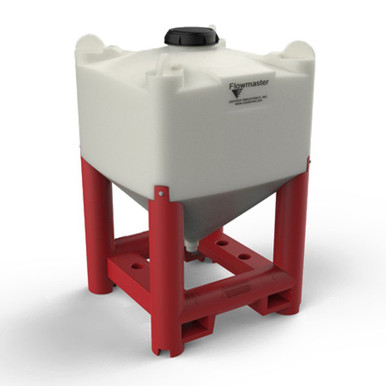
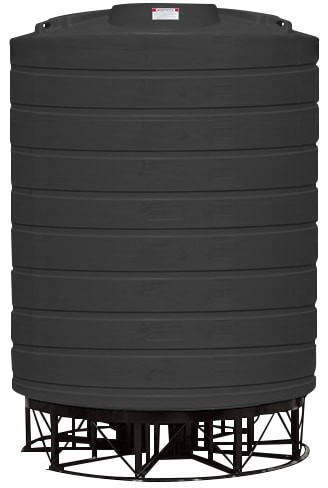
- Cone-bottom tanks for full drainage. The cone geometry directs all tank contents to the apex outlet. Reference N-43852 1,000 gallon 45-degree cone; the apex outlet typically takes a 2-inch or 3-inch full-port ball valve. The cone shape eliminates flat-bottom solids accumulation that drives knife-gate selection.
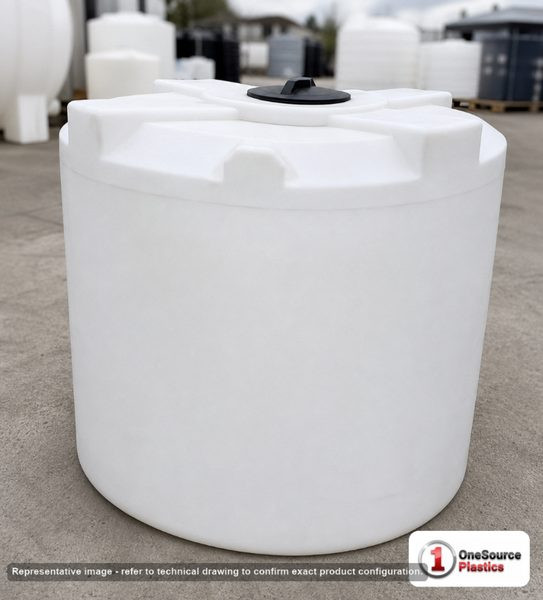
- Vertical bulk tanks with bottom-outlet bulkhead fittings. Reference N-40164 5,000 gallon Norwesco vertical. Bottom-outlet bulkheads typically accept 2-inch through 4-inch fittings; the drain valve mounts directly to the bulkhead's threaded or flanged interface.
- Inductor-cone tanks for chemical induction service. Reference 15-gallon 60-degree inductor with apex drain valve sized for the dosing or bulk-transfer application.
- Double-wall containment tanks for hazardous service. Reference Snyder Captor units like the SII-5590000N52 3,000 gallon Captor; the drain valve is typically dual (a full-port ball on the primary tank outlet, a secondary drain on the containment for any leaked chemistry).
The bulkhead size on the tank limits the drain-valve through-bore. A 2-inch bulkhead is the maximum on smaller tanks; 3-inch and 4-inch are common on larger tanks. Larger drain capacity requires either multiple parallel drain lines or a custom large-diameter bulkhead specification at order time.
9. Inspection, Maintenance, and Replacement Cadence
The drain valve is a wear component. Maintenance cadence:
- Each cycle: visual confirmation of full open and full closed positions. Operator-interface check.
- Monthly: drop-tight closure test. Close the valve, observe downstream piping for any drip or weep over 5-10 minutes. Document any leakage rate.
- Annually: full-cycle exercise plus stem-packing inspection. Operate the valve through full open-close several times to verify smooth operation. Inspect stem packing for visible wear or leakage. Tighten packing gland or replace packing as needed.
- At 5,000 cycles or 5 years (whichever sooner): seat condition assessment. Disassemble (if possible without service interruption) and inspect the seat for wear scars, chemical attack, or deformation. Replace seat if worn.
- At 25,000 cycles or 15 years: full valve replacement. Even properly maintained valves reach end-of-life eventually; replace before unexpected failure.
The maintenance log should track cycle count, observed drop-tight performance, packing-gland adjustment history, and any chemistry exposure events that may have stressed the valve materials. This log supports replacement decisions and warranty claims.
10. The Selection-Procedure Conclusion
The tank-bottom drain valve selection is a structured engineering decision. Define the service envelope (head, cycle, closure class, solids, flow, chemistry, temperature). Map the envelope to a candidate valve type (ball, butterfly, knife-gate, or specialty). Specify the materials of construction for the chemistry. Specify the actuation for the operator interface. Verify the bulkhead-to-valve compatibility on the tank. Plan the maintenance cadence. The valve that emerges from this procedure is fit for purpose, reliable in service, and cost-effective relative to alternatives. The valve that emerges from "what does the supplier have on the truck" is sometimes correct by coincidence and frequently is not.
OneSource Plastics ships polyethylene storage tanks with bulkhead fittings sized and positioned for the major drain-valve types across all 5 brands — Norwesco, Snyder, Chem-Tainer, Enduraplas, Bushman. Tank specification documentation includes bulkhead size, location, and fitting interface so that the drain-valve specification can be made before tank arrival. List pricing is on the product page; LTL freight to your ZIP is quoted separately via the freight estimator or by phone at 866-418-1777. For related installation engineering see tank plumbing system design walkthrough and cone-bottom vs flat-bottom tank comparison.
Recommended Tanks for This Guide
Live pricing, updated automatically · estimate freight to your ZIP.