Tank Skin-Temperature Differential and Contained-Volatile Vapor Pressure: How Solar-Loaded South-Facing Walls Drive Headspace Pressure Cycling, Vent Volumetric Flow, and Diurnal Breathing Loss on Polyethylene Bulk Storage Tanks
The wall of a polyethylene tank is not isothermal. The south-facing wall under direct sunlight reaches surface temperatures 30 to 60 degrees Fahrenheit above the shaded north-facing wall during summer afternoons, and the temperature differential drives a measurable thermodynamic response in the contained chemistry: vapor pressure rises in the warm zone, vapor migrates to the cool zone and recondenses, and the headspace experiences a continuous internal convective loop that cycles vapor through the vent line on every diurnal heating cycle. The cumulative breathing loss across a hot summer can exceed several percent of the contained inventory for volatile chemistries; the operational implications include emission compliance, inventory accuracy, and tank wall integrity at the saturated vapor zone. This article walks the physics of skin-temperature differential, the field measurement methodology for characterizing the effect on a specific tank installation, and the engineering options for managing the consequences.
The discussion is grounded in heat-transfer physics, vapor-pressure thermodynamics, and field practice across the 5-brand polyethylene tank catalog (Norwesco, Snyder, Chem-Tainer, Enduraplas, Bushman). List pricing on each tank product page; LTL freight quoted to your ZIP via the freight estimator or by phone at 866-418-1777.
1. The Physics of Skin-Temperature Differential on a Cylindrical Tank Wall
A vertical polyethylene tank standing in an open yard receives heat input from multiple sources, and the heat input is non-uniform across the wall surface:
- Solar shortwave radiation. The dominant daytime heat input is direct solar shortwave radiation absorbed by the tank wall. The peak solar flux at noon on a clear summer day at 35-degree latitude is approximately 950 to 1000 watts per square meter on a horizontal surface, and the projected component on a vertical south-facing wall reaches 700 to 850 watts per square meter at solar noon during summer. The east-facing wall sees comparable flux at 8-10 AM, the west-facing wall at 4-6 PM, and the north-facing wall sees only diffuse radiation (typically 80-150 watts per square meter).
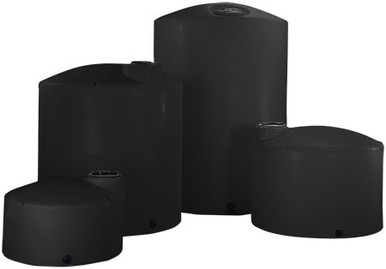
- The wall absorptivity dependence. A black or dark-colored polyethylene tank absorbs 85-95 percent of incident shortwave radiation. A natural-white tank absorbs 35-45 percent. The wall surface temperature reached at thermal equilibrium scales with the absorbed flux divided by the convective heat-transfer coefficient on the air side. A black tank in still air can reach surface temperatures 50-70 degrees Fahrenheit above ambient air temperature; a natural-white tank reaches 15-25 degrees above ambient under the same conditions.
- The convective heat transfer to ambient air. Wind speed at the tank surface drives the convective heat-transfer coefficient. At 0 mph wind the coefficient is 1-2 BTU per hour per square foot per degree Fahrenheit; at 10 mph it rises to 5-7; at 20 mph it reaches 10-12. The wind cooling reduces the wall surface temperature for any given solar input. A tank in a sheltered location reaches higher wall temperatures than the same tank in an open windy yard.
- The internal convective coupling to the chemistry. The chemistry inside the tank is in thermal contact with the wall on the wetted surface. The chemistry typically has higher thermal mass than the wall and the headspace combined; the wall temperature equilibrates to the chemistry temperature on the wetted side. The above-liquid wall (the headspace zone) is decoupled from the chemistry thermal mass and can reach wall temperatures much higher than the bulk chemistry on the warm side of the tank.
- The headspace stratification. Above the liquid level the headspace contains vapor and air. The headspace is typically thermally stratified: warm vapor near the warm south wall rises and accumulates near the dome, cool vapor near the cool north wall sinks and accumulates near the liquid surface. The stratification produces a circulating flow pattern with vapor migrating from warm zones to cool zones internally, and the recondensation at the cool wall produces a downward film of recondensed liquid.
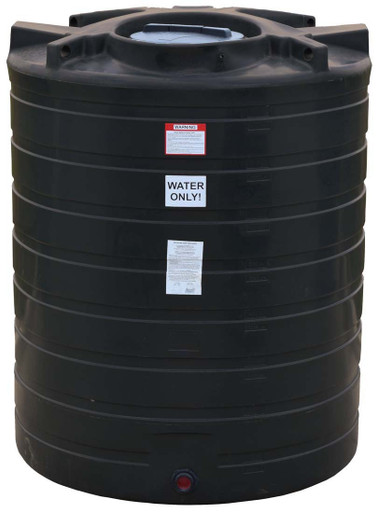
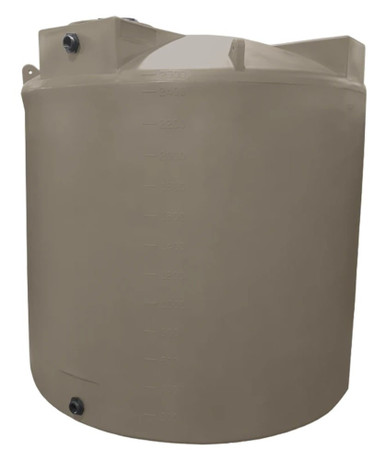
- The reference geometry for skin temperature analysis. Reference N-40164 5000 gallon Norwesco vertical as the typical mid-volume tank where skin temperature differential analysis applies directly. The 95-inch outside diameter and 168-inch overall height presents a wall surface area of roughly 350 square feet on the cylindrical portion, with substantial differential between sun-exposed and shaded zones.
The skin temperature differential is intrinsic to any cylindrical tank exposed to directional solar input. The magnitude depends on color, ventilation, geometry, and time of day; the pattern is universal.
2. Vapor Pressure Response to Wall Temperature
The vapor pressure of a volatile chemistry rises exponentially with temperature according to the Clausius-Clapeyron relationship:
- Water vapor pressure response. Water has a vapor pressure of 17.5 mmHg at 68 degrees Fahrenheit and rises to 31.8 mmHg at 86 degrees Fahrenheit and 55.3 mmHg at 104 degrees Fahrenheit. The vapor pressure approximately doubles for every 18 degrees Fahrenheit temperature rise. A tank with bulk water at 70 F but a wall surface temperature of 130 F at the saturated headspace experiences elevated local vapor concentration above the warm wall.
- Methanol vapor pressure response. Methanol has a vapor pressure of 95 mmHg at 68 F, 165 mmHg at 86 F, and 280 mmHg at 104 F. The exponential rise with temperature is steeper than for water on an absolute scale because of the lower latent heat of vaporization. A methanol storage tank with surface temperatures reaching 130 F in summer can reach internal headspace partial pressures approaching atmospheric, with substantial implications for vent loss.
- Sodium hypochlorite vapor pressure response. Sodium hypochlorite solution evolves chlorine, oxygen, and water vapor at rates that rise sharply with temperature. The decomposition kinetics roughly double for every 18-degree-Fahrenheit rise, similar to the Clausius-Clapeyron pattern but driven by chemistry rather than physics. A hypochlorite tank with sun-loaded walls evolves chlorine gas at multiples of the rate of a shaded tank.
- Ammonium hydroxide vapor pressure response. Aqueous ammonia (ammonium hydroxide) has a partial pressure of approximately 50 mmHg at 68 F for a 19 percent solution, rising to 110 mmHg at 86 F. The ammonia fume generation rate at warm walls is substantial; tank installations storing ammonium hydroxide should always be sun-shaded or natural-white-color to minimize wall temperature.
- Hydrogen peroxide vapor pressure response. Hydrogen peroxide decomposes thermally and the decomposition rate roughly doubles for every 18-degree-Fahrenheit rise in temperature. A 35 percent hydrogen peroxide solution at 75 F may decompose at 1 percent per year; at 110 F the rate rises to 4-8 percent per year. Sun-loaded peroxide tanks can experience significant inventory loss and oxygen release into the headspace that complicates vent sizing.
- The internal saturation pattern. The headspace vapor concentration at any point is bounded by the saturation pressure at the local wall temperature. Where the wall is hot, the local saturation pressure is high; where the wall is cool, the local saturation pressure is low. Vapor migrates from high-saturation zones to low-saturation zones until the headspace establishes a quasi-steady distribution that depends on wall temperature distribution and headspace mixing.
The vapor pressure response is the thermodynamic engine that drives all of the operational consequences of skin-temperature differential. Higher wall temperatures produce higher local vapor pressure, more aggressive vent breathing, and more rapid inventory loss for volatile chemistries.
3. The Diurnal Vent Breathing Cycle
Across a 24-hour day the tank wall temperature follows the solar cycle, and the headspace responds with a corresponding pressure cycle that drives vent breathing:
- The morning warming phase. As the sun rises, the east-facing wall heats first. The headspace temperature rises and the vapor pressure of the contained chemistry rises with it. The total headspace pressure (chemistry vapor partial pressure plus atmospheric air) rises above atmospheric, and the vent line releases vapor outward. This is the morning out-breathing phase.
- The afternoon peak temperature phase. By solar noon to 3 PM the south wall (or south-west wall depending on orientation) reaches peak temperature. The headspace reaches peak temperature and peak vapor pressure. The out-breathing rate peaks during this window. Cumulative out-breathing volume across a hot summer afternoon can exceed several percent of the headspace volume on a partially-empty tank.
- The evening cooling phase. After sunset the wall begins to cool. The headspace cools, the vapor pressure drops, and the headspace pressure falls below atmospheric. The vent line draws atmospheric air inward. This is the evening in-breathing phase.
- The overnight equilibration phase. Through the overnight hours the wall reaches its minimum temperature near sunrise. The headspace equilibrates to the cooler temperature and the in-breathing rate slows toward zero. The headspace by morning contains a different mixture of chemistry vapor and atmospheric air than it contained the previous morning, with cumulative ingress of moisture, oxygen, and contaminants from the outside air.
- The cumulative breathing loss math. A vertical tank with 25 percent headspace volume experiencing 30 degrees Fahrenheit diurnal swing produces approximately 5-7 percent volumetric exchange per day on the headspace volume alone. For a 5000-gallon tank with 1250 gallons of headspace, that is 60-90 gallons of vapor mixture exchanged daily. At 100 percent saturation of a volatile chemistry vapor, the daily mass loss can be substantial.
- The seasonal accumulation effect. Across a 90-day summer the cumulative breathing loss can reach 10-25 percent of the original chemistry inventory for highly volatile materials. Methanol, isopropyl alcohol, ethanol, and similar volatile organics suffer substantial breathing loss in sun-exposed installations. Less volatile materials (sodium hydroxide, calcium chloride, urea solutions) experience minimal breathing loss because their vapor pressures are low at all expected wall temperatures.
The diurnal vent breathing cycle is the dominant emission pathway for volatile chemistry stored in atmospheric polyethylene tanks. Compliance with state and federal volatile-organic-compound emission limits often requires breathing-loss management on tanks where the contained chemistry has significant vapor pressure at expected wall temperatures.
4. Field Measurement Methodology for Skin Temperature
Quantifying the skin temperature differential on a specific tank installation requires a measurement protocol with adequate spatial and temporal coverage:
- The infrared thermometer survey. A handheld infrared thermometer with adjustable emissivity setting is the field tool for tank wall surface temperature. The emissivity for polyethylene tank surfaces is typically 0.85 to 0.92; the operator sets the instrument to 0.90 as a working value. Measurements are taken at the four cardinal compass points (N, S, E, W) at three heights (low, mid, upper) for each measurement campaign. The 12-point grid produces a snapshot of wall temperature distribution.
- The measurement timing schedule. A useful field study takes measurements every two hours from 6 AM to 8 PM across one or more clear summer days. The resulting time-series captures the full diurnal cycle with adequate temporal resolution to identify the peak warm-wall temperature and the trough cool-wall temperature.
- The headspace temperature monitoring. A thermocouple or RTD probe inserted through a manway penetration into the headspace volume provides direct measurement of the headspace gas temperature. The probe should be positioned at mid-headspace height and away from the wall to avoid wall-conduction artifacts. The data logger records at 5-minute intervals across the measurement campaign.
- The chemistry temperature reference. A temperature probe in the bulk chemistry below the liquid surface establishes the chemistry temperature reference. The differential between headspace temperature and chemistry temperature is the relevant driver of internal vapor migration; a 30 degree Fahrenheit differential produces substantially more vapor cycling than a 5 degree differential.
- The vent flow measurement. A bidirectional vent flow meter (typically a thermal mass flow sensor or a hot-wire anemometer in a calibrated venturi) installed in the vent line provides direct measurement of out-breathing and in-breathing volumes. Cumulative vent flow over a 24-hour period quantifies the daily breathing loss directly. For high-value chemistry this measurement justifies its installation cost through the operational data it produces.
- Reference tank for the field study. Reference N-41524 2500 gallon Norwesco vertical as a practical study tank where the field methodology applies. The 95-inch outside diameter and 80-inch overall height presents a manageable measurement surface area with the same physics as larger tanks.
The field measurement methodology produces an objective characterization of the specific installation. The data feeds the engineering decision on whether breathing-loss management infrastructure is justified for the specific tank.
5. Engineering Mitigations for Skin Temperature Effects
The engineering toolkit for managing skin temperature effects ranges from passive surface treatments to active cooling and vapor recovery:
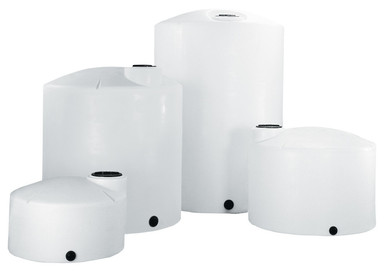
- Tank color selection at procurement. The first and least expensive mitigation is tank color selection. A natural-white polyethylene tank absorbs roughly half the solar flux of a black tank, and the wall surface temperature differential drops correspondingly. For volatile chemistry storage in sun-exposed yards, natural-white is the default selection and black is reserved for applications where biological growth (algae in water tanks) outweighs the vapor-pressure consideration.
- Solar shade structures over the tank. A simple shade structure (corrugated metal canopy, awning, fabric shade sail) blocks direct solar radiation and converts the heat-input mode from direct radiation to convective and reradiated. Wall surface temperatures under a well-designed shade structure approach ambient air temperature plus 5-10 degrees Fahrenheit, compared to 50-70 degrees above ambient for an unshaded black tank.
- Tank wall insulation. Foam-board insulation wrapped around the tank wall and clad in a reflective metal jacket reduces heat input by an order of magnitude. Insulated tanks track ambient air temperature closely with low diurnal swing. The capital cost is high (typically 30-60 percent of the tank cost) but the operational benefit is substantial for high-value chemistry or for emission-sensitive installations.
- Active cooling systems. A glycol-loop chiller or evaporative cooling system can hold tank chemistry temperature below ambient regardless of solar input. The capital cost and operational complexity are significant; this option is reserved for chemistry where temperature stability is non-negotiable for the process or where regulatory limits prohibit headspace vapor temperatures above defined thresholds.
- Vapor recovery on the vent line. A vapor recovery system (carbon adsorber, refrigerated condenser, or thermal oxidizer) on the vent line captures or destroys the volatile vapor that would otherwise breath out. The technology selection depends on the chemistry, the breathing volume, and the regulatory regime. Vapor recovery is the standard approach for applications where breathing loss must be eliminated for compliance or economic reasons.
- Pressure-vacuum vent valve installation. A pressure-vacuum vent valve replaces the open vent and limits breathing flow. The valve cracks open at a small positive pressure (typically 0.5 to 2.0 inches water column) and a small negative pressure. The reduced breathing volume cuts emission losses by 20-50 percent compared to an open vent on a tank where the diurnal pressure swing fits within the valve dead band. The valve must be sized for emergency flow under fill, drain, or fire-exposure conditions.
- Reference 100 gallon doorway tank for small-scale installations. Reference N-44800 100 gallon Norwesco doorway tank as a small-scale point-of-use installation where the same physics apply at smaller scale. Small tanks experience proportionally larger breathing losses (higher surface-to-volume ratio) but the absolute losses are lower per tank.
The mitigation hierarchy starts with the cheapest passive measures (color, shade) and escalates to active systems (chiller, vapor recovery) where the application requires. Most installations land at color selection plus shade structure as the cost-effective combination.
6. Wall Integrity at the Saturated Vapor Zone
The skin-temperature differential has a second-order consequence on the polyethylene wall material itself, beyond the chemistry breathing loss:
- The saturated vapor zone above liquid level. The above-liquid wall on the warm side of the tank is exposed to chemistry vapor at concentrations approaching saturation at the local wall temperature. For aggressive chemistries (sodium hypochlorite, sulfuric acid, ammonium hydroxide) the saturated vapor is more chemically aggressive than the bulk liquid, and the wall material can experience faster degradation in this zone than in the wetted zone.
- The thermal cycling stress on the wall. The diurnal temperature cycle subjects the wall material to expansion-contraction stress. At the saturated vapor zone the wall combines elevated temperature with chemical exposure with thermal cycling. The combined stress can produce environmental stress cracking (ESC) in the wall material at rates higher than would be predicted from any single stressor.
- The differential wall thickness consideration. ASTM D1998 specifies wall thickness based on hydrostatic head and chemistry specific gravity. The standard does not explicitly address the saturated vapor zone stress; tank manufacturers typically apply the same wall thickness specification to the saturated zone as to the lower wetted zone. For aggressive chemistry in sun-exposed installations the saturated vapor zone can become the wall failure-initiation site, with leak development at the warm side at the upper wall where the standard failure analysis would not predict.
- Inspection focus on the saturated vapor zone. The annual tank inspection should include particular attention to the warm-side wall surface above the liquid level. Visual inspection for crazing, surface micro-cracks, or color change indicates accumulating ESC stress. Internal inspection (when manway access permits) for similar features on the inside surface confirms the assessment.
- Service life implications. A polyethylene tank with sun-exposed saturated-vapor zone for aggressive chemistry can experience service life shortened by 30-50 percent compared to the same tank in a shaded installation. The economic case for shade structure or insulation extends beyond breathing-loss control into asset preservation.
- Replacement timing planning. Tanks identified through annual inspection with accumulating warm-side wall degradation should be scheduled for replacement on an accelerated timeline. The replacement should consider color selection and shade structure to extend the new tank's service life beyond what the prior tank achieved.
The wall integrity consequence connects the skin temperature differential to capital asset planning. A site that recognizes this connection makes better procurement decisions across multiple tanks over multiple decades.
7. Procurement Implications and Tank Selection Discipline
The skin-temperature analysis informs procurement decisions across the full lifecycle of a tank installation:
- Color selection at quote stage. The procurement specification should explicitly call out tank color based on the chemistry vapor pressure and the planned installation environment. Volatile chemistry plus sun-exposed yard equals natural-white tank; non-volatile chemistry plus algae-prone water service equals black tank. The quote-stage discipline avoids the hidden costs of breathing-loss management on a poorly-color-specified tank.
- Site survey for solar exposure. A pre-procurement site survey documents the planned installation orientation, the surrounding shade structures (existing trees, buildings, equipment), and the expected solar exposure by hour. The survey informs the color decision and the shade-structure planning.
- Vent valve specification at quote stage. For volatile chemistry the quote should specify a pressure-vacuum vent valve rather than a simple atmospheric vent. The valve adds 200-1000 dollars to the tank cost depending on size and material but cuts breathing loss substantially across the service life.
- Insulation jacket as factory option. Some manufacturers offer factory-applied insulation jackets as an option. The factory installation is typically cleaner and longer-lasting than field-installed insulation. For temperature-sensitive applications the factory option is worth the cost premium.
- Reference 1000 gallon for typical mid-volume procurement. Reference N-40152 1000 gallon Norwesco vertical as a typical mid-volume procurement where the color, vent valve, and shade discussion applies. The decision matrix scales identically for all common vertical tank sizes.
- Total cost of ownership perspective. The tank purchase cost is one component of total cost of ownership. Breathing loss across a multi-decade service life, premature replacement from saturated-vapor wall degradation, and emission compliance costs all contribute to TCO. The skin-temperature analysis at the procurement stage produces tanks that minimize TCO across the full lifecycle.
The procurement discipline supports the operational discipline. Tank selection that internalizes the skin-temperature physics produces installations that perform better at lower lifetime cost.
8. The Skin Temperature Engineering Conclusion
Skin-temperature differential on polyethylene tank walls is a fundamental consequence of solar exposure on a cylindrical surface in a non-isothermal environment. The differential drives vapor pressure response on volatile chemistry, diurnal vent breathing cycles, cumulative breathing loss, and second-order wall integrity effects at the saturated vapor zone. The engineering response spans color selection, shade structures, insulation, active cooling, and vapor recovery, with the appropriate mitigation level determined by chemistry properties, installation environment, and regulatory regime.
OneSource Plastics ships polyethylene tanks across the 5-brand catalog (Norwesco, Snyder, Chem-Tainer, Enduraplas, Bushman) in natural-white, black, and selected color options with vent valve and accessory configurations matched to the chemistry. Tank selection for any specific application is performed by the customer site engineer with reference to the chemistry vapor pressure curve, the installation solar exposure, and the operational and regulatory constraints. List pricing on each product page; LTL freight to your ZIP via the freight estimator or by phone at 866-418-1777. For related engineering see tank temperature control in hot climates and wall thickness at the saturated vapor zone.
Recommended Tanks for This Guide
Live pricing, updated automatically · estimate freight to your ZIP.