
Clean-In-Place (CIP) Systems
Clean-In-Place (CIP) Systems
Clean-in-place lets a process line be cleaned without dismantling it. Done right, it turns sanitation from a manual chore into a repeatable, documented, automated cycle.
What Clean-In-Place Is
Clean-in-place (CIP) is a method of cleaning the interior surfaces of tanks, vessels, pipework, valves, and associated equipment without disassembly. Instead of taking the line apart and scrubbing components by hand, cleaning and sanitizing solutions are circulated through the closed system at controlled flow, temperature, and concentration. CIP is the backbone of sanitation in dairy, beverage, brewing, food, nutraceutical, and personal-care manufacturing because it is fast, repeatable, safer for operators, and — critically — able to be validated and documented.
The economic case for CIP is straightforward. Manual cleaning of a large vessel is slow, exposes workers to hot caustic and acid, and produces inconsistent results that depend on who held the brush. CIP replaces that with a programmed cycle that runs the same way every time, frees skilled labor for production, and shortens the changeover between batches. The trade-off is that CIP only works if the equipment was designed to be cleaned this way and if the cycle itself is engineered correctly. A CIP cleaning result is never accidental; it is the product of four interacting factors that must be balanced for the specific soil being removed.
The Sinner Circle: Four Levers of Cleaning
The framework for understanding any cleaning process is Sinner's circle, which describes four factors that together accomplish soil removal. Reduce one, and you must increase one or more of the others to compensate.
- Time. How long the cleaning solution contacts the soil. Longer contact dissolves and lifts more residue, but it also lengthens downtime, so it is balanced against the other factors.
- Temperature. Heat accelerates chemical reactions and softens fats and proteins. Most caustic cycles run hot; cold or ambient cleaning needs more of the other factors to achieve the same result.
- Chemistry. The cleaning agent and its concentration — caustic for organic soils, acid for mineral scale, plus sanitizers. Concentration must be controlled, because too little leaves soil and too much wastes chemical and complicates rinsing.
- Mechanical force. The physical energy of the flow: turbulence in pipe, and impingement and sheeting action from spray devices in tanks.
Mechanical Force: Spray Devices and Flow
In piping, the mechanical factor is delivered by turbulent flow — a common target is a velocity around 1.5 meters per second (roughly 5 feet per second) to ensure scouring turbulence through the full bore. Below that, flow becomes laminar and the layer of solution against the pipe wall stops scrubbing. In tanks, mechanical force comes from spray devices that wet the entire interior surface.
| Device | Action | Best For |
|---|---|---|
| Static spray ball | Floods surfaces by sheeting flow from fixed holes | Light soils, sanitary tanks designed to drain freely |
| Rotary spray head | Slowly rotating distribution of fan sprays | Improved coverage, moderate soils |
| Rotary jet / impingement head | High-impact jets in a programmed indexed pattern | Tenacious soils, large vessels, lower water use |
Static spray balls rely on a continuous flooding curtain of solution sheeting down the walls; they are simple, have no moving parts, and are reliable when the tank is well designed and not too large. Rotary jet heads deliver concentrated high-impact streams that physically blast soil in a repeating geometric pattern, providing far more mechanical energy and full coverage with less water and chemistry, at the cost of more complex moving hardware that must itself be cleanable. Spray-device sizing must match the tank diameter so that the curtain or jet reaches and overlaps across every surface, including the underside of the top head and around agitator shafts, baffles, and nozzles where shadows can form.
A Typical CIP Sequence
While recipes vary by industry and soil, a representative CIP cycle proceeds through ordered steps. Each rinse and chemical phase has defined time, temperature, flow, and concentration set points that are recorded for each run.
- Pre-rinse. Ambient or warm water flushes out gross product residue and sends it to drain before any chemistry is introduced. This minimizes chemical consumption and reduces the soil load on the wash steps.
- Caustic wash. A hot alkaline solution (commonly sodium hydroxide based) circulates to saponify fats and dissolve proteins and other organic soils. This is the primary cleaning step for most food and dairy soils.
- Intermediate rinse. Water flushes residual caustic before the acid step to prevent neutralization in the line, which would waste both chemicals.
- Acid wash. An acidic solution (such as nitric or phosphoric acid based) removes mineral scale, milkstone, beerstone, and water-hardness deposits that caustic alone leaves behind. The acid step also helps passivate the stainless surface.
- Final rinse. Clean water removes all chemistry. Final rinse water quality is often checked by conductivity or pH to confirm chemistry has been fully purged.
- Sanitize. A sanitizing step — chemical sanitizer or hot water / steam — reduces microbial load just before the next production run, and in some lines is performed immediately before use rather than after cleaning.
Single-Pass vs. Recirculating CIP
CIP can be configured as single-pass (single-use) or recirculating, and the choice affects water, chemistry, and energy use.
- Single-pass (single-use). Solution makes one trip through the system and goes to drain. It avoids cross-contamination risk between zones and is simpler, but it consumes more water and chemistry. It is favored where soils are heavy, where carryover is unacceptable, or for smaller systems and allergen changeovers.
- Recirculating (re-use). Caustic and rinse solutions are collected in tanks, replenished to strength, and re-used across multiple cleans. This dramatically reduces water, chemical, and heating costs but requires solution tanks, filtration, and continuous monitoring of concentration. It suits high-throughput plants with consistent, well-understood soils.
Many plants run a hybrid: recovering the relatively clean final rinse to serve as the next cycle's pre-rinse, capturing the bulk of the water savings without re-using chemistry across incompatible products. The right architecture depends on throughput, soil type, utility costs, and how strict the cross-contamination requirements are.
Validation and Documentation
Because CIP replaces visual hand cleaning, its effectiveness must be proven and recorded. Validation establishes that a given recipe reliably cleans to an acceptable standard, and routine monitoring confirms each cycle ran to set point. Common verification tools include conductivity and temperature logging, riboflavin coverage tests to confirm full spray-device wetting, allergen and protein swab tests, ATP bioluminescence checks, and microbial sampling of surfaces and final rinse water.
A CIP system designed for hygiene depends on the underlying equipment being cleanable in the first place — drainable geometry, no dead legs, smooth welds, and an appropriate surface finish — so good vessel design and good CIP are inseparable. When both are right, the result is a sanitation process that is fast, safe, repeatable, and fully documented, which is exactly what food safety regulations and quality systems demand.
Designing the CIP System
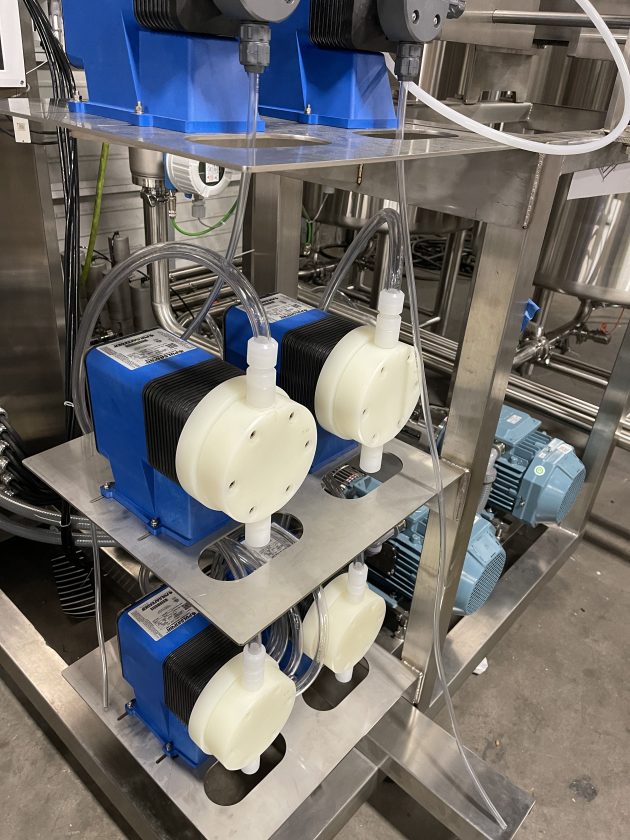
A CIP installation is more than a pump and a spray ball; it is an engineered subsystem with its own tanks, instruments, and controls. The core of a recirculating system is a CIP skid, which typically includes solution tanks for caustic, acid, and water, a supply pump sized to deliver the required flow and pressure to the spray devices, a return pump or self-draining return line to recover solution from the vessel, a heat exchanger to bring solution to temperature, and instrumentation for flow, temperature, conductivity, and concentration.
Several design decisions determine whether the system works in practice rather than only on paper.
- Flow and pressure. The supply pump must deliver enough flow to feed every spray device on a circuit at its rated pressure simultaneously; undersized pumps starve the spray devices and leave parts of the vessel unwashed.
- Return handling. Solution must leave the vessel as fast as it enters, or the tank floods. Self-draining gravity return is simplest; a return pump is used where the geometry will not drain by gravity.
- Circuit design. Equipment is grouped into CIP circuits of similar soil and material so each can be cleaned with an appropriate recipe without leaving stagnant branches.
- Air breaks and segregation. Hygienic design keeps cleaning chemistry from contaminating product zones and keeps potable water sources protected, often with air gaps and dedicated lines.
Common CIP Pitfalls
Most CIP failures trace back to a small set of recurring problems, and knowing them is half of avoiding them.
Beyond coverage, frequent issues include insufficient flow velocity in piping that drops the flow out of the turbulent regime, dead legs that the recipe never reaches, chemistry concentration drifting out of range in re-used solutions, and final rinses that are too short to fully purge chemistry. Each of these is detectable with the right instrument — flow meters, conductivity probes, coverage tests — which is why a well-instrumented CIP system is not a luxury but the means by which the cleaning is proven. Building the system with verification in mind from the start is what turns CIP from a hopeful routine into a controlled, auditable process.
Frequently asked questions
- What are the basic steps of a CIP cycle?
- A representative cycle runs pre-rinse, caustic wash, intermediate rinse, acid wash, final rinse, and sanitize. The pre-rinse flushes gross residue, caustic removes organic soils like fats and proteins, acid removes mineral scale, the final rinse purges chemistry, and the sanitize step reduces microbial load before the next run. Exact steps, times, and temperatures are tuned to the specific soil.
- What is the Sinner circle in cleaning?
- Sinner's circle describes the four factors that together remove soil: time, temperature, chemistry, and mechanical force. They trade off against one another, so if you reduce one factor you must increase another to keep the same result. For example, lower-temperature cleaning requires stronger chemistry or longer contact time to compensate.
- When should I use a rotary jet head instead of a spray ball?
- Static spray balls work well for light soils in well-drained sanitary tanks, relying on a flooding sheet of solution down the walls. Rotary jet heads deliver high-impact, programmed jets that physically blast tenacious soils and cover large vessels with less water and chemistry. They cost more and add moving parts, so they are chosen when soils are heavy or vessels are large.
- How do you verify that a CIP cycle actually cleaned the tank?
- CIP is validated and monitored rather than visually inspected. Common methods include logging conductivity and temperature against set points, riboflavin tests to confirm full spray coverage, ATP bioluminescence and protein or allergen swabs on surfaces, and microbial sampling. Together these confirm both that the cycle ran correctly and that the result meets the cleanliness standard.
Scope your custom build
Send us your volume, service chemistry, dimensions, and finish or code requirements. We return a full engineering package, firm lead time, and a fixed quote — freight quoted separately to your ZIP.
Request a Custom QuoteCall 866-418-1777