
Sanitary Mixing & Blending Tanks
Sanitary Mixing & Blending Tanks
A sanitary mix tank has to do two jobs at once: blend the product uniformly and stay effortlessly cleanable. The best designs never compromise one for the other.
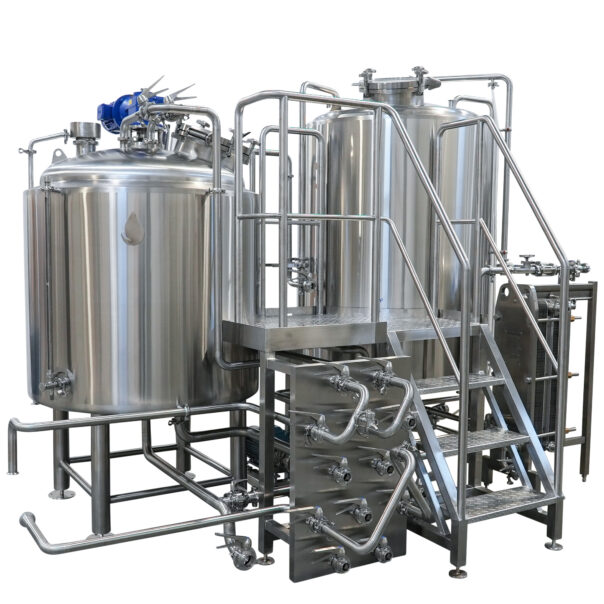
The Role of the Sanitary Mix Tank
The mixing and blending tank is the workhorse of hygienic processing. It is where ingredients are combined, hydrated, dissolved, heated or cooled, and brought to a uniform finished state before filling or further processing. These vessels appear throughout food and beverage, dairy, nutraceutical, cosmetic, and personal-care manufacturing, handling everything from thin juices and beverages to thick sauces, creams, gels, and slurries.
What sets a sanitary mix tank apart from an ordinary process tank is that it must achieve a process result — uniform blending, heat transfer, suspension of solids — while remaining fully cleanable and contamination-free. Every design choice is a balance between mixing performance and hygiene, and the two are specified together rather than in sequence. A tank that mixes beautifully but cannot be cleaned, or one that is spotless but leaves dead zones in the batch, has failed at half its job.
Selecting the Agitator
The agitator is the heart of the tank, and its selection is driven primarily by the viscosity and rheology of the product and the mixing goal (blending, suspension, dissolution, or emulsification). No single impeller suits every product, and choosing the wrong one is a common and expensive mistake.
| Agitator Type | Flow / Action | Suited To |
|---|---|---|
| Marine propeller / hydrofoil | High-flow axial; gentle turnover | Low-viscosity liquids; blending, light suspension |
| Pitched-blade turbine | Combined axial and radial; balanced | General blending and solids suspension |
| Flat-blade / radial turbine | High shear, radial discharge | Gas dispersion, moderate-shear blending |
| Anchor / close-clearance | Slow sweep along the wall | Viscous pastes, creams; aids heat transfer |
| High-shear rotor-stator | Intense localized shear | Emulsions, dispersions, powder wet-out |
For thin liquids, high-flow axial impellers turn the whole batch over efficiently and economically. As viscosity climbs, flow-based mixing loses reach — the impeller carves a cavity in the product and the bulk stops moving — and close-clearance designs such as anchors become necessary. An anchor sweeps product off the wall, prevents it from baking onto a heated surface, and keeps the whole mass moving, often combined with a high-shear element on a second shaft for dispersion. Where fine emulsions or thorough powder hydration are required, a rotor-stator high-shear mixer provides the intense localized energy that a simple impeller cannot, drawing material through a small gap between a spinning rotor and a fixed stator to reduce droplet and particle size.
Jacketing for Heating and Cooling
Many sanitary processes require precise temperature control — to dissolve ingredients, pasteurize, hold a cook temperature, or cool a finished batch. This is provided by a jacket on the vessel wall through which a heating or cooling medium flows, such as steam, hot water, glycol, or chilled water.
- Dimple jacket. A panel spot-welded to the shell forming dimpled flow channels; efficient, economical, and common for moderate pressures and a wide range of duties.
- Half-pipe (half-coil) jacket. Half-round pipe welded in a spiral around the shell; robust and well suited to higher pressures and high-temperature media, and it can be zoned along the height of the tank.
- Conventional / full jacket. A simple outer shell creating an annular space; straightforward but less efficient at distributing flow and prone to channeling unless baffled.
Effective heat transfer also depends on the agitator continuously renewing product at the jacketed wall, which is why close-clearance impellers with wall scrapers are often paired with jackets for viscous, heat-sensitive products that would otherwise scorch on the hot surface. Jacketed vessels are typically insulated and clad to conserve energy, hold temperature stable, and protect operators from hot surfaces.
Hygienic Fittings and Connections
The fittings on a sanitary tank are as important to cleanability as the tank body. The dominant standard for hygienic connections is the tri-clamp (tri-clover) sanitary fitting: a flanged ferrule sealed by a gasket and held by a hinged clamp. Tri-clamp connections seal without crevices, require no tools, and break apart in seconds for inspection or clean-out-of-place of the components.
- Crevice-free seals. Sanitary gaskets sit flush so no gap traps product, and the gasket material is matched to the product and cleaning chemistry.
- Flush-mounted valves and ports. Sample valves, drain valves, and instrument ports are mounted flush with the interior to avoid dead spaces.
- CIP-ready spray devices. A spray ball or rotary head is mounted in the top head so the tank cleans in place between batches.
- Bottom outlet at the low point. A flush sanitary outlet valve at the lowest point of a sloped or dished bottom ensures complete drainage of both product and cleaning solution.
- Hygienic agitator seal. The shaft entry uses a cleanable mechanical seal rather than a packing gland, so the most movement-prone joint does not become a contamination point.
Portable vs. Fixed Tanks
Sanitary mix tanks come in both portable and fixed configurations, and the right choice depends on batch size, plant layout, and flexibility needs.
| Type | Strengths | Considerations |
|---|---|---|
| Portable (on casters) | Flexible, moved between stations; ideal for small to mid batches and multi-product lines | Limited size; agitator usually smaller; needs clearance to roll |
| Fixed / floor-mounted | Large capacity; permanent piping, jacket, and controls; high throughput | Less flexible; dedicated footprint and utilities |
Portable tanks suit recipe-driven, small-batch operations — nutraceuticals, cosmetics, specialty foods — where the same vessel may serve several products and move to different process steps such as mixing, holding, and filling. Fixed vessels suit high-volume, single-product or continuous lines where the tank is integrated into permanent piping and automated controls and the economics favor a large, dedicated asset. Some plants use both: portable tanks for development and small runs, fixed tanks for established high-volume products.
Designing for the Whole Lifecycle
A successful sanitary mix tank is specified by working backward from the product and the process: the rheology determines the agitator, the thermal duty determines the jacket, the batch strategy determines portable versus fixed, and the cleaning regime determines fittings and surface finish. Getting these decisions to reinforce one another — rather than fight — is what separates a tank that simply holds product from one that consistently makes good product.
Because these vessels are cleaned constantly, hygienic design — drainable bottoms, smooth welds, an appropriate surface finish, and CIP-ready geometry — is not an add-on but the foundation that lets the tank perform safely for years across changing recipes and batches. Specified well, a sanitary mix tank becomes the most reliable and flexible asset on the line, capable of producing a uniform, safe, repeatable product batch after batch with minimal downtime between them.
Tank Geometry and Baffling
Mixing performance depends not only on the impeller but on the shape of the vessel and the features inside it. The ratio of liquid height to tank diameter — the aspect ratio — influences how many impellers are needed and how the batch turns over. A squat tank may be blended thoroughly by a single impeller, while a tall, narrow tank often needs two or more impellers stacked on the shaft to move product through its full height and avoid a stagnant zone near the bottom or top.
Baffling is the other major geometry decision. In an unbaffled tank, a center-mounted agitator tends to spin the whole batch as a mass and pull a deep vortex down the shaft, which entrains air, reduces actual mixing, and can cause the impeller to cavitate. Baffles — vertical strips set off the wall — break that rotational flow and convert it into the top-to-bottom turnover that actually blends the batch. In sanitary service, baffles must be mounted with standoffs from the wall so cleaning solution passes freely behind them, and they are often rounded and polished like every other internal surface. An alternative for hygienic tanks is to mount the agitator off-center or at an angle, which disrupts the swirl without adding internal hardware that complicates cleaning.
Instrumentation and Controls
A modern sanitary mix tank is rarely just a vessel and a motor. Process instruments are integrated to monitor and control the batch: temperature sensors track heating and cooling, level sensors or load cells measure fill and dose ingredients by weight, and pressure or pH probes may be fitted depending on the process. All of these must use hygienic, flush-mounted connections so they do not become contamination points.
Where consistency and traceability matter, the agitator drive is often a variable-frequency drive that allows controlled ramping of speed — gentle at first to wet out powders without throwing dust, faster once the batch is liquefied — and the whole vessel can be tied into a control system that runs the recipe automatically and logs it. This pairing of well-chosen mechanical design with controlled instrumentation is what makes the difference between a tank that can make a good batch and a tank that makes the same good batch every single time.
Frequently asked questions
- How do I choose the right agitator for a sanitary mix tank?
- Agitator selection is driven mainly by the product's viscosity and rheology and by the mixing goal. Thin liquids use high-flow axial impellers like propellers or hydrofoils, viscous pastes need close-clearance anchors that sweep the wall, and fine emulsions or powder hydration call for high-shear rotor-stator mixers. Because many products are shear-thinning, you must consider how the product behaves under shear, not just a single viscosity figure.
- What is a tri-clamp fitting and why is it used?
- A tri-clamp, or tri-clover, is a sanitary connection made of two flanged ferrules sealed by a gasket and held together with a hinged clamp. It seals without crevices, requires no tools, and disassembles in seconds for inspection or out-of-place cleaning. These properties make it the standard hygienic connection for sanitary tanks and piping.
- What type of jacket is best for a mixing tank?
- It depends on the thermal duty and pressure. Dimple jackets are efficient and economical for moderate conditions, half-pipe jackets handle higher pressures and high-temperature media well, and conventional full jackets are simple but less efficient at distributing flow. Effective heating or cooling also requires the agitator to keep renewing product at the wall, so close-clearance impellers are often paired with jackets for viscous products.
- Should I choose a portable or fixed mixing tank?
- Portable tanks on casters are best for small to mid-size batches and multi-product lines where flexibility and movement between stations matter, such as nutraceuticals or cosmetics. Fixed, floor-mounted tanks suit high-volume or continuous production where large capacity, permanent piping, jacketing, and automated controls are integrated. The decision comes down to batch size, plant layout, and how much flexibility the operation needs.
Scope your custom build
Send us your volume, service chemistry, dimensions, and finish or code requirements. We return a full engineering package, firm lead time, and a fixed quote — freight quoted separately to your ZIP.
Request a Custom QuoteCall 866-418-1777