
Clean-Out-of-Place (COP)
Clean-Out-of-Place (COP)
Not every part can be cleaned in place. Valves, fittings, gaskets, and small components often must be removed and cleaned in a dedicated bath — that is clean-out-of-place.
What COP Is and Why It Exists
Clean-out-of-place (COP) is the cleaning of equipment components that have been removed from the process line and cleaned in a dedicated wash station rather than in their installed position. It is the complement to clean-in-place (CIP): where CIP cleans fixed surfaces by circulating solution through a closed system, COP cleans the loose parts that CIP cannot reliably reach.
Many components in a sanitary process line have complex geometries — threads, slots, springs, mesh, intricate internal passages — that a spray device or recirculating flow simply cannot fully clean while assembled. Rather than risk leaving soil in those features, hygienic operations disassemble them and clean them in a controlled bath where every surface can be reached, agitated, brushed, and inspected. COP is not a fallback for poor CIP design; it is a deliberate, standard part of a complete sanitation program, recognized in the same hygienic frameworks that govern CIP.
Components Typically Cleaned by COP
- Valve bodies, seats, and stems
- Gaskets, O-rings, and seals
- Fittings, clamps, ferrules, and tri-clamp connections
- Pump components and impellers
- Spray balls and small spray devices
- Filter housings, screens, and sieves
- Hoses, tubing, and small portable parts
- Sample valves and instrument probes
COP Wash Tanks and Carts
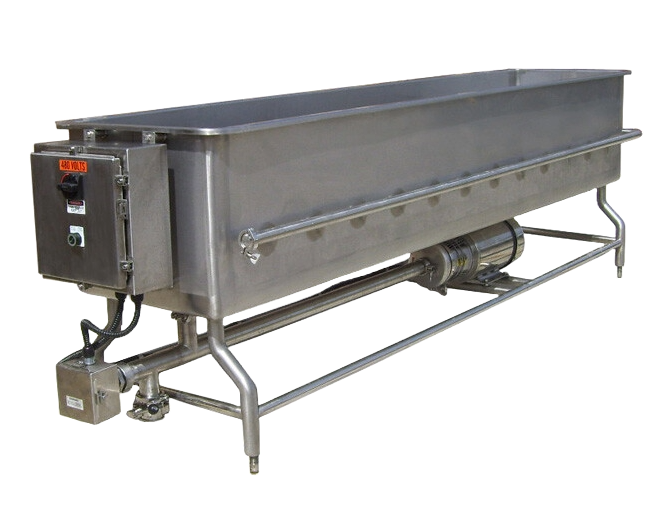
The heart of a COP operation is a dedicated wash tank or wash cart. These are sanitary stainless vessels — typically rectangular for easy parts loading — that hold heated cleaning solution and provide a controlled environment for soaking and agitating components. A mobile COP cart brings the wash station to the work area and can be moved between zones; a fixed COP sink or tank serves a central wash room where parts are brought after each shift or batch.
A well-designed COP tank shares the same hygienic principles as any sanitary vessel: smooth, drainable interior, rounded corners, a sloped bottom and drain, and a controlled surface finish so the wash station itself does not become a contamination source. Many include immersion or jacketed heating to hold the solution at an effective temperature, perforated baskets or racks to keep parts off the bottom and fully submerged, and a lid to retain heat and control fumes. Sizing matters: the tank must be large enough to fully immerse the largest parts with room for solution to circulate around them, since a part resting on the bottom or breaking the surface will not clean evenly.
How COP Provides Mechanical Energy
Just as in CIP, the four factors of cleaning — time, temperature, chemistry, and mechanical force — all apply to COP. The difference is how the mechanical force is delivered, since there is no closed loop of circulating flow through the part. COP supplies mechanical energy through one or more of the following methods.
| Method | How It Works | Notes |
|---|---|---|
| Recirculating agitation | A pump circulates and turbulently agitates the bath around the parts | Good general-purpose action; keeps chemistry uniform and warm |
| Air sparging | Compressed air bubbles rise through the bath to scrub surfaces | Gentle, simple, no high-shear hardware |
| Ultrasonic cleaning | Transducers create cavitation bubbles that implode against surfaces | Reaches blind holes, threads, mesh; excellent for intricate parts |
| Manual brushing | Operator scrubs after or during soak | Used for gross soil and verification |
Most COP operations combine methods: a heated, agitated soak loosens the bulk of the soil, ultrasonics reach the difficult internal features, and a final manual brush addresses anything remaining and lets the operator confirm cleanliness by eye. The combination is chosen to match the soil and the geometry of the parts being cleaned.
COP vs. CIP: Choosing the Right Method
CIP and COP are partners, not competitors. A sanitary line uses both: CIP for the fixed tanks and pipe runs, COP for the removable parts. The decision for any given component comes down to whether cleaning solution can reliably reach and scour every surface while the part is installed. If it cannot, that part belongs in COP.
| Factor | CIP | COP |
|---|---|---|
| Disassembly | None — cleaned in place | Parts removed and cleaned in a bath |
| Best for | Tanks, vessels, fixed pipework | Valves, gaskets, fittings, small parts |
| Mechanical action | Spray impingement, turbulent flow | Agitation, sparging, ultrasonics, brushing |
| Geometry reach | Limited by line of sight and flow | Every surface accessible by hand |
| Labor | Lower, largely automated | Higher — manual handling |
Procedure and Best Practices
A disciplined COP operation follows a consistent sequence so that results are repeatable and defensible.
- Disassemble. Break down the components, keeping related parts together and noting orientation for correct reassembly. Inspect for wear; worn gaskets and seals are replaced rather than re-used.
- Pre-rinse. Knock down gross soil before parts enter the bath so the wash solution is not quickly fouled.
- Soak and agitate. Submerge parts fully in heated cleaning solution at the target concentration, with agitation, sparging, or ultrasonics for the prescribed time.
- Brush as needed. Use dedicated, color-coded brushes for stubborn soil and to verify visually.
- Rinse. Rinse with clean water to remove all chemistry from every surface and internal passage.
- Sanitize and dry. Apply a sanitizer and allow parts to drain and air-dry on clean racks before reassembly, since pooled water can support microbial growth.
Good COP practice also keeps cleaning solution fresh, monitors temperature and chemistry concentration, physically separates clean and dirty parts to avoid recontamination, and uses dedicated cleaning tools reserved for hygienic work. Like CIP, COP results can and should be verified — visual inspection plus ATP or protein swab testing of cleaned surfaces — so that the parts returning to the line are demonstrably clean rather than presumed clean. Treated this way, COP closes the gap that CIP cannot reach and keeps the entire process line, fixed and removable alike, to a single defensible standard.
Cleaning Chemistry and the Four Factors in COP
The chemistry used in COP mirrors the chemistry used in CIP because the soils are the same; only the delivery method differs. Alkaline (caustic) detergents handle organic soils — fats, proteins, sugars — while acidic cleaners remove mineral scale and inorganic deposits. The cleaning solution is selected to match both the soil and the materials being cleaned, since some elastomers and aluminum components do not tolerate strong caustic and would be damaged by a chemistry chosen only for the soil.
Temperature and concentration are controlled just as in any cleaning process. A heated bath dramatically improves the action of most detergents, and concentration is held within the chemical supplier's recommended range — too dilute leaves soil, too concentrated wastes chemical and complicates rinsing. Because COP relies on immersion and agitation rather than the high-velocity impingement of a CIP jet, the mechanical factor is generally weaker than in CIP, which means COP often compensates with longer soak times, higher temperatures, or the targeted energy of ultrasonics. Understanding this trade-off is what lets an operator design a COP cycle that reliably cleans without simply scrubbing harder by hand.
Safety and Operator Considerations
Because COP is more hands-on than CIP, operator safety and ergonomics deserve attention. Workers handle hot caustic and acid solutions and lift wet, sometimes heavy components, so personal protective equipment, splash protection, and good ventilation around the wash station are essential. Wash tanks are set at a working height that avoids awkward reaching into hot solution, and lifting aids are provided for heavy parts.
The handling discipline that protects operators also protects the product. Dirty parts and cleaned parts are kept physically separated so a cleaned component is never set down where it can be recontaminated; dedicated, color-coded tools prevent cross-use between hygienic and non-hygienic tasks; and cleaned parts are stored covered and dry until reassembly. These habits, combined with verified cleaning and replacement of worn seals, are what make COP a controlled process rather than a hopeful one — the manual counterpart to the automated rigor of CIP, applied to exactly the parts where human reach and judgment outperform a spray jet.
Designing a Plant Around COP
For a sanitation program to run smoothly, the COP function is planned into the facility rather than improvised. A dedicated wash room or wash area, separated from production to avoid cross-contamination and from raw-material zones to avoid splash, gives operators a controlled space with the right utilities: hot and cold water, drainage, ventilation, the wash tank or ultrasonic unit, and clean racks for drying and staging finished parts. Locating it on the path between the production line and storage keeps the flow of dirty-to-clean parts moving in one direction, which is itself a contamination control.
Throughput is the other planning factor. The number and size of wash tanks, and whether ultrasonics are warranted, follow from how many parts must be cleaned per shift and how quickly they must be returned to service. A line that strips and cleans many valves and fittings at every changeover needs more wash capacity than one that disassembles only occasionally. Sizing the COP operation to the real workload prevents the bottleneck where production waits on clean parts — or, worse, where pressure to keep running tempts shortcuts that compromise hygiene. Planned properly, COP becomes an unremarkable, reliable background process, which is exactly what good sanitation should be.
Frequently asked questions
- What is the difference between CIP and COP?
- CIP cleans fixed equipment — tanks, vessels, and pipework — in place by circulating cleaning solution through the closed system without disassembly. COP cleans components that have been removed from the line, such as valves, gaskets, and fittings, in a dedicated wash tank or cart. They are complementary: a sanitary line uses CIP for its fixed surfaces and COP for the removable parts that CIP cannot reach.
- When should a part be cleaned by COP instead of CIP?
- A part should go to COP when cleaning solution cannot reliably reach and scour all of its surfaces while it is installed. Components with threads, slots, springs, mesh, or complex internal passages are prime candidates because spray and recirculating flow leave shadowed areas. Removing them lets every surface be agitated, brushed, and inspected by hand.
- Why are ultrasonics used in COP cleaning?
- Ultrasonic cleaning creates cavitation bubbles in the bath that implode against surfaces and reach into blind holes, threads, recesses, and fine mesh. These are exactly the features where COP parts trap soil and where brushes or sprays cannot reach. Ultrasonics are therefore valued for small, intricate, and precision components such as valve internals.
- What does a COP wash tank look like?
- A COP wash tank is a sanitary stainless vessel, often rectangular for easy parts loading, that holds heated cleaning solution. It typically includes heating, perforated baskets or racks to keep parts submerged and off the bottom, a sloped drainable interior with rounded corners, and a means of agitation such as recirculation, air sparging, or ultrasonics. The tank itself must be hygienically designed so it does not become a contamination source.
Scope your custom build
Send us your volume, service chemistry, dimensions, and finish or code requirements. We return a full engineering package, firm lead time, and a fixed quote — freight quoted separately to your ZIP.
Request a Custom QuoteCall 866-418-1777