
Electropolishing & Passivation
Electropolishing & Passivation
Stainless steel is not automatically corrosion proof. Fabrication leaves contaminants on the surface, and passivation and electropolishing are how those surfaces are restored and protected.
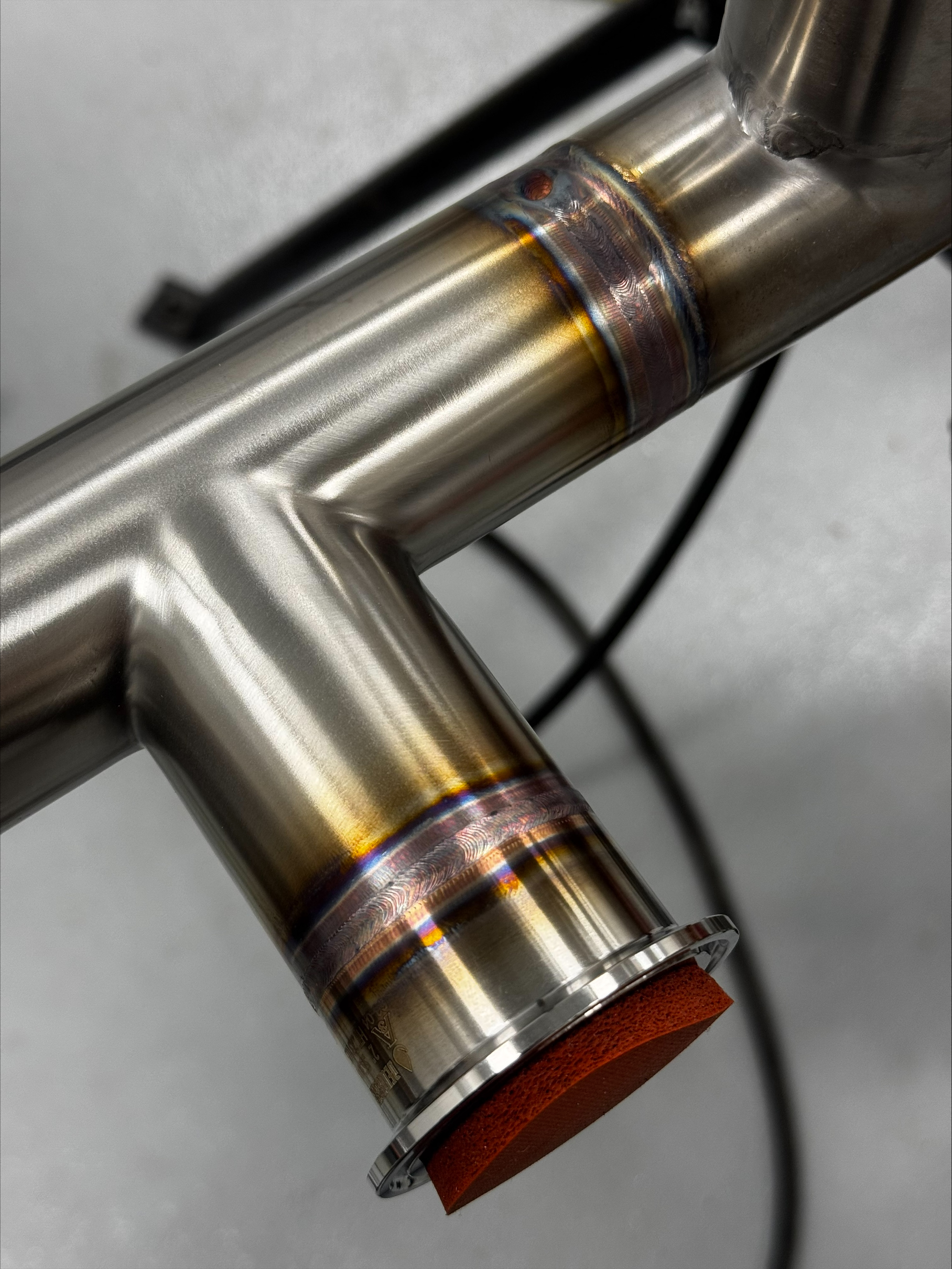
Why Stainless Needs Surface Treatment
Stainless steel resists corrosion because chromium in the alloy reacts with oxygen to form a thin, tenacious, self-healing chromium-oxide passive layer on the surface. That layer is what makes the steel "stainless," and it is only a few atoms thick. The problem is that fabrication — machining, grinding, forming, cutting, and especially welding — disrupts that layer and contaminates the surface with free iron and other foreign particles embedded from tools, abrasives, and handling.
Free iron on the surface rusts. Even though the bulk alloy is corrosion resistant, those embedded iron particles will oxidize, create rust spots, and can initiate localized corrosion such as pitting that attacks the steel beneath. Welding additionally produces heat tint — the rainbow oxide scale along a weld — where chromium has migrated out of the surface layer and the passive film is weakened, making the heat-affected zone the most corrosion-prone part of an otherwise sound vessel. Surface treatment exists to remove these contaminants and restore a robust passive layer across the whole surface. The two principal treatments are passivation and electropolishing, and they are often confused even though they do different things.
Passivation
Passivation is a chemical treatment that removes free iron and surface contaminants from stainless steel and promotes the formation of a uniform, enriched chromium-oxide passive layer. Critically, passivation does not remove base metal and does not change the appearance or dimensions of the part — it is a cleaning and conditioning process, not a polishing one. A passivated surface looks essentially the same as it did before, but it is chemically clean and far more corrosion resistant.
The governing specification in North America is ASTM A967 (Standard Specification for Chemical Passivation Treatments for Stainless Steel Parts), with the related ASTM A380 covering cleaning, descaling, and passivation practice. These standards define acceptable chemistries, process controls, and verification tests so that a passivation result can be specified and audited.
- Nitric acid passivation. The traditional method, using a nitric acid bath to dissolve free iron and leave the chromium-rich surface intact. Effective and well understood, but with handling and waste-disposal hazards.
- Citric acid passivation. A more recent, environmentally friendlier chemistry that achieves comparable results without the hazards and disposal burden of nitric acid; increasingly preferred in food and many other industries.
Electropolishing
Electropolishing is an electrochemical process that removes a controlled thin layer of metal from the stainless surface. The part is made the anode in an electrolyte bath and current is applied; metal is dissolved preferentially from the high points, or micro-peaks, of the surface profile. The result is a surface that is simultaneously smoother, brighter, deburred, and passivated.
Because electropolishing removes peaks faster than valleys, it does more than clean — it actually reduces surface roughness (Ra), often substantially, and it enriches the chromium content at the surface, leaving a passive layer that is typically more corrosion resistant than a mechanically polished and chemically passivated surface alone. It also rounds off micro-burrs, exposes and removes embedded contaminants and inclusions, and produces a clean, reflective finish. The amount of metal removed is small and controlled, but it is enough to meaningfully change the surface, which is why dimensionally critical parts must account for the stock loss.
| Attribute | Passivation | Electropolishing |
|---|---|---|
| Process type | Chemical (acid bath) | Electrochemical (anodic dissolution) |
| Removes base metal? | No | Yes — thin controlled layer |
| Effect on Ra | None (cleans only) | Reduces / smooths surface |
| Removes free iron | Yes | Yes |
| Appearance | Unchanged | Brighter, mirror-like |
| Relative cost | Lower | Higher |
| Typical use | General corrosion protection, post-weld cleanup | Demanding hygienic / pharma surfaces |
When Each Is Specified
The two treatments are not mutually exclusive — electropolishing inherently passivates, while passivation is the standalone choice when smoothing is not required. The selection depends on the surface requirements of the application and the level of cleanability and corrosion resistance it demands.
- Passivation is specified for general corrosion protection, after fabrication and welding to remove free iron and heat tint, and wherever a clean, corrosion-resistant surface is needed without changing the finish. It is the routine treatment for most food, dairy, and general process equipment, and it is the practical choice for large vessels that cannot be immersed in an electropolishing bath, where it is applied as a gel or by circulation.
- Electropolishing is specified where the lowest possible roughness and the highest cleanability and corrosion resistance are required — pharmaceutical, biotech, high-purity water, and the most demanding hygienic surfaces. It is also used to brighten and deburr complex small parts where a mirror finish and the removal of every micro-burr are worth the added cost.
In practice, many sanitary surfaces are mechanically polished first to a specified Ra, then passivated; the most demanding surfaces are mechanically polished and then electropolished, which both lowers the Ra further and passivates in a single step.
Verification
A passivated or electropolished surface should be verified rather than assumed, because the treatments leave little visible evidence of success or failure on their own. ASTM A967 references several acceptance tests that confirm free iron has been removed and a passive layer is present, including:
- Water immersion / high-humidity test. Exposes the surface to humid conditions for a set period to reveal any rusting from residual free iron.
- Copper sulfate test. A copper sulfate solution is applied; free iron causes a copper-colored deposit, indicating an unacceptable surface.
- Salt spray and ferroxyl tests. Additional methods to detect free iron and assess corrosion resistance under more aggressive conditions.
For electropolished surfaces, roughness is also verified by measuring Ra to confirm the specified finish has been achieved. Together, surface finishing and its verification close the loop on hygienic fabrication: smooth, passivated, free-iron-free stainless cleans more easily, resists corrosion, and holds up to the repeated aggressive caustic and acid cleaning that sanitary service demands. Skipping or shortcutting these steps is a frequent root cause of premature corrosion and rouging in stainless systems, so they are treated as integral to the build, not optional finishing touches.
How Welding Damages the Surface
It is worth understanding why welds in particular demand attention, because the heat of welding does several things at once that all undermine corrosion resistance. The intense heat drives chromium toward carbon at grain boundaries, forming chromium carbides and leaving the adjacent metal locally depleted of the chromium it needs to passivate — a condition called sensitization, which the low-carbon L grades are formulated to resist. The heat also produces the visible oxide scale, or heat tint, whose color indicates how thick the oxide is and how depleted the underlying metal has become; a dark blue or grey tint signals a thicker, more damaged layer than a light straw color.
This is why post-weld treatment is not cosmetic. Removing the heat tint and the chromium-depleted layer beneath it — mechanically, then chemically by passivation or by electropolishing — restores a surface with enough chromium at the interface to rebuild a sound passive film. A weld that is left with its heat tint intact is the most likely place on an otherwise excellent vessel to corrode first, often appearing as rust or pitting tracing the exact line of the weld.
Maintaining Corrosion Resistance in Service
Surface treatment at fabrication establishes corrosion resistance, but service conditions can erode it over time, and maintenance practices either preserve or degrade the passive layer. Chlorides are the chief enemy of austenitic stainless: chloride-bearing cleaners, sanitizers left in contact too long, or chloride carryover in process water can attack the passive film and initiate pitting, particularly in 304 where 316's molybdenum is absent. Mechanical damage from abrasive pads, carbon-steel brushes, or contact with non-stainless tools embeds fresh free iron and scratches that locally raise roughness and create corrosion sites.
For these reasons, sanitary stainless is cleaned with chloride-controlled chemistry where possible, rinsed thoroughly so no sanitizer sits on the surface, and worked only with dedicated stainless or non-metallic tools. Where rouging or light corrosion does develop over years of service, derouging and re-passivation can restore the surface chemistry without replacing the equipment. Understood and maintained this way, a properly passivated or electropolished stainless system delivers the decades of clean, corrosion-resistant service that justify the choice of stainless in the first place.
Frequently asked questions
- What is the difference between passivation and electropolishing?
- Passivation is a chemical bath that removes free iron and contaminants and conditions the chromium-oxide layer without removing base metal or changing the finish. Electropolishing is an electrochemical process that dissolves a thin layer of metal, preferentially from the high points, so it smooths the surface, lowers roughness, brightens it, and passivates it at the same time. Electropolishing does more but costs more; passivation is the routine treatment when smoothing is not required.
- Why does stainless steel need passivation?
- Fabrication processes like machining, grinding, and welding embed free iron and other contaminants into the stainless surface and disrupt its protective chromium-oxide layer. That free iron will rust and can initiate localized corrosion in the steel beneath. Passivation removes the free iron and restores a uniform, corrosion-resistant passive layer, which is why it is standard after fabrication and welding.
- What standard governs passivation?
- In North America the primary specification is ASTM A967, the Standard Specification for Chemical Passivation Treatments for Stainless Steel Parts, with ASTM A380 covering cleaning and descaling. A967 defines acceptable chemistries, such as nitric and citric acid treatments, and the acceptance tests used to verify that free iron has been removed and a passive layer is present.
- Does electropolishing improve corrosion resistance?
- Yes. Because electropolishing dissolves metal preferentially from surface peaks, it reduces roughness and enriches the chromium content at the surface, producing a passive layer that is typically more corrosion resistant than a mechanically polished and separately passivated surface. The smoother, cleaner result also resists soil retention and biofilm formation, which is why it is chosen for demanding pharmaceutical and high-purity hygienic surfaces.
Scope your custom build
Send us your volume, service chemistry, dimensions, and finish or code requirements. We return a full engineering package, firm lead time, and a fixed quote — freight quoted separately to your ZIP.
Request a Custom QuoteCall 866-418-1777