40 Gallon 40 Degree Cone Bottom Inductor Tank: Complete Buyer's Guide
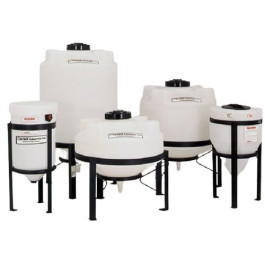
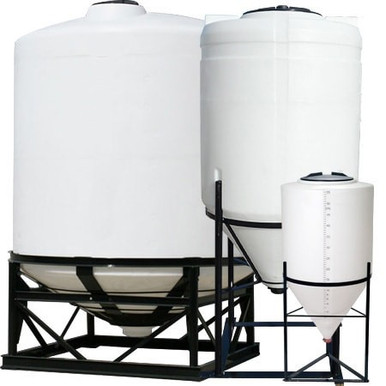
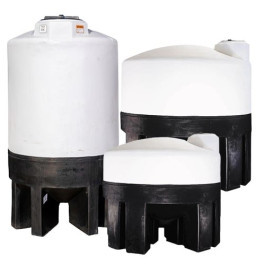
A 40-gallon induction cone built for the working end of a chemical-mixing line. The 40-degree cone keeps powders and concentrates moving toward the drain instead of caking on a flat floor, and the seamless Norwesco poly shell shrugs off the agricultural and industrial concentrates that eat lesser tanks.
Specifications at a Glance
Every figure below is pulled straight from the live product record for this exact tank — the same data on the product page, so what you read here and what you buy never disagree.
Standards & Materials
- ASTM D1998 — Standard Specification for Polyethylene Upright Storage Tanks. Governs wall-thickness and hydrostatic design for vertical rotomolded poly tanks of this class.
- FDA 21 CFR 177.1520 — Olefin polymers. The food-contact regulation the FDA-grade resin in this tank is compounded to meet.
- Specific gravity rating 1.5 — the tank is engineered for liquids up to 1.5× the density of water (water is about 8.34 lb/gal). Confirm your fluid’s SG before storage.
Product Overview
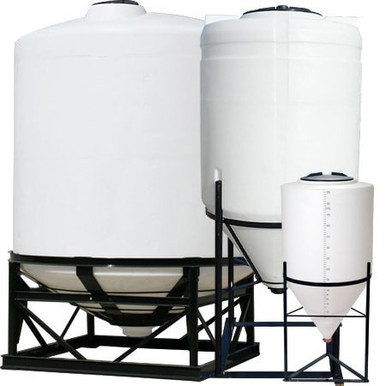
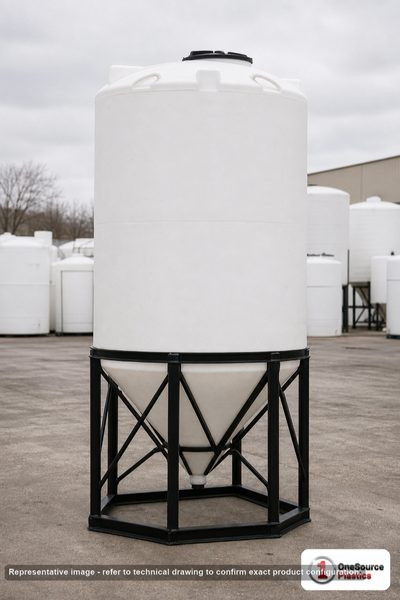
An inductor tank is not a storage vessel — it is a mixing station. The 40 Gallon 40 Degree Cone Bottom Inductor Tank earns its name from the cone: a 40-degree slope that funnels dry chemical, wettable powder, or heavy concentrate down to a single low point where it can be drawn off, recirculated, or eductor-fed into a larger batch without leaving residue stranded on a flat bottom.
At 27 inches in diameter and 34 inches tall, this is a benchtop-and-stand vessel sized for the operator who is actively working it: charging chemical through the lid, recirculating with a transfer pump, and drawing the blended solution off the cone tip. The 27-pound empty shell is easy for one person to handle and reposition, while a full 40-gallon charge at the 1.5 specific-gravity rating puts roughly 527 pounds onto the stand — which is exactly why the stand, not the tank, is the load-bearing component of the system.
Norwesco rotationally molds the tank as one continuous piece of polyethylene with no seams or weld lines, the failure points that matter most when you are repeatedly cycling aggressive concentrates through the same vessel. The translucent white wall lets the operator watch the blend level and color through the side rather than opening the lid mid-mix, and a 16-inch lid gives wide-open access for adding chemical, fitting a mixer shaft, or reaching in to clean the cone between formulations.
This is chemical-handling equipment, and it should be treated as such: it is built to mix and meter agricultural and industrial solutions within its density rating, not to store drinking water. Norwesco backs the shell with a 3-year warranty against manufacturing defects, the same molding pedigree that makes them the largest poly-tank producer in North America.
Technical Drawing
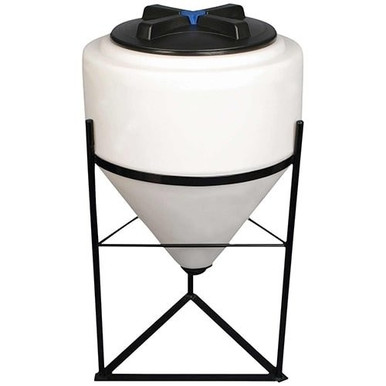
Official Norwesco technical drawing — 40 Gallon 40 Degree Cone Bottom Inductor Tank
Key Features and Specifications
- 40-gallon capacity — sized for chemical induction and mixing operations
- Constructed from virgin linear polyethylene (HDPE) with 1.5 specific gravity rating — handles liquids up to 12.5 lbs/gal
- 34" tall x 27" diameter — compact vertical footprint
- 27 lbs empty, approximately 527 lbs when full at rated specific gravity
- 16" lid opening for fill, venting, and interior access
- FDA approved for potable water and food-grade liquid contact
- 3 Year Warranty from Norwesco against manufacturing defects
- Translucent white walls allow visual level monitoring without opening the tank and reflect sunlight to keep contents cooler
- Rated for continuous service up to 120 F / 48 C
- Seamless one-piece rotational molding — no seams, no welds, no leak points
- Manufactured by Norwesco — a leading name in rotomolded polyethylene tanks
- Must be installed on the manufacturer-supplied or compatible stand rated for the full loaded weight. Never rest a cone bottom tank directly on its apex
- Ships via UPS or FedEx ground — typically arrives within 5-7 business days
Installation and Setup Guide
An inductor tank is only as safe as the structure it stands on. Unlike a flat-bottom tank that carries its own weight, a cone-bottom inductor transfers every pound through the cone into a stand — so the stand is the install.
Stand and Support
This tank must sit in a matched cone-bottom stand rated for the full loaded weight — roughly 527 pounds with a 1.5 specific-gravity charge. Never let the cone tip carry the load directly; the apex is the drain, not a foot, and resting on it concentrates stress at the single weakest geometry on the tank. Set the stand on a hard, level floor — sealed concrete in a mix room is ideal — and confirm all four legs make full contact before the first fill so the cone hangs square and drains evenly.
Plumbing the Cone and Eductor
Plumb the cone-tip outlet to feed your transfer pump or eductor with the shortest, straightest run you can manage; the whole point of the 40-degree cone is complete, residue-free drainage, and a long horizontal pipe full of settled concentrate defeats it. Use a full-bore valve at the tip so partially dissolved powder cannot bridge across a reduced port. Run the first connection in chemical-rated flexible hose, since rigid pipe bolted to the cone will crack the fitting as the poly flexes under each fill-and-drain cycle.
Ventilation
Charging dry chemical and recirculating concentrate releases vapor and dust, so this tank lives in a ventilated mix area, not a closed cabinet. Keep the 16-inch lid in place during agitation to contain splash, and fit a vent appropriate to the chemistry — many concentrates demand a pressure/vacuum relief vent rated for the specific product rather than a plain screen. Place an eyewash station within reach; you are working open chemical here.
Maintenance and Long-Term Care
An inductor tank works harder than a storage tank — it sees fresh chemical, mechanical agitation, and a full drain on every cycle — so its care is about residue control and fitting integrity rather than weatherproofing.
Between-Batch Inspection
- Cone clean-out: After each drain, look down the cone for caked powder or a residue ring above the tip. Stranded concentrate from one formulation contaminates the next and can chemically attack the wall if it sits.
- Tip valve: Cycle the cone-tip valve open and closed and feel for grit. Partially dissolved powder is abrasive and wears valve seats faster than clean liquid ever would.
- Wall translucency: Hold the tank to the light. Clouding, crazing, or a soft swelling on the inside face is the early signature of a concentrate that is too aggressive or too concentrated for poly — catch it before it becomes a leak.
- Stand check: Confirm the stand legs are square, uncorroded, and still taking the load evenly. A leaning stand throws the cone off-axis and leaves product in one quadrant.
Decontamination Between Chemistries
This is the maintenance step that matters most on an inductor. Before switching formulations, flush the tank, cone, and outlet line per the chemical manufacturer's decontamination procedure — not just a water rinse. Residual concentrate from an incompatible product can react with the next charge or quietly degrade the resin from the inside. Because this is chemical-service equipment, it is never sanitized and returned to potable use.
Long-Term Care
Indoors and out of direct sun, the polyethylene itself ages slowly; the wear shows up first at the working interfaces — the tip valve, the mixer mount, and the lid gasket. Keep a spare valve and gasket on the shelf so a worn part never forces an unplanned shutdown mid-formulation.
Alternatives and Comparisons
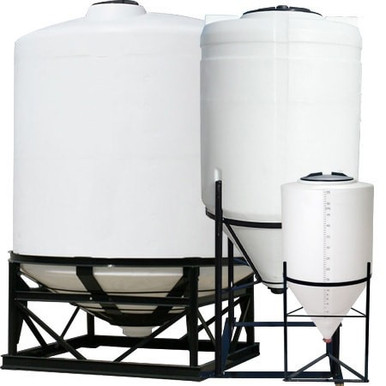
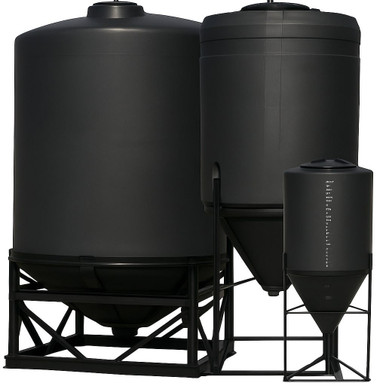
The 40 Gallon 40 Degree Cone Bottom Inductor Tank sits in a family of cone-bottom mixers, and the right choice turns on cone angle and capacity rather than gallons alone.
Cone angle drives drainage: A 40-degree cone is a balanced middle ground — steep enough to clear most powders and concentrates, shallow enough to keep overall height manageable on a benchtop stand. Steeper 45- and 60-degree cones evacuate sticky or fast-settling solids more aggressively but stand taller; a shallower angle is harder to fully drain. Match the angle to how readily your chemical settles, not to a number.
Inductor vs. flat-bottom storage: If you are blending and metering, the cone is the whole value — it gives you a clean, complete drain between batches. If you only need to hold a finished solution, a flat-bottom vertical tank stores the same volume cheaper and without the stand. Buy the cone for mixing, not for parking liquid.
Other 40-Gallon Options

Frequently Asked Questions
How long will the 40 Gallon 40 Degree Cone Bottom Inductor Tank last?
Used as intended — mixing compatible chemistries within its density rating, on a proper stand, out of direct sun — the shell readily reaches 15-plus years. An inductor's life is usually limited by the working parts and the chemistry, not the poly: tip valves wear from abrasive powders and aggressive concentrates can craze the wall over time. Decontaminate thoroughly between products and inspect the cone after each batch, and the tank itself will outlast several rounds of valves and gaskets.
What chemicals can I store in this tank?
This is chemical-mixing equipment, not a drinking-water tank. It is rated to 1.5 specific gravity and built to induct, blend, and meter agricultural and industrial concentrates — fertilizers, wettable powders, surfactants, and water-based cleaning chemistries within that density band. Keep it away from fuels, solvents, and anything flammable, and always verify a new product against a polyethylene compatibility chart before charging it, since certain oxidizers and hydrocarbons attack poly. Do not use this tank for potable water.
Does this tank come with a warranty?
Yes — Norwesco covers the shell with a 3-year warranty against defects in materials and workmanship when the tank is used within its ratings. That protects molding defects like voids and pinholes. It does not cover chemical attack from an incompatible product, a cone cracked by resting on the tip, or wear to valves and gaskets, which are normal-service items on a mixing tank. Keep your invoice and a photo of the tank seated correctly in its stand.
Can I install this tank underground?
No — emphatically not. A cone-bottom inductor is open-topped working equipment with a thin, steeply tapered cone designed to drain, not to resist soil pressure. Burying it would collapse the cone and void the warranty. Underground storage calls for a purpose-built cistern with ribbed, reinforced walls. This tank belongs above ground, in its stand, in a ventilated mix area.
Buying Considerations
Before ordering the 40 Gallon 40 Degree Cone Bottom Inductor Tank, settle three things. First, the stand: a cone-bottom tank cannot stand on its own, so confirm you have a matched stand rated for the roughly 527-pound loaded weight before the tank arrives. Second, the chemistry: verify every concentrate you plan to mix is compatible with polyethylene and falls within the 1.5 specific-gravity rating — this is a chemical vessel, never a potable-water tank. Third, the freight: at 27 pounds empty it ships UPS or FedEx ground, usually arriving in 5 to 7 business days, so no liftgate or dock is required to receive it.
Related Products You May Need
Questions? Call (866) 418-1777 — our team knows these products inside and out and can help you select the right tank for your application.
Recommended Tanks for This Guide
Live pricing, updated automatically · estimate freight to your ZIP.