Five hundred gallons at 45 degrees, 64 inches across
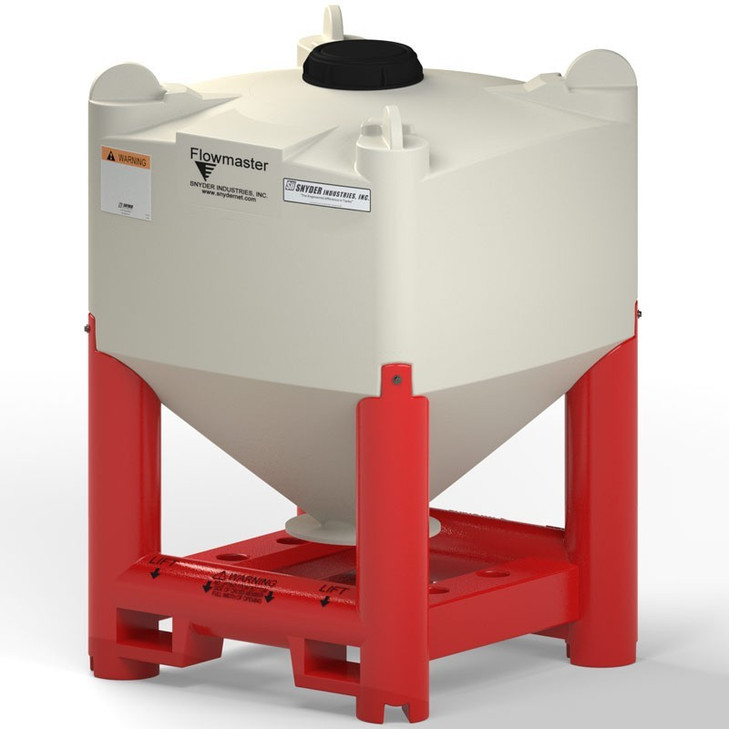
The Snyder SII-6190000N45 is a 500 gallon 45 degree cone bottom tank in white polyethylene, listed at 64 inches in diameter and 63 inches tall, at 120 pounds empty and 120 pounds shipping. Wider than it is tall is unusual for a cone, and it is the shape that makes this a workable bench-height process vessel rather than a tower. The wall is rated at a specific gravity of 1.9, and the sheet gives 4,170 pounds for 500 gallons of water at 8.34 pounds per gallon, with 7,923 pounds of max contents. The top fitting is an 18 inch threaded vented manway. The service limit is 120 F / 48 C. Freight is given as LTL under NMFC 156600-01, out of Lincoln, Nebraska. The sheet publishes no outlet, no inlet, no cone angle field, no stand and no warranty term, so none of them is claimed here; the 45 degrees comes from the product name.
Want a second opinion on the size? Call 866-418-1777 with the daily draw and the delivery interval, or price freight to your ZIP and add it to your cart above.
The steep cone, and the three listings that match it to the inch
Four tanks on this sheet hold 500 gallons and three of them are listed at exactly the same 64 by 64 by 63 inches and exactly the same 120 pounds as this one: 6190000N42, 6190000N48 and 6190000N51. The sheet gives no dimension, no weight and no rating that separates them, so we print what it says and tell you to order the part number your drawing, your spares list or your existing installation already names; matching a number that is already in a plant's paperwork is worth more than any argument about which is nominally better. What does separate this tank from the rest of the world is the angle. Forty-five degrees is the steepest of the three common cone angles, and it is bought for one reason: the vessel has to empty completely, every time, without a heel left in the bottom and without anything bridging across the throat. Where a product settles, thickens, carries solids or simply has to be changed out between batches, that angle is the specification and the capacity is secondary. Where the vessel is a buffer that never runs dry, a shallower cone is cheaper in height and just as good, and we would rather say so. The two buyer's guides written around this exact size are the right place to settle it: the 500 gallon 45 degree cone bottom tank buyer's guide covers this angle in detail, and the 500 gallon 30 degree cone bottom tank buyer's guide makes the case for the shallower one so you can see both arguments in full. The second thing to settle before the order is what holds it up. A cone bottom tank has no flat floor, this sheet publishes no stand, no legs and no ring, and we will not print a part number that is not on it. The stand is a separate item, and it also sets the clearance underneath, which is the dimension that decides whether a drum, a tote or a pump fits below the discharge. Design it around the loads: 120 pounds of empty tank, 4,170 pounds of water and 7,923 pounds at the rating, all arriving through the stand's feet onto flat, continuous, level ground. Check 500 gallons against your real batch and turnover in the tank sizing calculator before the stand is built around it, and take the freeboard from the tank sizing guide, because a mixer in a cone throws product further up the wall than most people expect.
Four 500s, a 150 and a 1000
| Part | Gallons | Diameter or plan x height | Empty weight |
|---|---|---|---|
| SII-6190000N45 (this tank, 45 degree) | 500 | 64 x 64 x 63 in | 120 lb |
| 6190000N42 (heavy duty name, same dimensions) | 500 | 64 x 64 x 63 in | 120 lb |
| 6190000N48 (heavy duty name, same dimensions) | 500 | 64 x 64 x 63 in | 120 lb |
| 6190000N51 (heavy duty name, same dimensions) | 500 | 64 x 64 x 63 in | 120 lb |
| 32101 (small mixing tank) | 150 | 36 x 36 x 48 in | 45 lb |
| 1890000N42 (the step up, wide and low) | 1000 | 86 x 86 x 66 in | 210 lb |
The bottom two rows are where the real choice lives, because the top four are one vessel under four part numbers. 32101 is a 150 gallon cone bottom mixing tank at 36 inches across, 48 inches tall and 45 pounds. That is a genuinely small vessel: a single-person lift when it is dry, a footprint that fits between two machines, and a batch size for pilot work, a lab, a small dosing duty or a product you make a little of at a time. If your batch is 100 gallons, buying this 500 means three quarters of the vessel is freeboard and the mixer never reaches the surface properly. 1890000N42 is the step up, and it is the more interesting row: 1,000 gallons in an 86 inch circle only 66 inches tall, at 210 pounds. Twice the volume for three inches of extra height is an unusually good trade, and it happens because the vessel gets wider rather than taller. What it costs is floor and bund area, an 86 inch circle instead of a 64 inch one, plus a stand sized to match. So the sequence is: decide the angle from how your product behaves, then decide the volume from the batch, then check the floor. If the batch is genuinely 500 gallons, this tank at 64 inches across and 63 inches tall is about as convenient as a cone gets, because at that height a person standing beside it on the floor can see into it and reach the rim of the manway without a platform.
Not sure which one? Tell us the liquid, the site and the ceiling height at 866-418-1777, or request a written quote with freight to your ZIP.
A vented manway at eighteen inches on a five foot tank
- The vent arrives with the fitting: this sheet lists an 18 inch threaded vented manway, so the breathing path is part of the top fitting rather than something specified separately. That is exactly what a steep cone needs, because a pump pulling from the low point of a 45 degree cone drops the level quickly and a wall that cannot take air in takes the load instead. Keep it clear, check it whenever the manway is opened, and never blank, tape or paint over it.
- Access: 18 inches of opening at 63 inches, which is the one real ergonomic advantage of a wide, low cone. Plus the stand it will be lower than most cone tanks of this volume, and a hose, a paddle or a sampling device goes in without a fixed platform in many installations. Check the final height with the stand under it before assuming that.
- The discharge: the sheet publishes no outlet, no inlet and no bulkhead. The cone ends in a discharge that the sheet does not dimension, so no size, thread or valve is claimed here. Tell us the line size, the valve type and the product and we will confirm what this part number carries before it ships.
- What hangs below: the valve and the first run of pipe are carried on the stand's own steelwork, not on the cone, with a flexible connector at the first joint so a pump start never loads the wall.
- The stand: not on this sheet. No legs, no frame, no bolt pattern and no load rating is published, and none is invented. It is a separate item bought before the tank so the clearance under the discharge is a decision and not a surprise.
- Ratings: a specific gravity rating of 1.9, 4,170 pounds of water at 500 gallons, 7,923 pounds of max contents, and a service limit of 120 F / 48 C. No warranty term appears on this sheet.
Name the product when you order, because on a cone the gasket, the valve and the discharge fitting are all chosen against the chemistry rather than against the tank. A 45 degree cone is also the shape people fit mixers to, and a mixer belongs on its own bridge or frame over the tank rather than clamped to a polyethylene rim; tell us the duty and we will be honest about what this vessel will and will not carry.
Mixing, batching and the tank that has to run dry
Five hundred gallons over a steep cone is a batch vessel, and the buyers are the operations that make something up, use it, and start again: polymer and coagulant make-up at a small water or wastewater plant, batch blending in specialty chemical manufacture, dye and finishing baths in textiles, food and beverage make-up where the vessel is cleaned between products, agricultural blending and nurse duty where the tank must leave clean before the next chemistry, plating and metal finishing, and pilot or small-batch production where the product changes weekly. The thing all of them share is changeover. A vessel that leaves a heel behind contaminates the next batch, costs a disposal ticket, and turns a cleaning routine into an argument; a steep cone that drains completely removes the problem rather than managing it. If your material settles hard or packs, say so when you enquire and we will be straight with you about whether this angle is enough.
Chemical service ratings
The resin is rated for the liquids below at the concentrations shown; the fitting and gasket called out are the ones to order with the tank. Verify the exact service on the linked page or in the chemical compatibility database before ordering.
- sulfuric acid (98%, CPVC fittings, Viton gaskets)
- hydrochloric acid (37%, PVC, Viton)
- phosphoric acid (85%, PVC, Viton)
- hydrofluoric acid (48%, PP/PVC, Viton)
- hydrofluosilicic acid (26%, PP/PVC, Viton)
- sodium hypochlorite (under 16.5%, PVC, Viton)
- hydrogen peroxide (50%, PVC, Viton)
- ferric chloride (50%, PVC, EPDM)
- ferric sulfate (60%, PVC, EPDM)
- aluminum sulfate (50%, PVC, EPDM)
- potassium hydroxide (saturated, PVC, EPDM)
- sodium carbonate (30%, PVC, EPDM)
- ethylene glycol (100%, PVC, EPDM)
- calcium chloride (40%, PVC, EPDM), and ozonated water (up to 10 PPM, PVC, EPDM), among others. Two cases change your install bill of materials:
- DEF (32.5%, 316SS fittings, EPDM) and
- peracetic acid (30%, 316SS, Aflas) both call for stainless-steel fittings rather than PVC, and peracetic acid needs Aflas gaskets - not the Viton or EPDM
Lincoln, Nebraska, and 120 pounds shipped
This tank is moulded at Lincoln, Nebraska, and the sheet lists Nebraska as the state it ships from, a central lane into the plains and the Midwest. The freight class is given as LTL, a shipping mode rather than a numeric class, under NMFC 156600-01, and it shipments at 64 inches by 64 inches by 63 inches, so it moves on a pallet rather than as a parcel. Price the lane to your ZIP with the freight cost estimator; the listed price is before freight. At 120 pounds empty it comes off with a pallet jack or between two people, carried under the body and never by the manway, and a cone bottom tank on the ground is unstable by design, so plan where it goes before it arrives rather than standing it in a corner. Build and level the stand first, anchor it, then set the tank into it. Fill it with clean water, hold that 4,170 pound load, and read the manway seal, the cone joint and the stand's feet before any product goes near it. Drain it and let it dry. On a batch vessel the habit worth starting on day one is a written changeover routine taped to the stand, because the tank that empties completely only helps if somebody actually empties it. Chalk the full-water line on the outside after the first fill; it is the level every later reading gets checked against.
Freight and documents
Ships from: Lincoln, NE. LTL freight is quoted to your ZIP with the freight cost estimator or by phone at 866-418-1777. The listed price is before freight.
Technical drawing (PDF) for Snyder Industries 6190000N45.
See this tank
Interactive 3D model with live fill. This tank has an interactive 3D model built to its manufacturer dimensions. Rotate it, and set a fill level to see how much liquid it holds at any height. Open the 3D view on the product photo above. Download the 3D model (GLB).
Product video. Watch the Snyder Industries 500 Gallon 45 Degree HDPE Cone Bottom Tank in White video (67 seconds) with dimensions, fittings and shipping notes.
Ready to order?
Add it to your cart at the top of this page, get LTL freight to your ZIP, request a written quote, or call 866-418-1777. The listed price is before freight.