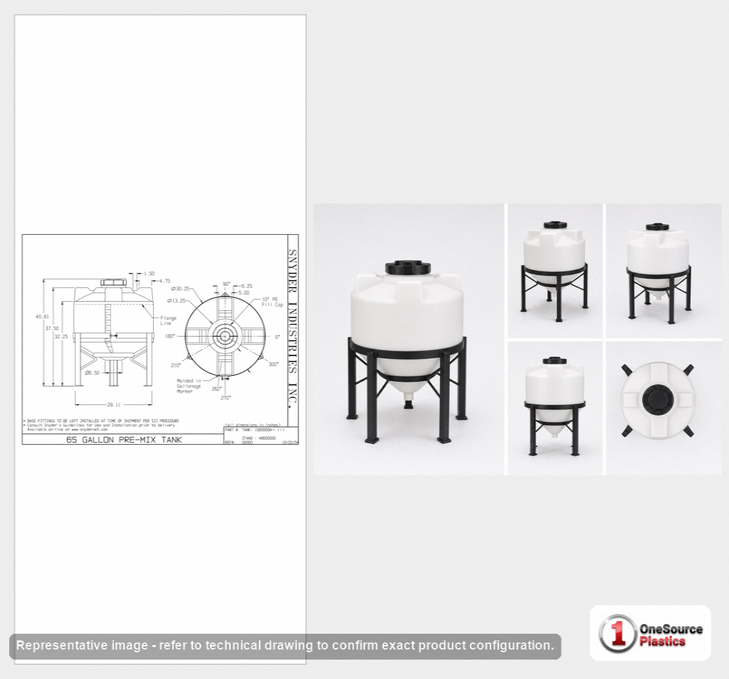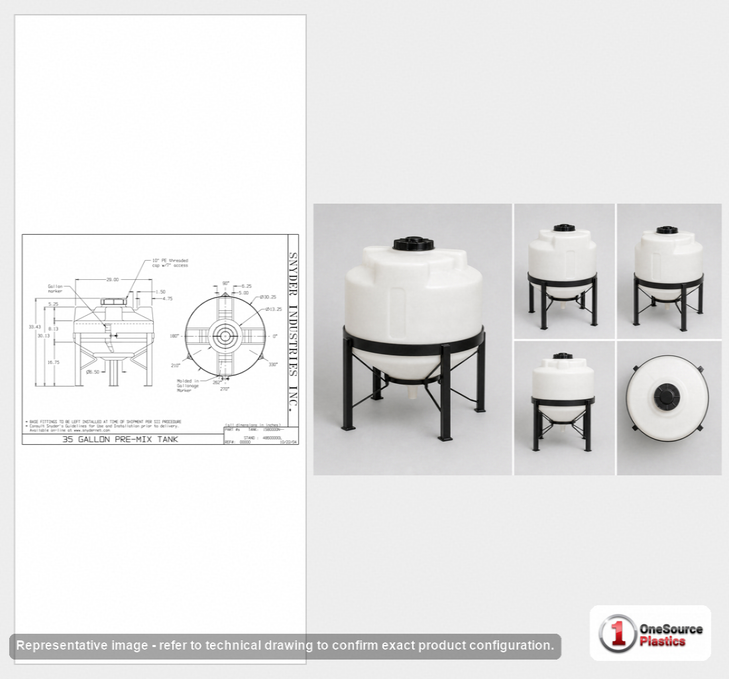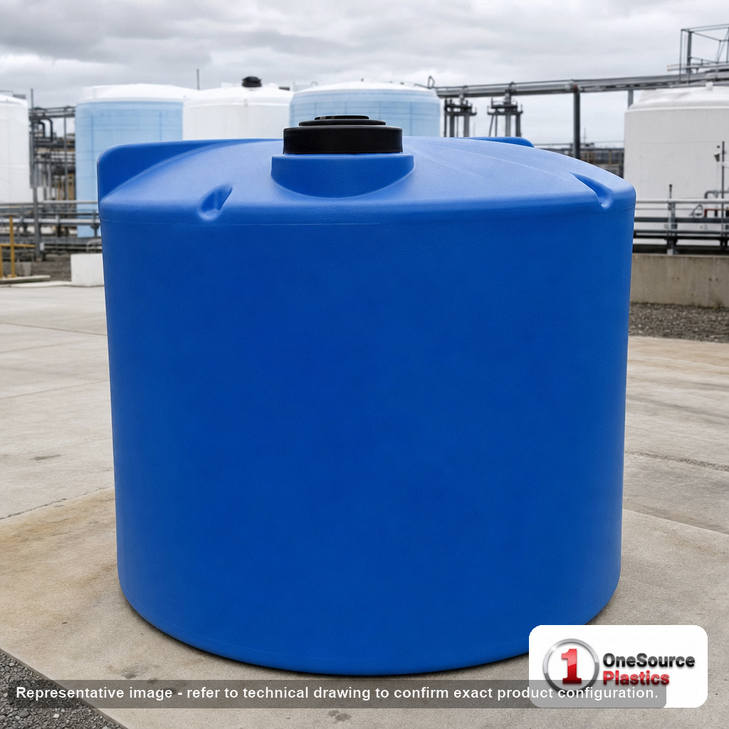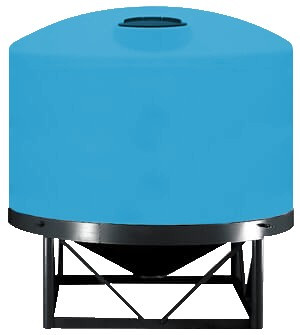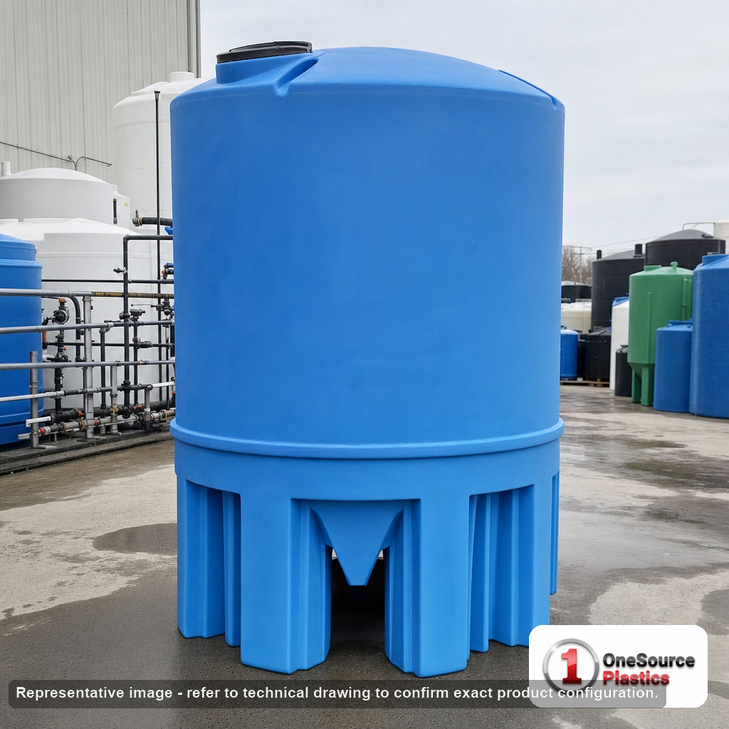
Three hundred and twenty-five gallons on its own stand, fifty-five inches overall
Part number SII-1560500N45 is a 325 gallon cone bottom tank listed at 48 inches long, 48 inches wide and 55 inches tall, with the diameter given as 48 inches, at 145 pounds empty and 145 pounds shipping. The material field reads High Density Linear Polyethylene and the colour field reads White. The cone angle field on this record reads 30 degrees. The wall carries a specific gravity rating of 1.9, and the sheet gives 5,150 pounds of max contents against 2,710 pounds of water at 8.34 pounds per gallon. The opening on top is an 18 inch threaded vented manway and the lid field reads 18 inches. The service limit is 100 F / 37 C. This is the with-stand listing: the application field reads Cone Bottom w/Poly Stand, and the 55 inch height and 145 pound weight on this record are the figures this page works from. No separate stand height, stand load, leg count, anchor pattern or stand material beyond that field is published, and none is stated. Freight class reads 400 beside an LTL ship mode, out of Merced, California. The outlet and inlet fields are empty, and there is no warranty term, no NMFC number and no structural detail on this sheet.
Need the certification on file? Add the 325 gallon tank to your cart above with freight quoted to your ZIP, or call 866-418-1777 and the paperwork ships with the tank.
The duty a stand-mounted cone is bought for: gravity draw and a clean drain
The duty comes first and here it is specific: this is bought where liquid has to come out of the bottom of a tank without a pump under it, and where the vessel has to empty completely between batches. That is a gravity draw, and it only works if the discharge sits above whatever it is filling. A nursery or greenhouse feeding an injector or filling a sprayer. A wash bay or vehicle wash making up and drawing off a solution. A dosing station feeding a metering pump that needs flooded suction rather than a lift. A small batching operation where a mix is made up, held briefly and run off into containers, carts or a line. A settling duty where solids drop to the point and are drawn off first. In every one, the height of the outlet above the floor is the specification, and that is exactly what the stand in this listing buys: the whole assembly is listed at 55 inches, four feet seven inches, so the tank is off the floor on arrival rather than sitting on something a site had to source, weld or improvise. That matters more than it sounds. A cone bottom tank has no flat floor and cannot stand on its own bottom, so on most cone listings the support is a separate purchase, a separate lead time and a separate engineering question. On this one the stand is part of the listing, and the figures this page quotes for it are the ones the record publishes: 55 inches overall and 145 pounds empty, with an application field reading Cone Bottom w/Poly Stand. No stand height, no load rating, no leg count, no anchor specification and no material for the stand beyond that field appears on the sheet, so none is stated here; if the drawing matters to your installation, ask and we will confirm what the part number carries in writing. Plan the rest of the space around two numbers. The footprint is a 48 inch circle, four feet, which is a genuinely compact area for this volume. The finished height is 55 inches plus the clearance a person needs above an 18 inch manway to open it, look into it and run a fill line in, and that clearance is what you measure to the lowest fixed thing above the spot rather than to the roof. Under the cone, leave the room the container, cart or pump actually needs, because that space is what the stand was bought to create and it cannot be recovered afterwards. Size the working volume with the tank sizing calculator and take the freeboard discipline from the tank sizing guide before the bay is marked out.
The only tank on this sheet, and two dry hopper bins listed beside it
| Part | Listed capacity | Length x width x height | Empty weight |
|---|---|---|---|
| SII-1560500N45 (this tank with its stand, white, rated 1.9) | 325 gallons | 48 x 48 x 55 in | 145 lb |
| SII-6370540N95402 (a dry hopper bin, rated in cubic feet) | 40 cubic feet | 53 x 48 x 68 in | 341 lb |
| SII-6370719N95402 (a larger dry hopper bin) | 80 cubic feet | 53 x 48 x 102 in | 385 lb |
This record is unusual and it is worth being straight about why. The only liquid tank on it is this one; the two rows beside it are dry hopper bins, and the sheet rates them in cubic feet rather than in gallons. They are listed here exactly as the record lists them and nothing about liquid duty, drain behaviour or a gallon figure is attributed to either of them, because the sheet does not carry that and we will not invent it. Their dimensions are the useful part of the comparison: both are 53 by 48 inches in plan, one at 68 inches tall and 341 pounds, the other at 102 inches and 385 pounds. Put beside this tank's 48 inch circle at 55 inches and 145 pounds, the pattern is that this is the smallest and lightest item on the record by a clear margin, and the only one that arrives as a tank on a stand. That leaves the family question unanswered in the honest direction: there is no other 325 gallon listing on this sheet to compare against, no second colour and no second rating. If you are choosing between this volume and a larger or smaller stand-mounted cone, the four buyer's guides we link below cover the neighbouring sizes and angles in detail, and they are a better comparison than a table that does not carry them. Start with the three hundred gallon cone bottom with poly stand buyer's guide, which is the closest volume to this one, then read the guide for the next step up in that family, the smaller stand-mounted guide where the bay is tight, and the larger, shallower-angle guide where the batch is bigger than this one holds. Between them they cover the decision this table cannot.
Pad already poured? Send its size to 866-418-1777 or in a quote request and we will match a row to it, freight to your ZIP included.
Thirty degrees to the low point, with no discharge size on the record
- The drain path, and on this listing it is published: the cone angle field reads 30 degrees, so the fall to the low point is a stated fact on this record rather than something read off an image. On a stand-mounted tank that angle is the whole reason the vessel empties into whatever is underneath it.
- What the record does not size: the outlet field is empty. No outlet dimension, no thread, no bulkhead and no valve is published, so none is claimed here. Since this listing exists to discharge by gravity, that is the first question to settle before an order: tell us the line size you need to land, the valve type and the product, and we will confirm what this part number carries.
- The inlet: blank on this record. The fill arrangement is not published and is not described here.
- The stand: the record gives 55 inches overall and 145 pounds, and the application field reads Cone Bottom w/Poly Stand. No stand height, no load rating, no leg count, no anchor pattern and no bolt specification appears on this sheet, so none is stated. Anything below the tank that is not in those two figures is a question for us rather than an assumption for you.
- Access on top: an 18 inch threaded vented manway with a lid field of 18 inches, at 55 inches from the floor. That is a reachable opening from a step, which is one of the practical advantages of this size over a taller column holding the same volume.
- The vent: it arrives with the manway on this sheet rather than as a separate item. Keep it clear, look at it whenever the tank is opened, and never blank, tape or wrap it.
- Ratings and blanks: a specific gravity rating of 1.9, 2,710 pounds of water at 325 gallons, 5,150 pounds of max contents and a service limit of 100 F / 37 C. No warranty term, no NMFC number and no structural detail appears on this record.
One line about the loads, because a stand-mounted tank concentrates them: 145 pounds of assembly, 2,710 pounds of water and 5,150 pounds at the rating all arrive at the feet of the stand rather than over a 48 inch circle of slab. Set it on something flat, level and solid, and check it is bearing evenly before the first fill.
Nurseries, wash bays and dosing rigs that need the tank off the floor
The jobs that buy a stand-mounted 325 are the ones where the discharge has to be above something. A greenhouse or nursery drawing feed into an injector, a cart or a sprayer without lifting it. A vehicle wash or wash bay making up a solution and running it off into a bucket, a machine or a line. A dosing rig where a metering pump wants flooded suction rather than a lift, which is both easier on the pump and easier on the person who has to prime it. A small batch operation making up a mix, holding it briefly and decanting it into containers. A settling duty where the solids drop to the point, get drawn off first, and the clear liquid follows. A mobile or seasonal setup where the whole assembly has to be positioned once and used as it stands. In all of them the 30 degree cone and the 55 inch overall height are doing the same job together: the contents run to a point and the point is above the floor. Two honest limits. The 1.9 figure on this record is a wall rating, describing how dense a liquid the wall is rated to hold and nothing more. It says nothing about how your product behaves against polyethylene, and we will not present it as if it did. Name the liquid, the concentration and the year-round temperature when you enquire, check it in our chemical compatibility reference before a gasket, a seal or a valve is specified, and let the chemistry decide those. The service limit is 100 F / 37 C, which matters where a solution is made up warm or where the tank stands in full sun, so read your duty against it rather than around it. On the routine: check the stand is bearing evenly before the first fill and again after it, because a tank on feet tells you about an uneven floor faster than a tank on a slab does. Walk right around the assembly at every inspection, read the manway seal and the cone in daylight, keep the area under the discharge clear so a weep is seen rather than stepped in, and keep a written record of what the tank has held. On a vessel that changes product between jobs, that record is worth more than any single inspection.
Chemicals this resin is rated for, with the fitting and gasket to order
These are the chemicals listed for this tank at the concentrations shown. Each links to the full compatibility page; confirm your exact concentration and temperature there or in the chemical compatibility database before ordering.
- Hydrochloric Acid (37%)
- Sulfuric Acid (98%)
- Phosphoric Acid (85%)
- Sodium Hypochlorite (
- Hydrogen Peroxide (50%)
- Ferric Chloride (50%)
- Ethylene Glycol (100%)
- Peracetic Acid (30%)
- Potassium Hydroxide (saturated)
- DEF (32.5%) &
- Urea Solution (50%)
- Acetic Acid
- Hydrofluoric Acid
- Sodium Thiosulfate and
- Potassium Carbonate - verify each in the full
A hundred and forty-five pounds out of Merced, California
This one is moulded at Merced, California, and California is the shipping state on the record, which makes the west coast the short lane and the east a planned one. It is the only item in this group that ships from California. The freight class field reads 400, a numeric class rather than a mode, the ship mode reads LTL, and the sheet publishes no NMFC number. The package is 48 inches by 48 inches by 55 inches at 145 pounds, which is a compact shipment at a light weight and generally an easy ticket by tank standards. Price your own ZIP with the freight cost estimator; the listed price is before freight. Receiving it is a forklift or a two-person job depending on your dock, and the sensible plan is to move it as one item to where it will stand rather than handling it twice. Have the floor or pad ready first: flat, level, solid and clear enough to walk right around a four-foot circle, with room underneath for whatever the discharge is meant to reach. Set it down square, check every foot is bearing before anything goes in, and look at the cone and the low point in daylight while the tank is still empty and easy to move. Then prove it with clean water rather than with product: hold the 2,710 pound load, read the manway seal, the cone, the stand feet and the floor around them, and leave it standing full overnight before a line is connected. If the assembly has to be moved later, empty it first and move it as one piece rather than dragging it loaded; 5,150 pounds at the rating is not a load to slide across a floor on a Friday afternoon. Tape a copy of the spec sheet inside the control panel door; the next person to touch the tank will not have the box it came in.
Freight and documents
Ships from: Merced, CA. LTL freight is quoted to your ZIP with the freight cost estimator or by phone at 866-418-1777. The listed price is before freight.
Technical drawing (PDF) for Snyder Industries SII-1560500N45.
See this tank
Product video. Watch the 325 Gallon 30 Degree HDPE Cone Bottom Tank with Stand in White video (67 seconds) with dimensions, fittings and shipping notes.
Ready to order?
Add it to your cart at the top of this page, get LTL freight to your ZIP, request a written quote, or call 866-418-1777. The listed price is before freight.