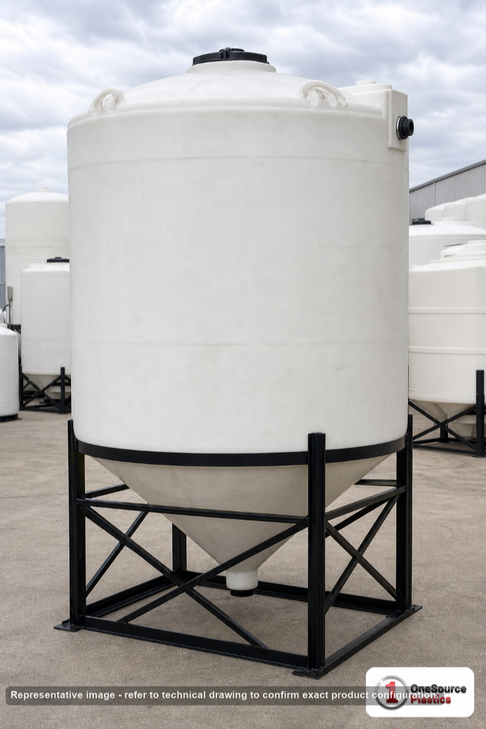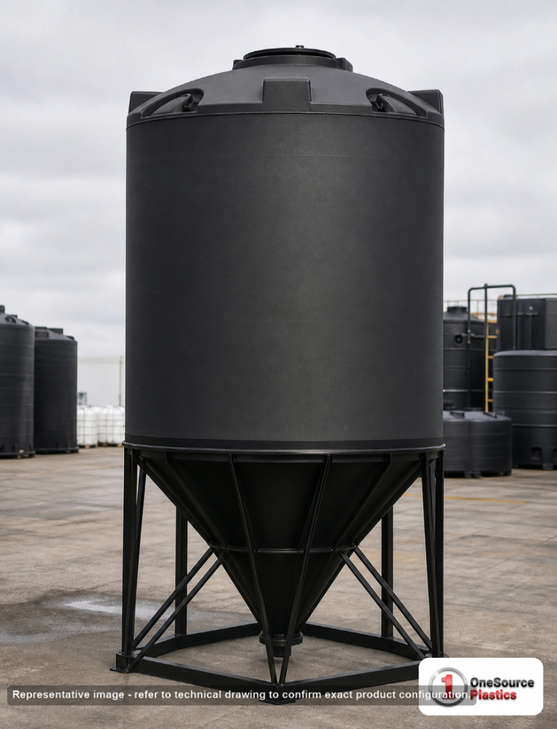
The black thousand: the same sixty-four inch column, no light through the wall
Snyder lists the 5000000N48 as a 1000 gallon cone bottom tank, 64 inches long, 64 inches wide and 103 inches tall, diameter 64 inches, at 210 pounds empty and 210 pounds shipping. The colour field reads Black and the material field reads Crosslinked Linear Polyethylene. Heavy duty is the maker's own name word here. The cone angle field reads 45 degrees, the wall carries a specific gravity rating of 1.9, and the sheet gives 15,846 pounds of max contents against 8,340 pounds of water at 8.34 pounds per gallon. The opening on top is an 18 inch threaded vented manway. The outlet field reads 1 Manway / Lid, naming an opening rather than a discharge, and no discharge size appears on the record. The structural fields list 4 tiedown lugs and 1 flange line. The service limit is 100 F / 37 C, freight class reads 400 beside an LTL ship mode, and the tank is moulded at Lincoln, Nebraska. No inlet, no lid size, no warranty term, no certification entry, no NMFC number and no stand is published, and none is claimed on this page.
Want a second opinion on the size? Call 866-418-1777 with the daily draw and the delivery interval, or price freight to your ZIP and add it to your cart above.
Duty first: dosing and holding where daylight is part of the problem
What this tank is bought to do is hold a thousand gallons of something that is drawn down and made up again, in a place where sunlight reaches the vessel. That second clause is the whole reason the black listing exists alongside the natural white one. Outdoors on a pad, in a yard, under a skylight, in a bay with a roof light or a translucent panel wall, light reaching a stored liquid is not a cosmetic question: it feeds algae in water systems, and plenty of products are specified to be kept dark. An opaque wall answers that without a cover, a shade or a tarpaulin somebody has to remember. The trade is equally plain and worth stating: you cannot see the level through the wall of a black tank, so a level instrument stops being an optional extra and becomes part of the specification. The duties are the ordinary ones at this volume. Dosing solution held at a pump skid. Polymer or coagulant made up and drawn down through a shift. Liquid feed and crop input blends between applications. Rinse or recovery water that cycles through the day. Buffer volume between two stages running at different rates. All of them empty and refill, which is why the cone is here: the sheet gives 45 degrees, so the fall to the low point is published rather than guessed, and at 8,340 pounds of water the difference between draining to a point and leaving a ring on a floor is a genuine volume rather than a detail. Then the shape, because it decides where the tank can go. The circle is 64 inches, five feet four inches, and the shell stands 103 inches, eight feet seven inches. It is a column rather than a drum, so it buys its volume out of height and hands you back floor area. That suits a crowded plant room, a marked bay on a skid, the gap between two machines, or an outdoor pad where the concrete is already poured to a size. Stack the heights before ordering: the stand, plus 103 inches of shell, plus the clearance above an 18 inch manway for a person and a fill line, measured to the lowest fixed thing over the spot. Underneath, leave the cone the room to discharge into whatever it is discharging into, because that space cannot be recovered once the structure is set. The structure is a separate purchase. There is no flat floor on this vessel, it cannot stand on its own bottom, and this sheet publishes no stand, no legs, no skirt, no support ring and no bolt pattern, so this page prints none. It does publish the loads: 210 pounds empty, 8,340 pounds of water, 15,846 pounds at the rating, all landing on stand feet inside a 64 inch circle. Settle that properly against the cone bottom tank stand compatibility matrix, size the volume with the tank sizing calculator, and take the freeboard discipline from the tank sizing guide.
The eighty-six inch thousand, the five hundred and the twelve fifty
| Part | Gallons | Length x width x height | Empty weight |
|---|---|---|---|
| 5000000N48 (this tank, black, 45 degree cone, rated 1.9) | 1000 | 64 x 64 x 103 in | 210 lb |
| 1890000N42 (the wide, short thousand) | 1000 | 86 x 86 x 66 in | 210 lb |
| 1890000N48 (that wide shell, another listing) | 1000 | 86 x 86 x 66 in | 210 lb |
| 1890000N51 (that wide shell, a further listing) | 1000 | 86 x 86 x 66 in | 210 lb |
| 6190000N42 (half the volume on this same circle) | 500 | 64 x 64 x 63 in | 120 lb |
| 8310000N42 (more volume, widest and shortest here) | 1250 | 95 x 95 x 70 in | 300 lb |
Four of these rows hold 1000 gallons and two shapes carry them. This one is the column: 64 inches of circle, 103 inches of height, 210 pounds. The three 1890000 listings are the drum: 86 inches of circle, 66 inches of height, the same 210 pounds. That is the only difference worth making a decision on, and it is decided by your building rather than by anything the tank does. Roof low, floor free? Take the wide shell. Floor crowded, height available? This one. Snyder lists this shell in more than one colour and the other listing is not carried on this record, so no part number for it is printed here; ask and we will confirm it in writing rather than guess it. The 6190000N42 row is the most useful comparison on the page for anyone still sizing. It holds 500 gallons on exactly this 64 inch circle at 63 inches and 120 pounds, so it occupies the identical floor area at four feet less height. If the process turns over less than you first assumed, that is the tank, and the footprint on your drawing does not change by an inch. At the other end, 8310000N42 holds 1250 gallons but takes a 95 inch circle at 70 inches and 300 pounds, which is the answer when the ceiling is the binding constraint rather than the slab. Nothing on this sheet describes a wall thickness, a layer count or a construction difference between any of the listings, so this page describes none. Where the material rather than the shape is the real question, the article on when crosslinking matters for a chemistry duty settles it properly.
Not sure which one? Tell us the liquid, the site and the ceiling height at 866-418-1777, or request a written quote with freight to your ZIP.
Where the liquid leaves, and what the outlet field actually says
- The discharge path: a 45 degree cone is published on this sheet, so the fall to the low point is a stated fact rather than an inference. On a column 103 inches tall, that fall is also what stops solids settling out where a pump cannot reach them.
- The outlet field: it reads 1 Manway / Lid. That names an opening, not a discharge, and it is printed here exactly as it reads rather than converted into a pipe size. No outlet dimension, no thread, no bulkhead and no valve is published, so none is claimed. Tell us the line size, the valve type and the product, and we will confirm what this part number carries before an order is placed.
- Supporting the pipework: valve, reducer and the first run of pipe belong on their own steelwork off the stand rather than on the tank, with a flexible connector at the first joint so pump vibration stays out of the wall.
- The opening on top: an 18 inch threaded vented manway sitting at 103 inches plus the stand. Plan the access with the structure, not afterwards, and bring the fill to a coupling at working level instead of asking anyone to carry a hose up a ladder.
- The vent: supplied with the manway on this sheet rather than specified separately. On a black tank the vent is also the thing nobody sees from the ground, so put it on the same inspection round as the manway seal and never blank, tape or wrap it.
- Structural detail: 4 tiedown lugs and 1 flange line, which is all this record carries. No lifting lug, no ladder lug, no anchor specification and no bolt pattern is published, and none is stated.
- Ratings and blanks: a specific gravity rating of 1.9, 8,340 pounds of water at 1000 gallons, 15,846 pounds of max contents, a service limit of 100 F / 37 C. No inlet, no lid size, no warranty term and no NMFC number appears anywhere on the sheet.
One consequence of the colour deserves its own line: an opaque wall means the level has to be instrumented or measured, not eyeballed. Decide how that is done before the tank is standing, because retrofitting it on a full vessel is nobody's idea of a good afternoon.
Outdoor pads and skylit rooms, and product that will not tolerate light
The jobs that ask for this listing rather than the white one are the ones where the tank sees daylight. An outdoor dosing pad at a treatment works. A yard tank at an agricultural retailer feeding a fill point. A skid in a building with roof lights or translucent panel walls. A greenhouse service area where the whole roof is glazing. A wash bay with a clear roof sheet. In water systems light is what turns a clean tank green over a season, and an opaque wall removes that problem at the point of purchase rather than at the point of cleaning. For products specified to be kept dark, the same wall does the same job without a cover somebody has to remember to replace. Beyond the colour, the working case is the case for any 45 degree cone at this volume: batch make-up, dosing, holding and rinse duty where everything that goes in has to come back out. At 1000 gallons the residue argument is not theoretical. Whatever a flat bottomed vessel leaves in the last inches of an 8,340 pound column is a volume somebody has to account for at the product change, and on this shape it keeps running to one point instead. Two honest cautions. First, 1.9 is a wall rating on this sheet and nothing more; it says how dense a liquid the wall is rated to hold and says nothing about how your product behaves against polyethylene, so name the liquid, the concentration and the year-round temperature when you enquire, check it in our chemical compatibility reference before the fittings are specified, and let the chemistry choose the gaskets and the valve. Where this is the first cone bottom tank on a site, the 1000 gallon cone bottom tank buyer's guide works through stand, discharge and access in one place. Second, the service limit here reads 100 F / 37 C, which matters most on the very installations this colour is bought for, because an outdoor tank in full sun is a different thermal problem from one in a plant room. Ask us with the site described rather than assuming. Day to day: confirm every stand foot is bearing before the first fill and again after it, walk the full circle of the tank when you inspect rather than looking at the side you happen to stand on, and keep a written record of what went in and when.
Listed chemical service for this shell
The maker's list for this resin: each liquid, the concentration it is rated to, and the fitting and gasket that go on the order. Verify your own service on the linked page or in the chemical compatibility database before ordering.
- Acetic Acid at 60% - PP/PVC fittings, EPDM gaskets
- Aluminum Sulfate at 50% - PVC fittings, EPDM gaskets
- Calcium Chloride at 40% - PVC fittings, EPDM gaskets
- DEF at 32.5% - 316SS fittings, EPDM gaskets
- Ethylene Glycol at 100% - PVC fittings, EPDM gaskets
- Ferric Chloride at 50% - PVC fittings, EPDM gaskets
- Ferric Sulfate at 60% - PVC fittings, EPDM gaskets
- Ferrous Sulfate at 20% - PVC fittings, EPDM gaskets
- Hydrofluosilicic Acid at 26% - PP/PVC fittings, Viton gaskets
- Magnesium Chloride at 30% - PVC fittings, EPDM gaskets
- Polyaluminum Chloride (concentration not specified - confirm your operating concentration) - PVC fittings, EPDM gaskets
- Potassium Carbonate at 50% - PVC fittings, EPDM gaskets
- Potassium Hydroxide saturated - PVC fittings, EPDM gaskets
- Propylene Glycol (concentration not specified - confirm your operating concentration) - PP/316SS fittings, EPDM gaskets
- Sodium Carbonate at 30% - PVC fittings, EPDM gaskets
- Sodium Thiosulfate at 40% - PVC fittings, EPDM gaskets
- Urea Solution at 50% - PP/PVC fittings, EPDM gaskets
A hundred and three inches lying on a trailer out of Nebraska
Lincoln, Nebraska is where this tank is moulded and Nebraska is the shipping state on the record, which makes the central plains the short lane and either coast a planned one. The freight class field reads 400, a numeric class rather than a mode, the ship mode reads LTL, and no NMFC number is published. The shipping size is listed at 64 inches by 64 inches by 103 inches at 210 pounds: eight feet seven inches of package at a weight two people could lift if the shape allowed it, which it does not. Price your own ZIP with the freight cost estimator; the listed price is before freight. It travels lying down and is stood up at your end, so nominate the machine and the person for that before the truck is booked rather than working it out on the tail lift. This sheet publishes no crane, no rigging, no permit and no escort detail and none is stated here; settle the offload equipment and the delivery window with us in advance. Set, level and anchor the stand first, sling under the body rather than by the manway, and keep the tank restrained from the moment it is upright, because a tall empty column catches wind long before anyone expects it to. Fill with clean water before product, hold the 8,340 pound load, and read the manway seal, the cone joint, the four tiedown lugs, the stand feet and the ground around the pad in daylight. Leave it standing full overnight and look again in the morning, because what has moved overnight is almost never the tank. One last habit specific to a black shell: mark the tank clearly with what is in it. Nobody can tell from the outside, and the person who needs to know is usually not the person who filled it. Chalk the full-water line on the outside after the first fill; it is the level every later reading gets checked against.
Freight and documents
Ships from: Lincoln, NE. LTL freight is quoted to your ZIP with the freight cost estimator or by phone at 866-418-1777. The listed price is before freight.
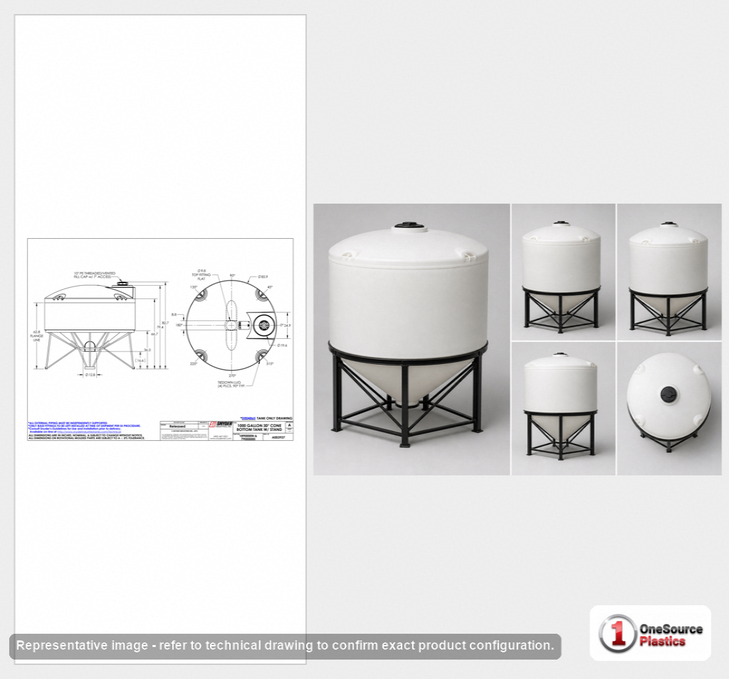
Technical drawing (PDF) for Snyder Industries 5000000N48.
See this tank
Interactive 3D model with live fill. This tank has an interactive 3D model built to its manufacturer dimensions. Rotate it, and set a fill level to see how much liquid it holds at any height. Open the 3D view on the product photo above. Download the 3D model (GLB).
Ready to order?
Add it to your cart at the top of this page, get LTL freight to your ZIP, request a written quote, or call 866-418-1777. The listed price is before freight.