Bushman Rainwater Harvesting Tanks: First-Flush Diverter Sizing per Texas Manual on Rainwater Harvesting (3rd Edition)
Rainwater harvesting in Texas has institutional support that few other states match. The Texas Water Development Board (TWDB) publishes the Texas Manual on Rainwater Harvesting (3rd Edition, 2005, with subsequent updates referenced through TWDB Report 380), which gives engineers, designers, and homeowners a sizing methodology that is technically defensible and code-citable. Texas House Bill 3391 (passed 2011) and TWDB rules under Texas Water Code Chapter 16 establish rainwater harvested for potable use as legally permissible when treatment meets state drinking water standards. The result: a market for rainwater harvesting that runs from 100-gallon backyard cisterns to 50,000-gallon residential whole-house systems to 250,000-gallon commercial collection at warehouse scale.
The component that disproportionately determines water quality in any rainwater harvesting system is the first-flush diverter. The first 1-2 minutes of rainfall washes the roof of accumulated dust, bird droppings, leaves, and atmospheric deposition. That fraction of the rainfall has 5-20x the bacterial count, 5-50x the suspended solids load, and concentrated dissolved organic carbon compared to the cleaner rainfall that follows. Diverting and discarding the first flush is the single highest-impact water quality improvement available in a rainwater harvesting system. Sizing the first-flush diverter correctly is the engineering question this guide answers, with sizing math rooted in the Texas Manual and pairing recommendations from the OneSource Bushman rainwater tank catalog.
Roof Catchment Hydrology: The Source of First-Flush Volume
Roof catchment surfaces accumulate three categories of contamination between rain events:
- Atmospheric deposition — dust, pollen, soot, wind-borne soil, agricultural drift particles. In urban environments, this loading is dominated by automotive particulate (tire wear, brake dust, exhaust soot). In rural environments, agricultural dust and soil. Deposition rates vary 10-1,000 mg/m2/day depending on location.
- Biological deposition — bird droppings, animal scat (squirrels, raccoons on roof), insect carcasses, plant litter (leaves, twigs, fruit). Biological deposition is concentrated near tree canopies and varies seasonally. The microbial load is the dominant water quality concern: fecal coliform, E. coli, Giardia, Cryptosporidium oocysts.
- Roof material leaching — asphalt shingles leach polycyclic aromatic hydrocarbons (PAH) and oils for the first 12-24 months of service; metal roofs leach zinc and copper from coatings and flashings; cedar shake leaches tannins. Tile and slate roofs are the lowest-leaching options.
The first rainfall after a dry period flushes accumulated contaminants off the roof in a concentration spike that decays exponentially as the rainfall continues. Texas Manual Figure 4-2 (3rd Edition) characterizes this washout: the first 0.05" of rainfall typically carries 30-50% of the accumulated contaminant mass; the first 0.10" carries 60-80%; the first 0.20" carries 90-95%. By the time 0.25" has fallen, the roof is essentially clean and subsequent runoff is the high-quality fraction worth collecting.
Texas Manual First-Flush Sizing Method
The Texas Manual on Rainwater Harvesting (3rd Edition) Section 4 presents the sizing method as a function of catchment area:
Sizing rule: divert the first 1 to 2 gallons per 100 square feet of catchment area, with 2 gallons per 100 ft2 as the conservative recommendation for most Texas locations. The 1 gallon per 100 ft2 lower bound applies where the roof is steep (60+ degree pitch) and self-cleaning between events; 2 gallons per 100 ft2 applies to flatter roofs that accumulate more deposition between rainfalls.
For a 1,500 ft2 residential roof catchment (the modal Texas single-family home), the first-flush diverter capacity is:
- Conservative (2 gal/100 ft2): 1,500 / 100 x 2 = 30 gallons
- Steep-roof minimum (1 gal/100 ft2): 15 gallons
For a 5,000 ft2 commercial roof:
- Conservative: 100 gallons
- Minimum: 50 gallons
For a 25,000 ft2 warehouse roof:
- Conservative: 500 gallons
- Minimum: 250 gallons
The Texas Manual notes that first-flush diverter sizing can be increased above the 2 gal/100 ft2 baseline in high-particulate environments (industrial areas, near unpaved roads, agricultural drift zones) or where the catchment surface is asphalt shingle (higher leaching during early service). For potable rainwater systems where the harvested water will be treated and consumed, the conservative 2 gal/100 ft2 minimum is recommended.
First-Flush Diverter Architectures
Standpipe Diverter
The simplest and most common architecture. A vertical PVC standpipe is plumbed into the downspout. The first water entering fills the standpipe; once full, subsequent water overflows the standpipe top and continues into the storage tank. A small drain valve at the bottom of the standpipe slowly drains the diverted volume between rain events (typically 1-3 days drain time depending on orifice size). A floating ball at the top of the standpipe rises with the water and seals when full to prevent additional dirty water entry.
Sizing: the standpipe inside diameter and length give you the diverted volume. For a 30-gallon diverter using 6" diameter PVC standpipe (cross-section area 28.3 in2 = 0.196 ft2), the required length is 30 gal / 7.48 gal/ft3 / 0.196 ft2 = 20.5 ft. That's a tall standpipe. More commonly, multiple smaller-diameter standpipes are paralleled, or a 4" standpipe is used at greater length and tucked alongside the downspout chase.
Build cost: $50-$200 in PVC fittings and pipe for a residential-scale diverter. Maintenance: simple — open the bottom drain valve every 6 months to clear sediment.
Roof Washer (Tipping Bucket)
A hinged trough that fills with water until the contained weight exceeds a counterbalance, at which point the trough tips and dumps the diverted water. After tipping, the trough returns to the upright position and the rainfall now flows past the trough into the storage tank. Mechanical, no moving parts to electrify. Pros: no drain valve to clear, no standpipe height constraint. Cons: more complex fabrication, tipping mechanism can stick if not maintained.
In-Line Diverter Cartridge
Commercial pre-fabricated diverters with a fixed diversion volume. Examples: WaterCloset Co. RainHarvest WH-50, Greenway First-Flush 50, Bushman accessory diverters. Plug-and-play install: cut the downspout, splice in the diverter, plumb the diverter outlet to a drain or a separate tank. Cost: $200-$800 for residential sizes. Industrial sizes (250+ gallon diversion) are custom fabrications.
Drain Time and Orifice Sizing
The first-flush diverter must drain between rainfall events so the diverter is empty and ready to capture the next first-flush volume. Drain time is set by the orifice diameter at the diverter bottom. Texas Manual Section 4.3 recommends a drain time of 24-72 hours: long enough to ensure the diverter is full during the rain event (the drain rate during rainfall is much slower than the inflow rate), short enough to be empty before the next typical rain event.
Orifice sizing: for a 30-gallon diverter draining in 48 hours, the average drain rate is 30/48 = 0.625 gal/hr = 0.0104 gpm. Using the standard orifice flow equation:
Q = Cd * A * sqrt(2 * g * h)
Where Cd = 0.6 (sharp-edged orifice), A = orifice area, g = 32.2 ft/s2, h = average head (about half of standpipe full height). For a 6" diameter standpipe at 5 ft fill, average head is 2.5 ft. Solving for orifice area: A = Q / (Cd * sqrt(2gh)) = (0.0104 / 60) ft3/s / (0.6 * sqrt(2 * 32.2 * 2.5)) = 6.94e-5 ft2 = 0.01 in2 = 0.11" diameter.
That's a 1/8" diameter orifice. Practical: drill a 1/8" hole, install a stainless steel mesh screen over it to prevent clogging, and verify drain time empirically over several rain events.
Catchment Coefficient and System Yield
Not all rainfall ends up in the storage tank. The catchment coefficient accounts for losses to:
- First-flush diversion (calculated above)
- Wetting losses (the first rainfall must wet the dry roof surface before runoff begins)
- Evaporation during light rainfall
- Wind-driven loss past gutters
- Overflow when the storage tank is full
Texas Manual Table 3-1 gives catchment coefficients for various roof types:
- Standing seam metal: 0.95
- Concrete tile: 0.85-0.90
- Asphalt shingle: 0.80-0.90
- Cedar shake: 0.75-0.85
- Rolled membrane (commercial flat roof): 0.85-0.90
- Gravel ballast (built-up commercial roof): 0.50-0.70
For a 1,500 ft2 metal roof in Austin (33.6 inches average annual rainfall per NOAA):
Annual yield = 1,500 ft2 x 33.6 in x (1 ft / 12 in) x 7.48 gal/ft3 x 0.95 catchment coefficient = 29,888 gallons per year, before deducting first-flush diversion (typically 5-15% of total volume).
Net deliverable rainwater after first-flush: about 27,000-28,000 gallons per year. That sustains a 2-person household at 40-50 gallons per day per person if used for non-potable purposes (irrigation, toilet flushing, laundry); for whole-house potable use, additional supply (well, municipal connection, or hauled water during droughts) is typically required.
Storage Tank Sizing: The Texas Manual Yield Approach
Storage tank sizing depends on the use case (irrigation, indoor non-potable, whole-house potable), the rainfall pattern (Texas climates range from 50+ inches/year in East Texas to 8-15 inches/year in West Texas), and the demand schedule. Texas Manual Chapter 5 provides three sizing methods:
- Demand-side sizing: tank holds 3-6 months of demand, sized for the dry-season carry-over.
- Supply-side sizing: tank holds the largest single rainfall event multiplied by catchment coefficient.
- Mass-balance simulation: monthly rainfall vs monthly demand, calculate required reserve to meet demand reliability target (typically 95-99%).
For a residential whole-house system in Austin with 33.6" annual rainfall and 75 gpd demand, the mass-balance approach gives a typical tank size of 5,000-10,000 gallons. For irrigation-only systems with seasonal demand (summer high, winter low), the tank can be smaller — 1,500-3,000 gallons is common.
Bushman Rainwater Tank Catalog
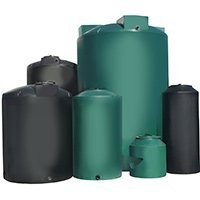
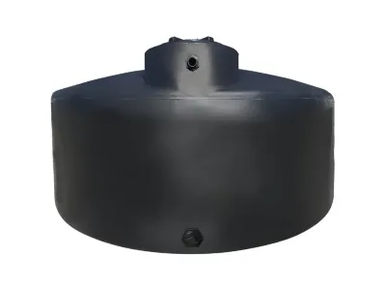
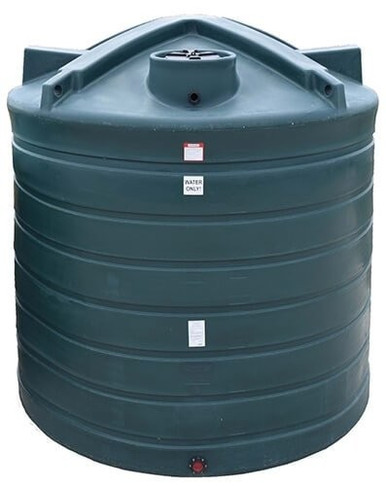
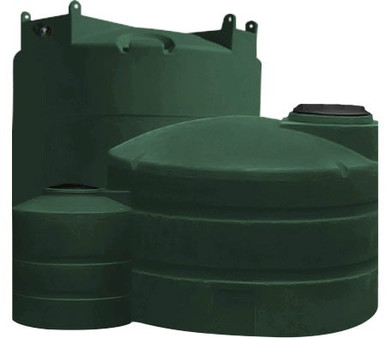
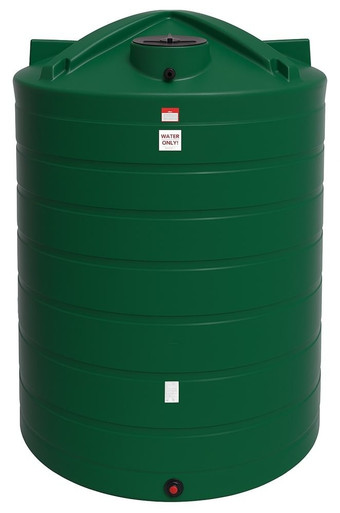
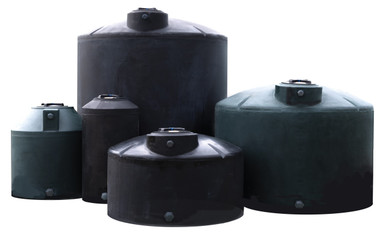
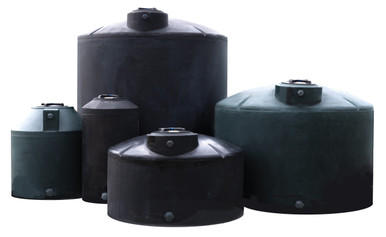
The OneSource Plastics Bushman catalog covers the rainwater harvesting size range from 100 gallons (single-downspout collection) to 5,000 gallons (whole-house and small commercial). Bushman tanks are HDPE rotomolded, NSF/ANSI 61 certified for potable water service when the water is treated to drinking water standards, and available in colors that blend with residential exterior palettes (Mocha, Dark Brown, Dark Green, Black). The architecture is vertical with closed top, threaded fill inlet, overflow outlet, and bottom-side outlet bulkhead — the standard rainwater configuration.
Catalog selections by capacity:
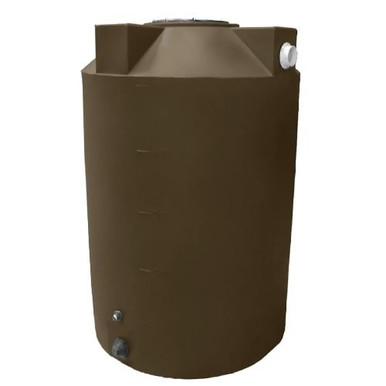
- Bushman 100 Gallon Plastic Vertical Rainwater Harvesting Tank in Mocha (MPN 30705, listed at $479.99) — entry-level single-downspout collection.
- Bushman 100 Gallon Plastic Vertical Rainwater Harvesting Tank in Black (MPN 30031, listed at $518.99).
- Bushman 100 Gallon Plastic Vertical Rainwater Harvesting Tank in Brown (MPN 30036, listed at $479.99).
- Bushman 100 Gallon Plastic Vertical Rainwater Harvesting Tank in Green (MPN 30037, listed at $479.99).
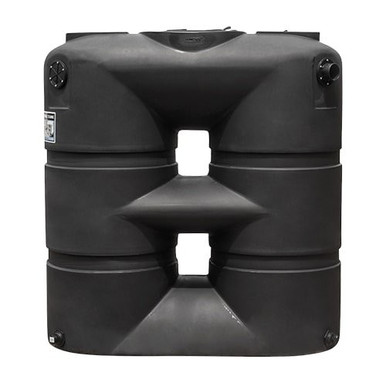
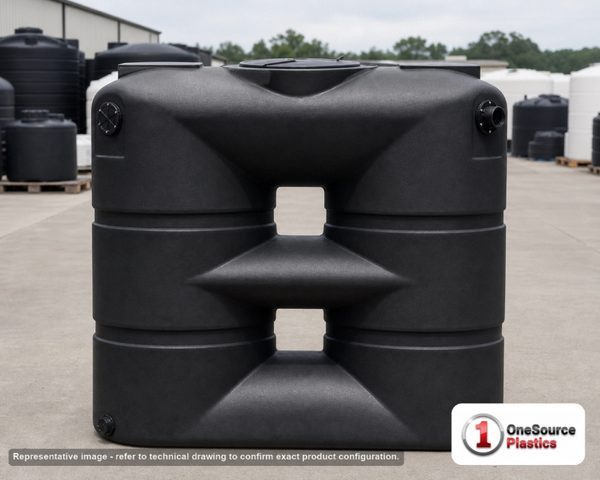
- Bushman 730 Gallon Plastic Low Profile Vertical Rainwater Collection Storage Tank in Mocha (MPN 45444, listed at $1,398.99) — low-profile slimline form factor for tight residential side-yard installations.
- Bushman 1,000 Gallon Plastic Vertical Rainwater Harvesting Tank in Black (MPN 30310, listed at $1,809.00).
- Bushman 1,000 Gallon Plastic Vertical Rainwater Harvesting Tank in Dark Brown (MPN 30313, listed at $1,809.00).
- Bushman 1,000 Gallon Plastic Vertical Rainwater Harvesting Tank in Green (MPN 30314, listed at $1,798.99).
- Bushman 1,150 Gallon Plastic Vertical Rainwater Harvesting Tank in Mocha (MPN 30714, listed at $1,869.00).
- Bushman 5,000 Gallon Plastic Vertical Rainwater Harvesting Tank in Dark Brown (MPN 30718, listed at $6,699.00) — whole-house residential tier.
- Bushman 5,000 Gallon Plastic Vertical Rainwater Harvesting Tank in Dark Green (MPN 30438, listed at $6,609.00).
For pre-tank roof washer / first-flush diverter installation, Bushman accessory components include leaf screen inlets, atmospheric vents with insect screens, and overflow flapper assemblies. The tank itself does not include a first-flush diverter; that component is sourced separately and plumbed into the downspout-to-tank path.
Plumbing Configuration for Texas Residential Whole-House Potable
The full Texas Manual Chapter 6 plumbing recommendation for a whole-house potable rainwater system:
- Roof catchment — sloped collection surface, gutters with leaf guards.
- Downspout to leaf screen — bug screen and leaf eliminator at the gutter outlet.
- First-flush diverter — sized at 2 gal/100 ft2 of catchment.
- Tank inlet via calmed inflow — the inlet pipe terminates near the tank bottom in a 90-degree elbow pointing horizontally, so incoming water does not stir up settled sediment.
- Floating intake / flexible draw line — the suction line for downstream pump draws from 6-12 inches below the water surface (avoiding bottom sediment AND surface debris).
- Overflow outlet — sized to handle peak rainfall event without backing up. Typically 4" diameter for residential, 6"+ for commercial.
- Pump — submersible or jet pump appropriate for the demand pressure and flow.
- Pre-filtration — 100 micron sediment filter, 5 micron polishing filter.
- UV disinfection — NSF/ANSI 55 Class A UV system delivering 40 mJ/cm2 minimum dose for potable use.
- Activated carbon polishing — taste/odor and dissolved organic removal.
- Distribution to fixtures — under TWDB Standards Subchapter F for potable rainwater service.
For non-potable systems (irrigation, toilet flushing only), the treatment train simplifies: pre-filter and pump only, no UV or carbon required. NSF/ANSI standards for non-potable use are less stringent.
Potable Rainwater Treatment Standards
For potable use, the Texas Manual references multiple standards:
- NSF/ANSI 61 — drinking water system components covers tank materials, pipe materials, fittings.
- NSF/ANSI 53 — drinking water treatment units (sediment, taste/odor removal).
- NSF/ANSI 55 — UV disinfection systems for residential and commercial drinking water.
- EPA primary drinking water regulations under 40 CFR Part 141 — finished water must meet primary MCL standards (turbidity, total coliform, microbiological, chemistry).
Bushman rainwater tanks carry NSF/ANSI 61 listing for the tank as a component of a drinking water system, meaning the tank itself does not leach contaminants into the water above NSF 61 thresholds. This does not mean the water IS drinking water — that is a function of the entire treatment train, not the tank alone. NSF 61 listing of the tank is the necessary but not sufficient condition for potable use.
Texas-Specific Code and Permit Framework
Texas Health and Safety Code Section 341.042 (Rainwater Harvesting) authorizes rainwater harvesting for potable use when the system meets American Rainwater Catchment Systems Association (ARCSA) standards and TWDB rules. Texas House Bill 3391 (2011) prohibits municipalities from banning rainwater harvesting for residential use. Texas Property Tax Code Section 11.32 grants property tax exemption for the rainwater harvesting equipment when used as a primary water supply.
Plumbing connections of rainwater systems to municipal water supplies require an air gap or RPZ backflow prevention device per Texas Plumbing Code Section 608. Direct connection without backflow protection is prohibited.
For commercial / multi-family potable rainwater systems, TCEQ (Texas Commission on Environmental Quality) regulates the system as a public water supply if it serves 25+ persons or 15+ connections. The regulatory burden increases substantially: monthly bacteriological testing, certified operator, treatment validation. Most commercial rainwater installations stay under that threshold by design.
For state-specific rainwater harvesting code in other states, see the OneSource state regulations hub. Some states (Colorado historically restrictive; California, Arizona, New Mexico encouraging) have varying frameworks. Texas is among the most permissive and best-documented.
Mosquito and Vector Prevention
An open or poorly-sealed rainwater tank is a mosquito breeding site. Texas Department of State Health Services (DSHS) regulations and TCEQ guidance require:
- Insect-screened atmospheric vent (16-mesh stainless steel minimum)
- Sealed fill openings (gasketed manway covers)
- Insect-screened overflow outlet
- Insect-screened first-flush diverter drain
Bushman tanks ship with insect-screened vents standard. The user-installed components (downspout adapters, first-flush diverter, overflow plumbing) must also be screened. The cost of a mesh screen is trivial; the West Nile Virus exposure cost of an unscreened tank is not.
Algae Prevention
Sunlight penetration through translucent or clear tank walls drives algae growth. Bushman rainwater tanks are opaque (Black, Dark Brown, Dark Green, Mocha) for this reason — opaque tanks block UV and prevent photosynthesis-driven algae. White or translucent tanks should NOT be used for rainwater storage; they will green up within months. Bushman's color palette is intentional rainwater-optimized engineering, not aesthetic preference.
For tanks installed in shaded locations, algae risk is lower. For tanks in direct sun, opaque construction is mandatory.
Maintenance Cadence
- After every major rain event: visual inspection of leaf screens, gutter cleanout if needed.
- Quarterly: open first-flush diverter drain to flush sediment, inspect inlet leaf screen, check tank overflow operation, verify mosquito screens intact.
- Annually: drain tank to bottom 10%, hose down interior to remove settled sediment, inspect tank interior for algae growth (should be none in opaque tanks), inspect bulkhead fittings for leakage.
- Every 5 years: full tank empty and detailed inspection. Replace UV lamp on disinfection system if equipped (UV lamp service life is typically 9,000 hours = ~1 year continuous, ~2 years on flow-actuated controls).
For chemical compatibility of rainwater (which contains dissolved CO2 making it slightly acidic, pH 5.5-6.5 typically, with some chloride and dissolved organic carbon), HDPE polyethylene is fully compatible across the entire chemistry envelope. Service life of properly installed Bushman tanks in rainwater service is 25+ years.
Sizing Worksheet for a Texas Residential System
For a 2,400 ft2 residential metal roof in Austin TX (NOAA 33.6" annual average rainfall):
- Annual yield: 2,400 x 33.6 / 12 x 7.48 x 0.95 = 47,820 gallons/year gross.
- First-flush diverter: 2,400 / 100 x 2 = 48 gallons. Plumbed as a 6" PVC standpipe approximately 32 ft tall (or two parallel standpipes 16 ft each), with 1/8" drain orifice for 24-48 hour drain time.
- First-flush volume per year: 48 gal/event x 70 events/year average = 3,360 gallons diverted. Net yield ~44,500 gallons/year.
- Storage tank: 5,000 gallons (Bushman MPN 30718 or 30438) sized for ~40 days dry-season carry-over at 75 gpd demand. Listed at $6,609.00-$6,699.00 depending on color.
- Treatment for potable use: 100/5 micron filtration + NSF/ANSI 55 Class A UV + activated carbon polishing. Treatment system cost $1,500-$3,500.
- Pump: submersible or shallow-well jet, sized for 8-12 gpm at 40-60 PSI. Cost $400-$1,200.
- Plumbing, valves, electrical, foundation: $2,000-$5,000 typical.
Total system cost in the $10,000-$16,000 range for a fully-engineered Texas residential whole-house potable rainwater harvesting installation. The economics depend on local water utility cost; in areas where municipal water is $15-$30/1,000 gallons (typical for commercial customers, premium for some residential customers), the system payback is 8-15 years on water cost alone, faster when drought-tolerance and rate-stability benefits are valued.
Pairing with the Texas Regulatory Framework
For Texas-specific code, permit, and TWDB framework documentation, see the Texas state regulations pillar. For chemistry-specific tank pairing including municipal water supply backup and treatment chemistry storage, see the chemical compatibility hub at /chemical-compatibility/. For freight pricing on Bushman tanks shipping to your Texas ZIP, use the freight estimator; LTL freight on a 5,000 gallon tank to most Texas metropolitan areas runs $600-$1,400 depending on origin and accessibility. For SPCC and stormwater management considerations on commercial-scale rainwater systems, see our secondary containment volume math walkthrough.
For sizing assistance on your specific catchment, demand profile, and rainfall climate, talk to OneSource Plastics at 866-418-1777. We will run the Texas Manual sizing methodology against your specific NOAA rainfall data and demand schedule and recommend the Bushman tank size plus first-flush diverter that matches your project economics.
Recommended Tanks for This Guide
Live pricing, updated automatically · estimate freight to your ZIP.