Pump Skid Design for Tank-Fed Dosing Operations: Stainless Steel Frame Engineering, Drip-Pan Containment, Leak Detection Architecture, and the Procurement Decisions That Govern Reliable Chemical Metering Service
The pump skid that dispenses chemistry from a bulk storage tank to a downstream point-of-use is the operational fulcrum of every dosing system. The skid must move chemistry from the tank to the process at controlled flow rate, must contain any chemistry that escapes from the pump or its connections, must detect a leak quickly enough to support response before environmental release or downstream upset, must support routine maintenance without major shutdown, and must operate reliably across thousands of duty cycles per year. A pump skid that is well-engineered runs for years with predictable maintenance cadence, contains the rare leak event safely, and integrates cleanly with the tank and the downstream process. A pump skid that is poorly-engineered fails unpredictably, contaminates the surrounding work area through uncontained leaks, and forces emergency shutdowns during process windows that cannot tolerate them. This article walks the stainless-steel frame engineering, the drip-pan containment design, the leak-detection architecture, the pump-and-piping selection, the control integration, the maintenance-access design, and the procurement decisions that distinguish reliable chemical metering skids from operational liabilities.
The framework draws on API 610 chemical pumping practice, OSHA 1910.119 Process Safety Management requirements, EPA secondary-containment standards, and field experience across the 5-brand polyethylene tank catalog (Norwesco, Snyder, Chem-Tainer, Enduraplas, Bushman). List pricing on each tank product page; LTL freight quoted to your ZIP via the freight estimator or by phone at 866-418-1777.
1. Why Pump Skids Belong on Every Tank-Fed Dosing System
The skid concept consolidates the pump, piping, controls, and containment into a single integrated unit. The benefit case:
- Engineered integration of components. The pump, piping, valves, instruments, and controls are engineered as a single unit at the design stage. The integration eliminates field-fit variability and produces consistent performance across multiple deployments of the same skid design.
- Pre-fabricated assembly with pre-tested operation. Skids are fabricated and tested at the manufacturer or fabricator before delivery. Field installation reduces to setting the skid, connecting the inlet/outlet/electrical, and commissioning. The factory-test discipline catches construction issues before they become field problems.
- Concentrated containment for leak management. A skid with integrated drip-pan containment captures any leak from the pump or its connections within a defined volume. The captured leak can be drained to a regulated route rather than reaching the surrounding work area.
- Standardized maintenance access. Skid layouts position pumps, valves, and instruments for accessibility. The standardization enables maintenance crews to work efficiently across multiple skids of the same design without re-learning each installation.
- Replaceability and standardization across multi-tank installations. Sites with multiple tanks doing similar dosing benefit from skid standardization. A failed skid can be replaced with a spare standard unit; the standardization reduces spare-parts inventory and simplifies operator training.
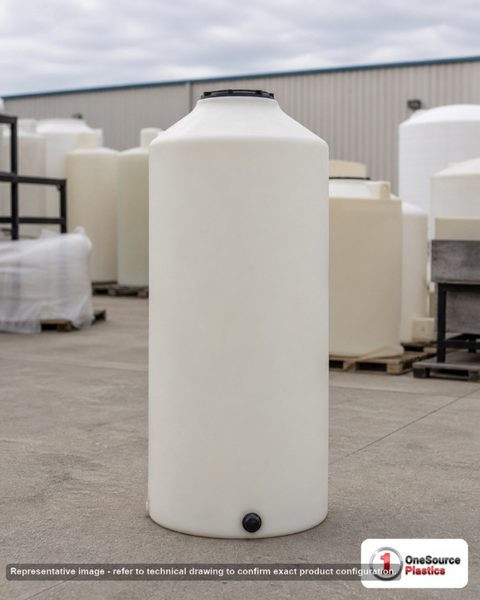
- Reference 1500 gallon tank for typical dosing-supply application. Reference N-40144 1500 gallon Norwesco vertical as a typical bulk-supply tank where the discharge piping feeds a pump skid that doses chemistry to a downstream process at controlled flow rate.
The skid concept is the dominant approach for chemical dosing service in modern industrial installations. Field-built piping arrangements without skid integration persist in legacy installations but are progressively replaced as those installations modernize.
2. Stainless Steel Frame Engineering
The skid frame is the structural foundation that supports the pump and piping. The frame engineering decisions:
- Stainless steel grade selection. Type 304 stainless is the workhorse grade for ambient-temperature, non-aggressive-environment skids. Type 316 stainless adds molybdenum for chloride and reducing-environment service. Duplex 2205 adds additional corrosion resistance for marine and high-chloride applications. Selection follows the chemistry exposure expected on the frame surfaces.
- Structural-tubing versus channel-section selection. Square or rectangular structural tubing produces a clean, weldable, easily-coated frame. Channel-section steel produces frames with internal corners that hold debris and water. Structural tubing is the modern preference; channel section is legacy.
- Welded versus bolted construction. Welded frames are more rigid and have fewer crevice-corrosion sites; bolted frames are field-modifiable and easier to ship in pieces. Most modern skids use welded construction with bolted lifting points.
- Surface-finish specification. Stainless surfaces can be mill-finish (cheaper, slightly rougher), brushed (smoother, easier to clean), or electropolished (smoothest, most expensive). Brushed finish is the typical industrial standard.
- Lifting and handling provisions. The frame includes engineered lifting points (lugs, eyebolts, forklift-pocket cutouts) that support safe handling during installation and relocation. Field-improvised lifting from non-engineered points has caused injuries and skid damage.
- Drainage geometry on the frame surface. The frame top surface (where the drip pan sits) is angled or graded to direct any spill toward a drain point. Flat geometry holds standing liquid; sloped geometry drains to a defined location.
- Reference 2500 gallon cone-bottom for industrial-scale dosing. Reference N-40066 2500 gallon 30 degree cone bottom as a typical industrial-scale dosing-supply tank where a stainless-steel pump skid handles the discharge metering with sized capacity for the downstream process.
The frame engineering is the unglamorous foundation of the skid. A well-engineered frame supports decades of service without corrosion, deflection, or maintenance issue; a poorly-engineered frame becomes the source of nuisance corrosion that propagates to the rest of the skid.
3. Drip-Pan Containment Design
The drip pan is the containment under the pump and piping that captures any chemistry that leaks from the components. The design decisions:
- Pan footprint coverage. The drip pan extends under all components that could leak: the pump, the suction and discharge piping, the valves, the instruments. The footprint coverage is sized to capture splash and drip from any normal-operation leak source.
- Pan depth and capacity. The pan depth and surface area determine the contained volume. A typical sizing target is 110 percent of the largest pump-volute fluid contents plus the largest piping section between isolation valves. The 110 percent allows for sealing variability.
- Pan material compatibility. The pan material is compatible with the chemistry served. Stainless steel handles a broad chemistry range. Polyethylene handles benign aqueous service. Polypropylene handles acid service. Chemical-resistant coatings extend the compatibility of carbon-steel pans for moderate exposure.
- Pan-drain port and routing. The pan has a low-point drain that routes captured chemistry to a defined disposal route. Common routes include a dedicated effluent tank, a containment sump, or a secondary contained-area drain. Routing to general site drains (storm or sanitary) is incompatible with chemistry containment.
- Drain valve and isolation. The drain has an isolation valve that is normally closed during operation (to retain captured liquid for assessment) and opened during cleaning or after a contained event for controlled drainage. Automated drain-on-detection valves are an alternative for low-toxicity chemistries.
- Pan elevation above the deck. The pan is elevated slightly above the surrounding deck to prevent surrounding-area liquid from running into the pan and prevent contained liquid from running out. The elevation is typically 25 to 50 millimeters with a curb or lip.
- Reference 1000 gallon tank for typical dosing supply. Reference N-40152 1000 gallon Norwesco vertical as a typical dosing-supply tank where a single pump skid with integrated drip-pan containment handles the metering to a downstream process.
The drip-pan containment converts a leak event from an environmental release into a contained operational event. The cost of the pan is small relative to the cost of an environmental release; sites that omit the pan or under-size it absorb the periodic release events as ongoing operational risk.
4. Leak Detection Architecture
The drip pan captures leaks; the leak-detection system identifies that a leak has occurred and triggers response. The detection architecture:
- Conductive-sensor leak detection. Two electrodes positioned in the drip-pan low-point are electrically isolated when dry; conductive liquid between them closes a circuit. The closed circuit triggers an alarm. Conductive sensors are inexpensive but only detect electrically-conductive liquids.
- Float-switch leak detection. A float switch positioned in the pan rises when liquid accumulates. The float switch triggers an alarm when the level exceeds a threshold. Float switches handle both conductive and non-conductive liquids.
- Optical-sensor leak detection. An infrared or capacitance-based sensor detects liquid presence at the pan low-point without electrical contact. Optical sensors are more expensive but detect a broader liquid range and resist fouling.
- Multi-stage alarm hierarchy. The alarm hierarchy escalates based on the captured volume: a low-level alarm at first liquid presence triggers operator notification; a high-level alarm at near-pan-capacity triggers automatic isolation of the pump suction and discharge.
- Sensor calibration and test discipline. The leak sensors are tested periodically (typically monthly or quarterly) by introducing test liquid to verify alarm operation. The test discipline catches sensor drift or failure before a real leak event.
- Alarm integration with plant control system. The leak alarm is wired into the plant control system and the operator notification system (HMI display, audible alarm, mobile alert). The integration ensures the alarm reaches operators who can respond.
- Alarm-acknowledgment and event-log discipline. Each alarm event is acknowledged with operator action documented in the event log. The log supports event-pattern analysis and continuous improvement of the dosing system.
The leak-detection architecture is the response trigger of the containment system. Without detection, the drip pan would slowly fill until it overflowed and produced the release the containment was meant to prevent. With detection, the leak is identified within minutes and response is initiated within the operational window.
5. Pump and Piping Selection for the Service
The pump and piping themselves are matched to the chemistry, the flow rate, and the metering precision required:
- Centrifugal pump for general-purpose chemical service. Magnetic-drive centrifugal pumps are the workhorse for general-purpose chemical dosing. The magnetic drive eliminates the shaft seal that is the failure point of mechanical-seal designs. Capacities run from 5 to 200 gallons per minute with discharge pressure to 100 psi.
- Diaphragm pump for precision dosing. Air-operated diaphragm pumps and metering-diaphragm pumps provide precision flow control with self-priming capability. Diaphragm pumps tolerate dry-running and abrasive slurry service better than centrifugal pumps.
- Peristaltic pump for sterile or solids-bearing service. Peristaltic pumps move liquid through a flexible tube with no contact between the pump body and the liquid. The geometry supports sterile-service and slurry-service applications where conventional pumps fail.
- Piping material matched to the chemistry. CPVC, PVC, polypropylene, PVDF, and stainless steel are the common materials for chemical-dosing piping. Selection follows the chemistry compatibility chart with margin for temperature and concentration variation.
- Suction-line sizing for pump performance. The suction line is sized for low velocity (typically 3 to 5 feet per second) to minimize cavitation risk. Undersized suction lines cause cavitation that damages impeller and reduces flow.
- Discharge-line sizing against velocity and pressure-drop. The discharge line is sized for moderate velocity (5 to 8 feet per second) and acceptable pressure drop to the point of use. Undersized discharge lines waste pump head; oversized lines carry capital cost without operational benefit.
- Isolation valves at strategic locations. Each pump has isolation valves on the suction and the discharge to support pump removal without draining the supply tank. The valves are typically full-port ball valves in the chemistry-compatible material.
- Reference 1000 gallon cone-bottom for high-pump-cycle applications. Reference N-43852 1000 gallon 45 degree cone bottom as a typical batch-dosing supply where the cone geometry supports complete evacuation and the small volume drives high pump-cycle frequency.
The pump-and-piping selection determines the operational character of the dosing system. Conservative selection (slightly oversized pumps, slightly oversized lines, all isolation valves provided) produces installations that operate reliably across the chemistry, flow-rate, and maintenance variations encountered over a 10 to 20 year service life.
6. Control Integration and Metering Accuracy
The pump skid integrates with the plant control system to deliver controlled metered flow to the downstream process. The control integration:
- Flow-meter selection for the metering accuracy required. Mass-flow (Coriolis) meters provide highest accuracy and direct mass measurement. Magnetic flow meters provide good accuracy for conductive liquids. Turbine and paddle-wheel meters are lower-cost options for moderate accuracy. Selection follows the metering-accuracy specification.
- Variable-speed drive on the pump motor. A variable-frequency drive on the motor allows pump speed to be adjusted to match the metering setpoint. The VFD is the standard for closed-loop flow control and reduces wasted energy compared to throttle-valve control.
- Closed-loop flow control. The flow meter feeds a control signal to the VFD that adjusts pump speed to maintain the flow setpoint. The closed loop responds to upstream pressure variation and downstream demand variation.
- Run-time totalization for batch control. The control system totalizes the metered flow against a batch target and stops the pump when the target is reached. The totalization is the foundation of recipe-based dosing.
- Pressure transmitters for system-status monitoring. Suction and discharge pressure transmitters report pump operating point. Anomalous values (cavitation-suction-pressure-drop, plugged-line discharge-pressure-rise) trigger alarms before the pump damages.
- Tank-level integration with pump operation. The supply-tank level is monitored and integrated with pump operation: low-low level locks out the pump to prevent dry-running; low level triggers refill alerts; high-high level prevents over-fill from upstream.
- HMI access for operator interaction. The skid integrates with the plant HMI for operator visibility of pump status, alarms, totalized flow, and historical trends. Local-display options support operations during plant-control-system outages.
The control integration converts the pump skid from a standalone dosing pump into an instrumented metering station with closed-loop accuracy and integrated alarming. The integration is the operational discipline that turns dosing from a manual-skill operation into a controlled-system operation.
7. Maintenance-Access Design
The skid layout supports the routine and break-fix maintenance that the equipment will receive over its service life:
- Pump-removal-without-pipe-modification access. The pump is positioned with clearance for removal of the pump body without modifying the connected piping. Spacer-spool sections in the suction and discharge piping support pump removal.
- Valve-handle access at standing height. Operating valves are positioned with handles at standing height (typically 36 to 60 inches above the deck). Valves below knee height or above shoulder height are difficult to operate during routine work.
- Instrument calibration ports. Pressure transmitters, flow meters, and other instruments include calibration ports that support periodic calibration without removing the instrument from service.
- Sample-port specification for analytical verification. A discharge sample port supports periodic chemistry-verification sampling. The sample port is designed for clean sampling without spillage and with isolation during non-sampling operation.
- Drain-down procedure for line cleaning. The skid piping includes drain valves at low points for line evacuation during chemistry-changeover operations or before maintenance work. The drain points route to the same containment system as the leak-detection drain.
- Flush-water connection for line cleaning. A water flush connection at the suction side supports water flushing of the lines during cleaning operations. The flush water displaces the chemistry from the lines for safe maintenance.
- Reference 750 gallon cone-bottom for compact dosing supply. Reference N-40811 750 gallon 20 degree cone bottom as a typical compact dosing-supply tank where the pump skid sits adjacent to the tank with maintenance access on three sides for valve, instrument, and pump service.
The maintenance-access design pays back through every preventive-maintenance cycle and every break-fix event. Skids that were designed for maintenance access produce maintenance work that completes in hours rather than full shifts; skids that were not designed for access force maintenance crews into improvised approaches that introduce additional risk.
8. Procurement Decisions That Govern Long-Term Reliability
The pump-skid procurement decisions affect reliability, maintenance cost, and operational flexibility for the service life:
- Service-specification clarity at procurement. The procurement specification documents the chemistry, the temperature, the flow-rate range, the discharge-pressure range, the duty-cycle profile, and the metering-accuracy requirement. Clear specification produces skids matched to the service; vague specification produces compromise skids that fit the average but not the extremes.
- Pump-type selection alignment with the duty-cycle profile. A continuous-duty service favors centrifugal pumps; an intermittent-duty service may favor diaphragm or peristaltic. The duty-cycle profile drives the pump-type decision.
- Material-of-construction scope across the chemistry portfolio. Sites that handle multiple chemistries on similar skids benefit from materials specified for the broadest chemistry range. The premium for broad-spectrum materials supports operational flexibility.
- Spare-skid versus spare-component strategy. Some operations stock complete spare skids; others stock spare components (pumps, valves, instruments). The decision depends on the skid count, the failure-rate experience, and the response-time requirement.
- Standardization across multi-skid installations. Sites with multiple skids benefit from design standardization. Standard skids share spare-parts inventory, operator-training, and documentation. Customized skids fragment the operations and maintenance burden.
- Documentation package scope. The skid procurement includes a documentation package: drawings, P&IDs, instrument data sheets, valve schedules, electrical schematics, calibration records, and operating instructions. Complete documentation supports operations and maintenance for the service life.
- Factory-acceptance test discipline. The skid is tested at the manufacturer or fabricator before shipment. The factory test verifies pump performance, instrument calibration, alarm operation, and piping integrity. Test failures are corrected at the factory rather than discovered in the field.
- Reference 5000 gallon tank for high-volume dosing operations. Reference N-40164 5000 gallon Norwesco vertical as a typical high-volume dosing-supply tank where a multi-pump skid handles distribution to multiple downstream points-of-use, justifying the procurement investment in standardized engineered skid construction.
The procurement decisions are the long-term cost drivers of the dosing operation. Decisions made with consideration of service-specification clarity, material scope, standardization, and documentation produce skids that operate reliably for decades; decisions made on initial-cost basis only produce skids with chronic maintenance issues and operational disruptions.
9. The Pump Skid Engineering Conclusion
The pump skid for tank-fed dosing is the operational fulcrum that converts bulk storage into controlled metered delivery. The stainless-steel frame engineering provides the structural foundation. The drip-pan containment design captures leaks within a defined volume. The leak-detection architecture identifies leaks within the operational response window. The pump-and-piping selection matches the chemistry, flow rate, and metering precision requirements. The control integration delivers closed-loop accuracy and alarm-integrated operation. The maintenance-access design supports routine and break-fix work efficiently. The procurement decisions across service specification, material scope, standardization, and documentation drive the long-term reliability of the installation. Sites that engineer the pump skid across these dimensions sustain reliable dosing operations through 10 to 20 year service lives; sites that under-engineer absorb chronic maintenance overhead, occasional environmental release events, and operational disruptions during process windows that cannot tolerate them.
OneSource Plastics ships polyethylene tanks across the 5-brand catalog (Norwesco, Snyder, Chem-Tainer, Enduraplas, Bushman) with discharge fitting configurations and capacity options matched to pump skid integration for chemical-dosing service. Tank specification for any specific dosing application is performed by the customer site engineer with reference to the chemistry, the throughput, the metering precision, and the regulatory regime. List pricing on each product page; LTL freight to your ZIP via the freight estimator or by phone at 866-418-1777.
Recommended Tanks for This Guide
Live pricing, updated automatically · estimate freight to your ZIP.