Tank Mixer + Agitator Engineering: Top vs Side vs Bottom Mount Selection Math
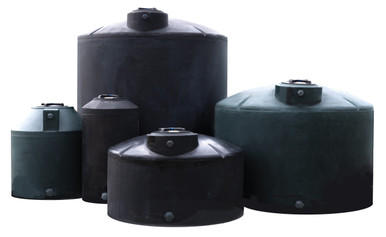
Mixer and agitator selection is where chemical, water-treatment, and process operators most often over-pay or under-spec. The mount geometry — top-mount through a manway, side-mount through a bulkhead, or bottom-mount through a sealed shaft — drives capital cost, mechanical reliability, mixing time, and the long-term integrity of the tank shell itself. Pick the wrong geometry and you either burn through 5 HP for a job a 1.5 HP mixer would handle, or you torque-load a polyethylene tank shell that ASTM D1998 never rated for that bending moment. This pillar walks the math for top, side, and bottom mount selection on Norwesco, Snyder, Chem-Tainer, Enduraplas, and Bushman tanks, with real cone-bottom and open-top mixing-tank SKUs from the OneSource catalog.
The reference standards in this guide are ASME PTC 19.1 (test uncertainty for fluid-mixing process measurement), ASME B73.1 (centrifugal pump shafting that informs agitator-shaft design), API 650 Section 5 (tank shell loading at appurtenances), ASTM D1998 Section 8 (polyethylene tank fittings, supports, and load limits), NSF/ANSI 61 for potable contact, NFPA 70 / NEC Article 500 (electrical area classification when the mixer drives in a hazardous location), and IEEE 841 (severe-duty TEFC motors for industrial mixer drives). Real mixing-tank SKUs cited below include Snyder MPN 32223 (30-gallon heavy-duty cone-bottom), MPN 32419 (60-gallon), MPN 32101 (150-gallon), MPN 1850000N51 (17-gallon HDPE black), and Norwesco cone-bottom platforms MPN 43852 (1,000 gallon 45-degree) and MPN 43854 (1,500 gallon 45-degree) frequently used as agitated chemistry feed tanks.
The Three Mount Geometries
- Top-mount (vertical down-pumping): mixer mounted to the tank top via a clamp ring, beam bridge, or dedicated mounting flange. Shaft hangs straight down through the headspace and into the fluid. Default geometry for batch chemistry, polymer blending, and chemical feed tanks under approximately 10,000 gallons.
- Side-mount (horizontal entry): mixer mounted through the lower sidewall via a sealed bulkhead. Shaft is horizontal or slightly angled. Standard for very large tanks (above 10,000 gallons) where a top-mount shaft would be too long, and for storage tanks that need only intermittent re-suspension of settled solids.
- Bottom-mount (magnetic-drive or sealed shaft): mixer mounted under the tank bottom or through a sealed shaft penetration. No top access required; ideal for sterile / pharma / hygienic service. Highest cost, most demanding seal design.
Each geometry trades capital cost against power efficiency, sealing complexity, and tank-shell loading. The decision math below makes the trade explicit.
The Power Number Equation: Where Mixer Sizing Starts
The Rushton power-number equation is the foundational math for any mixer sizing decision:
P = Nₐ × ρ × n³ × D⁵
where P is shaft power (watts), Nₐ is the impeller power number (dimensionless, depends on impeller geometry and Reynolds number), ρ is fluid density (kg/m³), n is impeller rotational speed (revolutions per second), and D is impeller diameter (meters). The equation is exact in the fully-turbulent regime (Re > 10,000) and approximate elsewhere.
Power numbers for the most common impellers (Rushton turbine, pitched-blade turbine, hydrofoil, marine propeller) range from approximately 0.3 (high-efficiency hydrofoil) to 5.5 (six-blade Rushton in fully-turbulent flow). Manufacturer data sheets publish Nₐ vs Reynolds-number curves; never guess this value.
Reynolds number for mixers
Re = (ρ × n × D²) / μ where μ is dynamic viscosity (Pa·s). Three flow regimes:
- Laminar (Re < 10): highly viscous fluids (polymers, glycerine, heavy slurries). Power number is approximately constant times 1/Re; use anchor or helical-ribbon impellers.
- Transitional (10 < Re < 10,000): moderate viscosity. Power number varies. Most chemical-feed mixers operate here.
- Fully turbulent (Re > 10,000): water and water-like chemistry. Power number is constant. Standard turbines and hydrofoils dominate.
Top-Mount Mixer Sizing: The Standard Path
Step 1 — Establish the mixing duty
| Mixing Duty | Tip Speed (ft/min) | Power per Volume (HP/1000 gal) |
|---|---|---|
| Mild blend (miscible liquids) | 200–400 | 0.1–0.3 |
| Solids suspension (light, dilute) | 400–600 | 0.5–1.0 |
| Solids suspension (dense, fast) | 600–800 | 1.0–3.0 |
| Gas dispersion / mass transfer | 800–1200 | 3.0–10.0 |
| Emulsification / high shear | 1200–3000 | 10.0+ |
For a typical chemical-feed tank dosing a polymer or coagulant into water, the duty is “solids suspension, light” or “mild blend.” Specifying 3 HP per 1,000 gallons for a polymer make-down is over-specifying by 3× and wastes capital plus electricity for the life of the tank.
Step 2 — Pick the impeller
- Pitched-blade turbine (PBT): general-purpose, axial flow, moderate shear. Default for solids suspension and miscible blending. Power number approximately 1.27.
- Hydrofoil (high-efficiency axial): 30–40% lower power for equivalent flow. Higher capital, lower operating cost. Excellent for large tanks.
- Rushton turbine (six-blade flat): radial flow, high shear, high gas-dispersion efficiency. Power number approximately 5.5. Standard for fermentation, gas–liquid contacting.
- Anchor / helical ribbon: laminar / high-viscosity service.
Step 3 — Geometry rules
- Impeller diameter D = approximately 0.33 to 0.4 times tank diameter for standard turbines.
- Impeller off-bottom clearance C = approximately 1.0 times D.
- Liquid level Z = approximately 1.0 times tank diameter (square-batch geometry); above Z = 1.5 D, install a second impeller staged up the shaft.
- Baffles: four full-length plate baffles, width = 1/12 tank diameter, offset 1.5 inches off the wall. Without baffles, central vortex forms and mixing collapses to zero net flow.
Polyethylene tanks like Snyder MPN 32223 (30 gal) and MPN 32101 (150 gal) cone-bottom mixing tanks ship from the factory with pre-engineered baffle geometry and a top-flange mounting boss for direct mixer attachment. Norwesco cone-bottom MPN 43852 (1,000 gal 45-degree) and MPN 43854 (1,500 gal 45-degree) require field-installed baffles plus a beam bridge for top-mount mixer support.
Side-Mount Mixer Engineering
When side-mount makes sense
- Tank diameter exceeds approximately 12 ft (top-mount shaft becomes too long for cost-effective tubular cantilever).
- Roof access is restricted (low headroom, indoor tank under structural bay).
- Mixing duty is intermittent solids re-suspension rather than continuous blending (sludge tanks, fuel storage, settled-solids re-mix).
- Tank top is non-load-bearing (most rotomolded polyethylene tanks above 5,000 gallons; manufacturer data sheets explicitly limit top-loading to 100–300 lb point load).
The bulkhead-load problem
Side-mount mixers transfer their full motor torque, axial-thrust load, and dynamic vibration into the tank shell at a single penetration. ASTM D1998 Section 8 explicitly limits bulkhead-fitting loads to hydrostatic pressure plus modest static piping loads. Side-mount mixers exceed those limits by an order of magnitude. The correct engineered solution: a structural reinforcement collar, factory-installed at the side-mount location, plus an external structural mount that off-loads the dynamic forces from the polyethylene shell entirely. Listed at $X to $Y for the collar, plus mixer hardware (freight quoted separately to ZIP).
For polyethylene rotomolded tanks — the dominant Norwesco / Snyder / Chem-Tainer category — side-mount mixers are typically NOT recommended. The shell cannot safely absorb the loads. Top-mount with a structural beam bridge is the standard approach, or transition to a steel or FRP tank for true side-mount service. See Certified Steel Tanks and FRP & Fiberglass Tanks for the engineered-fab path when side-mount is required.
Bottom-Mount Mixer Engineering
When bottom-mount is the right choice
- Sterile / pharmaceutical / hygienic service where top access is contamination risk.
- Closed-vessel chemistry where any top penetration introduces vapor leak path.
- Magnetically-coupled drives where no shaft penetration is permitted (zero-emission service, oxygen-sensitive chemistry).
Sealing engineering
- Single mechanical seal: standard for water and mild chemistry. Failure = leak; not catastrophic.
- Double mechanical seal with barrier fluid: required for hazardous chemistry per OSHA PSM 1910.119 when the chemistry is on the highly-hazardous-chemicals list.
- Magnetic coupling: no shaft seal; full hermetic isolation. Maximum torque limited (typically under 50 ft-lb on the high-end couplings). Cost premium 3–5× over conventional shaft seals.
Bottom-mount on rotomolded polyethylene tanks is rare; the engineered solution is a sanitary-grade steel or FRP vessel from a custom fabricator. See Sanitary Process Tanks.
Selection Decision Tree
- Tank capacity under 200 gallons, batch chemistry? Top-mount fixed-clamp portable mixer (1/3 to 1.5 HP). SKUs: Snyder MPN 32223 / 32419 cone-bottom platforms.
- Tank capacity 200–2,000 gallons, continuous chemistry feed? Top-mount gear-reducer mixer with structural beam bridge (1.5 to 5 HP). SKUs: Snyder MPN 32101 / Norwesco MPN 43852 cone-bottom platforms.
- Tank capacity 2,000–10,000 gallons, batch or continuous? Top-mount geared mixer with engineered support truss (5 to 25 HP). Requires custom-engineered drawings; coordinate with tank manufacturer.
- Tank capacity above 10,000 gallons, intermittent re-suspension? Side-mount on FRP or steel vessel (NOT rotomolded polyethylene). Refer to Specialty & Metal Fabrication.
- Sanitary / sterile / closed-vessel chemistry? Bottom-mount with magnetic coupling, custom stainless vessel. See Sanitary Process Tanks.
Mixer Mount Loads: The Tank-Shell Math
A 5 HP top-mount mixer turning at 350 RPM with a 24-inch pitched-blade turbine in water generates approximately:
- Static weight load: mixer head + reducer + motor + shaft + impeller = approximately 350–500 lb depending on configuration.
- Dynamic axial thrust: approximately 200–400 lbf depending on impeller design.
- Dynamic radial / overturning moment: from impeller imbalance and fluid asymmetry, can reach 100–200 ft-lb at full operating speed.
- Vibration: 0.05–0.15 inches per second velocity per ISO 10816-3 acceptable limits for medium-duty industrial machinery.
For a polyethylene tank with manufacturer-rated top-load capacity of 200–300 lb, this mixer cannot mount directly. The required engineering solution is a structural beam bridge that spans the tank manway, anchored to the foundation pad outside the tank footprint, with the mixer suspended from the bridge so that none of the mixer load transfers into the polyethylene shell. ASCE 7 Chapter 13 covers the seismic anchorage of equipment supported on independent structures; the bridge anchorage must be designed for the seismic-design-category of the site.
The structural beam bridge is the difference between a working mixer installation and a polyethylene tank shell that fatigue-cracks within 18 months. It is non-negotiable for top-mount mixers above approximately 1 HP on rotomolded tanks above 500 gallons.
Power, Drive, and Electrical Engineering
Motor selection
- TEFC severe-duty: standard outdoor / wash-down service. IEEE 841 specifies the construction.
- Explosion-proof Class I Div 1 or Div 2: required for hazardous-location service per NEC Article 500. Petroleum service, ethanol fermentation, solvent-recovery service. Listed at significant cost premium over standard TEFC.
- Variable Frequency Drive (VFD): standard for any mixer above 1 HP where load varies (batch fill / drain cycles, viscosity change, solids suspension transition). Pays back the capital in 2–3 years on energy alone.
- Soft-starter (alternative to VFD): minimum for any mixer above 5 HP to avoid inrush-current spikes that trip site-wide breakers.
Speed reduction
Mixer impellers operate at 30–500 RPM depending on duty; standard motors run 1,750–3,600 RPM. The gear-reducer between motor and shaft is sized for the operating torque plus a 1.5× service factor. AGMA 6010 covers the gear design standard. Cost: gear reducers are typically 50–80% of total mixer hardware cost.
Field Installation Checklist
- Verify tank top-load capacity from manufacturer data sheet; confirm beam bridge required.
- Engineer beam bridge per ASCE 7 seismic and AISC 360 structural-steel design.
- Set foundation anchors before tank installation; bridge mounts independently of tank shell.
- Install mixer with shaft pre-aligned vertical to within 0.5 degrees; misalignment causes shaft-seal wear and bearing failure.
- Verify impeller off-bottom clearance per design (typically 1 D).
- Install baffles per design (four equispaced full-length, width = T/12, offset 1.5 inches).
- Bump-test motor for rotation direction; reverse rotation drives flow opposite to design and degrades performance 50–100%.
- Run unloaded for 1 hour to bed-in seals; check for leak.
- Run loaded with design fluid for 4 hours; measure vibration per ISO 10816-3.
- Document amperage draw at full load; record as baseline for trending.
Pricing Doctrine
Mixer hardware list pricing varies widely by motor HP, impeller geometry, materials of construction, and gear ratio. OneSource Plastics provides the agitated-tank platform — cone-bottom mixing tanks like Snyder MPN 32223 (30 gal), MPN 32419 (60 gal), MPN 32101 (150 gal), MPN 1850000N51 (17 gal), and Norwesco platform tanks MPN 43852 (1,000 gal) and MPN 43854 (1,500 gal). Listed at $2,496.36 before freight; mixer drives, beam bridges, and impellers are quoted per project. Freight quoted separately per ZIP via the Freight Cost Estimator or by phone.
Common Mixer Selection Errors
Error 1: Side-mount on a polyethylene tank
Bulkhead-mounted mixers transfer torque and vibration into a shell ASTM D1998 never rated for that load. Failure mode: bulkhead loosens, leaks, then tears out. Top-mount with beam bridge or transition to steel / FRP.
Error 2: Skipping baffles
Without baffles, the fluid spins as a rigid body around the shaft and net mixing drops to near zero. Energy is consumed but no mass-transfer or solids-suspension occurs.
Error 3: Over-specified HP
Specifying 5 HP for a 500-gallon polymer make-down tank that needs 0.5 HP wastes capital and electricity for the life of the installation. Use the power-per-volume table above as a sanity check.
Error 4: Direct-coupled motor without speed reducer
3,600 RPM impellers operate beyond the cavitation threshold for water and create extreme tip-speed shear that damages most chemistry. Specify a gear reducer to land in the 100–500 RPM impeller speed range.
Error 5: Missing structural beam bridge on rotomolded tanks
Mounting a 3 HP mixer directly to a polyethylene tank top is the single most common cause of premature tank failure on agitated-tank installs. Always engineer the beam bridge.
Error 6: No vibration monitoring
Mixer bearing failure is the highest-frequency mechanical failure on agitated tanks. ISO 10816-3 vibration trending catches the failure 4–12 weeks before catastrophic seizure.
Error 7: Wrong impeller for the fluid regime
Rushton turbines on viscous polymer (Re < 100) dump enormous power into the fluid for almost no mixing. Anchor or helical-ribbon impellers move 5–10× the fluid for the same shaft power.
Internal Resources
- Cone-Bottom Discharge Engineering
- Tank Plumbing System Design
- Multi-Tank Manifolding
- Industrial Mixing Equipment Hub
- Sanitary Process Tanks
- Chemical Compatibility Database
- Freight Cost Estimator
Source Citations
- ASME PTC 19.1 — Test Uncertainty: Instruments and Apparatus
- ASME B73.1 — Specification for Horizontal End Suction Centrifugal Pumps for Chemical Process
- API 650 Section 5 — Welded Tanks for Oil Storage: Design Loads and Appurtenances
- ASTM D1998 Section 8 — Standard Specification for Polyethylene Upright Storage Tanks: Fittings, Supports, and Loads
- NSF/ANSI 61 — Drinking Water System Components: Health Effects
- NFPA 70 / NEC Article 500 — Hazardous (Classified) Locations
- IEEE 841 — Standard for Petroleum and Chemical Industry Severe-Duty Totally-Enclosed Fan-Cooled Squirrel-Cage Induction Motors
- ISO 10816-3 — Mechanical Vibration Evaluation
- AGMA 6010 — Standard for Spur, Helical, Herringbone, and Bevel Enclosed Drives
- ASCE 7 Chapter 13 — Seismic Design of Nonstructural Components
- AISC 360 — Specification for Structural Steel Buildings
- OSHA PSM 29 CFR 1910.119 — Process Safety Management of Highly Hazardous Chemicals
- OneSource Plastics master catalog data, dated 2026-03-26 snapshot (9,419 products)
Recommended Tanks for This Guide
Live pricing, updated automatically · estimate freight to your ZIP.