Chemical Metering Pump Selection: Peristaltic vs Diaphragm vs Progressive Cavity vs Gear
Chemical Metering Pump Selection: Peristaltic vs Diaphragm vs Progressive Cavity vs Gear
Filed under: chemical feed engineering, water and wastewater treatment, ag chemical handling. Companion read: Chemical Compatibility Pillar Index and Chemical Storage Tank Category.
The pump-and-tank pairing problem
A chemical storage tank is half of an installation. The other half is the pump that draws from the tank and meters dose into the process line. Get the pump wrong and the tank becomes irrelevant — you cannot deliver the chemistry, or you destroy the pump in six months and end up replacing it constantly, or the dosing accuracy drifts so badly that the whole treatment loop fails its compliance metric.
OneSource sells the tanks. We do not stock the pumps directly — that is Pulsafeeder, Watson-Marlow, ProMinent, Iwaki, and Grundfos territory. But almost every tank quote we generate includes a pump-selection conversation, because the customer needs the pair to work together. This guide walks through the four positive-displacement pump architectures most commonly paired with polyethylene chemical storage tanks, with the engineering reasoning that drives selection.
The four architectures in 30 seconds each
Peristaltic (hose pump, tube pump). A roller squeezes a flexible elastomer tube against a track. The tube is the only wetted part. Fluid is pushed through the tube as the rollers rotate. Used everywhere from medical IV pumps to 200 GPM ag chem dispensers.
Diaphragm (mechanical, hydraulic, or solenoid). A flexible diaphragm flexes against a chamber, displacing fluid through check valves on inlet and discharge. The diaphragm is the only moving wetted part. Mechanical-actuated for low-pressure metering, hydraulically-actuated for high-pressure precision dosing, solenoid-actuated for small low-cost feeders.
Progressive cavity (PC, Moyno-style). A helical rotor turns inside a flexible elastomer stator, creating sealed cavities that progress from suction to discharge end. Excellent for high-viscosity, shear-sensitive, and slurry service.
Gear pump (external or internal). Two intermeshing gears trap fluid between teeth and the casing wall, transferring it from suction to discharge. Used for clean, low-viscosity-to-medium-viscosity, lubricating fluids — primarily oils, glycols, and similar hydrocarbon-derived chemistries.
Selection variable 1: chemistry compatibility
This is the first gate and it eliminates more candidates than any other variable.
| Chemistry | Peristaltic | Diaphragm | Progressive Cavity | Gear |
|---|---|---|---|---|
| Sodium hypochlorite 12.5% | Excellent (Norprene/Pharmed tube) | Excellent (PTFE diaphragm) | Good (FKM stator) | Poor (chlorine attack on metal) |
| Sulfuric acid 50-93% | Limited (tube swelling) | Excellent (PTFE diaphragm + alloy heads) | Limited (stator selection critical) | Poor |
| Sodium hydroxide 50% | Excellent | Excellent | Good | Poor |
| Ferric chloride 40% | Excellent | Excellent (PTFE) | Good (FKM) | Poor |
| Glyphosate concentrate | Excellent | Excellent | Excellent | Marginal (gear wear) |
| UAN-32 fertilizer | Excellent | Excellent | Excellent | Marginal |
| Lubricating oil / hydraulic oil | Possible (tube life) | Possible | Excellent | Excellent |
| Heavy fuel oil / waste oil | Limited | Possible | Excellent | Excellent |
| Calcium hypochlorite slurry | Excellent | Limited (check valve clogging) | Excellent | Poor |
| Polymer flocculant (high viscosity) | Good | Limited (shear-sensitive) | Excellent | Possible |
The pattern: peristaltic and diaphragm dominate aqueous chemistry handling. Progressive cavity dominates viscous and shear-sensitive service. Gear pumps dominate clean lubricating fluids. There is overlap in the middle.
Selection variable 2: required metering accuracy
How accurately do you need to dose? This drives the pump architecture more than any other engineering variable.
- Plus/minus 0.5% accuracy or better: Hydraulically-actuated diaphragm metering pump (think Pulsafeeder PULSAtron HD-series or ProMinent gamma/X series). Stroke length and stroke rate are independently adjustable, and the hydraulic actuation produces highly repeatable displacement per stroke. Standard for fluoride dosing in potable water plants where 4 ppm is the absolute upper limit and dosing accuracy directly drives compliance.
- Plus/minus 1-2% accuracy: Mechanical-actuated diaphragm metering pump or peristaltic with calibration tube. Most water treatment chlorination, alum dosing, lime slurry feed.
- Plus/minus 3-5% accuracy: Solenoid diaphragm pumps (small ProMinent gamma/L, LMI), basic peristaltics. Acceptable for non-critical chemical addition where downstream monitoring closes the loop.
- Plus/minus 5-10% accuracy: Progressive cavity pumps in metering service with VFD control. Good for polymer makedown and slurry feed where high accuracy is not the dominant requirement.
- Volumetric transfer (not metering): Gear pumps, large progressive cavity, large peristaltic. Used to move fluid from tank A to tank B, not to dose into a process stream.
Selection variable 3: viscosity range
Pumps have widely different viscosity envelopes.
- Peristaltic: Excellent on water-thin to moderately viscous (1-5,000 cP). Above 10,000 cP the tube collapse-and-recovery cycle slows and capacity drops sharply.
- Diaphragm: Best below 500 cP. Above 1,000 cP the check valves stop sealing reliably and accuracy degrades.
- Progressive cavity: The viscosity champion. Handles 100,000+ cP routinely. Polymer flocculant at 5,000-50,000 cP is its bread and butter.
- Gear: Sweet spot 50-50,000 cP. Below 50 cP the gear-to-casing clearance leaks and efficiency drops; above 50,000 cP the viscous drag overwhelms the gear motor.
Selection variable 4: dry-running tolerance
Tanks run empty. Operators forget to refill. Vortex breakthrough sucks air into the suction. Every chemical feed installation eventually experiences a dry-running event.
- Peristaltic: Tolerates dry-running indefinitely. The tube doesn't care if there's fluid in it. This is one of the largest selling points of peristaltic technology.
- Diaphragm: Tolerates dry-running for short periods. Long-duration dry-run (hours) can damage the check valve seats.
- Progressive cavity: Will destroy itself in minutes of dry-running. The elastomer stator overheats from rotor friction without lubricating fluid and burns through. This is the single largest failure mode for PC pumps in field service.
- Gear: Will destroy itself in seconds of dry-running. Metal-on-metal gear contact requires the pumped fluid for lubrication; dry-running galls the gears immediately.
If your installation is prone to running tanks empty (small day tanks, high-cycle dosing), peristaltic is the resilient choice. If you have reliable level control and high-low alarms feeding a PLC, all four architectures are workable.
Selection variable 5: discharge pressure
How much pressure does the pump have to develop to inject into your process line?
- Peristaltic: Limited to 7-15 bar (100-220 PSI) for most industrial models. Tube failure pressure is the bottleneck. Above 15 bar you're in specialty hose-pump territory.
- Diaphragm: Wide range. Mechanical 10-15 bar, hydraulic 100+ bar, specialty up to 250 bar for high-pressure injection (boiler chemistry, oilfield).
- Progressive cavity: 6-12 bar typical for single-stage, 18-36 bar for multi-stage. Pressure builds per stage; longer pump = higher pressure.
- Gear: Wide range, 10-200+ bar depending on construction. Internal gear excels at higher pressure.
For most ambient-pressure dosing (open process tanks, gravity-fed reactors), peristaltic and mechanical diaphragm cover the territory. For pressurized line injection (closed pipe networks, boiler feed, high-pressure scrubber), hydraulic diaphragm or gear is the answer.
Selection variable 6: total cost of ownership
Capital cost ranks: small solenoid diaphragm cheapest ($300-800), peristaltic and mechanical diaphragm midrange ($800-3,000), hydraulic diaphragm and progressive cavity higher ($3,000-15,000), specialty hose pumps and large gear pumps highest ($10,000-50,000+).
Operating cost is the inverse picture. Peristaltic tubes are consumables — replace every 3-12 months depending on chemistry and duty cycle, $50-300 per replacement. Diaphragm pumps replace diaphragms and check valves every 2-5 years, $100-500 per service kit. Progressive cavity stators are $500-3,000 and life is 1-3 years on hard chemistry. Gear pumps last 5-15 years with minimal consumables on clean lubricating service.
Lifecycle math example: a 5 GPH dosing application in 12.5% sodium hypochlorite at a small water treatment plant. Peristaltic option ($1,500 capital + $200 tube replacement annually) lands at roughly $2,500 over 5 years. Hydraulic diaphragm ($4,500 capital + $250 service kit at year 3) lands at roughly $4,750 over 5 years. The peristaltic is ~50% cheaper over 5 years, runs dry without damage, and matches the chemistry. Easy call.
Tank-side considerations that drive pump selection
The tank shape and outlet location drive a few pump-selection variables you might not anticipate.
Suction lift
If the pump is mounted above the tank's liquid level (not flooded suction), you need a pump that can prime itself. Peristaltic self-primes from up to 25 feet vertical lift on water-thin chemistry. Diaphragm self-primes from 5-15 feet depending on stroke speed. Progressive cavity self-primes 10-25 feet. Gear pumps generally do NOT self-prime from dry — they need a flooded suction or a primed casing.
Practical implication: if your tank installation has a top-mounted pump (common for ag chem and small water treatment), peristaltic is the easiest specification. For flooded-suction installations where the pump is mounted below tank liquid level, all four architectures work.
Suction line air entrainment
Vertical chemical storage tanks tend to vortex when drawn down rapidly. Vortex breakthrough entrains air, which kills diaphragm and gear pump prime. Peristaltic and progressive cavity tolerate gas slugs without losing prime; diaphragm and gear require continuous bubble-free suction.
Outlet sizing
Match the pump suction port size to the tank outlet, with no more than one size step down. A 1.5-inch tank outlet feeding a 0.5-inch pump suction will starve the pump on viscous chemistry. Specify the tank outlet at or above the pump suction port size.
Pairing examples with real OneSource tank SKUs
Pairing 1: Norwesco vertical for cold sodium hypochlorite dosing
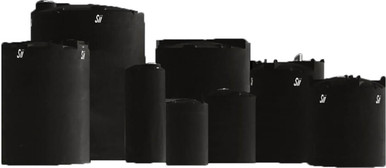
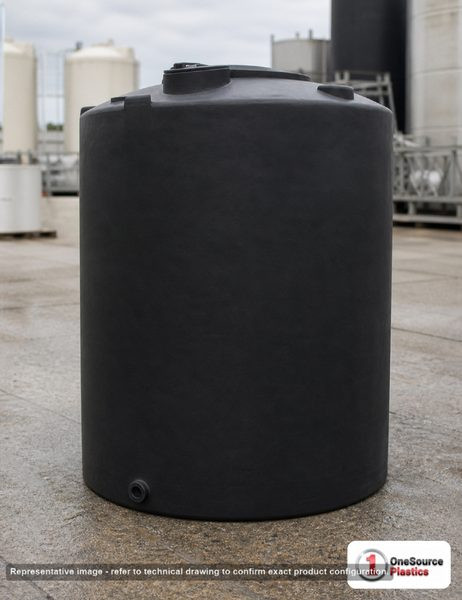
Tank: Norwesco MPN 41500 (1000 Gallon Vertical Water Storage Tank in Black, listed at $1,699.00) repurposed as a 12.5% sodium hypochlorite day tank with appropriate fittings. Black resin reduces UV-driven chlorine residual decay.
Pump architecture: peristaltic with Norprene tube. 0.1-5 GPH range. Tolerates the periodic dry-running when the tank is allowed to drain low between deliveries. No prime loss when air enters the suction. Tube replacement every 6-9 months on this chemistry.
Pairing 2: Snyder Captor for sulfuric acid pH adjustment
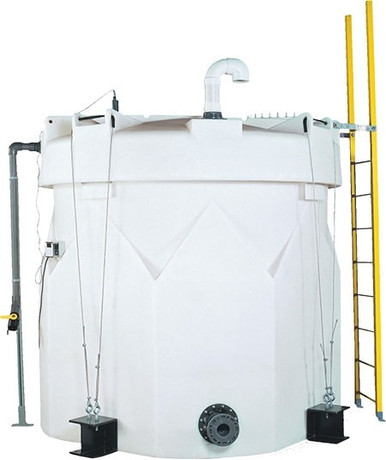
Tank: Snyder MPN 5490000N42 (1550 Gallon Vertical Double Wall XLPE in White, listed at $10,091.93). The XLPE construction handles dilute to moderate sulfuric service and the integral double wall provides SPCC secondary containment.
Pump architecture: hydraulically-actuated diaphragm metering pump with PTFE diaphragm and PVDF or alloy 20 wetted heads. Plus/minus 1% accuracy for pH-loop dosing. Solenoid diaphragm or peristaltic acceptable for less critical service.
Pairing 3: Enduraplas vertical for polymer flocculant
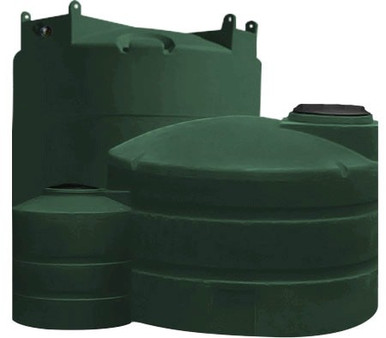
Tank: Enduraplas MPN THV02500 (2500 Gallon Vertical in Faint Green, listed at $2,769.85). Light color allows visual level check on translucent walls.
Pump architecture: progressive cavity with FKM stator. The 5,000-50,000 cP polymer chemistry is well outside the diaphragm and peristaltic envelope and well inside the PC sweet spot. Critical: install a low-level cutoff in the tank to prevent dry-running, because the PC stator will be destroyed in minutes if it runs dry.
Pairing 4: Norwesco horizontal leg tank for ag chem in-field dosing
Tank: Norwesco MPN 40298 (125 Gallon Horizontal Leg Tank in White, listed at $529.00) or Norwesco MPN 41468 (150 Gallon Plastic Horizontal Leg Tank, listed at $528.99). Mounted on a sprayer or skid for in-field herbicide dosing.
Pump architecture: 12V DC diaphragm pump for general dosing, or 12V DC peristaltic for very low GPH precision metering. Both tolerate the vibration and tilt of mobile field service.
Pairing 5: Bushman water tank for non-critical chlorine residual maintenance
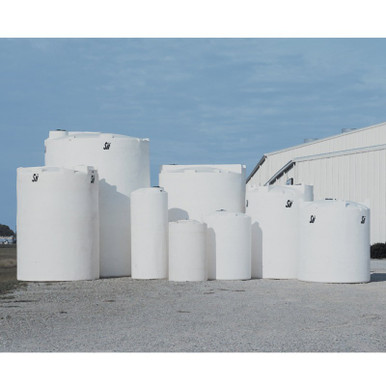
Tank: Bushman MPN WW-1500-GL-NAT (1500 Gallon Water Storage Tank Natural, listed at $1,998.99) as the source water tank.
Pump: small solenoid diaphragm dosing 1-2 ppm chlorine maintenance dose into the recirculating loop. Plus/minus 5% accuracy is fine for residual maintenance because downstream chlorine analyzer closes the control loop. $400-800 capital cost.
Pairing 6: Snyder Captor waste oil with gear pump transfer
Tank: Snyder MPN 5990102N95703 (1000 Gallon Plastic Vertical Double Wall Waste Oil Tank in Yellow, listed at $5,091.07). The double-wall integral containment satisfies SPCC.
Pump: external gear pump, cast iron construction, FKM seals. The clean lubricating oil chemistry is gear-pump territory. Flooded suction from the bottom outlet of the Captor; gear pump cannot self-prime from a dry casing. 5-25 GPM transfer rate to a tanker truck or to a downstream treatment process.
Common mistakes that destroy pumps in the first year
- Specifying a gear pump for a chemistry it cannot handle. The most expensive failure mode. A gear pump on chlorinated chemistry corrodes from the inside out and dumps chemistry through the failed seal in 6-12 months.
- Specifying a progressive cavity pump on a tank without level control. Operator allows the tank to run dry; PC stator burns through in 15 minutes; replacement stator is $1,500 plus a 4-day downtime to get the part shipped. Always pair PC with a low-level cutoff.
- Undersizing the tank outlet for a viscous chemistry. A 0.5-inch outlet on a polymer flocculant tank will cavitate any pump architecture. Spec the outlet at 1.5 inches or larger for viscous service.
- Specifying a diaphragm pump for a slurry chemistry. Calcium hypochlorite slurry, lime slurry, polymer with un-dissolved solids — diaphragm check valves clog within hours. Use peristaltic or PC.
- Specifying a peristaltic pump for high-pressure injection. Above 100 PSI on a typical industrial peristaltic, the tube life drops from months to days. If you need 200 PSI injection pressure, use hydraulic diaphragm or PC.
- Mounting the pump above the tank without verifying suction lift capability. A diaphragm pump rated for 8 feet vertical lift will not prime from 12 feet, no matter how long you run it dry.
- Using a single pump where redundancy is required. Compliance-critical dosing (chlorination of finished drinking water, fluoride dosing) typically requires duty/standby pump pairs with auto-switchover. One pump on critical service is a recipe for an EPA notice of violation.
The decision tree
If you remember one heuristic:
- If the chemistry is aggressive aqueous (chlorine, acid, caustic) and the dose rate is below 50 GPH, start with peristaltic. Move to hydraulic diaphragm only if you need higher pressure or tighter accuracy.
- If the chemistry is high viscosity (polymer, slurry, paste), default to progressive cavity. Diaphragm and gear cannot match the viscosity range, and peristaltic struggles above ~5,000 cP.
- If the chemistry is clean lubricating fluid (oil, glycol, fuel) and you need pressure, go gear pump. The gears need the fluid to lubricate themselves.
- If the dose rate is high accuracy and high pressure (boiler chemistry, fluoride dosing), specify hydraulic diaphragm.
- If the budget is tight and the accuracy requirement is loose (residual maintenance, polish dosing), solenoid diaphragm.
Specification checklist
When you write the pump purchase order, every line should have an answer:
- Pumped chemistry by name and concentration.
- Flow rate range required (minimum, normal, maximum).
- Discharge pressure required at maximum flow.
- Suction lift if not flooded suction.
- Required dosing accuracy in percent of setpoint.
- Dry-running tolerance requirement.
- Wetted materials (PTFE, PVDF, alloy 20, FKM, EPDM, etc.).
- Power supply (120 VAC, 240 VAC, 12 VDC, compressed air).
- Control input (manual stroke, 4-20 mA from PLC, pulse from flow meter, two-wire start/stop).
- Service environment (indoor, outdoor, classified electrical area, washdown).
- Redundancy requirement (single pump, duty/standby, multiple pumps in parallel).
- Spare parts inventory expectation (year-1 wear parts, year-3 major service kit).
Bottom line
The right tank without the right pump is half an installation. The four positive-displacement architectures — peristaltic, diaphragm, progressive cavity, gear — each occupy a defined service envelope, and the boundaries are sharp. Match the chemistry, the viscosity, the pressure, and the accuracy requirement to the architecture, and pair the pump with a tank from the OneSource catalog that has the right outlet location and size. Do not let a pump rep talk you into the architecture they happen to sell — pick the architecture first and the brand second.
For tank selection, browse the Chemical Storage Tank Category. For pump-paired packaged systems, OneSource routes pump quotes to qualified distributor partners. Freight on any tank is quoted to ZIP through the Freight Cost Estimator or by phone at 866-418-1777.
Recommended Tanks for This Guide
Live pricing, updated automatically · estimate freight to your ZIP.