8400 Gallon Vertical Liquid Storage Tank - Natural White (120" x 187"): Complete Buyer's Guide
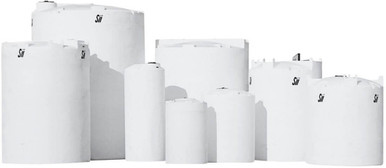
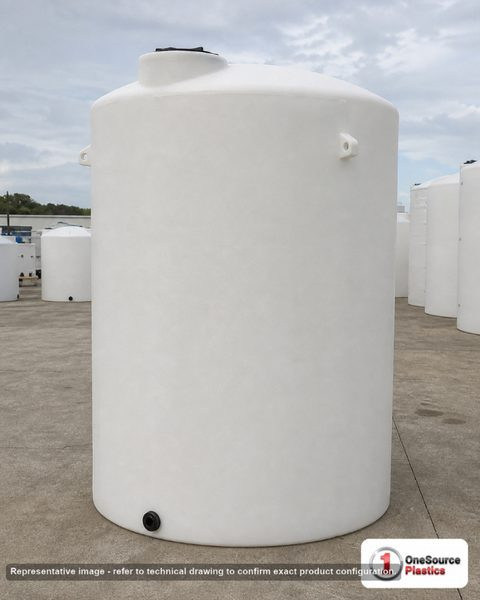
The 8,400-gallon vertical is heavy industrial bulk storage — 187 inches tall on a 120-inch base, better than fifteen feet of poly tank holding more than fifty tons of liquid when full. Its 1.5 specific-gravity wall and a 3-inch outlet with a 2-inch reducer and 3-inch siphon tube are engineered for large-volume agricultural and industrial chemical handling.
Specifications at a Glance
Every figure below is pulled straight from the live product record for this exact tank — the same data on the product page, so what you read here and what you buy never disagree.
Standards & Materials
- ASTM D1998 — Standard Specification for Polyethylene Upright Storage Tanks. Governs wall-thickness and hydrostatic design for vertical rotomolded poly tanks of this class.
- FDA 21 CFR 177.1520 — Olefin polymers. The food-contact regulation the FDA-grade resin in this tank is compounded to meet.
- Specific gravity rating 1.5 — the tank is engineered for liquids up to 1.5× the density of water (water is about 8.34 lb/gal). Confirm your fluid’s SG before storage.
Product Overview
At eighty-four hundred gallons this is among the largest single-piece poly tanks made, and everything about it operates at industrial scale. It stands more than fifteen feet tall on a ten-foot base — a tall-but-broad bulk vessel that delivers enormous capacity while keeping a footprint a site can actually accommodate. This is the tank for a fertilizer terminal, a large chemical operation, or any facility consolidating storage into fewer, bigger vessels.
It's rotomolded by Norwesco as one continuous piece of virgin linear polyethylene — no seam or weld across its entire fifteen-foot height — rated to a 1.5 specific gravity. That seamless construction is doing serious work at this scale: there is no fabricated joint anywhere to creep or fail under the immense sustained load. The 1.5-SG rating means the wall carries liquids up to 12.5 pounds per gallon, and at fifteen feet of liquid head the hydrostatic pressure at the base is very high — the wall is heavily graduated toward the bottom to handle it, which is also why the foundation here is a structural-engineering matter, not a judgment call.
Empty, the tank weighs 1,717 pounds — this arrives and is placed entirely by heavy equipment. Filled with a 1.5-SG product it loads the pad with roughly 106,801 pounds, over fifty-three tons across the 120-inch base. The translucent natural-white wall provides a level read on a tank far too tall to gauge any other casual way, and reflects sunlight to moderate the temperature of a very large stored volume. Maximum service temperature is 120°F, with UV inhibitors compounded into the resin.
The outlet is a 3-inch fitting with a 2-inch reducer and a 3-inch siphon tube, factory-installed and leak-tested — the larger bore moves bulk volume at a workable rate, the reducer adapts to downstream plumbing, and the siphon tube draws low for fuller recovery of the eighty-four hundred gallons. The 16-inch lid sits fifteen feet up and serves fill, vent, and inspection access. Norwesco's 3-year warranty applies, and the tank ships via dedicated freight carrier — contact us for delivery timeline and site-access requirements.
Technical Drawing
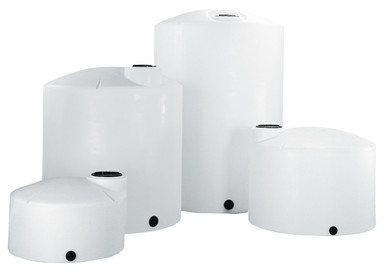
Official Norwesco technical drawing — 8400 Gallon Vertical Liquid Storage Tank - Natural White (120" x 187")
Key Features and Specifications
- 8,400-gallon capacity — sized for agricultural chemical and fertilizer storage
- Constructed from virgin linear polyethylene (HDPE) with 1.5 specific gravity rating — handles liquids up to 12.5 lbs/gal
- 187" tall x 120" diameter — compact vertical footprint
- 1717 lbs empty, approximately 106,801 lbs when full at rated specific gravity
- 3" fitting with 2" reducer and 3" siphon tube NPT outlet fitting — factory installed and leak-tested
- 16" lid opening for fill, venting, and interior access
- FDA approved for potable water and food-grade liquid contact
- 3 Year Warranty from Norwesco against manufacturing defects
- Translucent white walls allow visual level monitoring without opening the tank and reflect sunlight to keep contents cooler
- Rated for continuous service up to 120 F / 48 C
- Seamless one-piece rotational molding — no seams, no welds, no leak points
- Manufactured by Norwesco — a leading name in rotomolded polyethylene tanks
- Large tanks require professional installation. Ensure the pad is level within 1 inch across the full diameter and that all piping connections allow for thermal expansion
- Ships via dedicated freight carrier due to oversized dimensions — contact us for delivery timeline and site access requirements
Installation and Setup Guide
Installing a fifty-three-ton full tank fifteen feet tall is a civil and rigging project. Two things govern success: a structurally engineered foundation, and a professional plan for setting an 1,800-pound, fifteen-foot shell upright on site.
Site Preparation
This tank requires a structurally engineered reinforced concrete foundation, designed by someone who has run the numbers for over fifty tons concentrated on a 120-inch base with fifteen feet of liquid head bearing on the bottom. The subgrade must be engineered against settlement, and the slab must be dead level — on a fifteen-foot column even a small out-of-level condition creates large eccentric loads. This is not a pour-it-yourself pad; treat the foundation as the most important line item in the project.
Placement and Connections
Setting this tank requires a crane or large equipment and trained riggers — do not improvise. Once positioned, plumb the 3-inch outlet for high-volume transfer, using the reducer where downstream plumbing requires, and keep the siphon-tube line clean so air doesn't break the low draw. Use flexible connections at the bulkhead; thermal movement on a fifteen-foot column is significant and a rigid line on a fifty-ton-loaded fitting will fail. Build permanent platform access to reach the lid fifteen feet up — safe, code-compliant access is mandatory at this height, not optional.
Venting
A 3-inch outlet moves bulk volume fast, and an eighty-four-hundred-gallon tank exchanges a huge air volume during fill and draw. Size the vent in the 16-inch lid generously to match peak flow — on a tank this tall and large, an undersized vent during a fast transfer can pull enough vacuum to catastrophically buckle the wall. For off-gassing chemistry, fit a properly sized pressure/vacuum relief vent rated to both the vapor and the flow rate.
Maintenance and Long-Term Care
At this scale, maintenance is a formal program: the consequences of a failure — a fifty-ton release fifteen feet up — make disciplined, documented inspection essential rather than optional.
Quarterly Inspection Checklist
- Plumb and foundation: Verify the fifteen-foot column stands true against a surveyed vertical and that the engineered slab shows no cracking, settlement, or movement. On a tank this tall, any base movement is a serious finding — involve the foundation engineer if you see it.
- Base region: The bottom of the wall carries the maximum hydrostatic load from fifteen feet of liquid. Inspect the lower wall and the wall-to-floor knuckle closely for any bulge or distortion.
- 3-inch outlet, reducer, siphon: Inspect all fittings for weeping — at this volume even a slow seep is a large loss and a containment concern. Confirm the siphon draws cleanly.
- Vent: Confirm the vent is clear and correctly sized; a vent failure during transfer is the most dangerous scenario for a tank this size.
Cleaning and Changeover
Changing product in an eighty-four-hundred-gallon tank is a major planned operation. Drain via the siphon outlet for fuller recovery, then flush thoroughly per the outgoing chemical's procedure — the residual in a poorly cleaned tank this size is itself thousands of pounds of material. Confined-space and fall-protection protocols apply for any man-access through the 16-inch lid at this height. Verify polyethylene compatibility before introducing new chemistry, and manage rinsate per the chemical's label and your facility's environmental permits.
UV and Heat
A fifteen-foot wall takes a large sun load. Inspect exposed faces yearly for chalking. A very large stored volume changes temperature slowly, which moderates thermal cycling, but in extreme climates managing the tank's temperature may matter for the product. Shading a tank this size is a project in itself; weigh it against your UV exposure and the value of the stored inventory.
Alternatives and Comparisons
At eighty-four hundred gallons your decisions are about consolidation and recovery, not capacity steps:
One large tank versus several smaller ones: consolidating into a single 8,400-gallon vessel cuts the number of foundations, fittings, and inspection points, and lowers per-gallon cost — the case for going big. The counterargument is risk concentration and product flexibility: several smaller tanks let you store different chemistries and contain a failure to a smaller volume. Match the choice to your operation's risk posture and product mix.
The 3-inch outlet, reducer, and siphon: this tank's plumbing is built for both high transfer rate and fuller pull-down — a meaningful advantage over a plainer-outlet bulk tank when throughput and usable volume both matter.
Other 8400-Gallon Options
Frequently Asked Questions
How long will the 8400 Gallon Vertical Liquid Storage Tank - Natural White (120" x 187") last?
With a structurally engineered foundation and use within the 1.5-SG and 120°F ratings, fifteen to twenty years is realistic. At this scale the dominant life factor is the foundation — any settlement or movement under fifty-plus tons is the thing that shortens service. The seamless rotomolded wall, with no joints to fail, reaches the upper range when the base holds true.
What chemicals can I store in this tank?
The 1.5-SG rating covers ag chemicals, liquid fertilizers, herbicides, pesticides, and industrial and treatment solutions up to 12.5 pounds per gallon. Not for fuels, solvents, or flammables. At eighty-four hundred gallons, rigorous compatibility verification against a chart is essential before committing — polyethylene resists most acids and bases but is attacked by certain hydrocarbons and strong oxidizers.
What kind of foundation does a 8400-gallon tank need?
It requires a structurally engineered, reinforced concrete foundation designed for roughly 106,801 pounds on a 120-inch base with fifteen feet of liquid head. This is an engineer's calculation, not a rule of thumb — the subgrade must be engineered against settlement and the slab poured dead level. The foundation is the single most important element of the install.
Does this tank come with a warranty?
Yes — Norwesco's 3-year warranty covers factory material and workmanship defects. It excludes over-spec products, inadequate or non-engineered foundations, incompatible-chemical attack, and impact or rigging damage. At this scale, retain full engineering and installation documentation for any claim.
Can I install this tank underground?
No — this is an above-ground industrial vertical, not engineered for burial, and a tank this size would be impractical to bury regardless. Soil pressure would deform the wall. For below-grade storage use a purpose-built underground cistern designed for soil load.
Buying Considerations
Buying at this scale is project procurement. The non-negotiables: a structurally engineered foundation in your scope, a crane-and-rigging plan to set the fifteen-foot shell, code-compliant permanent access to the lid, and verification that your product is at or under 1.5 SG before committing eighty-four hundred gallons to it. Confirm the 3-inch outlet, reducer, and pump capacity suit your throughput. This ships by dedicated freight carrier — engage us early to coordinate delivery, site access, and the rigging your facility will need.
Related Products You May Need
Questions? Call (866) 418-1777 — our team knows these products inside and out and can help you select the right tank for your application.
Recommended Tanks for This Guide
Live pricing, updated automatically · estimate freight to your ZIP.