Day-Tank vs Bulk-Tank Topology for Batching Operations: When the Two-Tank Architecture Earns Its Cost, How to Size the Day Tank Against the Production Cycle, and the Plumbing Topology That Keeps Both Tanks Working as a System
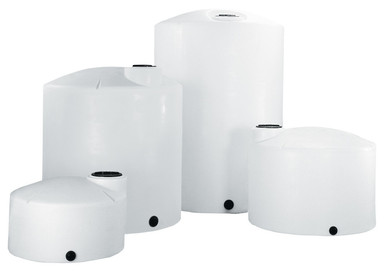
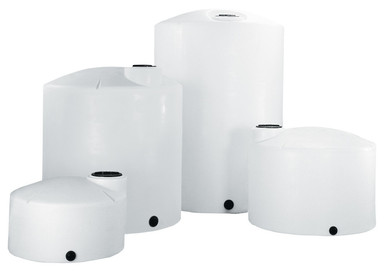
The two-tank topology — a bulk storage tank feeding a smaller day tank that supplies the process — is one of the oldest patterns in industrial chemical handling, and one of the most consistently misunderstood. The new installation gets specified as a single large tank to save the cost of the second vessel. The retrofit gets a day tank added later when the original single-tank installation hits its operating limits. The greenfield project sometimes gets the day tank but undersized, and the production cycle ends up gated on the day-tank refill schedule rather than the actual process throughput. Each of these outcomes traces back to a sizing decision made without a structured analysis of the production cycle, the chemistry stability envelope, and the operational risk profile.
This article walks the engineering of day-tank-vs-bulk-tank topology for batching operations. The references are the chemical process design textbook references on intermediate storage (Walas, Peters and Timmerhaus), the API and Chemical Processing magazine field-engineering guides, the manufacturer technical bulletins from Norwesco, Snyder, Chem-Tainer, Enduraplas, and Bushman on tank-pairing and feed-system specifications, and the OSHA process safety management framework on managing inventory hazards (29 CFR 1910.119). The objective is the structured framework for deciding when to install a day tank, how to size it, and how to plumb the bulk-to-day-to-process system as an integrated whole.
1. Why the Two-Tank Topology Exists
The single-tank topology — a bulk storage vessel that feeds the process directly — works well for steady-state continuous operations with stable chemistry and predictable demand. It fails for several common operating profiles:
- Batch operations with intermittent high-flow demand. A batch process that draws 500 gallons in a 5-minute charge cycle, then sits idle for 2 hours, imposes a flow profile that the bulk tank's outlet plumbing and pump system may not be sized to deliver. The day tank provides a buffer that is sized for the instantaneous batch flow while the bulk-to-day refill happens at a steady manageable rate.
- Multi-product or multi-recipe operations. A facility that runs different formulations on different days needs the ability to fully drain and clean between products. A day tank of 100-500 gallons can be drained and cleaned in an hour; a bulk tank of 5,000 gallons cannot, and the changeover schedule is gated by tank cleaning time.
- Chemistry stability envelopes. Some chemistries degrade over time at storage temperatures (peroxides, certain polymers, biocides), and the day tank serves as a "first in, first out" cycling vessel that ensures no product sits at storage temperature longer than its stability window. The bulk tank acts as a refrigerated or temperature-controlled long-term holding area; the day tank holds only the current production cycle's working volume.
- Chemistry purity and contamination risk. Some processes require uncontaminated chemistry at the process inlet. The day tank is filled from the bulk tank through a filter or polishing step; the day tank then supplies the process directly. Any contamination event at the bulk tank stays at the bulk tank and does not propagate to the process unless it makes it through the polishing step.
- Safety inventory limits under PSM or RMP. A facility under OSHA process safety management may have hazardous-chemistry inventory limits that require breaking the inventory into smaller vessels. The day tank holds an OSHA-tier-below quantity at the process; the bulk tank may sit at a separate location or under a separate management program.
The decision to install a day tank should be driven by one or more of these operating profiles, not by a default "we always use a day tank" engineering convention or a "we never use a day tank" cost-cutting decision.
2. Day-Tank Sizing Math Against the Production Cycle
The day tank is sized for the production cycle's working envelope plus an operating margin. The base calculation:
- Working volume = (peak hourly demand) × (hours of buffer). A process that draws 100 gallons per hour at peak with a 4-hour buffer requires a 400-gallon working volume. The buffer hours come from the production reliability analysis: how long can the bulk-to-day refill be unavailable before the process is forced to stop?
- Day-tank nominal capacity = working volume / fill ratio. A typical fill ratio is 0.7-0.85 (the working volume occupies that fraction of the nominal capacity), accounting for headspace, freeboard, and the high-low operating band. The 400-gallon working volume becomes a 470-575-gallon nominal capacity.
- Round to the nearest standard tank size. A 500-gallon vertical bulk-style tank fits the calculated envelope at standard pricing; a custom 470-gallon tank would be cost-inefficient.
- Verify against the batch size. If the process runs in 250-gallon batches, the day tank must hold at least one full batch with margin to start a second batch before refill. A 500-gallon day tank covers a 250-gallon batch with 50 percent margin; a 300-gallon day tank does not.
- Verify against the bulk-to-day refill rate. If the refill takes 30 minutes and the process can draw 50 gallons in that time, the day tank low setpoint must be at least 50 gallons above the empty point to avoid running the process on a partially-filled tank.
The sizing exercise should also include the worst-case day length (some operations run 24/7; some run 8-hour shifts), the maintenance window for the bulk tank or the bulk-to-day pump (during which the day tank must hold the day's full demand), and the safety margin for unexpected operational delays.
3. The Plumbing Topology — Bulk to Day to Process
The plumbing between the bulk tank, the day tank, and the process must be designed as a coherent system. The major topology decisions:
- Bulk-to-day refill mode: continuous, on-demand, or scheduled. Continuous refill maintains the day tank at a high-level setpoint with a control valve modulating to match draw. On-demand refill triggers when the day tank low-level setpoint trips. Scheduled refill runs at fixed times (typically end-of-shift or pre-shift). The choice depends on the chemistry stability envelope, the operator workflow, and the risk profile of running a partially-empty day tank.
- Day-to-process feed mode: gravity, pumped, or pressurized. Gravity feed requires the day tank elevation to exceed the process inlet elevation by enough to overcome pipe friction and any control valve pressure drop. Pumped feed uses a dedicated transfer pump (centrifugal, positive-displacement, peristaltic) sized for the peak process flow. Pressurized feed (rare in batching applications) maintains the day tank at slight overpressure to push the chemistry into the process. Each mode has its own pressure-control, surge-protection, and air-management implications.
- Refill control architecture: float valves, electronic level sensors, or PLC-based sequence. Float valves are the simplest and most fail-safe (no electronics to fail) but offer no overfill protection beyond the mechanical valve closure. Electronic level sensors (capacitive, ultrasonic, hydrostatic) connect to a PLC or controller that manages the refill sequence with high-low setpoints, alarm setpoints, and high-high shutoff. The PLC architecture is preferred for any application where the chemistry hazard or the operational risk justifies the additional engineering.
- Cleaning and changeover plumbing. The day tank must be drainable to a known endpoint, rinsable with a cleaning solution, and lockable from the bulk tank during the cleaning operation. Standard practice is a triple-valve manifold (bulk-to-day, day-to-process, day-to-drain) with all three valves capable of full positive shutoff and lockout-tagout-compliant operation.
- Vapor management between bulk and day tanks. If the chemistry generates vapors, both tanks need vent paths and the refill flow may push vapor between vessels. The vent and flame-arrestor configuration must accommodate both directions of flow under all operating conditions.
The plumbing topology should be drawn as a P&ID (process and instrumentation diagram) at the design stage and verified against the operating procedures. The mistake in too many installations is plumbing the bulk-to-day-to-process system as an extension of the original single-tank plumbing, which results in a topology that does not actually achieve the buffering and isolation objectives.
4. The Polishing Step Between Bulk and Day
For many applications, the bulk-to-day refill is also the appropriate point to insert a polishing step that cleans, filters, conditions, or concentrates the chemistry before it reaches the process. The day tank then holds polished chemistry; the bulk tank holds the as-delivered chemistry.
- Filtration for particulate removal. A bag filter or cartridge filter on the bulk-to-day line removes settled solids and contamination introduced during bulk delivery. Filter element selection depends on the chemistry, the particle-size requirement, and the flow rate; typical day-tank refill flows are well-served by 5-50 micron bag filters with a few hundred GPM capacity.
- Chemistry conditioning. A pH-adjustment step, a temperature-conditioning step, or a chemistry-blending step between the bulk and day tanks ensures the day tank holds chemistry that is ready for process use without further conditioning at the process inlet.
- Concentration adjustment. Some processes require dilute chemistry that is shipped concentrated for freight efficiency. The bulk-to-day step can include the dilution operation; the day tank then holds chemistry at process concentration.
- Settling and decanting. For chemistry with dispersed solids that will settle over time, the bulk-to-day refill can be timed to draw from a clarified portion of the bulk tank; the residue stays in the bulk tank and is removed periodically.
The polishing step adds capital cost but materially improves the chemistry quality at the process inlet. The decision to include it depends on the process tolerance for variation in the as-delivered chemistry.
5. The Operational Risk Profile — What the Two-Tank Topology Actually Mitigates
The two-tank topology is a risk-mitigation strategy. The risks it addresses:
- Bulk tank contamination event. If the bulk tank is contaminated by a delivery error, a microbial intrusion, or a chemistry decomposition, the contamination is contained at the bulk tank until it would otherwise propagate to the process. The day tank gives the operator a window to detect and isolate the bulk-tank issue before any contaminated chemistry reaches the process.
- Bulk tank maintenance and inspection windows. The bulk tank can be drained, cleaned, inspected, or repaired while the day tank continues to feed the process. The operation does not stop during the bulk-tank service window; the day tank provides the time buffer.
- Supply continuity through delivery delays. If a scheduled bulk delivery is delayed, the day tank continues to feed the process from the residual bulk inventory plus the day-tank working volume. The two-tank inventory is materially larger than a single bulk tank at the same total volume, because the day tank effectively doubles the front-loaded supply.
- Process upset isolation. If the process generates a backflow event (hot vapor, contaminated condensate, runaway reaction), the day tank absorbs the upset rather than propagating it back to the bulk tank where the contamination would spread to the entire bulk inventory.
- Hazardous chemistry inventory management. The day tank holds a smaller hazardous-chemistry inventory at the process, which may put the process under a lower regulatory tier (e.g., below the PSM threshold) than a single bulk tank at the process would create.
The risk-mitigation value is application-specific. A continuous-process operation with stable bulk chemistry and an unblemished operational history may not benefit materially from a day tank. A batch operation with chemistry-stability concerns or a hazardous-inventory regulatory exposure benefits substantially.
6. Tank Selection for the Day-Tank Role
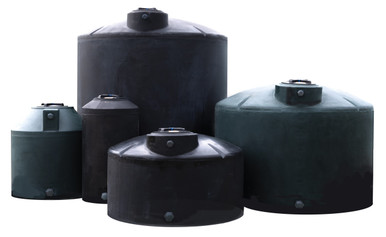
The day tank is typically a smaller polyethylene vessel sized between 50 and 1,500 gallons. The selection criteria differ from the bulk tank in several respects:
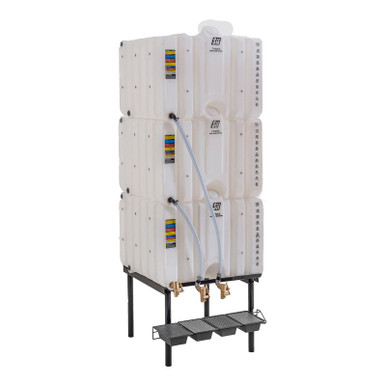
- Cone-bottom geometry preferred for full-drainage cleaning. The day tank gets cleaned more frequently than the bulk tank; the cone-bottom geometry drains to a single low point and supports rapid cleaning between batches. Reference N-43852 1,000 gallon 45-degree cone for the larger-batch day-tank role and N-42064 15 gallon 57-degree cone bottom inductor for the small-batch laboratory or pilot-scale role.
- Multiple top-fitting bosses for the integration plumbing. The day tank typically needs an inlet from the bulk-to-day plumbing, a vent or flame arrestor, a level-sensor port or sight tube, an overflow port to a containment, and possibly a polishing-step return line. The cone-bottom inductor designs typically include the fitting positions for this integration.
- Outlet sizing matched to the process draw rate. The day tank outlet must support the peak process draw without restriction. A 2-inch outlet supports up to roughly 130 GPM gravity drain; a 3-inch outlet supports up to 280 GPM. Larger outlets are available on the cone-bottom designs for high-flow applications.
- Material compatibility for the conditioned chemistry. The day tank may hold conditioned, concentrated, or temperature-adjusted chemistry that has different compatibility behavior than the as-delivered bulk chemistry. The material specification for the day tank is verified independently against the as-fed chemistry envelope.
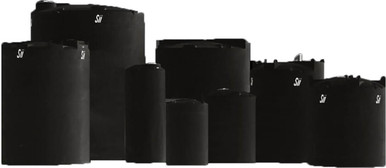
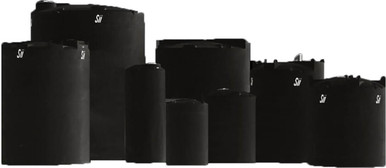
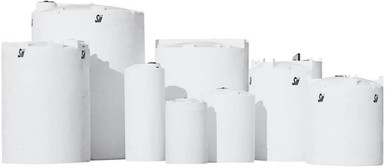
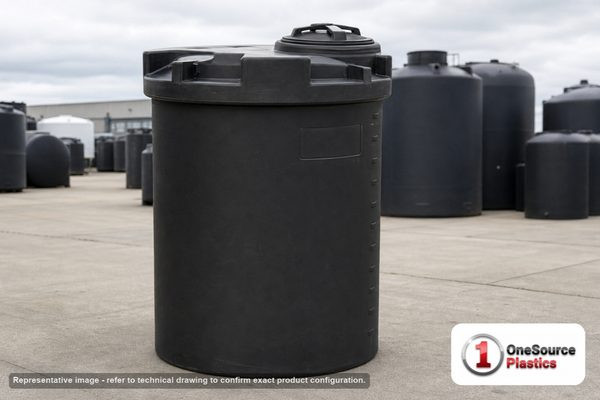
The bulk tank in the same installation is typically a vertical bulk-storage geometry sized for several days to a month of demand. Reference N-40164 5,000 gallon Norwesco vertical or N-43128 10,000 gallon Norwesco vertical for the typical bulk role; for hazardous-chemistry installations under SPCC or PSM, reference the SII-1006600N42 10,000 gallon XLPE Captor double-wall.
7. Common Mistakes in Two-Tank Installations
The recurring failure modes in field installations:
- Day tank undersized for the actual process demand. The original sizing used a steady-state demand value rather than the peak demand or the batch-size-plus-margin. The day tank empties between refills and the process runs intermittently against the bulk-to-day pump rather than the day tank.
- Refill control without overfill protection. A float valve as the only refill control is the most common single-point failure mode; if the float sticks open, the day tank overflows. Standard practice is float valve plus high-level alarm plus high-high shutoff with an independent sensor.
- No isolation valve between bulk and day during cleaning. The cleaning operation is interrupted by the bulk-to-day refill, defeating the cleaning. The triple-valve manifold with positive lockout is the engineering remedy.
- Vapor path neglected. If both tanks vent independently to atmosphere, the refill flow may pull vapor through the day-tank vent into the bulk-to-day plumbing, then into the bulk tank. For volatile chemistries, this can introduce explosive atmospheres into the bulk vapor space. The vent path must be analyzed for both forward and reverse flow.
- Polishing step bypassed during emergency refills. If the polishing step (filter, conditioning) becomes a bottleneck, operators may install a bypass valve that delivers unfiltered chemistry to the day tank. The bypass should be locked closed and only opened under documented exception procedures.
The common thread is treating the two-tank topology as two separate single-tank installations rather than as an integrated system. The integration is where the engineering value lives.
8. The Engineering Discipline Conclusion
The day-tank vs bulk-tank topology decision is structural to the operating economics, the chemistry quality, and the regulatory posture of the process installation. The single-tank choice is right for steady-state continuous operations with stable chemistry and predictable demand. The two-tank choice is right for batch operations, multi-product facilities, chemistry-stability-sensitive applications, hazardous-inventory management, and high-reliability operations where the bulk tank service windows must not stop production.
The structured analysis takes a few hours of engineering time at the project planning stage. The cost of doing it after the installation is operational — the production delays, the chemistry quality issues, the cleaning bottlenecks, the regulatory findings — accumulate as a multi-year drag on the operation. The engineering discipline pays for itself in the first year of any application where the topology decision actually matters.
OneSource Plastics ships the polyethylene tank platform that supports both the bulk-tank and day-tank roles across all 5 brands — Norwesco, Snyder, Chem-Tainer, Enduraplas, Bushman — with the dimensional drawings, fitting specifications, and material compatibility documentation that the application engineer needs to design the two-tank system. List pricing by SKU is on the product page; LTL freight to your ZIP is quoted separately via the freight estimator or by phone at 866-418-1777. For related installation engineering see tank plumbing system design walkthrough and tank mixer and agitator engineering.
Recommended Tanks for This Guide
Live pricing, updated automatically · estimate freight to your ZIP.