Emergency Reserve Water Storage Sizing for Small Systems: Ten States Standards Section 7 + AWWA D100 Practice
The Recommended Standards for Water Works (Ten States Standards) Section 7, "Finished Water Storage," provides the consensus regulatory framework for storage tank sizing on small public water systems across the upper Midwest and northeastern states that have adopted the document by reference. The AWWA D100 series adds the structural design standards for the tanks themselves. For small system operators sizing an emergency reserve — the volume held back for power outages, source-water failures, distribution pipe breaks, fire-flow events, and contamination response — the two documents work together. This piece walks the math, the regulatory backstop, and how to translate sizing requirements into real catalog tank selections from the OneSource inventory.
The three-component model of water storage
Standard practice (Ten States Standards Section 7, plus AWWA M22 supply-side guidance) divides total finished water storage into three additive components:
Daily Operational Storage (DOS)
DOS supplies water when system demand temporarily exceeds source supply during peak diurnal periods. The Ten States Standards generally interpret DOS as one day of average daily demand. For a 50-connection rural cluster averaging 250 gallons per day per connection, DOS = 50 * 250 = 12,500 gallons.
Fire Storage (FS)
FS is the volume reserved to deliver the fire-flow rate required by the local Insurance Services Office (ISO) classification or state fire code. For typical rural and small commercial systems the required flow is 500 to 1,000 gallons per minute for two hours, equating to 60,000 to 120,000 gallons. For very small unincorporated rural systems with no hydrant infrastructure, fire storage may be reduced or eliminated by AHJ approval.
Emergency Storage (ES)
ES is the buffer for unscheduled outages — pipe breaks, equipment failures, power loss, source contamination response, natural disaster. Common practice: 20 to 50 percent of maximum day demand, sized by risk assessment of the specific system.
For the 50-connection example with maximum day demand at 1.8 times average (industry typical), max day = 22,500 gallons. ES at 30 percent = 6,750 gallons.
Total finished water storage
Total = DOS + FS + ES = 12,500 + 60,000 (assuming ISO fire-flow requirement) + 6,750 = 79,250 gallons. This is the regulatory-and-practice target for the example system. In practice, very small rural systems without hydrants drop the FS component and end up at 19,250 gallons total — well within the catalog range of polyethylene or steel options.
When polyethylene is the right answer (and when it is not)
Polyethylene (HDPE/XLPE rotomolded) tanks are the right answer for small-system finished water storage when:
- Total volume is 5,000 gallons or less per tank, or systems can be configured as multiple smaller modules.
- The system is rural or small municipal (less than approximately 500 connections).
- NSF/ANSI 61 certification is required for potable water contact (Norwesco, Snyder, Bushman, Chem-Tainer, and Enduraplas water-rated lines all carry NSF/ANSI 61).
- Above-ground installation is permitted by AHJ.
AWWA D100 welded carbon steel tanks (and D101, D102, D103 series for related steel work) are the right answer for:
- Single-tank volumes above approximately 10,000 gallons.
- Elevated (overhead) storage where structural support is engineered for the tank weight.
- Systems sized for 500 connections or larger where standardized inspection, painting, and maintenance practices are integrated into the operations workflow.
The reality of small-system water reserves: the typical 50-connection rural cluster sized above can be served by a multi-tank polyethylene installation totaling 19,250 gallons (the no-hydrant case), broken into multiple 2,500 to 3,000 gallon vertical tanks. This is operationally simpler, cheaper to install, and easier to inspect than a single 20,000-gallon welded steel option.
Worked example — 50-connection rural cluster, no fire-flow requirement
System parameters:
- 50 connections, 250 gpd average per connection
- Average daily demand = 12,500 gpd
- Maximum day demand = 22,500 gpd (1.8x peak factor)
- No hydrant infrastructure (rural, AHJ has waived FS)
- Emergency Storage at 30 percent of max day = 6,750 gallons
- Total finished water storage requirement = 12,500 + 0 + 6,750 = 19,250 gallons
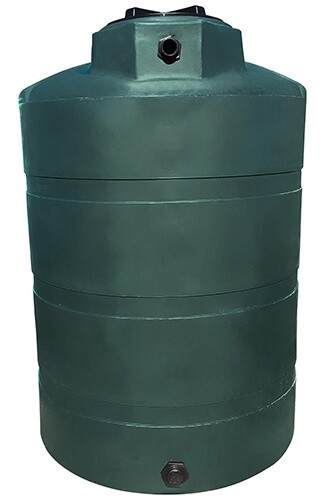
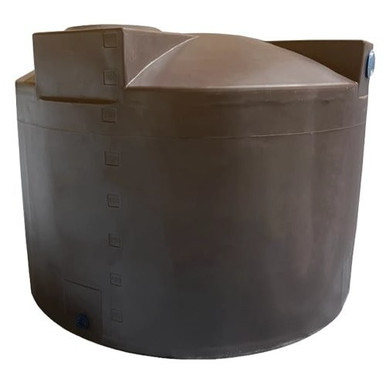
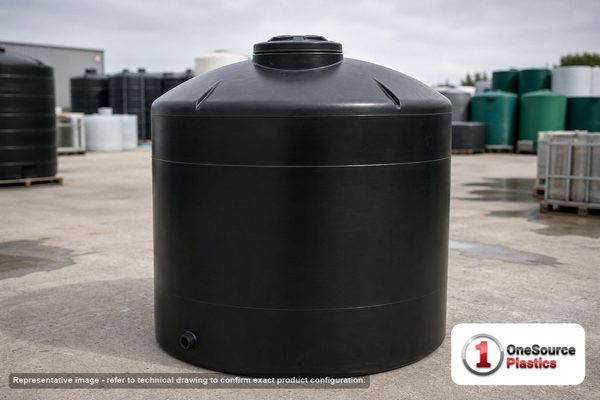
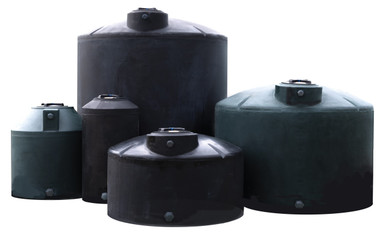
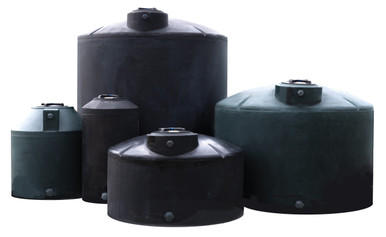
Catalog selection: 8 x Norwesco 2,500-gallon vertical water storage tanks in black HDPE.
- MPN 42040, 95-inch diameter x 91-inch tall, NSF/ANSI 61 certified, listed at $2,399.00 each
- Total tank cost: 8 * $1,990 = $15,920 list (freight quoted to ZIP per system)
- Total volume: 8 * 2,500 = 20,000 gallons (slightly oversized, accommodates future growth)
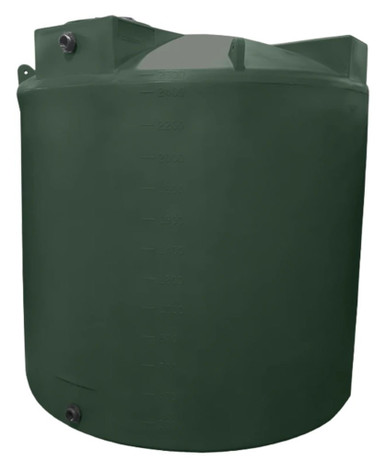
Alternative catalog selection: 4 x Norwesco 3,000-gallon dark green vertical water storage tanks (MPN 40868, listed at $2,999.00 each, 12,000 gallons subtotal) + 3 x Norwesco 2,500-gallon dark green vertical (MPN 40867, listed at $2,399.00 each, 7,500 gallons subtotal). Total: 19,500 gallons across 7 tanks. Total tank cost: 4 * $2,700 + 3 * $2,200 = $17,400 list.
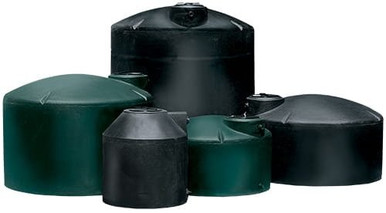
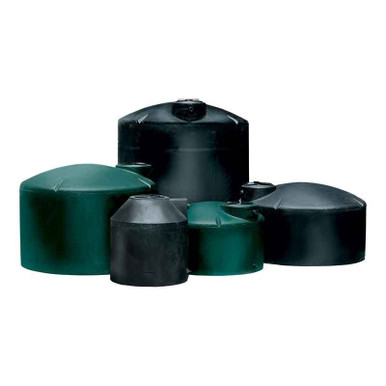
For the dark-green option the visual integration with rural landscape is improved, and the dark color reduces algal photosynthesis inside the tank — a common AHJ requirement for outdoor water storage in some jurisdictions.
Worked example — 200-connection rural community, hydrant fire-flow requirement
System parameters:
- 200 connections, 200 gpd average per connection
- Average daily demand = 40,000 gpd
- Maximum day demand = 64,000 gpd (1.6x peak factor for larger systems)
- ISO fire-flow requirement: 500 gpm for 2 hours = 60,000 gallons
- Emergency Storage at 25 percent of max day = 16,000 gallons
- Total finished water storage requirement = 40,000 + 60,000 + 16,000 = 116,000 gallons
This system is over the practical polyethylene single-tank limit. The realistic options:
- Single AWWA D100 welded carbon steel tank. 120,000 gallon nominal, ground-level cylindrical, glass-fused-to-steel or epoxy-lined for NSF/ANSI 61 contact. Outside the OneSource Plastics catalog scope.
- Modular polyethylene tank farm for the DOS + ES portion (56,000 gallons), with separate dedicated fire-storage cistern. Practical only if fire-storage can be pulled from a separate source (pond, separate bolted-steel reservoir).
For systems above the 50,000-gallon-total threshold, OneSource typically refers operators to bolted steel or welded steel installations. Polyethylene is right-sized for the smaller end of the small-system spectrum.
The maximum-day-demand calculation
Several state regulators apply specific peak-factor multipliers when sizing reserves for systems they regulate. Common values from published regulator guidance:
- Iowa Department of Natural Resources (DNR): peak hour factor 2.5x average for small systems under 100 connections; 1.8x for systems 100 to 1,000 connections.
- Wisconsin DNR: maximum day factor commonly 2.0x for rural systems, 1.5 to 1.8x for clustered residential.
- Minnesota Department of Health: maximum day factor 2.0x average for systems under 1,000 connections.
- Michigan Department of Environment, Great Lakes, and Energy (EGLE): maximum day factor 1.8 to 2.0x average is standard.
The peak factor is multiplicative on top of the average daily per-connection demand. For a system designer the practical implication: sizing the reserve to the average daily demand rather than the maximum day demand will short-size by a factor of 1.5 to 2.5x. AHJ permit reviewers reject submittals that miss this.
Multi-tank vs single-tank trade-offs
Multi-tank advantages
- Operational redundancy. One tank can be isolated for inspection, cleaning, or repair without taking the whole reserve offline.
- Phased capital outlay. A 4-tank installation can be permitted and installed as 2 tanks now plus 2 tanks in year 3.
- Easier site placement. Multiple smaller tanks fit on irregular small-acreage well sites where a single 20,000-gallon footprint will not.
- Easier permitting. Below 5,000 gallons per tank, many AHJs do not require P.E.-stamped foundation or wind-load engineering.
Single-tank advantages
- Lower per-gallon installed cost above ~10,000 gallons. Steel and bolted-steel options become economical at scale.
- Single inspection cycle. One tank means one inspection event per cycle, not 8.
- Higher fire-flow draw-down rate per tank. A single 100,000-gallon tank can deliver 2,000 gpm to a hydrant draw without depleting too quickly; a multi-tank manifold needs sized cross-connect plumbing to deliver the same rate.
Manifold design for multi-tank installations
The manifold (cross-connect plumbing) determines whether a multi-tank installation behaves as parallel reservoirs or as effectively-sequential storage. Two common configurations:
Common-suction manifold
All tank discharges connected to a single suction header that feeds the system pump. Tanks draw down at the same rate. Single-failure isolation is good — close one tank's isolation valve, and the rest stay online. This is the typical small-system configuration.
Lead-lag manifold
Tank 1 is the active service tank, Tanks 2 through N are reserve. Tank 1 fills from the source, system draws from Tank 1, overflow from Tank 1 feeds Tank 2 (or pumped fill on level), etc. More complex plumbing but each tank has predictable inventory behavior. Used in systems that need to track per-tank residence time for water-quality reasons.
For most small-system applications the common-suction manifold is the right call — simpler plumbing, easier operations, and a single failure does not compromise the reserve.
Tank residence time and water quality
Ten States Standards Section 7.0.4 addresses water-quality issues from extended storage residence time. The general principle: chlorine residual decays in storage, and total trihalomethane (TTHM) and haloacetic acid (HAA5) disinfection byproducts can grow over time. The Section 7 guidance for small systems with chloramine or chlorine residual systems:
- Target 3 to 5 days maximum residence time for finished water in storage.
- Active turnover (fill-draw cycling) is preferred over static reserve.
- Re-chlorination at the storage tank may be required for long-residence reserves.
For the 50-connection rural cluster sized at 19,250 gallons total against a 12,500 gpd average demand: residence time = 19,250 / 12,500 = 1.5 days. Well under the 3-to-5-day guideline.
For the 200-connection community sized at 116,000 gallons against 40,000 gpd: residence time = 2.9 days. Still within the guideline, but at the upper end. Re-chlorination capability at the storage tank is worth designing in as a contingency.
Catalog inventory for emergency reserve sizing
Real OneSource catalog options that map to small-system reserve sizing:
- Norwesco 1,000 gallon vertical water storage in black, MPN 41500, listed at $1,699.00
- Norwesco 1,550 gallon vertical water storage in black, MPN 40627, listed at $1,799.00
- Norwesco 2,500 gallon vertical water storage in black, MPN 42040, listed at $2,399.00
- Norwesco 3,000 gallon vertical water storage in dark green, MPN 40868, listed at $2,999.00
- Norwesco 3,450 gallon vertical water storage in black, MPN 44664, listed at $3,199.00
- Bushman 1,500 gallon water storage in natural, MPN WW-1500-GL-NAT, listed at $1,998.99
- Bushman 1,000 gallon vertical water storage in dark color, MPN 30332, listed at $1,749.00
For full water-tank category browse Water Tanks.
Permitting and AHJ submittal package
For a public water system, the permit submittal package for the storage tank installation should include:
- System demand calculation — average daily, maximum day, peak hour.
- Reserve sizing math — DOS + FS + ES with peak factor sourced from regulator guidance.
- Tank manufacturer catalog data sheet including NSF/ANSI 61 certification.
- Manifold and isolation valve plumbing diagram.
- Foundation and wind-load engineering (P.E. stamped above 5,000 gallons in most AHJs).
- Re-chlorination provision if residence time exceeds 3 days at average demand.
- Fire-flow capability summary if hydrants are part of the distribution system.
- Operator-of-record signoff for the operations and maintenance plan.
For state-by-state permit timeline see Tank Permitting Lead Time by State. For state-specific water-system context see State Tank Regulations.
Bottom line
Emergency reserve sizing for small public water systems is straightforward arithmetic once the inputs are pinned: average daily demand from connection count and per-connection use, maximum day demand from the regulator's peak factor, fire-flow requirement from ISO classification or AHJ waiver, and emergency reserve at 20 to 50 percent of maximum day. The Ten States Standards Section 7 framework supplies the consensus regulatory backstop; AWWA D100 series supplies the structural design standard for steel; polyethylene NSF/ANSI 61-certified rotomolded tanks supply the right answer for the smaller end of the small-system spectrum (5,000 gallons per tank or less, multiple modular installations). Manifold the tanks for common suction, manage residence time below 3 to 5 days at average demand, design re-chlorination for longer residence reserves. The catalog inventory at the small-system scale fits inside an installed cost envelope of $15,000 to $25,000 for the tank package on a typical 50-connection rural cluster.
For full water tank catalog browse Water Tanks. For potable certification details see NSF/ANSI 61 Above and Below Ground Potable Water Storage.
Recommended Tanks for This Guide
Live pricing, updated automatically · estimate freight to your ZIP.