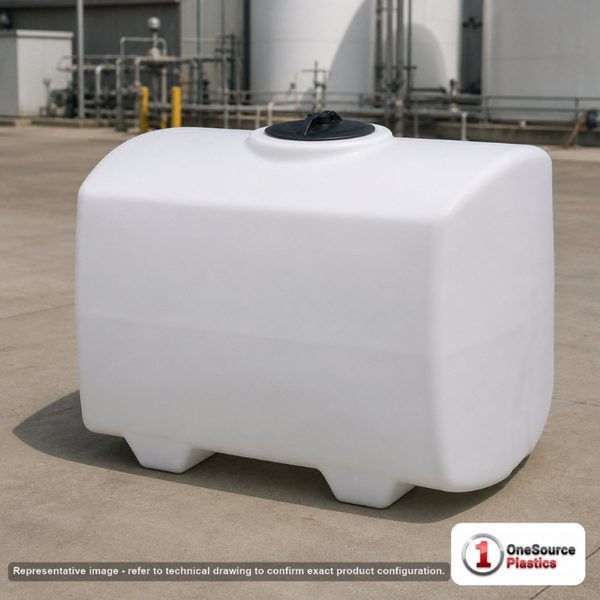
Fertilizer-Blend Tank Stratification: Thermal Layering Physics, Density-Driven Salting Out, Mixing Protocol Design, and the Field Verification Methods That Catch a Stratified Tank Before the Spreader Runs Off-Spec
UAN-32 (urea-ammonium-nitrate solution at 32 percent total nitrogen), 28 percent UAN, custom blends with thiosulfate or potash carryover, and high-density ammonium-polyphosphate (10-34-0) all share a stratification problem that is invisible at the tank exterior but consequential at the spreader: the bulk liquid in a static-storage tank does not stay homogeneous over weeks of hold. Temperature gradients drive thermal layering. Density differences between the source blend and any rainwater intrusion or partial-batch top-up drive density layering. Cooling toward the saturation point drives salting-out where dissolved salts crystallize at the cold layer and accumulate at the bottom of the tank. By the time the operator pulls product to the spreader, the tank can have a top-layer concentration 10-20 percent below the bulk-stated value and a bottom layer where crystalline solids have settled and may plug a suction strainer or carry forward as suspended solids that throw the spreader's calibration.
This article walks the stratification physics, the four mechanisms that produce layered fertilizer storage, the mixing protocol architectures that prevent or correct stratification, the field verification methods that catch a stratified tank before product is dispensed, and the polyethylene tank specifications that support reliable mixing without compromising tank integrity. References cited: TFI (The Fertilizer Institute) handling and storage guidelines, AAPFCO (Association of American Plant Food Control Officials) sampling and analysis standards, ASTM E126 (standard test method for inspection, certification, and verification of volumetric ware) and ASTM D1298 (hydrometer density determination), ANSI/ASAE S341 (procedures for measuring distribution uniformity), and IFDC (International Fertilizer Development Center) technical bulletins for liquid fertilizer chemistry.
1. The Four Stratification Mechanisms in Liquid Fertilizer Storage
A static-storage liquid fertilizer tank has four physical mechanisms that drive it from homogeneous to layered, each with its own time scale and its own field signature.
Mechanism 1: thermal layering. A tank loaded with 60-degree-F UAN in the spring sees a tank-skin temperature swing of 30-50 degrees F over a sunny April-May day in the central US. The wall heats faster than the bulk liquid; warm liquid near the wall rises by buoyancy; cool liquid at the center sinks; a slow circulation pattern develops that, paradoxically, can produce stable thermal layers where the warm-skin water rises only to the upper third and cools, while cooler-night air at night cools the upper layer and creates a stable thermal cap. Over a week of warm-day, cool-night cycling, the tank develops a measurable temperature gradient: 5-10 degrees F warmer at top than at bottom on a typical mid-Atlantic spring day. The thermal gradient is normally below the visible threshold but it is the precondition for the next two mechanisms.
Mechanism 2: density layering from solubility-temperature coupling. UAN solubility is temperature-dependent: 32 percent UAN at 32 degrees F is at its salting-out point. Cooler liquid holds slightly less dissolved salt than warmer liquid; if the bottom is cooler than the top, the bottom layer is at a lower effective concentration with crystals or near-crystals at the bottom of the tank; the top layer holds the equilibrium concentration in solution. The density difference (warmer liquid less dense than cooler crystallizing liquid) is small but persistent, on the order of 0.5-1.5 percent density spread between top and bottom in a 5,000-gallon tank that has cooled overnight after a warm-day fill. The difference is below visible level but above analytical detection.
Mechanism 3: density layering from intrusion or partial top-up. A receiving tank that takes a partial top-up of slightly different blend (say a 28 percent UAN top-off on a 32 percent UAN heel) develops an obvious density layer because 28 percent UAN density is roughly 1.28 g/mL while 32 percent is 1.32 g/mL. The fresh top-up sits on top of the heel without mixing for hours to days. Rainwater intrusion through a defective vent or hatch produces a similar layer at the top: rainwater density 1.00 sits indefinitely on top of UAN density 1.32 without mixing absent agitation. Density-driven layering from intrusion is the single most common stratification failure in field-installed fertilizer tanks.
Mechanism 4: salting-out at cold-weather conditions. If the tank temperature drops to or below the salting-out point of the blend (32 degrees F for 32 percent UAN, 0-15 degrees F for 28 percent UAN, well below 0 degrees F for 24 percent and lower), the dissolved salts crystallize. Crystals are denser than the supernatant liquid and accumulate at the bottom of the tank. The salting-out is reversible: warming the bulk liquid back above the salting-out point redissolves the crystals. The operational consequence: a tank that froze partially during a winter cold snap can carry residual crystals to spring even after temperature recovery if the bulk has not been actively mixed.
2. UAN Salting-Out Temperature Math by Concentration
The salting-out point (also called the crystallization onset point or the saturation temperature) of UAN solutions is well-tabulated and is the engineering basis for cold-weather storage planning.
- UAN-32 (32 percent total N): salting-out point 32 degrees F. Storage above 32 degrees F is safe; storage below 32 degrees F crystallizes urea-ammonium-nitrate co-crystal at the wall and bottom.
- UAN-30 (30 percent total N): salting-out point 14 degrees F. Common in transitional climates where 32 percent will salt out unless heated.
- UAN-28 (28 percent total N): salting-out point 1 degree F. Standard winter-storage formulation in the central and northern US.
- UAN-24 (24 percent total N): salting-out point minus-25 degrees F. True cold-climate storage; specified for North-Plains and Canadian-prairie applications.
- Custom blends with thiosulfate (UAN-S): salting-out is depressed slightly by thiosulfate addition; verify with the supplier's technical data sheet.
The math implication: a 32 percent UAN tank that experiences a 28-degree-F overnight ambient on a clear-sky calm-wind night will see tank-bottom liquid at 30 degrees F and skin at 28 degrees F; the salting-out point is breached at the wall and bottom; crystallization is initiated; the crystals settle to the bottom of the tank. Even if the tank is back at 50 degrees F by mid-afternoon, the crystals do not all redissolve without active mixing because the liquid above the crystal layer is now at saturation and cannot dissolve more salt without dilution or heat input.
The operational response is either to specify a lower-concentration formulation appropriate for the storage temperature, or to provide active heating that holds the tank above the salting-out point through the cold period. Heat tracing on the tank shell with an ambient-thermostat control is the standard solution at scale; reference the engineering math at our cold-climate trace article. For tank selection in liquid fertilizer service across the 5-brand catalog see our fertilizer storage tank guide.
3. Density-Driven Salting-Out and the Bottom-Crystal Problem
The bottom-crystal problem is a stratification failure with mechanical consequences. When crystals settle to the bottom of a static-storage UAN tank, they accumulate at the geometry's lowest points: the floor of a flat-bottom vertical, the elbow at the outlet bulkhead, the entry to the suction strainer. The accumulation does not redissolve on warming because the supernatant liquid above is at saturation and cannot accept additional dissolved salt without dilution.
The mechanical consequences in the field:
- Suction-strainer plugging: the strainer ahead of the dispense pump catches the crystal slurry first. The pump cavitates as flow drops; pressure indicates plugging; operator has to clean the strainer mid-batch.
- Pump damage: a centrifugal pump pulling crystal slurry experiences impeller wear at the leading edge; a positive-displacement pump (gear or progressive cavity) can lock up if the crystal load exceeds clearance.
- Spreader off-spec dispense: if the strainer passes some crystals to the spreader, the suspended solids change the apparent dispense rate (the spreader is calibrated to liquid flow, not to crystal-loaded slurry). The application rate per acre drifts off-spec.
- Sample ambiguity: a sample drawn at the tank top reads at saturation concentration; a sample drawn at the bottom reads at saturation concentration but with crystal load. Neither sample reflects the average tank concentration during a stratified condition.
The corrective action for a stratified UAN tank with bottom-crystal accumulation: warm the tank to 10-15 degrees F above the salting-out point, then aggressively mix to dissolve the crystals and homogenize the liquid. Mixing without heat will not dissolve the crystals; heat without mixing will not homogenize the concentration. Both are required.
4. Mixing Protocol Design: Top-Mount vs Side-Mount vs Recirculation
Three architectures are used for active mixing in 5-brand polyethylene fertilizer tanks. Each has its use window and its compatibility constraints.
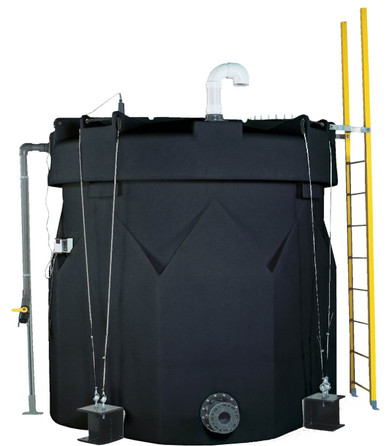
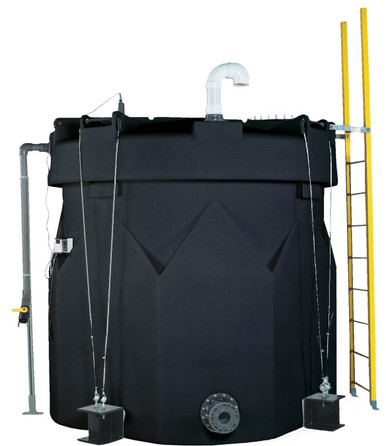
Top-mount agitator with vertical shaft and impeller. A motor-driven shaft penetrates the tank top through a sealed mount; the impeller (typically a 3-blade hydrofoil or 4-blade pitch-blade) sits at the lower third of the tank height. Top-mount is the most aggressive mixing architecture and produces the fastest stratification correction. Compatibility constraint: the mount has to be supported by the tank's structural top; a polyethylene rotomolded tank may not have sufficient top-flange strength for a heavy agitator without engineered reinforcement. Standard practice is to specify a tank with engineered manway or to add an external structural frame that bears the agitator load.
Side-mount agitator with horizontal shaft and impeller. The shaft penetrates the tank wall through a sealed bulkhead (typically at 30-40 percent of tank height from the bottom); the impeller is internal. Side-mount is structurally lower-impact than top-mount because the wall flexure absorbs less of the agitator load. The mixing pattern is less aggressive than top-mount; better suited to maintenance mixing than to corrective dissolution. Compatibility constraint: the bulkhead seal has to handle the dynamic shaft load; a standard PVC or polypropylene bulkhead with a packed-gland mechanical seal is the common engineering specification.
External recirculation loop. A pump pulls liquid from the bottom of the tank, passes it through external piping, and returns it to the top of the tank (or to a midway recirculation port). The motion through the loop produces shear and convective mixing without any internal mechanical apparatus. Recirculation is the lowest-impact architecture for the tank itself; the pump and piping can be engineered, sized, and replaced independently. Compatibility constraint: the recirculation flow rate has to be sufficient to turn over the tank volume on a useful time scale (typically 4-8 turnovers for full homogenization); a 5,000-gallon tank with a 20-GPM recirculation pump turns over once every 250 minutes, requiring 16-32 hours for full homogenization, which is too slow for corrective mixing of a stratified tank but is acceptable for routine maintenance.
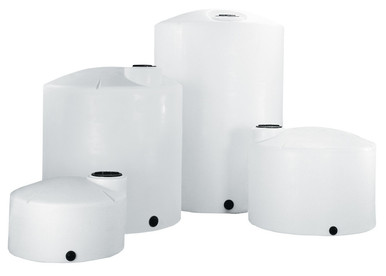
For tank-specific guidance on agitator architecture see our mixer-agitator engineering article. The bulk-storage architecture for liquid fertilizer is typically Norwesco vertical or Snyder Captor double-wall; reference N-40146 1,500 gallon for moderate-volume blend storage, N-40164 5,000 gallon for a single-truckload-per-fill receiving station, and N-43128 10,000 gallon for high-volume ag-retail bulk storage. Snyder Captor double-wall provides annular containment for SPCC compliance; reference SII-5490000N42 1,550 gallon.
5. Mixing Energy Math and Power Sizing for Effective Homogenization
The mixing energy required to homogenize a stratified tank is calculated from the tank volume, the desired blend time, and the chemistry's mixing-difficulty index. The simplified engineering approach:
Power per unit volume: for a low-viscosity aqueous fertilizer blend, mixing power requirements run 0.1 to 0.5 horsepower per 1,000 gallons for routine homogenization; 0.5 to 1.5 hp per 1,000 gallons for active dissolution of crystallized salts; 1.5 to 3.0 hp per 1,000 gallons for emulsification of high-viscosity additives.
Worked example for a 5,000-gallon UAN-32 tank with bottom-crystal stratification:
- Volume: 5,000 gallons.
- Routine homogenization power: 0.3 hp/1,000 gal × 5 = 1.5 hp.
- Crystal-dissolution power: 1.0 hp/1,000 gal × 5 = 5 hp.
- Top-mount agitator with 3-blade hydrofoil at 200 RPM: typical 5-hp drive on a 5,000-gallon vertical tank, roughly 8-12 hours to dissolve a moderate crystal load with concurrent heat input.
- Side-mount agitator at similar power: longer dissolution time due to less aggressive mixing pattern, typically 12-18 hours.
- External recirculation loop at 5 hp pump: even slower because shear is concentrated in the pump and piping, not distributed through the tank; can take 20-30 hours.
The ratio of mixing time to power input shows top-mount as the most time-efficient choice for corrective mixing; side-mount or recirculation are appropriate for routine maintenance where the tank is already homogeneous.
6. Density and Specific-Gravity Verification by Hydrometer
The field verification method for stratification is multi-point density measurement with an ASTM D1298 hydrometer or a portable digital densitometer. The protocol:
- Pull a sample at the top of the liquid level (within 6 inches of the surface).
- Pull a sample at the mid-tank level.
- Pull a sample at the bottom of the liquid level (within 6 inches of the floor).
- Measure each sample's specific gravity at 60 degrees F (or convert by ASTM table to 60-F equivalent).
- Compare top, mid, and bottom values. A spread greater than 0.5 percent (e.g., top 1.315, mid 1.318, bottom 1.325) indicates stratification beyond routine variation.
For UAN-32, the specific gravity at 60 degrees F is approximately 1.32. A 0.01 spread (1.31 at top to 1.32 at bottom) corresponds to roughly 1 percent concentration drift, which is at the threshold of operational concern. A 0.02 spread (1.30 at top to 1.32 at bottom) corresponds to roughly 2 percent concentration drift and is firmly stratified.
The ASTM D1298 procedure with corrected-temperature calculation is the standard reference. For a more comprehensive treatment of specific-gravity verification across blended chemistries see our blended-chemistry SG mixing rules article.
7. Polyethylene Tank Specification for Fertilizer Service with Mixing
The 5-brand catalog has tank specifications that directly support liquid-fertilizer mixing service. The decision framework:
- Specific gravity rating: UAN-32 has SG 1.32; the tank specification must rate to at least 1.5 SG (industry-standard rating for chemical-storage polyethylene is 1.9). All Norwesco vertical chemical-storage tanks and Snyder Captor double-walls meet this rating.
- Wall thickness: agitator-driven mixing imposes oscillating stress on the wall; the tank should have engineered wall thickness for the specific service. Norwesco rotomolded MDPE at standard thickness (3/8 to 1/2 inch wall) handles routine top-mount agitation. For aggressive mixing or larger tanks, Snyder Captor XLPE provides higher wall integrity through crosslinking.
- Manway and top-mount provision: a top-mount agitator requires either a structural reinforcement frame or a tank with an engineered top-flange. Custom-engineered Norwesco or Snyder builds with structural reinforcement are preferred over field-modification of a standard rotomolded tank.
- Wall-bulkhead provision for side-mount: side-mount agitators penetrate the tank wall; a PVC, polypropylene, or stainless bulkhead with a sealed shaft passage is the standard interface. Verify the bulkhead specification supports dynamic shaft loads.
- Bottom-outlet placement: a stratified tank with bottom-crystal accumulation should have the outlet at or near the floor with a strainer or sediment-trap arrangement. Sloped-bottom or cone-bottom designs improve crystal evacuation; reference N-43852 1,000 gallon 45-degree cone for cone-bottom geometry.
For applicator and leg-tank service in the on-the-go fertilizer-application application, see our Norwesco applicator and leg-tank DOT NRT scope article.
8. Sampling Discipline and AAPFCO Compliance
The fertilizer-distribution regulatory framework (state-by-state under AAPFCO model rules) requires that the dispensed product matches the labeled analysis. A stratified tank that pulls product from the top of the layer dispenses a different concentration than the labeled analysis; the dispensed product is technically out of compliance even if the bulk-tank average is in compliance. The sampling and documentation discipline:
- Pre-dispense sampling: before pulling product to the spreader or to a distribution truck, agitate or recirculate the tank and pull a representative sample. AAPFCO sampling guidance recommends a minimum of 3 sample points (top, middle, bottom) and a composite sample for analysis.
- Sample chain of custody: sample bottle labeled with tank ID, date, time, sampler initials. Composite analysis result attached to the dispense record.
- Analysis methods: for total nitrogen, AOAC Method 968.06 (Kjeldahl) or AOAC 978.02 (combustion); for individual N forms (ammonium, nitrate, urea), separate analytical methods are required. Spreader-applied product can be tested ad-hoc by quick-test refractometer or by hydrometer for SG correlation.
- Documentation cadence: bulk tank should have a quarterly composite analysis on file plus a per-dispense or per-batch sample for high-volume operators.
The AAPFCO compliance program also addresses the labeling of custom blends. A UAN-32 + thiosulfate blend dispensed to a customer has to be labeled with the specific thiosulfate percentage. Stratification that causes one customer to receive a top-of-tank low-thiosulfate fraction and the next customer to receive a bottom-of-tank high-thiosulfate fraction is a label-non-conformance even if the tank average matches the label.
9. Operational Cadence: Mixing Schedule for Routine Quality Maintenance
A bulk-storage fertilizer tank does not need continuous mixing. The operational cadence:
- Post-fill mixing: after a delivery, run the agitator for 1-2 hours or recirculate for 2-4 hours to homogenize the new product with any heel and verify uniform composition.
- Weekly maintenance mixing during long hold: 30-60 minutes of agitation prevents thermal-density stratification from developing. For tanks with active recirculation loops, intermittent operation at 4-hour intervals is more energy-efficient.
- Pre-dispense mixing: 30-60 minutes of agitation before pulling product to the spreader, particularly after extended static storage (more than 2 weeks).
- Cold-weather check: after any night or cold-snap event below the salting-out point, run an extended mixing cycle (4-8 hours) and pull a multi-point density sample to verify no crystal accumulation.
The operational time investment is approximately 4-8 hours per week of agitator runtime for a typical 5,000-gallon storage at moderate use, which converts to roughly 10-30 kWh per week of motor energy. The cost in electricity is small (under $5 per week at typical commercial rates); the cost of failing to mix is the off-spec dispense and the customer-service cost of a complaint about a slow-spreader application or a strainer-plugging service call.
OneSource Plastics ships polyethylene fertilizer-storage tanks across all 5 brands paired with manufacturer SG ratings, mixing-architecture compatibility data, and AAPFCO-aware sampling guidance. List pricing by SKU is published on each product page; LTL freight to your ZIP is quoted separately via the freight estimator or by phone at 866-418-1777. For the related fertilizer-handling reading set see our UAN antifoam dosing and agricultural fertilizer tank selection guide.
Recommended Tanks for This Guide
Live pricing, updated automatically · estimate freight to your ZIP.