Fertilizer Blender Tank Topology: Blend Recipe Architecture, Ratio Control Engineering, Custom Application Configuration, and the Procurement Decisions That Govern Liquid-Fertilizer Mix-Plant Throughput and Accuracy
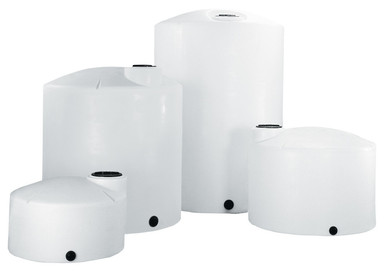
A fertilizer blender tank is not a single tank; it is a topology of source tanks, metering controls, blend tanks, and dispatch tanks arranged to convert raw nitrogen, phosphorus, potassium, and micronutrient inputs into customer-specific application-ready blends. The topology decisions made at procurement and at installation set the operational ceiling on throughput, blend accuracy, recipe flexibility, and contamination risk for the life of the plant. A blender plant that is built right delivers ratio-controlled custom-application loads in fifteen-minute cycles with single-percent ingredient accuracy and zero cross-contamination between recipes; a blender plant that is built wrong produces slow cycles, blend-accuracy drift, and rework loads that destroy margin during the spring-application rush. This article walks the source-tank architecture, the metering-control hierarchy, the blend-tank engineering, the dispatch-tank coordination, the recipe-management discipline, the contamination-prevention engineering, and the procurement decisions that distinguish well-built blender topologies from fragile ones.
The framework draws on liquid-fertilizer industry practice across nitrogen-solution, ammonium-thiosulfate, ammonium-polyphosphate, potassium-acetate, and micronutrient-chelate handling, and on field experience across the 5-brand polyethylene tank catalog (Norwesco, Snyder, Chem-Tainer, Enduraplas, Bushman). List pricing on each tank product page; LTL freight quoted to your ZIP via the freight estimator or by phone at 866-418-1777.
1. The Source-Tank Architecture: Inputs and Their Storage Discipline
Every blender plant starts with source tanks holding the input chemistries. The source-tank architecture sets the ceiling on what blends can be produced and at what speed:
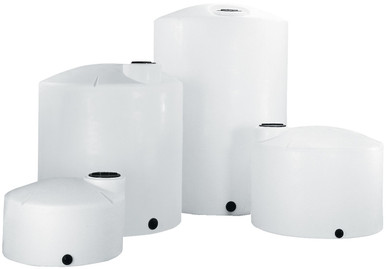
- Nitrogen-solution storage as the primary volume driver. 28-0-0 urea-ammonium-nitrate (UAN) and 32-0-0 are the highest-volume liquid fertilizer inputs at most blender plants. Source tanks for UAN are specified at the largest practical capacity to minimize tanker-truck visits during spring; a typical commercial blender holds 10,000 to 30,000 gallons of UAN at the peak season. Reference N-40164 5000 gallon Norwesco vertical as a single-tank UAN source unit; multi-unit installations bank tanks in parallel.
- Phosphate storage as a specific-gravity exception. 10-34-0 ammonium-polyphosphate carries a specific gravity of 1.4 to 1.5, well above the 1.0-water default. Source tanks for ammonium-polyphosphate must be rated for the actual specific gravity; specifying a 1.5 SG tank is mandatory. The premium for the SG rating is 15 to 25 percent over the equivalent 1.5 SG tank; underspecification is a tank-failure liability.
- Potash storage as a corrosion exception. 0-0-30 potassium-acetate is corrosive to steel and aluminum but compatible with polyethylene. The fertilizer industry standardized on poly tanks for potash storage decades ago because of the corrosion-rate gap. Source tanks for potash must be poly; never carbon steel.
- Sulfur storage as a temperature exception. 12-0-0-26S ammonium-thiosulfate (ATS) is stable at ambient temperature but degrades at elevated temperature. Source tanks for ATS may benefit from white or natural-white tank color to minimize solar heat gain; black tanks accelerate ATS degradation in summer storage.
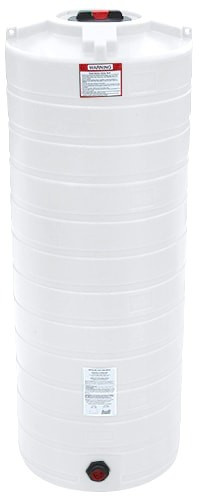
- Micronutrient storage as a multiplicity problem. Zinc, manganese, iron, copper, and boron micronutrient products are small-volume but multiplied: a full-service blender may stock 8 to 15 distinct micronutrient products. Source tanks for micronutrients are typically 100 to 500 gallon scale, multiplied across the product line. Reference N-41528 300 gallon Norwesco vertical as a typical micronutrient source-tank unit.
- The day-tank intermediate layer. Some plants run an intermediate day-tank layer between bulk source tanks and the blend tank. The day tanks are smaller (500 to 2000 gallon) and serve as the feed source for the blend operations. The day-tank layer reduces the metering distance and improves blend-cycle speed; it also adds a transfer step and additional tankage cost.
The source-tank architecture is the input substrate of the plant. A plant that under-builds source tankage runs out of UAN during the spring rush and pays standby-truck premium to refill mid-shift; a plant that over-builds source tankage carries excess inventory cost. The tankage scope is calibrated to peak-season throughput, supplier delivery cadence, and capital constraints.
2. The Metering Control Hierarchy
The metering control system converts customer recipe specifications into measured ingredient delivery to the blend tank. The hierarchy elements:
- Mass-flow versus volumetric metering. Mass-flow meters (Coriolis or thermal) measure pounds per minute directly; volumetric meters (turbine, paddle-wheel, magnetic) measure gallons per minute and rely on density assumptions. Mass-flow is more accurate but more expensive; volumetric is acceptable when source-density is stable and well-characterized. Most blender plants now run mass-flow metering on the high-volume nitrogen line and volumetric metering on the lower-volume ingredient lines.
- Batch-totalizer logic. The metering controller accepts a target weight or volume per ingredient per batch, opens the metering valve, accumulates the actual flow, and closes the valve at the target. The closing logic typically uses a slow-close stage near the target to minimize overshoot. The closing-stage parameters are tuned to the meter response time and the line geometry.
- Recipe-execution sequencing. The controller executes recipe ingredients in sequence (water first, nitrogen second, phosphate third, potash fourth, micronutrients last) or in parallel where line geometry supports it. The sequence accommodates ingredient-mixing chemistry: certain pairs are reactive when added in the wrong order. The sequence is part of the recipe definition.
- Source-tank-selection switching. The metering controller selects which source tank feeds each ingredient line. A plant with redundant source tanks (two UAN tanks, for example) can switch between tanks for inventory management or to take a tank offline for cleaning while keeping the other in service.
- Flow-verification interlocks. The controller monitors the metered flow against the requested flow during execution. If the actual flow deviates from the requested flow beyond a tolerance (a stuck valve, a clogged line), the controller halts the batch and alarms. The interlock prevents off-recipe blends from being produced.
- Recipe-completion handshake with the blend tank. When all ingredients are metered to the blend tank, the controller signals the blend-tank controller to begin agitation. The handshake prevents premature agitation that would distribute partial recipes; it also prevents blend-tank dispatch before all ingredients have been added.
The metering control hierarchy is the engineering core of recipe accuracy. Plants that invest in mass-flow metering, modern controllers, and well-tuned closing logic produce single-percent ingredient accuracy; plants that rely on hand-valving and operator-watch flow gauges produce multi-percent variability that customer agronomists detect in tissue-test feedback.
3. The Blend Tank Engineering
The blend tank is where metered ingredients combine into the finished blend. The engineering of the blend tank governs the blend uniformity, the cycle time, and the contamination-carryover characteristics:
- Capacity scaling against the dispatch-load size. The blend tank capacity is matched to the customer-application-load size. Common application loads are 1000 to 4000 gallons (single-truck nurse-tank or applicator-direct delivery). The blend tank is typically 1.2 to 1.5 times the largest dispatch load to allow some headspace and accommodate occasional larger orders. Reference N-41524 2500 gallon Norwesco as a typical mid-scale blend tank for a 2000-gallon-load operation.
- Agitation system selection. Liquid fertilizer blends require agitation to mix the metered components into a uniform solution. Air-sparge agitation is simple and low-maintenance; mechanical-impeller agitation is faster and more thorough. Most modern plants use mechanical agitators with vertical shafts and propeller or hydrofoil impellers. The agitator power scales with tank volume (typically 0.5 to 1.0 horsepower per 1000 gallon).
- Manway placement for cleaning access. The blend tank is cleaned between recipes that have contamination-incompatible ingredients. A 24-inch top manway and a 18-inch side manway support interior visual inspection and cleaning crew access. Manway placement is specified at procurement; field-cutting manways into a polyethylene tank is feasible but reduces tank rating.
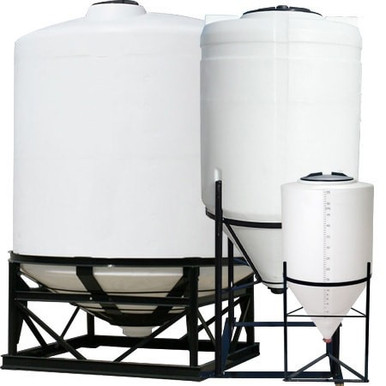
- Discharge-piping geometry for full evacuation. A blend tank with a flat bottom retains residual blend at the floor; a sloped or conical-bottom tank achieves more complete evacuation. For multi-recipe operations where contamination is a concern, the conical-bottom geometry justifies the procurement premium. Reference N-40356 1050 gallon 20 degree cone bottom as a representative cone-bottom blend candidate.
- Vent and overflow specifications. The blend tank must be vented to atmosphere through a vent that prevents blowback into the plant work area; the vent is typically piped to outdoors. The overflow line is sized for the maximum metering flow rate so that an over-filled batch does not pressurize the tank.
- Sample-port specification for recipe verification. A dedicated sample port supports periodic blend-uniformity verification. The port is positioned at mid-height where the blended solution is most representative of the batch; bottom-port samples may oversample dense components, top-port samples may undersample them.
- Temperature monitoring for exotherm detection. Some ingredient combinations produce mild exotherms during blending (acid-base partial neutralization, for example). Temperature monitoring during blending detects unexpected exotherm and supports the alarm-and-halt response if reactivity is greater than the recipe predicted.
The blend tank engineering is the conversion stage from metered inputs to dispatch-ready output. A well-engineered blend tank produces uniform blend in 8 to 15 minutes after metering completes; a poorly-engineered blend tank requires 20 to 45 minutes and produces stratification visible in customer tissue-test feedback.
4. Dispatch Tank Coordination and Truck-Loading Workflow
The dispatch tank receives the finished blend and feeds the customer truck or applicator. Coordination between blend tank and dispatch tank governs the truck-loading throughput:
- Dispatch tank as a buffer between blend cycle and truck-loading cycle. Without a dispatch tank, the blend tank cannot start a new batch until the current batch is fully loaded out. With a dispatch tank, the blend tank dumps the finished batch and immediately starts the next batch while the truck loads from the dispatch tank. The throughput-doubling argument justifies the additional tank on plants running spring peaks.
- Dispatch-tank capacity matching to the blend-tank-cycle time. A dispatch tank that holds two batches allows the blend tank to run continuously while truck-loading is intermittent. A dispatch tank that holds one batch bottlenecks the system to the slower of the two cycles.
- Truck-loading flow-rate sizing. Customer trucks typically expect loading at 200 to 400 gallons per minute for spring-rush throughput. The dispatch-pump and dispatch-piping sizing must support that flow rate; undersized pumping turns the customer wait into a constraint on the upstream blend cycle.
- Metering at the dispatch step for billing accuracy. The dispatched volume is measured separately from the blend-recipe metering for customer billing accuracy. Mass-flow or volumetric metering at the truck-load nozzle records the actual delivered quantity; the blend-recipe metering records the input components. Reconciliation between the two values catches metering errors and theft.
- Hose-management discipline. The truck-loading hose is fitted with a dry-disconnect coupling that prevents drip and spray when the connection is broken. The hose is rated for the maximum delivered flow rate and the chemical service. The discipline matters: a hose failure during truck-loading is a release event with EPA reporting implications.
- Reference 1500 gallon as a small-scale dispatch tank. Reference N-40144 1500 gallon Norwesco vertical as a typical dispatch tank for an operation running 1000-gallon truck loads with a single-batch buffer; larger plants stack multiple dispatch tanks.
The dispatch coordination converts the blend-cycle output into truck-loaded shipments without bottlenecking the upstream cycle. Plants that build the dispatch buffer and the metering-reconciliation discipline run smoother spring rushes than plants that load directly from the blend tank.
5. Recipe Management Discipline
The recipe-management system holds the customer-specific recipe library and governs how recipes are executed. The discipline elements:
- Recipe definition standardization. Each recipe is defined by its target nutrient analysis (10-20-10, for example), the ingredient list with target weights or volumes, the addition sequence, the agitation duration, and any temperature constraints. The standardization supports controller execution without operator interpretation.
- Recipe approval workflow. New recipes are approved by an agronomist or product-formulation lead before the recipe is loaded into the controller. The approval validates that the recipe achieves the target analysis within the ingredient-density tolerance and that no incompatible-ingredient combinations are present.
- Recipe-version control. Recipes evolve over time as ingredient sources change or formulation improvements are identified. A version-control system retains the recipe history and the version that was actually executed for each batch. Customer feedback or a production issue can be traced to the specific recipe version.
- Custom-recipe handling for one-off applications. Many customer orders are custom recipes built to a specific tissue-test diagnosis. The controller accepts custom recipes through the same workflow as standard recipes; the custom recipes are flagged in the batch records but not retained in the standard library.
- Recipe-recipe interlock for contamination prevention. Some recipe pairs are contamination-incompatible (a calcium-containing recipe followed immediately by a sulfate-containing recipe risks calcium-sulfate precipitation in residual lines). The recipe-management system enforces required cleaning steps between contamination-incompatible recipe pairs.
- Batch-record archival. Each executed batch is archived with the recipe, the actual ingredient quantities metered, the operator, the date and time, and any deviations. The batch records support customer-issue investigation and regulatory audit.
- Reference small inductor for spot-blending. Reference N-42064 15 gallon Norwesco inductor as a typical spot-blending ingredient-prep tank for adding small quantities of micronutrient or supplement chemistry to a primary blend tank; the inductor geometry enables operator-direct ingredient addition without contaminating the main source tanks.
The recipe-management discipline converts the blend plant from a manual-skill-dependent operation to a controller-executed system that produces consistent results regardless of operator. The discipline is the difference between a plant that depends on a specific operator's tribal knowledge and a plant that operates reliably across shifts and turnover.
6. Contamination Prevention Engineering
Cross-contamination between recipes is the central quality risk in a multi-recipe blender plant. The engineering for contamination prevention spans several layers:
- Source-tank dedication for incompatible chemistries. Some chemistry pairs are sufficiently incompatible that the operator does not even attempt to share source tankage. A plant might dedicate one set of source tanks to phosphate-bearing recipes and another set to calcium-bearing recipes to avoid the precipitation risk.
- Line-segregation for recipe families. The metering lines from source tanks to blend tank can be physically segregated into recipe families. Each recipe family has its own line set, valve set, and meter set. The segregation prevents cross-contamination through shared line residue at the cost of additional tankage and line capital.
- Flush-step inclusion in the blend cycle. When the upcoming recipe is a contamination-incompatible follow-on, the controller inserts a flush step before the new recipe. The flush sends water or a compatible solution through the lines to displace residue. The flush volume is based on line volume and a safety factor.
- Blend-tank cleaning between contamination-incompatible recipes. If line flushing is not sufficient, the blend tank itself is cleaned between recipes. Cleaning ranges from a water rinse to a full caustic-acid-rinse cycle depending on the residue characteristics. The cleaning cycle adds time to the changeover but prevents the contamination event.
- Sample-and-test protocols for high-stakes batches. Critical batches (regulatory-watched chemistries, customer-specific premium products) are sampled and tested before dispatch. The sample-and-test step adds time but provides the analytical evidence that the recipe was executed correctly.
- Returned-product handling discipline. Customer returns (truck-load remainders, mis-loaded batches) must be handled to avoid contaminating future batches. The discipline typically routes returns to a dedicated rework tank rather than reintroducing them to source or blend tanks.
- Reference 1000 gallon cone-bottom for full-evacuation cleaning. Reference N-43852 1000 gallon 45 degree cone bottom as a small-scale rework or inter-batch holding tank where the cone geometry supports full evacuation between cleaning cycles.
The contamination-prevention engineering is the quality moat of the blender plant. Plants that build the engineering, enforce the protocols, and document the cleaning between incompatible recipes sustain customer relationships through the full season; plants that cut corners produce occasional contamination events that destroy customer trust faster than the cost savings ever recovered.
7. Procurement Decisions That Set the Operational Ceiling
The blender topology decisions made at procurement and installation set the operational ceiling for the life of the plant. Key decisions:
- Source-tank capacity sizing against peak-season throughput. The peak-season throughput drives the source-tank sizing. A plant running 100,000 gallons per week of UAN through the blend cycle needs at least one full week of source-tank inventory plus refill cadence buffer. Underspecification at procurement means tanker-truck delays during the peak; overspecification ties up capital.
- Specific-gravity rating across the source-tank set. Each source tank is rated for the specific gravity of the chemistry it holds. A plant that initially holds 28-0-0 in a 1.5 SG tank has flexibility; a plant that initially holds water in a 1.0 SG tank cannot later repurpose that tank for ammonium-polyphosphate without replacement.
- Manway and accessory specification across the blend and dispatch tanks. The blend and dispatch tanks see periodic interior cleaning and inspection. Manways, level gauges, sample ports, and agitator-shaft seals are specified at procurement. Retrofit installation of these accessories is feasible but compromises tank rating.
- Cone-bottom versus flat-bottom tank geometry across the topology. Cone-bottom tanks support full evacuation; flat-bottom tanks retain heel residue. For source tanks holding a single chemistry, flat-bottom is typically acceptable. For blend and dispatch tanks where chemistry rotation occurs, cone-bottom geometry is justified.
- Pump and metering selection for ingredient-flow rates. The pump and meter selection at procurement determines the ingredient-flow ceiling. Upgrading meters and pumps later is feasible; the line and tank geometry are not. Plant scale-up plans should include the metering capacity in the original specification.
- Containment-area design for source-tank arrays. Source-tank arrays are typically installed in a secondary-containment area sized to hold the largest tank volume plus a safety margin. The containment geometry is set at site preparation and is hard to modify after installation.
- Foundation pad engineering for tank reliability. Each tank is set on a foundation pad sized and engineered for the tank load. Pad failure is a tank-failure risk; pad over-engineering is a capital cost. The pad specification is set at procurement and matched to the tank weight at full capacity.
The procurement decisions are the long-term cost drivers in blender-plant operation. Plants that invest in the front-end specification produce installations that scale, modify, and operate efficiently for decades; plants that under-specify face costly retrofit projects within a few seasons of operation.
8. The Field Operations Addendum: Spring-Rush Reality
Beyond the steady-state design, the blender plant must absorb the spring-rush peak where order volume can run 4 to 6 times the annual average for 6 to 10 weeks. The operational discipline for the rush period:
- Pre-season inventory build. The plant builds source-tank inventory before the rush starts. The pre-season build typically targets 70 to 90 percent fill on all source tanks two weeks before the agronomic-rush window.
- Multi-shift staffing. Plant operation moves from single-shift to two-shift or three-shift during the rush. The shift handover discipline ensures recipe-management state is transferred completely between shifts.
- Tanker-truck cadence escalation. The supplier-delivery cadence is escalated from weekly to twice-weekly or daily. The dispatch communication with suppliers is part of the rush operations plan.
- Cleaning-window compression. Inter-batch cleaning windows that take 30 minutes in the off-season may compress to 15 minutes in the rush. The compression is achieved through optimized cleaning procedures and dedicated source-tank arrangements that reduce inter-batch contamination risk.
- Maintenance deferral and scheduled-maintenance discipline. Routine maintenance is deferred during the rush window where possible. Critical maintenance (failed pump, leaking valve) is performed mid-shift with backup units. The maintenance backlog from the rush period is worked off during the post-rush slack.
- Regulatory-event preparedness. A release event during spring rush is high-impact because of the operational cost of the response. The plant maintains an event-response plan and pre-positions response equipment to minimize event-driven downtime.
The spring-rush operational discipline is where the topology investment pays off. A topology that supports rapid recipe changeover, full source-tank inventory, and parallel blend-and-dispatch cycling generates enough margin during the rush to underwrite the off-season carrying cost. A topology that bottlenecks during the rush erodes the season margin to recover from operational stoppages.
9. The Fertilizer Blender Topology Conclusion
The fertilizer blender plant is a topology of source tanks, metering controls, blend tanks, dispatch tanks, recipe systems, and contamination prevention engineering arranged to convert raw inputs into custom-application loads at speed and accuracy. The topology decisions made at procurement set the operational ceiling for the plant life: source-tank capacity, specific-gravity rating, manway and sample-port specification, cone-bottom versus flat-bottom geometry, pump and metering scope, and containment-area engineering. The recipe-management discipline, the metering-control hierarchy, and the contamination-prevention engineering are the operational discipline that sustains plant performance through the spring-rush peak. Plants that invest in the topology produce reliable, accurate, traceable custom-application blends with single-percent ingredient accuracy and zero cross-contamination; plants that under-invest produce variability that customer agronomists detect and seasonal stoppages that destroy margin.
OneSource Plastics ships polyethylene tanks across the 5-brand catalog (Norwesco, Snyder, Chem-Tainer, Enduraplas, Bushman) in capacities, specific-gravity ratings, cone-bottom and flat-bottom geometries, and accessory configurations matched to fertilizer-blender source-tank, blend-tank, and dispatch-tank applications. Tank specification for any specific blender topology is performed by the customer site engineer with reference to the recipe library, throughput projections, and regulatory regime. List pricing on each product page; LTL freight to your ZIP via the freight estimator or by phone at 866-418-1777.
Recommended Tanks for This Guide
Live pricing, updated automatically · estimate freight to your ZIP.