High-Purity Deionized Water Tank Engineering: TOC Drift, Resistivity Decay From Atmospheric CO2, Continuous Recirculation Loop Design, and the ASTM Type II vs Type III Decision
Deionized water that leaves a polishing demineralizer at 18 megaohm-cm resistivity does not stay at 18 megaohm-cm in a storage tank. The moment the water enters a vessel that has any contact with atmospheric air, dissolved carbon dioxide diffuses into the liquid, dissociates to carbonic acid, and contributes ions that drop the resistivity. Within 30 minutes of static storage in an unsealed tank, Type I water (18 MOhm-cm) typically decays to Type II quality (above 1 MOhm-cm). Within 4 hours, it commonly drops below the Type III threshold (0.05 MOhm-cm). The bulk tank in front of a DI water polishing skid is therefore not a reservoir of polished water - it is a buffer that holds intermediate-quality water, and the polish step typically lives downstream of the tank to recover the resistivity at the point of use.
This guide walks the engineering reality of DI water storage in polyethylene tanks: the physics of CO2 mass transfer that drives resistivity decay, the total organic carbon (TOC) drift that develops from polymer surface leachables and biofilm growth, continuous recirculation loop design that mitigates both, the ASTM D1193 water-type decision criteria, and the procurement specification that supports each grade. Reference standards: ASTM D1193 (Standard Specification for Reagent Water), USP General Chapter 1231 for purified water, NSF/ANSI 61 for tank materials in potable applications, and SEMI F063 for ultrapure water in semiconductor service.
1. Why Resistivity Decays in Storage
The atmosphere contains approximately 420 ppm CO2 in 2026 ambient. Henry's law gives the equilibrium dissolved CO2 concentration in pure water at 25 degrees C and ambient pressure as approximately 0.5 ppm. The dissolved CO2 partially dissociates: CO2 + H2O = H2CO3 (carbonic acid), and H2CO3 = H+ + HCO3- (bicarbonate). The dissociated ions contribute to the conductivity of the water, dropping the resistivity from the theoretical maximum of 18.18 MOhm-cm at 25 deg C to a value that depends on the equilibrium dissolved CO2 concentration.
The math: each ppm of dissolved CO2 produces approximately 1.4 microsiemens/cm of conductivity contribution at 25 deg C. The 0.5 ppm Henry's-law equilibrium produces 0.7 microsiemens/cm, which corresponds to approximately 1.4 MOhm-cm resistivity. This is the practical floor for water that has equilibrated with atmosphere. Storage of DI water in any vessel with air contact converges to this floor over time scales that depend on the air-water interfacial area, the CO2 diffusion rate, and the water volume.
For a typical 500-gallon vertical polyethylene DI storage tank with an open vent, the equilibrium decay timescale is approximately 4 hours from 18 MOhm-cm to 1.4 MOhm-cm. A sealed tank with a CO2-scrubbing vent filter (soda lime or activated carbon impregnated with hydroxide) extends the timescale to days but does not eliminate it - residual CO2 leakage past the seal still drives equilibrium toward the same floor over weeks of static storage.
The procurement consequence: a DI water tank cannot be specified to "hold 18 MOhm-cm water" without also specifying a continuous recirculation loop through a polishing demineralizer, a CO2-scrubbing vent filter, and a nitrogen blanket on the tank headspace. Each of these adds capital cost and operating complexity. Many users are better served by a smaller intermediate tank that holds Type II quality water with active recirculation, plus a final polish loop downstream that delivers Type I quality only at the point of use.
2. The TOC Drift Mechanism: Polymer Leachables and Biofilm Growth
Total organic carbon is the second water quality parameter that degrades in storage. TOC sources in a polyethylene DI water tank fall into three categories:
- Polymer leachables from the tank wall, fitting gaskets, and bulkhead components. Virgin polyethylene with FDA-21CFR-177.1520 compliance leaches approximately 50 to 200 ppb TOC into static DI water over the first 30 days of contact, declining to a residual rate of 5-20 ppb-day after the initial leaching period. Leaching is driven by extraction of low-molecular-weight oligomers, antioxidant additives, and slip agents that have not migrated to the tank surface during prior service. This is why DI water tanks should be water-flushed for 7-14 days at startup before being placed in service.
- Biofilm growth on the tank wall under conditions where TOC is greater than 50 ppb and dissolved oxygen is present. Biofilm cells produce exopolysaccharide that contributes to TOC, and the cells themselves shed into the water column as planktonic biomass that contributes further. A storage tank that has been online for 6 months with intermittent flow can accumulate 10-100 micrograms-per-cm2 of biofilm on the wall, contributing up to 100 ppb TOC to the tank effluent depending on flow conditions.
- Atmospheric organics that enter through the vent. VOCs in industrial atmospheres (solvent vapors, hydrocarbon fuels, aerosolized hydraulic fluids) dissolve into the tank surface water at rates that depend on the local air quality. A tank vented to a clean outdoor atmosphere accumulates atmospheric VOCs at perhaps 1-5 ppb-day equivalent TOC; a tank vented inside a paint shop or solvent storage room accumulates much faster.
The cumulative TOC drift in a DI water tank without active control is the sum of these three sources. For an aged tank in clean service: leachables contribute roughly 5-20 ppb-day asymptotic; biofilm contributes 0-100 ppb episodically; atmospheric VOCs contribute 1-5 ppb-day. A static tank with no flow can drift from less than 50 ppb TOC at fill to several hundred ppb within 30 days. Active recirculation through a UV-185-nm photoreactor and a TOC-removal mixed-bed resin keeps TOC under control; passive storage does not.
3. ASTM D1193 Water-Type Decision Criteria and Tank Implications
ASTM D1193 defines four reagent water types with progressively tighter quality:
- Type I: resistivity above 18 MOhm-cm at 25 deg C, TOC below 50 ppb, sodium and chloride below 1 ppb, particulates filtered to 0.22 micron. Used for HPLC mobile phase, semiconductor wet etch, and analytical laboratory standard preparation.
- Type II: resistivity above 1 MOhm-cm, TOC below 50 ppb, sodium below 5 ppb, chloride below 5 ppb. Used for buffer preparation, cell culture media, general analytical chemistry, and microbiology rinse.
- Type III: resistivity above 4 MOhm-cm OR conductivity below 0.25 microsiemens/cm (definitions overlap), TOC below 200 ppb. Used for glassware rinse, general laboratory work where ppm-level contamination is acceptable.
- Type IV: resistivity above 0.2 MOhm-cm, TOC not specified. Used for non-critical rinse and dilution.
The resistivity decay analysis above shows that no polyethylene tank with atmospheric venting can sustain Type I water over storage time scales relevant for production. The tank can hold Type II water with active recirculation or Type III water passively for shorter periods. The decision matrix:
- If point-of-use demand is Type I: do not store Type I water in a tank. Polish at the point of use from a Type II buffer tank.
- If point-of-use demand is Type II: store Type II water in a sealed tank with CO2-scrubbing vent and active recirculation. Plan for 30-90 day biofilm cleaning cadence.
- If point-of-use demand is Type III: store Type III water in a standard sealed polyethylene tank with sintered hydrophobic vent filter. Active recirculation preferred but not strictly required.
- If point-of-use demand is Type IV: standard polyethylene tank with no special venting or recirculation. Most common case.
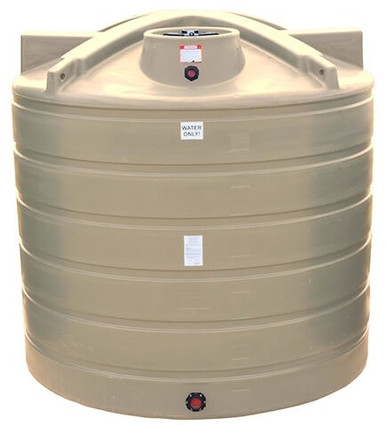
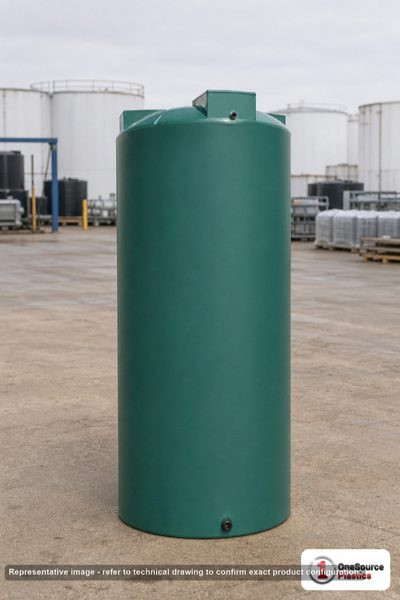
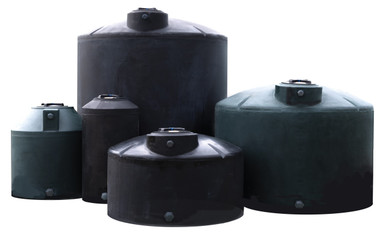
The catalog tanks that fit DI water service in the 100-gallon to 5,000-gallon range cover most laboratory and small industrial applications. The Norwesco N-44800 100-gallon doorway tank is the practical floor for a Type III lab water buffer in a research building. The Norwesco N-40146 1,500-gallon vertical serves as a buffer tank ahead of a polishing skid in a small industrial DI system. The Snyder SII-5990102N42 1,000-gallon double-wall XLPE provides containment for higher-purity service where any leachate from the tank wall would be a process contamination concern.
4. Continuous Recirculation Loop: Design Principles
The recirculation loop on a DI water buffer tank serves three functions: prevents biofilm growth by maintaining shear at the wall, removes CO2 and TOC contributed during storage, and keeps the bulk water at consistent quality regardless of the tank fill level.
The loop design parameters:
- Loop turnover rate: 0.5 to 2 tank volumes per hour depending on quality target. Type II service requires 1+ turnovers per hour; Type III service can run at 0.5 turnovers per hour.
- Loop flow velocity: 3 to 7 ft/s in the recirculation piping. Below 3 ft/s, biofilm formation accelerates in the loop piping itself. Above 7 ft/s, frictional pressure drop drives pump power consumption.
- Loop polishing components: 0.22-micron filter at the loop inlet to remove particulates entering the tank; UV-254-nm sanitizing lamp for biological control; mixed-bed polishing demineralizer for Type II resistivity recovery; UV-185-nm photoreactor for TOC oxidation in Type I service; 0.05-micron final filter at the loop discharge to capture resin fines.
- Loop temperature: 50 to 80 degrees F. Below 50 deg F, dissolved gas removal is impaired. Above 80 deg F, biofilm growth accelerates and polymer leachable rates increase.
- Tank inlet design: spray-ball or impingement plate at the tank top to wet the entire wall during recirculation. The wall-wetting is what prevents biofilm growth on the upper wall during partial-fill operation.
- Tank outlet design: bottom-drain port with anti-vortex baffle to deliver the recirculation loop suction without entraining headspace gas.
The recirculation pump for a 1,500-gallon tank running at 1.5 turnovers per hour delivers 38 gpm at 25-50 ft total dynamic head depending on loop component count. A 1.5-hp magnetic-drive centrifugal pump in 316 stainless steel sized for the duty draws approximately 1,000 watts continuous. Plan for the operating cost - approximately 75 dollars per month at industrial power rates - and budget the maintenance cycle for pump seal replacement at 18-24 months.
5. Tank Fitting and Material Selection for DI Water Service
The fittings and gaskets in a DI water tank are typically the dominant TOC contributors. The procurement specification should include:
- Bulkhead fittings in PVDF (Kynar) or PP-pure construction with EPDM peroxide-cure gaskets. Buna-N (NBR) gaskets are unacceptable; they leach extractables that contribute 50-200 ppb TOC over the first 6 months.
- Tank wall material in virgin FDA-grade HDPE or XLPE with NSF/ANSI 61 certification. Recycled-content polyethylene is unacceptable for any DI water service.
- Vent filter at the dome: hydrophobic PTFE membrane filter (0.22 micron) for Type II service; soda-lime or hydroxide-impregnated carbon CO2 scrubber upstream of the PTFE filter for resistivity preservation.
- Level sensor: hydrostatic pressure transmitter with PTFE-coated diaphragm, or radar gauge that does not contact the water. Capacitance-style level sensors with metal probes are not recommended; the metal probe leaches at low ppb levels into the water column.
- Sample port: dedicated port for sanitary sampling with valve isolation, located on the recirculation loop discharge rather than on the tank itself. Tank-mounted sample ports become biofilm reservoirs over time.
- Recirculation piping in PVDF or polypropylene-pure (Pure-PP). Stainless steel piping is acceptable for Type III service but contributes iron leachate that is unsuitable for Type II or Type I.
Polyethylene tank wall is dominant for the catalog SKU range. Stainless steel storage tanks are appropriate for Type I service in pharmaceutical or semiconductor applications and live outside the polyethylene scope addressed here.
6. Operational Cleaning and Sanitization Cadence
The cleaning cadence for a DI water buffer tank in continuous service:
- Weekly: verify recirculation loop function. Check loop pressure differential, UV lamp status, filter status, and resistivity at the loop discharge. Document in the CMMS.
- Monthly: sample and test resistivity, TOC, and microbiology. Type II service: targets 1+ MOhm-cm resistivity, 50 ppb TOC, less than 100 CFU/mL heterotrophic bacteria. Variances trigger investigation.
- Quarterly: hot-water sanitization at 80 deg C for 4 hours, or chemical sanitization with 1 percent hydrogen peroxide for 4 hours followed by extended water rinse to clear peroxide residual to below 1 ppm.
- Annual: full tank entry inspection following confined-space permit. Visual check of wall biofilm, fitting condition, and recirculation loop component status. Replace any gaskets that show degradation.
- 3-5 year: tank replacement decision based on accumulated TOC drift trend. A tank that has accumulated chronic biofilm contamination may not be cleanable to original specifications and may need replacement.
The hot-water sanitization at 80 deg C is the critical step that controls biofilm. Polyethylene tank wall is rated for 100 deg F continuous service and 140 deg F intermittent in most catalog SKUs; 180 deg F (82 deg C) hot-water sanitization is at the upper bound and should be confirmed with the tank manufacturer before adoption. For higher-temperature sanitization needs, stainless or specialty crosslinked polyethylene tanks designed for sanitization service are required.
7. Procurement and Specification Checklist
Before placing a DI water buffer tank order:
- Define the required water quality grade at the point of use (Type I, II, III, or IV).
- Define the storage volume needed for buffering between the upstream demineralizer capacity and the downstream demand profile.
- Confirm whether a recirculation loop will be installed; if Type II or higher, plan on it.
- Specify tank in virgin FDA-grade polyethylene or XLPE with NSF/ANSI 61 certification.
- Specify white or natural color to limit photodegradation of the polymer and biological growth.
- Specify all fittings in PVDF or PP-pure with EPDM peroxide-cure gaskets.
- Specify dome vent with PTFE 0.22-micron filter; CO2 scrubber upstream if resistivity preservation is critical.
- Specify sanitary sample port on the recirculation loop discharge, not on the tank.
- Specify hydrostatic or radar level sensor (no contact metal probes).
- Specify spray-ball wash inlet and bottom anti-vortex outlet for recirculation loop integration.
- Plan the 7-14 day pre-service flush to clear initial polymer leachables before placing in service.
- Document the cleaning and sanitization cadence in the operating procedure.
8. Brand Notes for DI Water Tank Service
The five-brand catalog options for DI water service:
- Norwesco vertical and doorway tanks: standard FDA-grade polyethylene, NSF/ANSI 61 certified, available in 35-gallon to 12,500-gallon vertical sizes. White or natural color. N-44800 100 gallon doorway for small lab service; N-40146 1,500 gallon vertical for industrial buffer.
- Snyder Industries Captor double-wall: integral secondary containment for laboratory applications where leak containment is critical. SII-5990102N42 1,000 gallon works for mid-size lab service.
- Enduraplas vertical tanks: available with PVDF bulkhead fittings as factory option for reduced TOC service. EP-THV02500FG 2,500 gallon.
- Chem-Tainer vertical tanks: standard FDA-grade options for laboratory service.
- Bushman vertical tanks: standard FDA-grade options with optional NSF/ANSI 61 documentation.
OneSource Plastics quotes complete DI water buffer tank packages including PVDF fitting upgrades, PTFE vent filters, sanitary sample ports, and recirculation loop tie-in fittings. Reference list pricing on a 1,500-gallon Norwesco DI buffer tank starts at $1,895 with standard fittings; PVDF fitting upgrade adds approximately 200-400 dollars depending on count. LTL freight to your ZIP is quoted via the freight estimator or by phone at 866-418-1777.
For complementary reading on related topics, see our stainless 316L vs polyethylene comparison for warm DI water for upgrade-decision criteria, and the chemical compatibility hub for material selection ahead of cleaning chemical exposure.
Recommended Tanks for This Guide
Live pricing, updated automatically · estimate freight to your ZIP.