NOM-127-SSA1-2021: Mexican Drinking Water Compliance Walkthrough for U.S. Plastic Tanks Exported into MX Distribution
Selling potable-water plastic tanks south of the border is not the same regulatory exercise as selling them domestically. The Mexican standard that governs water quality for human consumption is NOM-127-SSA1-2021, the Norma Oficial Mexicana published by the Secretaria de Salud (Ministry of Health). That standard replaced the long-running NOM-127-SSA1-1994 on May 2, 2022. If your buyer is a Mexican municipality, an industrial water-treatment plant in Monterrey, an agricultural co-op in Sinaloa, or a private rural water system in Chihuahua, the tank you ship has to support compliance with NOM-127. This walkthrough explains what NOM-127 actually requires, how it differs from the U.S. NSF/ANSI 61 framework you may know, and which OneSource catalog tanks are appropriate for export into the Mexican drinking-water market.
Worth saying up front: NOM-127 is a water-quality standard, not a tank-construction standard. It sets concentration limits for biological, chemical, and physical contaminants in water at the point of human consumption. It does not directly certify tanks. What it does is force the water-system operator to maintain those limits at the point of consumption, which means every component the water touches (pipe, fittings, storage tank, treatment media) has to be selected so it does not introduce contaminants that would push the system out of compliance. That is where tank material selection enters the picture. A polyethylene tank that leaches a regulated contaminant above the NOM-127 ceiling makes the operator non-compliant even if the source water was clean.
What NOM-127-SSA1-2021 Actually Regulates
The standard sets permissible limits for water for human use and consumption across several categories. The 2021 update tightened several parameters from the 1994 version and added new ones. Headline changes that matter for storage tank operators:
- Color: reduced from 20 to 15 platinum-cobalt units. Color rises if the tank shell sheds carbon black pigment or oxidation byproducts; high-quality FDA-grade resin tanks do not contribute meaningfully to color but bargain-grade rotomolded tanks with off-spec resin can.
- Turbidity: reduced from 5 to 4 NTU. Turbidity rises if the tank sheds particulates from a degraded interior surface. A new tank should not contribute turbidity; an aged tank with interior surface degradation can.
- Trihalomethanes (THMs): regulated under the 2021 update. THMs form when chlorine in disinfected water reacts with natural organic matter. The tank itself does not generate THMs but residence time in the tank affects formation kinetics.
- Synthetic organic compounds: regulated under the 2021 update for additional pesticide residues and industrial contaminants.
- Heavy metals: lead, cadmium, chromium, arsenic, mercury all regulated at parts-per-billion ceilings consistent with WHO guidelines.
- Microbiological: total coliforms, E. coli at non-detect for treated water reaching the consumer.
The tank's job is to not contribute any of those contaminants and to not promote conditions (long residence time, biofilm growth, sunlight exposure) that drive secondary contamination. The 2021 update also strengthened the operator's monitoring obligations and added more sample frequency requirements for larger systems.
How NOM-127 Compares to U.S. NSF/ANSI 61
U.S. potable-water tanks typically carry NSF/ANSI 61 certification. NSF 61 is a product certification: an independent lab evaluates the tank under controlled exposure conditions and certifies that the tank does not leach contaminants above NSF-prescribed action levels. NOM-127, by contrast, is a water-quality outcome standard placed on the operator, not a product certification placed on the tank. Mexico has a parallel certification scheme via NOM-117-SSA1-1994 and related standards for plastic articles in food-contact and water-contact applications, but NOM-117 and NOM-127 are administered separately.
For practical export purposes: an NSF/ANSI 61-certified tank from a U.S. manufacturer (Norwesco, Snyder Industries, Bushman) is the strongest position you can take. NSF 61 is widely recognized in Mexico as a credible third-party evidence that the tank will not contribute leachable contaminants that would push a NOM-127 system out of compliance. It does not substitute for any Mexican certification a particular state's CONAGUA office may require, but it satisfies the underlying technical question.
FDA Title 21 CFR 177.1520 Resin Compliance
The polyethylene resin used to mold the tank is the foundation. Both Norwesco and Snyder Industries use FDA-compliant linear medium-density polyethylene meeting 21 CFR 177.1520, the FDA olefin polymer regulation that authorizes specific polyethylene grades for food-contact applications. That same resin compliance is the technical basis for NSF 61 certification on the resulting tank. For Mexican import, a resin-compliance letter from the manufacturer plus the NSF 61 certificate plus the FDA-compliance statement together establish the full leachate envelope the buyer will need.
Tank Selection for Export to Mexico Potable Service
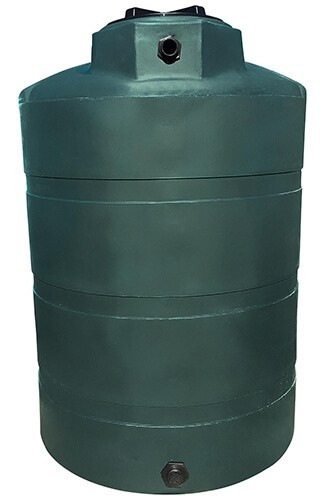
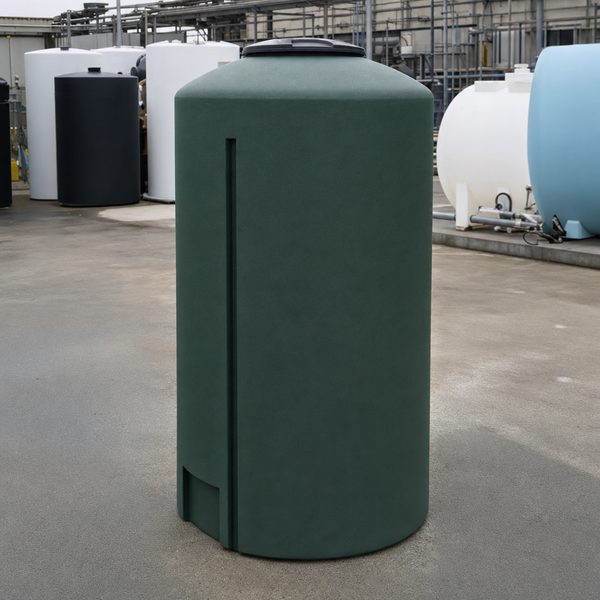
The OneSource Plastics catalog includes Norwesco vertical liquid storage tanks in white pigmentation that are well suited for Mexican potable-water distribution. White pigmentation matters: Mexican rural and peri-urban installations are often outdoor with high UV exposure (Mexican mainland sees substantially more UV than the northeastern U.S.), and white pigmentation reflects more solar gain than black or natural HDPE. Lower internal water temperature reduces biofilm growth rate and reduces THM formation kinetics inside the tank.
Norwesco Vertical White Tanks for MX Potable Distribution
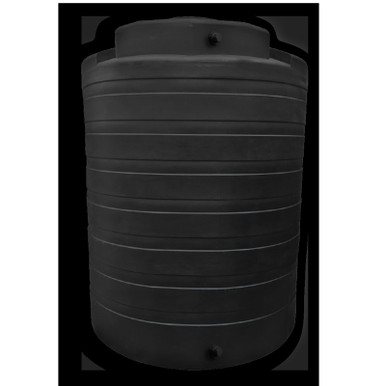
- Norwesco 1100 Gallon Vertical Liquid Storage Tank in White (MPN 42591, listed at $1,521.90) — village-scale or small commercial water system. Compact footprint, ships in a 40-foot container with margin for accessories.
- Norwesco 1295 Gallon Vertical Liquid Storage Tank in White (MPN 44968, listed at $1,499.00) — modest upgrade from the 1,100-gallon, common selection for school or clinic-scale water storage.
- Norwesco 2500 Gallon Vertical Liquid Storage Tank in White (MPN 42382, listed at $2,999.00) — small-municipality or large agricultural cooperative storage. Two units in a 40-foot HC container.
- Norwesco 3000 Gallon Vertical Liquid Storage Tank in White (MPN 45246, listed at $3,599.00) — light municipal distribution buffer storage.
- Norwesco 5000 Gallon Vertical Liquid Storage Tank in White (MPN 40941, listed at $5,599.00) — municipal-scale storage. Single unit per 40-foot HC container.
- Norwesco 6500 Gallon Vertical Liquid Storage Tank in White (MPN 42315, listed at $9,699.00) — larger municipal storage. May require flat-rack ocean container due to height.
- Norwesco 10500 Gallon Vertical Liquid Storage Tank in White (MPN 47638, listed at $17,729.26) — major municipal or industrial scale. Flat-rack ocean shipping required.
All of these are FDA-compliant resin, NSF/ANSI 61 certified by the manufacturer, and appropriate for Mexican potable-water distribution under NOM-127 compliance.
Sizing the Tank for NOM-127 Residence Time
Residence time inside the storage tank matters for water quality. Long residence time depletes residual chlorine, allows biofilm growth, drives THM formation, and risks pushing the system out of NOM-127 compliance even if the source water was clean. Short residence time prevents stagnation but also reduces emergency reserve capacity. The right answer is a function of system demand and disinfection strategy.
General sizing guidance for Mexican potable-water service: storage capacity equal to 1-3 days of average demand is reasonable for systems with reliable source supply. For systems with unreliable source supply (intermittent municipal pressure, well-pump cycling), 3-7 days of capacity is typical. Beyond 7 days of capacity, residence-time concerns dominate and the system needs either booster chlorination or active turnover (recirculation pumping during low-demand periods).
For a household at 200 liters per person per day (a generous Mexican household estimate; rural systems may target 50-100 L/person/day), a family of 5 uses about 265 gallons per day. A 1,100-gallon Norwesco (MPN 42591) provides about 4 days of capacity at that demand level — a reasonable balance for most rural Mexican homes. For a school of 200 students at 20 L/student/day, demand is about 1,050 gallons per day, and a 2,500-gallon Norwesco (MPN 42382) provides 2-3 days of capacity, in the right range for school operations.
Installation Considerations Specific to Mexican Conditions
UV Exposure
Mexican mainland latitude ranges from about 14 degrees north (Chiapas) to 32 degrees north (Sonora-Chihuahua border). UV index at midday in summer routinely hits 11-13 across the central plateau. That is meaningfully higher than most U.S. installations the manufacturer's UV testing was based on. For tanks installed in full-sun Mexican conditions, expect accelerated UV degradation relative to U.S. expectations. The mitigation is straightforward: shade the tank, paint the tank with UV-blocking paint compatible with HDPE, or specify a tank pigmentation with maximum UV stability (white with carbon-black UV stabilizer additive package, which most U.S. potable tanks use).
Seismic Loading
Coastal Mexico (Pacific coast from Baja to Chiapas, parts of the coastal) is in active seismic zones. Mexican civil construction code (RCDF for federal district, state-level codes elsewhere) addresses seismic anchoring of liquid storage. For a polyethylene tank, the practical seismic concern is the anchor straps and the foundation, not the tank shell itself (HDPE accommodates seismic deflection without cracking). Specify anchor straps rated for the local seismic zone — typically 3-4 ratchet straps anchored to a concrete pad with embedded anchor bolts for tanks above 1,000 gallons.
Concrete Pad Sizing
The foundation pad has to support the full water-filled weight of the tank plus a safety margin. A 5,000-gallon Norwesco (MPN 40941) full of water weighs about 41,700 pounds (5,000 gal x 8.34 lb/gal) plus tank weight of about 1,000 pounds, total around 42,700 pounds. The pad must be sized to spread that load to the soil bearing capacity. For typical compacted soil (1,500 psf bearing capacity), a 6-inch reinforced concrete pad sized 12 feet by 12 feet provides sufficient bearing area for the 5,000-gallon tank. ACI 318 covers reinforced concrete design; Mexican civil-engineering code follows similar principles with locally adopted load factors.
Plumbing Connections for Mexican Distribution Systems
Mexican plumbing standards (NOM-001-CONAGUA-2011 for water-distribution networks, NMX-C-415-ONNCCE for plastic pressure pipe) specify metric-thread fittings and metric pipe sizes. U.S. tanks come with NPT (national pipe taper) thread fittings as standard. For Mexican installation, the contractor typically installs an adapter at the tank wall transitioning from NPT (tank fitting) to BSP or metric thread (downstream piping). Specify NPT-to-metric adapters in advance and ship them with the tank.
Norwesco vertical tanks ship with standard 2-inch NPT fittings or 1.5-inch fittings depending on the tank size. The fittings are pre-molded into the tank shell at the factory; no field drilling is needed for the standard outlet. For atypical fitting locations, contact OneSource technical support before order placement.
Disinfection Strategy Inside the Tank
Many Mexican rural water systems rely on point-of-use chlorination with stored water in the polyethylene tank as the buffer. The chlorine residual decays over residence time. NOM-127 sets a maximum residual chlorine concentration of 1.5 mg/L at the point of consumption (typical operating range 0.2-1.5 mg/L). For systems with longer residence time, calculate the chlorine demand and dose the source water at the level needed to maintain residual at the consumption point. For a 1,100-gallon tank with 4 days of residence time and typical first-order chlorine decay constants, source dose of about 1.0 mg/L will yield residual of approximately 0.3-0.5 mg/L at the tap. For shorter residence time, source dose can be lower; for longer residence time, booster chlorination at the tank outlet is the engineering answer.
For UV disinfection as an alternative or supplement: install the UV reactor on the tank outlet line, not inside the tank. UV inside the tank shell is impractical (light absorption by water and biofilm fouling of the lamp) and can degrade the polyethylene wall over time. UV at the tank outlet treats the flow leaving the tank without exposing the tank shell to UV.
Documentation Package for Mexican Customs and CONAGUA Review
For tank export into Mexico, the documentation package the buyer typically needs to clear the tank through customs and through CONAGUA (or state water-authority) review:
- Manufacturer's NSF/ANSI 61 certification letter
- Resin supplier's FDA 21 CFR 177.1520 compliance statement
- Manufacturer's data sheet showing capacity, dimensions, fitting specifications, weight
- Commercial invoice with HTS classification (typically HTS 3925.10.0000 for plastic reservoirs over 300 liters)
- Certificate of origin (NAFTA/USMCA preference if applicable)
- Bill of lading with unit weight and dimensions
For tanks intended for Mexican government potable water projects (CONAGUA-funded municipal projects), additional documentation may be required including an apostilled NSF certificate translation and a Spanish-language data sheet. OneSource Plastics can supply these on request for export orders.
Comparison to Other Latin American Markets
For context: Brazil regulates potable water under Portaria GM/MS 888/2021 (the Brazilian national drinking-water quality standard) and tank materials under ABNT NBR 14785 for polyethylene tanks. Argentina regulates under Codigo Alimentario Argentino Capitulo XII. Chile regulates under NCh 409. Each has nuances. For Mexico, NOM-127-SSA1-2021 is the binding standard, and the U.S. NSF/ANSI 61 certification is the strongest substitute evidence widely accepted in commercial procurement.
Where NOT to Use a U.S.-Sourced Tank in Mexico
Some applications require Mexican-domestic certification that no amount of U.S. NSF certification will substitute for. Mexican federal infrastructure tenders (CFE bottled-water plants, federal hospitals, federal schools) increasingly require NMX-certified products, which means the tank must be tested and certified in a Mexican lab. For those tenders, a U.S.-sourced tank is not the right answer; the buyer needs a Mexican-domestic supplier or a U.S. supplier who has additionally pursued Mexican domestic certification. This is rare in the rotomolded-polyethylene tank market.
For private commercial procurement (private water utilities, agricultural cooperatives, industrial sites, schools and clinics not under federal infrastructure tender), U.S.-sourced NSF 61-certified tanks are routinely accepted and represent the dominant market for U.S.-export polyethylene storage tanks.
Cross-Border Freight Logistics
Polyethylene tanks ship from the U.S. to Mexico via two main routes:
- Truck across U.S.-Mexico land border (Laredo, El Paso, Otay Mesa, McAllen, Eagle Pass crossings). For tanks up to about 6,500 gallons, a single tank fits on a flatbed trailer. Cross-border trucking typically requires a U.S. carrier handing off at the border to a Mexican carrier (cabotage rules limit U.S. trucks operating south of the border).
- Ocean container from Houston, Long Beach, or Manzanillo. For tanks up to about 5,000 gallons, a 40-foot HC container is feasible. Above that, flat-rack containers are needed for the larger tanks. Ocean shipping is more economical for inland Mexican destinations remote from the U.S. border.
For cross-border duty: USMCA (formerly NAFTA) provides duty-free treatment for U.S.-origin polyethylene tanks meeting USMCA rules-of-origin (which all U.S.-rotomolded polyethylene tanks made from U.S. or Canadian resin satisfy). A USMCA certificate of origin is required at the border.
Long-Term Operation Under NOM-127
A polyethylene potable-water tank, properly installed and maintained, will support NOM-127 compliance for 15-25 years of service life. Maintenance items that drive long-term compliance:
- Annual interior cleaning to remove biofilm and any sediment that has settled
- Quarterly chlorine residual measurement at the tank outlet
- Annual exterior inspection for UV degradation, cracking, or fitting leaks
- Five-year interior wall thickness verification via ultrasonic gauge
- End-of-life replacement when wall thickness drops below 75% of as-new (typically 20-25 years in moderate UV exposure, faster in high UV)
For pricing on NSF 61-certified Norwesco tanks for Mexican export, contact OneSource Plastics at 866-418-1777. For internal cross-references, the OneSource chemical compatibility hub covers chemistry envelopes for non-potable applications, the Texas state regulations pillar covers cross-border-relevant U.S. potable storage rules near the Mexican border, and the freight estimator handles U.S. domestic freight quoting (cross-border freight is quoted per project).
Recommended Tanks for This Guide
Live pricing, updated automatically · estimate freight to your ZIP.