Tank Impact Protection: Bollard vs Curb vs Berm Design for Industrial Settings
An industrial tank is a fixed installation in a yard where moving things happen. Forklifts make 200 trips a day past the chemical bulk storage. Tank trucks back into the loading bay. Loaders, skid-steers, occasional pickup truck reversing into the gate. The tank itself does not move. Everything around it does. The only question is whether the impact protection between them survives the inevitable contact event without putting the tank out of service or producing a chemical release.
This guide covers the three impact-protection strategies for plastic tank installations — bollards, curbs, and berms — with the real engineering specifications that make each one work, and the failure modes that produce expensive insurance claims when they're done cheap. We cite ASTM F3016, AASHTO LRFD Bridge Design Specifications (vehicle impact loads), FHWA HSM, OSHA 29 CFR 1910.176 (powered industrial trucks), NFPA 30 (containment for flammable storage), and 40 CFR Part 112 (EPA SPCC). No fabrication.
Three Strategies, Three Threats
Each protection strategy answers a different threat:
- Bollard (vertical post): stops a vehicle from striking the tank itself. Threat: forklift, tank truck, pickup, occasional 20-ton commercial vehicle.
- Curb (low concrete or steel barrier): redirects low-speed wheel impact away from tank base. Threat: forklift bumper, dolly cart, sweeper.
- Berm (containment + barrier): contains a release AND deflects impact. Threat: chemical release combined with vehicle traffic.
Most installations need ALL THREE in different positions. A 5,000-gallon caustic tank in a transfer-yard typically has bollards on the truck-approach side, a curb around the pump panel, and a berm around the tank pad. The cost of doing this right is $2,000-15,000 depending on tank class and traffic. The cost of doing it wrong is the tank, the chemistry, the cleanup, the insurance increase, and possibly a worker injury claim.
Strategy 1: Bollards (Vertical Posts)
A bollard is a vertical post designed to absorb and redirect vehicle impact. The two functional categories per ASTM F3016 (Standard Test Method for Surrogate Testing of Vehicle Impact Protective Devices at Low Speeds):
- K4 (low-speed crash-rated): stops a 5,000-lb vehicle at 10 mph (4.5 mph permanent stop). Used at building entrances and pedestrian protection.
- K12 / M50 (high-speed crash-rated): stops a 15,000-lb vehicle at 50 mph (per ASTM F2656 / ANSI A156.31). Used at military, federal, and high-security perimeters. Significant overkill for industrial yard.
For typical industrial tank protection, K4-rated or non-crash-rated structural bollards are appropriate. The engineering question is force absorption, not penetration prevention.
Bollard Construction Standards
| Bollard type | Construction | Impact rating | Use case |
|---|---|---|---|
| Steel pipe bollard | 6-inch Schedule 40 pipe, concrete-filled, 36-inch above grade, 36-inch below grade in 12-inch concrete footing | ~10,000 ft-lb absorption | Forklift / pickup protection |
| Heavy-duty pipe bollard | 8-inch Schedule 80 pipe, concrete-filled, 42-inch above grade, 48-inch below grade in 18-inch concrete | ~25,000 ft-lb absorption | Tank truck approach |
| Removable bollard | Steel sleeve socket cast in concrete; 4 to 6-inch removable upper section | Limited (key-controlled access) | Service-access points |
| Crash-rated K4 (ASTM F3016) | Engineered steel + foundation per manufacturer drawings | 5,000 lb @ 10 mph | Building entrance / loading dock |
| Decorative cover bollard | Polyethylene or aluminum sleeve over structural pipe | Same as underlying pipe | Aesthetic + function |
Bollard Spacing and Placement
For industrial tank protection, AASHTO LRFD Bridge Design Specifications Section 3.6.5 provides the design vehicle impact load (600 kips applied 5 feet above ground for highway-grade barriers — far above typical industrial yard threats). For tank-yard application, OSHA 29 CFR 1910.176 governs powered industrial trucks (forklifts) and AASHTO design vehicle classes for occasional truck contact.
Practical spacing for bollards around a tank perimeter:
- 4 feet apart, 4 feet from tank for tanks under 1,000 gallon
- 4 feet apart, 6 feet from tank for tanks 1,000-3,000 gallon
- 5 feet apart, 8 feet from tank for tanks 3,000-10,000 gallon and tank truck approach
- Bollards offset to NOT impede equipment access for filling, valving, and inspection
The protection arc is set by what's approaching the tank. A tank with a single dedicated truck-approach lane needs bollards on that approach side only. A tank in a circulation yard with forklifts coming from all four sides needs bollards on all four sides.
Foundation Engineering
The bollard above-grade is the visible part. The foundation below-grade is what absorbs the impact. Standard concrete-filled steel pipe bollard foundation:
- Concrete footing: minimum 12-inch diameter cylinder, 36-48 inch deep (4,000 psi compressive strength concrete per ACI 318)
- Frost depth: footing extends to local frost depth (36-48 inch in northern states, 12-30 inch in southern; verify with local building department)
- Reinforcement: 4 vertical #4 rebar, ties at 12-inch on-center for heavy-duty installations
- Pipe embedment: minimum 36-inch (must penetrate to bottom of footing for direct moment transfer)
- Concrete fill in pipe: 3,000-4,000 psi grout to prevent crush of empty pipe
Skip the proper footing depth, and the bollard becomes a lever arm — first impact rotates it in the soil, second impact lays it over. The deep footing converts impact moment into earth-bearing stress over the foundation surface area, where the soil takes it.
Strategy 2: Curbs (Low Concrete or Steel Barrier)
Curbs are 6-12 inch vertical concrete barriers that redirect low-speed wheel contact. They do NOT stop a vehicle. They prevent a wandering forklift wheel from rolling into a tank base, a pump skid, or a piping manifold. They also serve as visual cue to operators that an exclusion zone exists.
Curb Standards
AASHTO M-Type and SA-Type concrete barriers (LRFD Section 13) specify curb geometry for highway use. For industrial yard application, MUTCD-style traffic calming curbs are appropriate:
- Type B6 (rolled-back): 6-inch face curb, sloped top, designed for low-speed deflection
- Type SC (straight-curb): 8-inch face vertical curb for clear deflection at speeds under 15 mph
- Steel angle-iron curb: 4 × 4 × 1/2-inch steel angle anchored to concrete, used where forklift abuse is severe
Curb Placement Geometry
A curb around a tank pad serves three functions: redirection (deflect approaching vehicle), demarcation (visual exclusion zone), and minor containment (small spill capture). Typical curb placement:
- Curb extends 18-24 inches beyond tank diameter on all sides (matches the pad extension)
- Curb height 6 inches minimum (visual cue + small containment)
- Curb-to-pad-edge distance maintained 24 inches minimum (allows operator foot access for inspection without stepping on tank pad)
- Curb continuous on three sides; opening on the operator-access side OR removable curb section at access opening
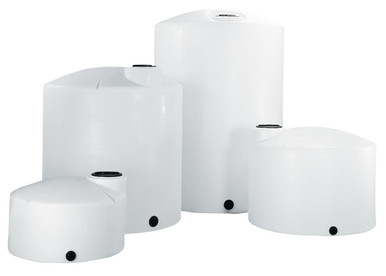
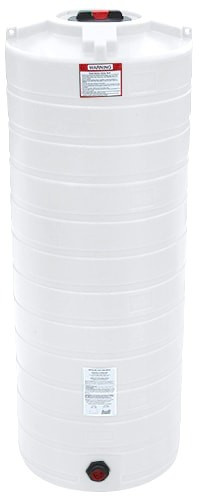
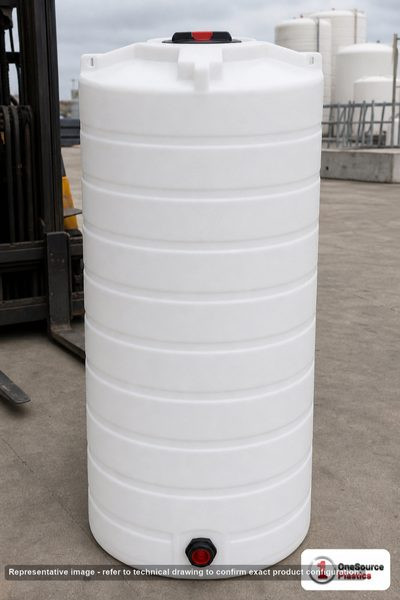
For tanks like the Norwesco MPN 41464 (100 gal vertical, $393.86 list, 23-inch diameter × 63-inch tall), a curb around the small pad is mostly visual demarcation — a forklift in motion is going to flatten the tank regardless. For larger tanks like the Snyder Industries 1500-gallon class (representative MPN WB46/WB47 at $1,540 list), curbs become functional traffic redirection.
Strategy 3: Berms (Containment Barriers)
A berm is the EPA SPCC and NFPA 30 secondary containment requirement made physical. It's an elevated containment perimeter designed to capture a release AND deflect approaching vehicle traffic.
Berm Sizing per Containment Code
For oil storage subject to EPA SPCC (40 CFR Part 112), secondary containment must hold 110% of the largest tank for general industry, or 100% plus precipitation for outdoor uncovered installations. For flammable liquid storage subject to NFPA 30, requirements are similar though calculation methodology varies. State variants (notably California Title 23 for petroleum, Florida 62-761 for petroleum, Texas 30 TAC Chapter 334 for UST/AST) impose specific sizing.
For a 5,000-gallon vertical XLPE tank, a 110% containment is 5,500 gallons of effective containment volume. With a typical 25-foot × 25-foot berm footprint (625 sq ft), berm wall height required is 5,500 gal / 7.48 (gal per cu ft) / 625 sq ft ≈ 1.18 ft. So a 14-inch berm wall handles the storage.
Add precipitation: 100-year 24-hour rainfall in central Texas is ~6 inches per NOAA Atlas 14. Over 625 sq ft, that's 312 cu ft = 2,335 gallons. Adjusted required containment: 5,500 + 2,335 = 7,835 gallons. Required wall height becomes 1.68 ft = 20 inches.
This is the math that determines whether your berm passes EPA inspection. Most inspectors require freeboard above the calculated level — typically 6 inches additional. Final berm wall height: 26 inches.
Berm Construction
| Berm type | Material | Service life | Vehicle protection |
|---|---|---|---|
| Earthen berm | Compacted clay over geomembrane liner (60-mil HDPE or PVC) | 15-25 years | Soft impact only; not vehicle-rated |
| Concrete berm | Reinforced concrete wall with epoxy chemical-resistant coating | 25-50 years | Light-vehicle deflection |
| Steel berm | Galvanized or coated steel panels with chemical-compatible liner | 15-30 years | Light-vehicle deflection; replaceable panels |
| Modular plastic berm | UV-stabilized polyethylene panels with chemical-compatible interior | 10-20 years | No vehicle protection — combine with bollards |
| Bermed concrete with bollard array | Concrete berm + integrated bollards at vehicle approach points | 25-50 years | Full vehicle protection rating |
Berm + Bollard Integration
The combined approach for industrial flammable / chemical storage: concrete berm wall with integrated bollard posts at every vehicle approach point. The berm handles containment, the bollards handle vehicle impact, and they are constructed as one engineered system. Common design:
- Reinforced concrete berm wall, 24-30 inches tall, 8 inches thick, 4,000 psi concrete with #4 rebar at 12-inch on-center each way
- Bollards spaced 4-6 feet on-center at all vehicle approach openings, embedded 36 inches into the berm foundation
- Berm interior coated with chemistry-compatible epoxy or bonded liner (verify against the chemistry in storage)
- Drainage valve at low point, normally-closed, with documented inspection-and-discharge protocol per 40 CFR 112.8(c)(3)
- Containment coating tested for chemistry compatibility — for sodium hypochlorite see Sodium Hypochlorite Storage, for caustic see Sodium Hydroxide Storage, etc.
Decision Matrix
| Tank service / location | Bollard? | Curb? | Berm? |
|---|---|---|---|
| Water tank, fenced yard | Optional | Recommended | No |
| DEF tank, fleet shop | Yes (forklift) | Yes | No (DEF non-hazardous) |
| Diesel tank under 1,320 gal | Yes (truck approach) | Yes | Optional (under SPCC threshold) |
| Diesel / gasoline tank over 1,320 gal | Mandatory | Recommended | Mandatory (SPCC) |
| Bleach (NaOCl) bulk tank | Yes | Yes | Mandatory (chemical release prevention) |
| Caustic (NaOH 50%) bulk tank | Yes | Yes | Mandatory |
| Sulfuric acid 93% tank | Yes | Yes | Mandatory + acid-resistant coating |
| Fertilizer / urea bulk tank | Yes (truck approach) | Yes | Mandatory in NPDES jurisdictions |
Worked Install: 3,000-Gallon Caustic Bulk at Pretreatment Plant
Site: outdoor concrete pad. Tank: 3,000-gallon Snyder Industries XLPE vertical (representative pricing $2,500-3,500 for 3,000-gal class XLPE), service: 50% sodium hydroxide. Vehicle traffic: tank truck delivery monthly, plant pickup truck weekly inspection access.
- Berm: 24-inch high reinforced concrete wall, 30-foot × 30-foot interior footprint (900 sq ft), holding 11,250 gallons (10,500 fluid + 750 freeboard for precipitation per 40 CFR 112). Interior coated with two-component epoxy rated for 50% NaOH continuous immersion. Drainage valve at low point with check-before-discharge protocol.
- Bollards: 6-inch Schedule 40 steel pipe, concrete-filled, 36-inch above grade, 36-inch below grade in 12-inch concrete footing. Five bollards spaced 5-foot on-center on the truck-approach side; integrated with berm wall foundation.
- Curb: 8-inch concrete curb extending 18 inches beyond berm exterior, demarcating exclusion zone. Yellow paint and reflective tape for visibility.
- Coordination: berm exterior bollards do double duty as containment-wall protection and tank-approach protection. Single design intent.
Total cost typically $8,000-15,000 for the system. Insurance discount on chemical-storage property policy plus avoided EPA enforcement action makes payback under 18 months in most jurisdictions.
Common Impact Protection Mistakes
Mistake 1: Bollards too far from tank
Bollard 12 feet from tank, forklift bumper extends 7 feet from drive wheels — bollard intercepts the bumper but the load on the forks reaches the tank. Place bollards close enough that load + bumper + offset cannot reach tank.
Mistake 2: Bollards too close together (no equipment access)
Bollards 18 inches apart create wall around tank that prevents pump access, valve service, and bulkhead repair. Forklift can't reach the tank for legitimate maintenance. Operators end up working from outside the bollard ring with extension tools — slower and less accurate.
Mistake 3: Concrete-filled pipe with no rebar in foundation
Pipe embedment in 12-inch unreinforced concrete fails in shear at first heavy impact. The pipe stays put but the concrete plug under it splits and rotates. Use #4 rebar tied around the pipe in the foundation.
Mistake 4: Berm wall without chemistry-compatible coating
Concrete in continuous contact with 50% caustic deteriorates within 5-10 years. Acid-resistant coating system on berm interior is non-negotiable for chemical service. Verify coating chemistry against tank service.
Mistake 5: No drainage valve management protocol
Berm drainage valve left open after rain to drain accumulated stormwater, then forgotten. Next chemical release runs out the open valve. Per 40 CFR 112.8(c)(3) the valve is normally-closed, opened only after visual inspection and documentation of clean discharge.
Mistake 6: Removable bollards stuck in place
Removable bollards seize in their sockets within 2-5 years from corrosion and grit accumulation. When emergency vehicle access is needed, the bollard won't come out. Use stainless socket sleeves and inspect annually.
Mistake 7: Curbs that are tripping hazards
Curbs with sharp vertical face become trip hazards in high-traffic operator zones. OSHA 29 CFR 1910.22(b) requires walking surfaces free of trip hazards. Use rolled-back or chamfered curb top in pedestrian-traffic zones.
Standards Reference Quick-Sheet
- ASTM F3016 — Standard Test Method for Surrogate Testing of Vehicle Impact Protective Devices at Low Speeds (K4 rating)
- ASTM F2656 — Standard Test Method for Crash Testing of Vehicle Security Barriers (K8/K12/M50 ratings)
- AASHTO LRFD Bridge Design Specifications — Section 3 (Loads), Section 13 (Railings)
- OSHA 29 CFR 1910.176 — Handling Materials (powered industrial trucks)
- OSHA 29 CFR 1910.22 — Walking-Working Surfaces, General Requirements
- OSHA 29 CFR 1910.144 — Safety Color Code for Marking Physical Hazards
- NFPA 30 — Flammable and Combustible Liquids Code
- 40 CFR Part 112 — EPA Spill Prevention, Control, and Countermeasure Rule
- FHWA HSM — Highway Safety Manual (vehicle impact methodology)
- ACI 318 — Building Code Requirements for Structural Concrete
- MUTCD — Manual on Uniform Traffic Control Devices (curb and bollard markings)
Internal Resources
- Secondary Containment Volume Math
- Tank Foundation Pad Engineering
- Loading Dock and Receiving Site Design
- Tank Storage Compliance Audit Checklist
- Hurricane Tie-Down Engineering
- Sodium Hydroxide Storage
- Sodium Hypochlorite Storage
- Freight Cost Estimator
- Contact OneSource
Source Citations
- ASTM F3016 — Standard Test Method for Surrogate Testing of Vehicle Impact Protective Devices at Low Speeds
- ASTM F2656 — Standard Test Method for Crash Testing of Vehicle Security Barriers
- AASHTO LRFD Bridge Design Specifications, 9th Edition (Sections 3, 13)
- OSHA 29 CFR 1910.176 — Handling Materials
- OSHA 29 CFR 1910.22 — Walking-Working Surfaces, General Requirements
- OSHA 29 CFR 1910.144 — Safety Color Code
- NFPA 30 — Flammable and Combustible Liquids Code
- 40 CFR Part 112 — Oil Pollution Prevention (EPA SPCC Rule)
- 40 CFR 112.8(c) — Bulk Storage Container Requirements
- FHWA Highway Safety Manual
- ACI 318 — Building Code Requirements for Structural Concrete
- MUTCD — Manual on Uniform Traffic Control Devices, Federal Highway Administration
- California Title 23 (Petroleum UST/AST)
- Florida Administrative Code 62-761 (Aboveground Petroleum Storage Tank Systems)
- Texas 30 TAC Chapter 334 (Underground and Aboveground Storage Tanks)
- OneSource Plastics master catalog data — 9,419 products, 2026-03-26 snapshot
Recommended Tanks for This Guide
Live pricing, updated automatically · estimate freight to your ZIP.