
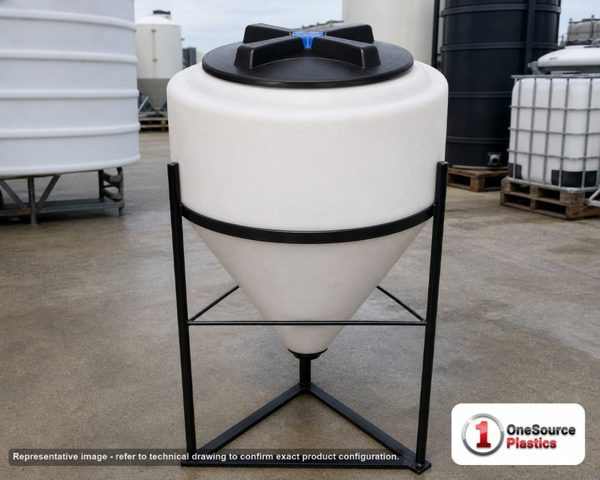
300 Gallon 45 Degree Cone Bottom Tank: Complete Buyer's Guide
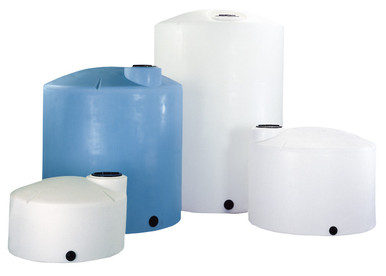

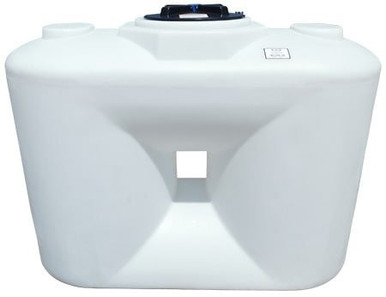
300-gallon white cone bottom tank built for full-drain mixing and batch processing. Manufactured by Norwesco from virgin linear polyethylene (HDPE) rated to handle liquids up to 12.5 pounds per gallon. FDA approved for contact with potable water, ensuring safe storage for drinking water and food-grade liquids.
Specifications at a Glance
Every figure below is pulled straight from the live product record for this exact tank — the same data on the product page, so what you read here and what you buy never disagree.
Standards & Materials
- ASTM D1998 — Standard Specification for Polyethylene Upright Storage Tanks. Governs wall-thickness and hydrostatic design for vertical rotomolded poly tanks of this class.
- FDA 21 CFR 177.1520 — Olefin polymers. The food-contact regulation the FDA-grade resin in this tank is compounded to meet.
- Specific gravity rating 1.5 — the tank is engineered for liquids up to 1.5× the density of water (water is about 8.34 lb/gal). Confirm your fluid’s SG before storage.
Product Overview
The 300 Gallon 45 Degree Cone Bottom Tank takes the aggressive 45-degree drain that handles settling solids and viscous chemistry and scales it up to a genuinely useful mid-size batch. At 48 inches in diameter and 56 inches tall it bridges the gap between a benchtop dosing tank and a plant-scale process vessel, making it a common choice for water-treatment dosing, fertilizer blending, and any batch operation that has to evacuate completely between runs.
Norwesco molds the body in a single rotational shot from virgin linear polyethylene, eliminating the seams and weld lines that flat-stock tanks rely on, and rates it to 1.5 specific gravity for liquids up to 12.5 pounds per gallon. UV inhibitors are compounded into the wall, and continuous service is rated to 120 F / 48 C. The translucent natural-white body doubles as a level indicator and a window onto the cone-shoulder stress zone.
Empty, the tank weighs 104 pounds; full at 1.5 SG it reaches about 3,857 pounds, all of which transfers through the supporting stand into the floor. The factory 2-inch NPT outlet sits at the cone tip for full gravity drainage, and the 16-inch lid is large enough for a top-entry mixer, a sight tube, or level instrumentation. It carries Norwesco's 3-year warranty against manufacturing defects.
Technical Drawing
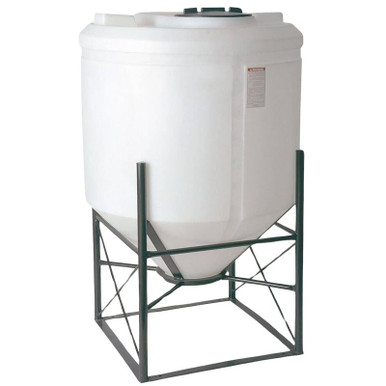
Official Norwesco technical drawing — 300 Gallon 45 Degree Cone Bottom Tank
Key Features and Specifications
- 300-gallon capacity — sized for full-drain mixing and batch processing
- Constructed from virgin linear polyethylene (HDPE) with 1.5 specific gravity rating — handles liquids up to 12.5 lbs/gal
- 56" tall x 48" diameter — compact vertical footprint
- 104 lbs empty, approximately 3,857 lbs when full at rated specific gravity
- 2" NPT outlet fitting — factory installed and leak-tested
- 16" lid opening for fill, venting, and interior access
- FDA approved for potable water and food-grade liquid contact
- 3 Year Warranty from Norwesco against manufacturing defects
- Translucent white walls allow visual level monitoring without opening the tank and reflect sunlight to keep contents cooler
- Rated for continuous service up to 120 F / 48 C
- Seamless one-piece rotational molding — no seams, no welds, no leak points
- Manufactured by Norwesco — a leading name in rotomolded polyethylene tanks
- Must be installed on the manufacturer-supplied or compatible stand rated for the full loaded weight. Never rest a cone bottom tank directly on its apex
- Ships via LTL freight on a pallet — residential delivery with lift gate available
Installation and Setup Guide
Step up to 300 gallons on a 45-degree cone and you keep the steep, solids-clearing drain of its smaller sibling while nearly doubling working volume. The body widens to 48 inches and stands 56 inches tall, and the deeper cone means the stand has real work to do. Get the stand right and this is one of the most useful mid-size process vessels you can own; get it wrong and the cone is the first thing to crack.
Sizing the Stand and Slab
At the 1.5 SG rating a full tank reaches roughly 3,857 pounds, all of it transferred through the stand into the floor. A good concrete slab handles that, but because the legs concentrate the load, set the stand on a flat, non-flexing surface and level it precisely. Order a stand matched to a 48-inch cone and rated comfortably above the wet weight; this is not a place to adapt a frame built for a different tank.
Seating and Apex Rule
Lower the tank so the cone beds continuously in the stand's seat with no air gaps. The apex carries the drain fitting, not the load — let the conical sidewall transfer weight into the seat and keep any hard point away from the tip. A 45-degree cone seats deeply, so a poor fit shows up immediately as a visible gap at the rim.
Plumbing the Drain
Run schedule 80 PVC or stainless off the 2-inch NPT outlet, support it within the first foot so it never hangs on the bulkhead, and fit a full-port valve for clean batch isolation. The 16-inch lid is roomy enough for a top-entry mixer, a sight tube, or a level sensor. Vent the lid to match your chemistry so the tank neither pulls vacuum on a fast draw nor pressurizes on a fast fill.
Maintenance and Long-Term Care
A 300-gallon cone in active batch service earns a disciplined quarterly walk-around. You are watching a loaded structure and a chemical path at the same time, with particular attention to where solids and concentration collect.
Quarterly Checks
- Apex and outlet: The cone tip is where the harshest concentration and any settled solids end up. Inspect the 2-inch fitting and valve for weeping, and verify the tip drains clean without buildup.
- Stand condition: Examine legs, welds or molded joints, and footings for corrosion, cracking, or settlement. The seat must still cradle the cone fully.
- Stress shoulder: Backlight the natural-white wall and read the cylinder-to-cone transition for milky stress whitening, the classic early indicator of a load-path problem on a steep cone.
Between-Batch Cleaning
Open the valve, let the steep cone evacuate liquid and solids together, then rinse from the top. The geometry does most of the cleaning for you. On a product change, run the new chemical's decontamination procedure and confirm polyethylene compatibility before refilling. This vessel is chemical-process equipment; it carries no potable-water duty, so cleaning is about preventing carryover between products.
Weather and Resin
UV stabilizer is built into the resin for outdoor service, but inspect the sun-facing wall yearly for chalking if the tank lives outside, and add shade in harsh-UV climates. The translucent wall doubles as a level gauge and a structural-health window — use it.
Alternatives and Comparisons
This 300-gallon, 45-degree cone is the volume most operators land on when a 160-gallon tank runs short but a 500-gallon tank is more than the process needs. The 45-degree slope keeps it firmly in solids-and-slurry territory.
How it compares: Against the 160-gallon 45-degree cone, this tank gives you nearly twice the batch with the same aggressive drain, at the cost of a wider footprint and a heavier stand requirement. Against a 300-gallon flat-bottom vertical, the cone drains to essentially nothing but stands taller and needs a stand the flat tank does not. If your chemistry never settles and a residual heel is acceptable, the flat tank is simpler and cheaper.
Other 300-Gallon Options
Frequently Asked Questions
How long will the 300 Gallon 45 Degree Cone Bottom Tank last?
Operated within the 1.5 SG and 120 F limits and supported on a proper stand, this tank should run 15 to 20 years. Complete drainage is its longevity advantage — nothing sits stagnant in the cone between batches. Premature failure traces back to an undersized stand, thermal abuse, or incompatible chemistry far more often than to the tank itself.
What chemicals can I store in this tank?
It covers the 1.5-SG range of agricultural and industrial liquids, and the 45-degree cone makes it well suited to settling solids and viscous products within that density. Confirm polyethylene compatibility for each chemical before use. Keep fuels, solvents, and flammables out of it. In cone service this is chemical-process equipment, not a drinking-water tank.
What kind of foundation does a 300-gallon tank need?
A full tank reaches about 3,857 pounds at 1.5 SG, channeled through the stand into the floor. A solid concrete slab carries it, but the surface must be flat and non-settling and the stand leveled and load-rated, because cone tanks point-load through their legs rather than spreading weight like a flat-bottom tank.
Does this tank come with a warranty?
Yes — Norwesco warrants it against manufacturing defects in materials and workmanship under normal use. Molded-in faults are covered; stand failures, overloading, incompatible-chemical damage, and impact are not. Retain your paperwork and an installation photo.
Can I install this tank underground?
No. A 45-degree cone tank is engineered to sit in an above-ground stand and has no resistance to soil pressure. Burial would collapse the cone and void the warranty. Choose our reinforced underground cistern or septic products for below-grade storage.
Buying Considerations
Three checks before you commit to this 300-gallon cone. First, the stand — rated above the roughly 3,857-pound wet load, matched to the 48-inch cone, and ordered with the tank if you do not own one. Second, vertical clearance, since a 45-degree cone plus stand stacks up tall and your fill access has to reach the lid. Third, your stored product, verified against a polyethylene compatibility chart, because the steep drain earns its keep on settling and viscous chemistries. The tank palletizes for standard freight; we will quote delivery to your ZIP.
Related Products You May Need
Questions? Call (866) 418-1777 — our team knows these products inside and out and can help you select the right tank for your application.
Recommended Tanks for This Guide
Live pricing, updated automatically · estimate freight to your ZIP.