Polyethylene Tank Wall Thickness Inspection Methods: Ultrasonic Pulse-Echo Versus Pin-Gauge Mechanical Probe Versus Dye-Penetrant Surface Examination, Calibration Standards, Operator Qualification Pathways, and Inspection Frequency Selection
The polyethylene tank wall is a load-bearing structural element whose thickness governs the burst pressure, the hoop-stress capacity at static head, the stiffness against ovalization, and the long-term creep allowance under sustained load. Wall thickness inspection is therefore a periodic structural verification: confirm that the as-built thickness has not eroded below the design minimum through chemical attack, UV degradation, abrasion, or processing variation, and document the verification in a record that supports the next inspection cycle. Three principal methods exist for non-destructive wall-thickness inspection on polyethylene: ultrasonic pulse-echo, pin-gauge mechanical probe, and dye-penetrant surface examination. Each has a different physical basis, a different accuracy envelope, a different operator-qualification pathway, and a different best-application zone. This article walks the three methods in depth, the calibration disciplines, the inspection-frequency framework, and the procurement implications.
The discussion is grounded in ASTM E797 ultrasonic thickness practice, ASTM D5199 plastic film thickness practice, ASTM E165 liquid penetrant practice, and field experience across the 5-brand polyethylene tank catalog (Norwesco, Snyder, Chem-Tainer, Enduraplas, Bushman). List pricing on each tank product page; LTL freight quoted to your ZIP via the freight estimator or by phone at 866-418-1777.
1. Why Wall Thickness Inspection Matters on a Polyethylene Tank
The structural design of a vertical polyethylene tank assigns wall thickness as a function of vertical position from the floor, with the lowest courses thicker than the upper courses to carry the increased hoop stress from accumulated static head. The rotational-molding manufacturing process produces a wall thickness distribution that the manufacturer controls within a specified tolerance. The as-built tank meets the structural design when the measured thickness in every course exceeds the design minimum at that course.
- The hoop-stress mechanism. A vertical tank holding liquid develops hoop stress in the wall proportional to the liquid density times the depth from surface times the tank radius divided by the wall thickness. The hoop stress is highest at the floor and lowest at the surface. The wall thickness must be sufficient at every elevation to keep the hoop stress below the long-term design stress allowance for the polyethylene grade at the operating temperature.
- The chemical-thinning mechanism. Some chemistries attack the polyethylene wall over service life. Strong oxidizers (concentrated nitric acid, hypochlorite at elevated concentrations, peroxides) erode the inner-wall surface progressively. Solvent absorption (aromatic hydrocarbons, chlorinated solvents) plasticizes the polyethylene and reduces the load-bearing thickness. Combined chemical and mechanical attack from agitated abrasive slurries removes inner-wall material at the splash zone.
- The UV-thinning mechanism. Outdoor tanks exposed to sunlight experience photo-oxidation that progressively degrades the outer-wall surface. UV stabilizer packages (carbon black, hindered amine light stabilizers) extend the time before significant degradation but do not eliminate it. After 15 to 30 years of outdoor exposure (depending on UV index, stabilizer level, and color) the outer-wall thickness can be measurably reduced.
- The abrasion-thinning mechanism. Tanks with internal mechanical agitation, slurry service with hard suspended solids, or high-velocity inlet flow at a localized area experience progressive wall thinning at the impact or abrasion zone. The wear pattern is localized to specific locations rather than uniform across the wall.
- The thermal-cycle thinning mechanism. Tanks subjected to large temperature swings (cold-water tank in summer outdoor service, hot-process tank with intermittent operation) experience thermal stress cycles that accumulate fatigue damage. The damage manifests as crazing, cracking, or wall thinning at the highest-stress regions.
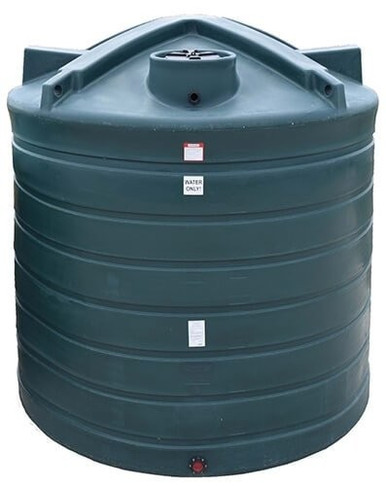
- Reference 5000 gallon tank for inspection scoping. Reference N-40164 5000 gallon Norwesco vertical as a typical industrial tank where the wall-thickness inspection program applies. The tank circumference and height define the inspection grid size and the number of measurement points per inspection cycle.
The thinning mechanisms operate continuously across service life. The inspection program quantifies the progress and projects the remaining service life before the wall thickness reaches the design minimum at any location.
2. Ultrasonic Pulse-Echo Thickness Measurement
Ultrasonic pulse-echo is the principal method for non-destructive wall-thickness measurement on polyethylene tanks. The physical principle, the equipment, and the operational discipline are all important to understand:
- The pulse-echo physical principle. A piezoelectric transducer coupled to the outer wall surface emits a short ultrasonic pulse into the polyethylene. The pulse propagates through the wall, reflects at the inner-wall surface (acoustic impedance change to liquid or air), and returns to the transducer. The instrument measures the time-of-flight, multiplies by the known speed of sound in polyethylene, divides by two for the round trip, and reports the wall thickness.
- The polyethylene-specific calibration. The speed of sound in polyethylene varies with the polymer grade, the molecular orientation from rotational molding, and the temperature. The calibration value is typically near 2400 meters per second for high-density polyethylene at room temperature, but the precise value should be verified by measurement on a known-thickness reference block of the same polyethylene grade. The calibration block is the foundation of the measurement; without it the readings are nominal at best.
- The transducer frequency selection. Standard ultrasonic thickness gauges use transducers in the 2 MHz to 10 MHz range. Higher frequencies produce sharper pulse leading edges and better thickness resolution but are more attenuated by the polyethylene; lower frequencies penetrate further but resolve thickness less precisely. For typical polyethylene tank walls of 5 to 25 mm a 5 MHz transducer is the standard selection.
- The couplant requirement. The transducer must couple acoustically to the wall surface. Air gaps prevent the pulse from entering the wall. A liquid couplant (water, glycerin, commercial ultrasonic gel) fills the gap between transducer and wall. The couplant choice should be compatible with the wall surface; some commercial couplants stain or chemically attack polyethylene over time.
- The two-point versus single-point method. Some instruments use a single transducer that both transmits and receives (pulse-echo); others use a dual-element transducer with separate transmit and receive elements (pitch-catch) which is preferred for thin walls or rough surfaces. The dual-element method gives cleaner thin-wall measurements at the cost of slightly larger transducer footprint.
- The operator skill and the surface preparation. Ultrasonic thickness measurement requires light surface cleaning to remove dirt and provide good acoustic contact. Heavy contamination, paint chips, and surface UV degradation can scatter the ultrasonic pulse. The operator examines each measurement location, identifies clean areas, and confirms readings with adjacent measurements before recording.
Ultrasonic measurement is the workhorse of polyethylene tank wall-thickness inspection. The accuracy is typically better than 0.1 mm with proper calibration and clean surfaces. The method is non-destructive and can be performed on a tank in service.
3. Pin-Gauge Mechanical Probe Measurement
Pin-gauge mechanical probe is a destructive but precise wall-thickness measurement method used for confirmatory checks on areas where ultrasonic readings are suspect:
- The mechanical-probe principle. A small-diameter pin (typically 1 to 3 mm) is driven through the wall at a measurement location. A depth indicator on the pin housing reads the thickness as the pin emerges through the inner wall. The pin is then retracted; a small plug or sealant fills the residual hole.
- The accuracy advantage. The mechanical measurement is direct: the pin records the actual physical distance through the wall. There is no acoustic-coupling interpretation, no calibration speed-of-sound assumption. The accuracy is limited only by the depth-indicator resolution, which is typically 0.05 mm or better.
- The destructive-method limitation. The pin creates a small hole through the wall. The hole must be sealed before the tank returns to service. The seal is typically a polyethylene-compatible sealant (extrudable polyethylene rod, hot-air welding, mechanical plug). The repaired location is structurally weaker than the surrounding wall.
- The confirmatory-use case. Pin-gauge is rarely used as the primary inspection method due to the destructive nature. It is used when ultrasonic readings are suspect (very thin wall, very degraded surface, inconsistent readings) and a definitive thickness is required to make a decision (continue in service, schedule repair, immediate retirement).
- The location-selection discipline. Pin-gauge measurements are limited to discrete locations because each measurement creates a wall penetration. The locations are chosen at the highest-suspected-thinning zones (lower hoop-stress regions, inner-wall splash zones, outer-wall UV zones, abrasion zones). The locations are documented in the inspection record so subsequent inspections can avoid them.
- Reference 1000 gallon tank for pin-gauge use. Reference N-40152 1000 gallon Norwesco vertical as a tank size where pin-gauge confirmatory checks are practical. The tank can be drained, the inspection performed at confirmed locations, the holes sealed, and the tank returned to service within a single inspection visit.
Pin-gauge is the second-line inspection method. It is destructive but accurate; it is reserved for cases where the ultrasonic reading needs to be verified against a direct mechanical measurement.
4. Dye-Penetrant Surface Examination
Dye-penetrant surface examination does not measure wall thickness directly but reveals surface defects (cracks, crazing, pinholes, weld defects) that signal local thinning or impending failure:
- The penetrant-principle physics. A low-viscosity dye is applied to the wall surface. The dye flows by capillary action into any surface-breaking cracks or pinholes. Excess dye is wiped off. A developer (powder or aerosol) is applied; the developer draws the dye out of the cracks and produces a visible indication on the surface. The indication reveals the location, length, and orientation of the crack.
- The polyethylene-specific dye selection. Standard penetrant dyes formulated for steel are sometimes incompatible with polyethylene; the carrier solvent can attack the polymer or the dye can stain the surface permanently. Polyethylene-compatible penetrants exist; the manufacturer specification should be consulted before application. Test-patch verification on a sacrificial sample of the same polyethylene grade is prudent.
- The crack-detection sensitivity. Dye-penetrant detects surface-breaking defects with sensitivity better than visual inspection. Hairline crazing patterns in stress-concentration zones (knuckle radii, fitting boundaries, manway gaskets) are revealed when they would be invisible to the naked eye. The detection is limited to surface-breaking defects; sub-surface voids are not revealed.
- The thinning-correlation interpretation. A dense crazing pattern in a defined area correlates with local material degradation that often coincides with wall thinning. The penetrant inspection identifies the suspect area; the ultrasonic inspection then quantifies the thickness at the suspect location. The two methods used together produce a more complete picture than either alone.
- The cleanup discipline. Penetrant residue must be removed after inspection. Solvent rinses and water flushes are typical; the cleanup is documented to confirm no residual chemistry remains in the tank that could contaminate downstream chemistry. For pharmaceutical or food-grade tanks the cleanup discipline includes verification swabs.
- The qualification of the operator. ASTM E165 specifies operator qualification for liquid-penetrant examination at three levels (Level I, Level II, Level III). The Level II operator can perform inspections and interpret results; the Level III operator can establish procedures and supervise. Procurement of inspection services should specify the required level for the application.
Dye-penetrant complements the wall-thickness measurements by revealing surface defects that point to thinning zones. The method is non-destructive when properly cleaned up but does require tank-out-of-service for inspection access.
5. Calibration Standards and Reference Blocks
The accuracy of any inspection method depends on calibration against known reference standards. The reference-block discipline is the foundation of credible inspection records:
- The polyethylene reference block. A reference block fabricated from the same polyethylene grade as the tank, with multiple known-thickness steps (typically 5, 10, 15, 20, 25 mm), provides the calibration foundation for ultrasonic measurement. The block is dimensionally certified by an accredited laboratory and re-certified periodically.
- The temperature-correction record. The speed of sound in polyethylene varies with temperature; the calibration block should be measured at the same temperature as the tank wall during inspection, or a temperature-correction factor should be applied. The correction factor varies from approximately +0.1 percent per degree Celsius near room temperature; more for elevated temperatures.
- The transducer-condition verification. Before each inspection session the transducer is checked against the reference block. Out-of-tolerance readings are corrected by adjustment of the instrument calibration or by transducer replacement. The verification is recorded in the inspection log as part of the audit trail.
- The pin-gauge dimensional verification. The pin-gauge depth indicator is verified against a dimensional standard (calibrated bore gauge, gauge block stack). Verification is performed periodically per the manufacturer instructions. Out-of-tolerance findings trigger instrument repair before continued use.
- The penetrant-process verification. A reference panel with machined cracks of known dimensions is used periodically to verify that the penetrant-process performance has not degraded. Aged penetrants, contaminated developers, and deteriorated emulsifiers can reduce sensitivity below the standard; the verification panel reveals the degradation.
- The records of calibration. Each calibration event is recorded with the date, the operator identifier, the standard used, the readings produced, and the disposition (accept, reject, adjust). The records are retained for the inspection record-retention period (typically 5 to 10 years for industrial tanks; longer for pharmaceutical or process-safety-management applications).
The calibration discipline transforms an inspection from operator opinion to documented technical evidence. Without calibration the inspection is not credible; with rigorous calibration the inspection withstands regulatory and forensic scrutiny.
6. Inspection Frequency Selection
The inspection frequency is set by the application risk profile, the chemistry attack rate, the regulatory environment, and the operational constraints:
- The new-tank baseline. The first inspection is the as-built baseline within 6 months of commissioning. The baseline records establish the starting wall thickness across the inspection grid. All subsequent inspections compare against the baseline to quantify thinning.
- The benign-service interval. Tanks holding benign chemistries (potable water, low-strength saltwater, light-duty agriculture) at moderate temperatures with no abrasion can be inspected every 5 to 10 years. The thinning rate is low and the consequence-of-failure is moderate.
- The aggressive-chemistry interval. Tanks holding strong oxidizers, concentrated acids, or hot-service chemistry should be inspected every 1 to 3 years. The thinning rate is significant and the consequence-of-failure is severe (chemical release, environmental contamination, personnel injury).
- The regulated-application interval. Some applications have regulatory-mandated inspection frequencies. Underground storage tanks have frequencies set by 40 CFR 280; pharmaceutical tanks have frequencies set by site quality systems; pressure-rated tanks have frequencies set by applicable pressure-vessel codes. The regulated minimum sets the floor; the site can inspect more frequently.
- The risk-based adjustment. Inspection frequencies should be adjusted based on findings. A tank with rapid thinning warrants more frequent inspection until the cause is understood and mitigated. A tank with stable thickness over multiple inspection cycles can stretch toward the upper-bound interval. The risk-based approach focuses inspection effort where it produces value.
- Reference 2500 gallon tank for frequency scoping. Reference N-41524 2500 gallon Norwesco vertical as a typical mid-volume tank where the inspection-frequency framework applies. A 2500 gallon tank in benign water service can run on a 5-year cycle; the same tank in aggressive-chemistry service requires 1 to 2 year cycles.
The frequency framework balances inspection cost against risk reduction. The optimal frequency is application-specific and should be revisited as the tank ages and as chemistry conditions evolve.
7. Operator Qualification and Inspection Procedures
The inspection findings are only as good as the operators who perform them. The qualification framework ensures consistent, traceable, and defensible inspection results:
- The ASTM E797 ultrasonic-thickness operator qualification. ASTM E797 specifies operator qualification levels for ultrasonic-thickness measurement. Level I operators can perform measurements under direct supervision; Level II operators can perform and interpret measurements independently; Level III operators can establish procedures, train other operators, and supervise inspections. Industrial tank inspection typically requires Level II minimum.
- The vision examination requirement. Operators performing visual inspection must demonstrate adequate vision (corrected if necessary) per the applicable specification. A Jaeger card test for near vision and an Ishihara test for color discrimination are typical. The vision examination is repeated annually.
- The procedure-document requirement. Each inspection method is performed per a written procedure that specifies the equipment, the calibration, the inspection-grid layout, the measurement technique, the reporting format, and the acceptance criteria. The procedure is approved by a Level III operator or qualified inspection authority.
- The hands-on demonstration. Operator qualification includes hands-on demonstration of the inspection technique on a known specimen. The demonstration is observed and graded by a qualified examiner. Failed demonstrations result in additional training and re-qualification.
- The continuing-qualification record. Qualified operators maintain qualification through continued practice (annual hours of inspection performed) and periodic re-examination. Lapsed qualifications require full re-qualification.
- The third-party-inspector option. Many sites contract inspection services from third-party inspection firms whose operators carry industry-recognized qualifications. The third-party model concentrates the qualification cost in firms that perform inspection as their core business; the site benefits from the depth of expertise without maintaining the qualification infrastructure.
The operator-qualification framework is the link between technical inspection methods and documented inspection records. Sites that maintain rigorous qualification produce inspection records that carry weight in regulatory, insurance, and forensic settings.
8. Procurement Implications and Tank Selection
The wall-thickness inspection program has implications at the procurement stage that should inform tank specification and accessory selection:
- Manway placement for inspection access. The tank specification should include manway placement that supports interior inspection access. A 24-inch manway near the floor allows interior visual and dye-penetrant inspection. A roof manway allows level-gauge access and overhead inspection. Tanks specified without adequate manway access force inspection-only-from-outside, which limits the methods available.
- Wall-thickness documentation as a deliverable. The tank quote should specify that the manufacturer documentation package includes the as-built wall-thickness measurement data. The measurements are typically taken at multiple elevations and circumferential positions during quality release. The data establishes the inspection baseline without needing first-inspection reverse engineering.
- UV stabilizer specification for outdoor service. Tanks specified for outdoor exposure should specify the UV stabilizer level and the expected service life under typical UV index. The specification informs the inspection-frequency selection: tanks with strong UV-stabilizer packages can run longer inspection intervals than tanks with minimal stabilization.
- Color selection for thermal performance. Black tanks absorb solar radiation and reach higher wall temperatures than white tanks under the same ambient conditions. The thermal effect accelerates oxidative degradation. Color selection is a procurement decision that affects long-term inspection findings.
- Lifting-lug placement for inspection-position. Tanks may need to be temporarily moved or rotated for inspection of areas not accessible in the operating position. Lifting-lug placement should support these operations without compromising the structural design. The lugs are specified at procurement and installed during fabrication.
- Reference 100 gallon tank for small-scale procurement. Reference N-44800 100 gallon Norwesco doorway tank as the smallest-scale procurement where the same inspection-access framework applies. The decision matrix scales identically across all tank sizes, with the manway and access provisions scaled to the tank dimensions.
The procurement-stage decisions support or constrain the inspection program for the tank service life. Sites that integrate procurement and inspection planning produce installations that minimize lifetime inspection cost while maximizing inspection-finding credibility.
9. The Wall Thickness Inspection Engineering Conclusion
The wall-thickness inspection program is the structural-verification heartbeat of a polyethylene tank installation. Three methods cover the inspection space: ultrasonic pulse-echo as the non-destructive workhorse, pin-gauge mechanical probe as the destructive-confirmatory backup, and dye-penetrant surface examination for surface-defect detection. Each method has a calibration discipline, an operator-qualification pathway, and a best-application zone. The inspection-frequency framework adjusts the cadence to the application risk; the procurement-stage decisions enable or constrain the inspection access for the tank service life. Sites that build the full inspection program produce tanks that operate through their planned service life with documented evidence of structural integrity at every inspection cycle.
OneSource Plastics ships polyethylene tanks across the 5-brand catalog (Norwesco, Snyder, Chem-Tainer, Enduraplas, Bushman) with manway, fitting, and accessory configurations matched to the inspection-access requirements. Tank specification for any specific application is performed by the customer site engineer with reference to the chemistry, the regulatory regime, and the inspection-frequency target. List pricing on each product page; LTL freight to your ZIP via the freight estimator or by phone at 866-418-1777.
Recommended Tanks for This Guide
Live pricing, updated automatically · estimate freight to your ZIP.