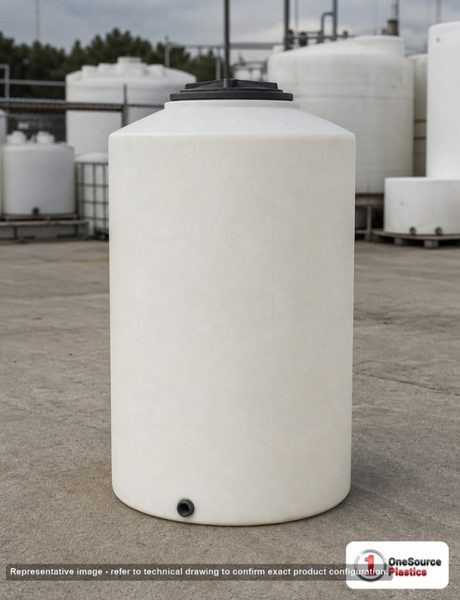
Tank Outdoor Installation + Snow Load: ASCE 7 Snow Engineering for Stationary Tanks
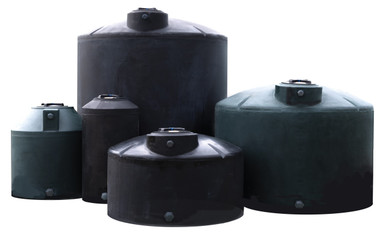
Wind load gets all the attention. Snow load is what actually crushes tank tops in the field. The wind-load worst-case is 30 to 60 psf (pounds per square foot) lateral pressure on the tank shell, well within the structural envelope of any properly anchored rotomolded HDPE vertical tank. The snow load worst-case is 100 to 200 psf VERTICAL on the tank top, sustained for weeks under cold-soaked conditions. The HDPE dome at -10 F under 200 psf for three weeks behaves nothing like the same dome at 70 F under 200 psf for one hour. Operators in IECC zones 6, 7, and 8 — basically anywhere north of a line from Boston through Chicago to Spokane — see this failure mode every 5-15 winters depending on the year and the tank.
This guide walks the actual ASCE 7-22 (Minimum Design Loads and Associated Criteria for Buildings and Other Structures) snow-load engineering as it applies to free-standing outdoor stationary tanks. We translate the ground snow load (pg) maps and the flat-roof snow load formula into the values an operator needs: how much snow weight my tank top will see, what the tank manufacturer rated the dome to support, and what mitigation strategies (snow shields, heated tops, tarps, winter inspection schedules) actually work. The tank installer who ignores ASCE 7 in zones 6-8 is rolling dice on every winter.
How Snow Load Works on a Tank
ASCE 7-22 Chapter 7 defines snow load through several variables. For a free-standing cylindrical tank, only a subset apply, but understanding all of them prevents misapplication of the formula:
- pg = ground snow load in pounds per square foot, taken from ASCE 7-22 Figure 7.2-1 (US ground snow load map). Pg ranges from 5 psf in Florida and southern California to 100+ psf in northern Maine, the Sierras, the Cascades, and the Wasatch.
- Ce = exposure factor (ASCE 7-22 Table 7.3-1). For a tank in open exposed terrain (typical commercial / industrial site), Ce = 0.9. For a tank sheltered by trees or buildings, Ce = 1.1.
- Ct = thermal factor (ASCE 7-22 Table 7.3-2). For a heated tank with insulated top, Ct = 1.0. For an unheated tank (most water and chemistry tanks), Ct = 1.2. For a deliberately well-insulated, well-vented unheated structure, Ct = 1.3.
- Is = importance factor (ASCE 7-22 Table 1.5-2). For a tank in normal occupancy, Is = 1.0. For tanks supporting essential facilities (water treatment plants, hospitals), Is = 1.2.
- pf = flat-roof snow load = 0.7 × Ce × Ct × Is × pg per ASCE 7-22 §7.3 — this is the design snow weight per square foot on the tank top.
- pm = sloped roof snow load = pf × Cs where Cs is the slope factor; for tank tops sloped 0-30 degrees, Cs = 1.0 (no reduction); steeper sloped covers shed snow.
For a typical commodity HDPE tank top (slight crown, 5-10 degree slope, unheated, normal occupancy):
- Ce = 0.9 (open exposure)
- Ct = 1.2 (unheated)
- Is = 1.0
- Cs = 1.0 (low slope)
- pf = 0.7 × 0.9 × 1.2 × 1.0 × pg = 0.756 × pg
So the design snow load on the tank top is approximately 75 percent of the ground snow load value for the location. That's the number that goes against the tank manufacturer's dome rating.
Ground Snow Load by Region
| Region | Pg (psf) | Tank top design (pf, psf) | Hazard rating |
|---|---|---|---|
| FL, southern TX, southern CA | 5 | ~4 | Negligible |
| Mid-South (TN, NC, GA, AL) | 10-15 | ~8-12 | Negligible |
| Mid-Atlantic (VA, MD, DE) | 15-25 | ~12-19 | Low |
| Lower Midwest (KS, MO, IL south) | 15-30 | ~12-23 | Low-moderate |
| Upper Midwest (MN, WI, IA, ND) | 35-60 | ~26-45 | High |
| New England (NH, VT, ME) | 50-100 | ~38-76 | High-severe |
| Mountain West (CO, WY, MT) | 30-60 lowland; 100-200+ alpine | ~23-152 | Variable |
| Cascades / Sierras (WA, OR, CA mountain) | 100-300+ | ~76-227 | Severe |
| Northern Plains / interior AK | 40-80; AK coastal 100-300 | ~30-227 | High-severe |
For exact values, look up your specific zip code in ASCE 7-22 Figure 7.2-1 or the ATC Hazards by Location tool (a free service maintained by the Applied Technology Council). Local building codes may also publish revised ground snow load values that supersede ASCE 7 in particular jurisdictions.
Tank Manufacturer Top Ratings
OEM datasheets for rotomolded vertical tanks publish top-load ratings that range from approximately 50 psf (commodity 1,500-gallon vertical, lowest spec) to 200+ psf (heavy-duty industrial vertical or cone-bottom top dome). The rating is for short-duration concentrated load (e.g. an installer standing on the dome) AND distributed long-duration snow load. The manufacturer's spec sheet or warranty terms call out the snow / live-load rating; if it isn't stated, ask the OEM directly before installing in a snow-load environment.
Approximate top-load ratings by tank class (verify with manufacturer for specific SKU):
- Commodity 1,500-2,500 gal HDPE vertical: 30-60 psf typical; explicit snow-load rating often unstated.
- Commodity 5,000-10,000 gal HDPE vertical: 40-80 psf with reinforced dome geometry.
- Heavy-duty industrial vertical (Snyder Industrial, Norwesco H-series): 100-200 psf rated.
- XLPE chemistry tanks: 80-150 psf typical (thicker wall + reinforced top).
- Cone-bottom or open-top tanks: top is open or covered by light lid; snow accumulates IN the tank top opening if exposed — different failure mode (water displacement / freeze).
The mismatch: in zones 7-8 with Pg above 60 psf, a commodity 2,500-gallon HDPE tank's 30-50 psf top rating is exceeded under design snow load by a factor of 1.5-2x. The tank top progressively yields, sometimes recovers in spring, sometimes fractures during a freeze-thaw cycle. The operator hears a "pop" in February and finds a partially collapsed dome by March.
Drift and Sliding Snow Loads (Often Worse Than Flat Snow)
ASCE 7-22 §7.7 and §7.8 cover drift loads where wind redeposits snow against vertical surfaces. For a tank installed near a building wall, the drift on the leeward (downwind) side of the wall can deposit 2-5x the ground snow load against the tank shell and on the tank top adjacent to the wall.
Sliding snow (§7.9) is when snow slides off a sloped roof onto an adjacent tank top. A tank installed below a metal roof in heavy snow country can receive a sustained additional load of 40-100 psf from sliding snow, on top of the design pf snow.
The lesson: siting matters as much as snow load itself. A tank in open exposure with no adjacent structures accumulates only the design pf. A tank tucked next to a building wall under a roof eave can accumulate 3-5x the design pf. The lazy install location is often the worst structural location.
Failure Modes Under Snow Load
Mode 1: Top-dome inversion / collapse
The most common. Sustained snow load exceeds the dome's allowable stress; the dome progressively deforms inward, eventually fractures at the radial flow lines from the rotomolding process. Often initially pops back when snow melts but leaves micro-fractures that propagate over subsequent seasons.
Mode 2: Vent blockage
Snow accumulating around the tank vent or covering the vent screen blocks atmospheric communication. As liquid is drawn from the tank, vacuum develops; if the dome is pulled inward by vacuum AND snow load simultaneously, failure is amplified. NFPA 30 §27.4 and API 2000 require breather vents sized for the maximum withdrawal rate; snow blockage effectively zeros that vent.
Mode 3: Overflow / vent freeze
Water in the vent or overflow line from condensation or rain freezes during cold spell, blocking venting. Same vacuum mechanism as Mode 2; sometimes catastrophic if a process pump is running.
Mode 4: Foundation freeze-heave
Snow accumulation against the foundation pad combined with poor drainage creates ice lenses under the tank that lift the foundation differentially, stressing the tank wall at fittings. This is a slow failure mode (3-10 years) showing up as bulkhead leaks at the lowest fittings.
Mode 5: Pipe-stub freeze and rupture
Outboard piping less than 36 inches from the tank wall freezes solid, expands, and ruptures the pipe AND sometimes the tank-side bulkhead fitting. NOT directly a snow load issue but adjacent to it; insulation and heat trace mitigate.
Mitigation Strategies
Strategy 1: Install a snow shield / canopy
The most effective mitigation: a free-standing shed roof or hooped canopy over the tank, anchored independently of the tank. The canopy carries the snow load to engineered support; the tank is in shadow underneath. Cost: $2,000-$10,000 for a single-tank canopy; pays for itself in 1-3 winters in zones 7-8 by avoiding tank replacement.
Strategy 2: Heated tank top (insulated and trace-heated)
Install a heat trace cable on the tank top under insulation. The localized heat melts snow above the tank, and snow slides off (if sloped) or sublimates. Energy cost: $40-$120 per heating season for a 10-foot-diameter tank top. Effective in zones 5-7; struggles in zone 8 sustained subzero temps.
Strategy 3: Manual snow removal
Inspection and broom-clearing of tank tops after each major storm. Labor-intensive but reliable. Schedule after every 6+ inch event. Use a soft broom or push-foam to avoid scratching the tank top.
Strategy 4: Tank top reinforcement (custom OEM option)
For high-snow installations, specify the heavy-duty top-rated tank when ordering — Snyder Industrial vertical line, Norwesco H-series with thicker dome, or XLPE chemistry tanks (which have heavier walls overall). The cost premium is 15-30 percent over commodity but the failure rate in heavy-snow zones drops to near-zero.
Strategy 5: Snow shedding / sloped covers
A sloped sheet-metal cap installed over the tank top provides a fixed slope (30+ degrees) that sheds snow naturally. The cap is supported on the tank rim and protects the dome from direct snow load. A simple, low-cost option for retrofitting commodity tanks in moderate snow zones.
Strategy 6: Site selection
Avoid placing tanks in drift accumulation zones: leeward of buildings, in valleys that channel wind-driven snow, under rooflines that shed snow. Open-exposure flat-area placement keeps the tank exposed to the design pf only, no amplification.
Winter Inspection Schedule for Snow-Zone Tanks
| Cadence | Inspection items |
|---|---|
| Pre-winter (Oct/Nov) | Verify vent unobstructed; check heat trace operation; clear roof valleys / wind drift areas; inspect dome for cracks |
| After 6"+ snowfall | Clear tank top with soft broom; inspect for dome deformation; clear vent screen |
| Sustained subzero (week+) | Verify heat trace functional; inspect outboard pipe insulation; check vent / overflow for ice formation |
| Post-thaw (March/April) | Full visual; look for new fractures, bulkhead leaks, foundation differential settlement |
| Annual | Per existing tank inspection SOP (visual / UT / ECT) |
Common Snow-Load Mistakes
Mistake 1: Assuming the tank manufacturer's spec covers ASCE 7 design snow load
OEM ratings are typically point-load for installer access (e.g. "300 lb point load") not distributed snow load. Ask explicitly for the "distributed dome load rating" in the units of psf. If the OEM cannot answer, treat the tank as low-snow-rated.
Mistake 2: Installing without a vent rain-cap
An open vent fills with snow during a storm. The vent screen freezes shut. The next pump-out draws vacuum on the tank. Specify a rain-cap or weatherhead on every outdoor tank vent.
Mistake 3: Placing tank under a building eave
Sliding snow from a metal building roof can deliver 200+ psf transient load on a tank top in one event. Setback of 8-15 feet from any sloped roof eave is the minimum safe siting in snow zones.
Mistake 4: Ignoring the importance factor for critical tanks
A potable-water tank serving a hospital or fire-suppression reserve has Is = 1.2 per ASCE 7-22 Table 1.5-2. The design snow load is 20 percent higher than a normal-occupancy tank. The OEM should be informed of the importance category before quoting; standard commodity tanks may not meet the specification.
Mistake 5: Treating "we've never had a problem" as an engineering principle
Snow loads in zones 7-8 follow a roughly 50-year recurrence interval for the design value. A site that has been fine for 20 years can see a single winter event that exceeds the 50-year design and crushes the tank. Engineering for the design load means engineering for an event that may not have happened in living memory.
Mistake 6: Heat-trace for snow melt without insulating the cable
A heat trace cable on the tank top with no insulation above wastes 70-90 percent of its energy heating the air above the tank. The cable should be on top of the tank dome, then 2-3 inches of insulation, then a UV-resistant cover. This delivers the BTUs to the snow interface, not to the sky.
Mistake 7: Ignoring the freeze-thaw cycle on cracked domes
A dome with a hairline fracture from one winter survives the summer. The next winter, water freezes in the fracture, expands, and propagates the crack. By year three, the dome has a quarter-inch separation. Repair or replace cracked domes in the spring; do not let them ride.
Quick-Pick Reference
| Climate zone (Pg) | Recommended tank class | Mitigation |
|---|---|---|
| South / Southwest (Pg ≤ 15) | Standard commodity | None required |
| Mid-Atlantic / lower Midwest (Pg 15-30) | Standard commodity | Pre-winter vent inspection; manual clearing of large events |
| Upper Midwest / New England (Pg 30-50) | Heavy-duty top rated; 80+ psf preferred | Sloped cap or canopy; manual clearing schedule; rain-cap on vent |
| Mountain / Alpine (Pg 60-150) | Industrial heavy-duty 150+ psf, custom-spec dome | Engineered canopy required; heat trace for vent; weekly winter inspection |
| Cascade / Sierra / interior AK (Pg 150+) | Custom-fab; FRP / steel may be appropriate | Indoor or under-roof installation strongly preferred |
Internal Resources
- Tank Weather Protection
- Vertical Tank Wind Load Engineering (ASCE 7)
- Cold Climate Tank Field Performance
- Tank Insulation + Heat Tracing
- Foundation Pad Engineering
- Tank Vent Engineering
- Tank Inspection SOP
- Hurricane-Season Tie-Down Engineering
- Freight Cost Estimator
- Contact OneSource
Source Citations
- ASCE 7-22 - Minimum Design Loads and Associated Criteria for Buildings and Other Structures, Chapter 7 Snow Loads
- ASCE 7-22 Figure 7.2-1 - US Ground Snow Load Map (Pg)
- ASCE 7-22 Table 7.3-1 - Exposure Factor (Ce)
- ASCE 7-22 Table 7.3-2 - Thermal Factor (Ct)
- ASCE 7-22 Table 1.5-2 - Importance Factor by Risk Category (Is)
- ASCE 7-22 Section 7.7 - Drifts on Lower Roofs
- ASCE 7-22 Section 7.8 - Roof Projections and Parapets
- ASCE 7-22 Section 7.9 - Sliding Snow
- NFPA 30 - Flammable and Combustible Liquids Code, Section 27 (vent sizing for atmospheric tanks)
- API 2000 - Venting Atmospheric and Low-Pressure Storage Tanks
- ASTM D1998 - Standard Specification for Polyethylene Upright Storage Tanks
- ATC Hazards by Location tool (Applied Technology Council) - look-up for site-specific Pg, wind, seismic
- IECC 2021 - International Energy Conservation Code (climate zone reference)
Recommended Tanks for This Guide
Live pricing, updated automatically · estimate freight to your ZIP.