11000 Gallon Plastic Water Storage Tank: Complete Buyer's Guide
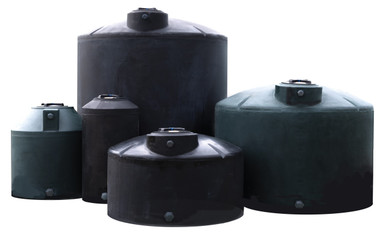
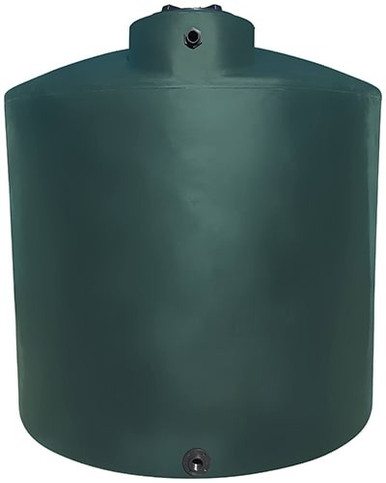
11,000-gallon black water storage tank built for safe potable water storage. Manufactured by Norwesco from virgin linear polyethylene (HDPE) rated to handle liquids up to 9.2 pounds per gallon. FDA approved for contact with potable water, ensuring safe storage for drinking water and food-grade liquids.
Specifications at a Glance
Every figure below is pulled straight from the live product record for this exact tank — the same data on the product page, so what you read here and what you buy never disagree.
Standards & Materials
- ASTM D1998 — Standard Specification for Polyethylene Upright Storage Tanks. Governs wall-thickness and hydrostatic design for vertical rotomolded poly tanks of this class.
- FDA 21 CFR 177.1520 — Olefin polymers. The food-contact regulation the FDA-grade resin in this tank is compounded to meet.
- Specific gravity rating 1.1 — the tank is engineered for liquids up to 1.1× the density of water (water is about 8.34 lb/gal). Confirm your fluid’s SG before storage.
Product Overview
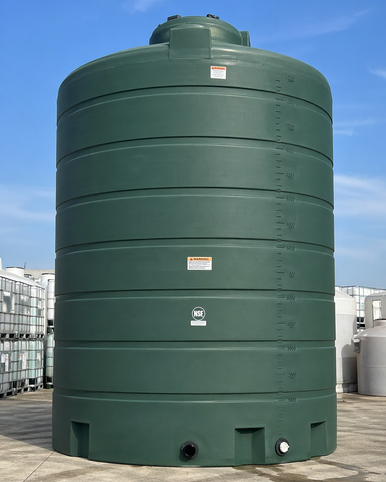
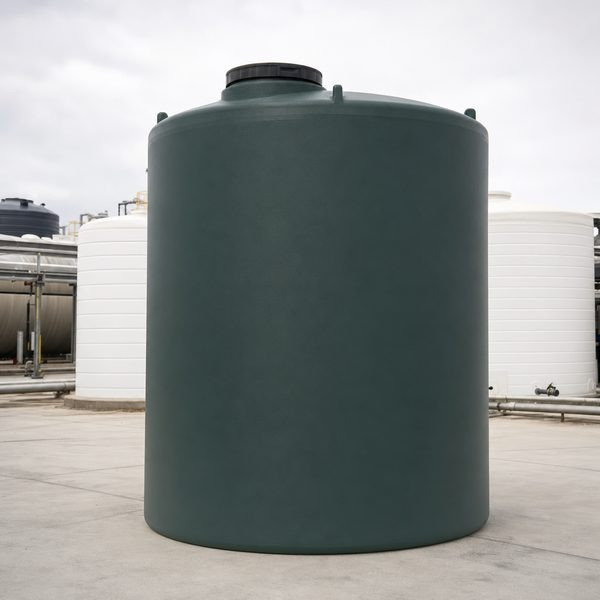
The 11,000 Gallon Plastic Water Storage Tank is among the largest single-piece potable tanks made, and it serves the projects that need water measured in tank-trucks: large fire-protection systems, district well storage, commercial irrigation, and major rainwater-harvest installations. Standing nearly fourteen feet tall on a twelve-foot base, it is a fixed asset that anchors a water system rather than supplements one.
Norwesco rotationally molds it in one seamless piece of virgin linear polyethylene — eleven thousand gallons of capacity with not a single weld in the shell. It is rated to 1.1 specific gravity for water-based liquids up to 9.2 pounds per gallon, with a 120 F / 48 C ceiling. The black pigment is critical at this volume, blocking the light that would otherwise feed an algae bloom and giving the wall its maximum UV life for permanent outdoor service.
The empty shell weighs 1,628 pounds; full at 1.1 SG it presses down at roughly 102,542 pounds — over fifty tons that mandates a fully engineered foundation. A factory 2-inch NPT outlet feeds distribution, and the 22-inch lid permits confined-space entry for interior cleaning and inspection. Norwesco's 3-year manufacturing-defect warranty applies, and each tank is re-inspected before it ships.
Technical Drawing
Official Norwesco technical drawing — 11000 Gallon Plastic Water Storage Tank
Key Features and Specifications
- 11,000-gallon capacity — sized for safe potable water storage
- Constructed from virgin linear polyethylene (HDPE) with 1.1 specific gravity rating — handles liquids up to 9.2 lbs/gal
- 167" tall x 144" diameter — compact vertical footprint
- 1628 lbs empty, approximately 102,542 lbs when full at rated specific gravity
- 2" NPT outlet fitting — factory installed and leak-tested
- 22" lid opening for fill, venting, and interior access
- FDA approved for potable water and food-grade liquid contact
- 3 Year Warranty from Norwesco against manufacturing defects
- UV-resistant black pigmentation provides maximum outdoor durability and inhibits algae growth in stored liquids
- Rated for continuous service up to 120 F / 48 C
- Seamless one-piece rotational molding — no seams, no welds, no leak points
- Manufactured by Norwesco — a leading name in rotomolded polyethylene tanks
- Large tanks require professional installation. Ensure the pad is level within 1 inch across the full diameter and that all piping connections allow for thermal expansion
- Ships via dedicated freight carrier due to oversized dimensions — contact us for delivery timeline and site access requirements
Installation and Setup Guide
Fifty tons of water makes this installation a structural and logistical undertaking from start to finish. Every step — foundation, placement, plumbing, venting — is scaled to a tank that, when full, weighs as much as a loaded semi and its trailer.
The Foundation Is the Project
A structural engineer must design a reinforced concrete slab for roughly 102,542 pounds distributed across the 144-inch diameter, flat within one inch across that full width. At fifty tons, foundation tolerance is not cosmetic: a high or settling spot drives enormous force into a small area of wall. Pour generously, cure completely before any water goes in, and grade the site so drainage always carries water away from the pad.
Placement and Piping
The shell alone exceeds sixteen hundred pounds and ships oversized; a crane sets it on the cured slab. Plumb the 2-inch outlet in schedule 80 PVC with deliberate expansion provisions, since a tank this tall moves significantly with temperature and rigid piping will not survive that movement. Carry every line on its own supports so none of the pipe weight loads a tank fitting.
Large-Volume Venting
At distribution fill and draw rates, the air exchange through this tank is substantial, and the vent must keep pace. Install a large, screened breather in the 22-inch lid sized to your peak rates; an undersized vent will let the shell pull a vacuum and collapse during a hard draw. The same lid is your confined-space access for interior service.
Maintenance and Long-Term Care
An 11,000-gallon potable tank is operated like a water-utility asset, with structural surveillance on a schedule and a thorough annual interior service governed by confined-space rules.
Structural Surveillance
- Foundation: Inspect the slab and surrounding earth for cracking, settlement, and erosion on a regular cycle. At fifty tons, even slight foundation movement reshapes the load path through the tank.
- Wall: Walk the full perimeter and examine the lower wall, where hydrostatic pressure is greatest, for any bulge or distortion. Expect gradual chalking of the black surface long before any real degradation.
- Outlet and vent: Verify the 2-inch fitting is dry and the large vent is clear; on a tank this large a blocked vent is the single most dangerous oversight.
Annual Interior Service
Each year, isolate and drain the tank and clear the sediment from the floor. The 22-inch lid allows entry for cleaning — treat it as a confined space: test and ventilate the atmosphere, use a spotter, and never enter alone. Sanitize to the potable standard, a quarter cup of unscented bleach per fifteen gallons, hold the charge two hours, and flush completely before the tank returns to service.
Climate
The carbon-loaded black wall is engineered for permanent sun exposure; an annual inspection of the sun-facing side suffices even in extreme-UV regions. A reservoir of this size in steady use will not freeze, but an idle tank should be drained where hard winters occur.
Alternatives and Comparisons
At 11,000 gallons you are near the practical ceiling for a single rotomolded poly tank, which shapes the comparison.
Maximum single tank vs. multiple tanks: This 11,000-gallon tank gives you the most capacity in one foundation and one set of plumbing, at the lowest cost per gallon — but it concentrates everything in a single vessel that must be taken fully offline to service. Two 5,000- to 6,500-gallon tanks manifolded together cost more and need more ground, yet they keep water available during cleaning or repair and divide the foundation load across two slabs. For sheer fire reserve and bulk supply the single tank leads; for uninterrupted operation, the paired system is worth the premium.
Other 11000-Gallon Options
Frequently Asked Questions
How long will the 11000 Gallon Plastic Water Storage Tank last?
On a fully engineered foundation and within its 1.1 SG and 120 F ratings, this tank readily achieves 15 to 20 years and commonly more in steady potable service. The black, UV-loaded shell is built for permanent exposure and has no seam to fail. At fifty tons, the foundation is everything — a correctly engineered, level slab is what determines how long the tank serves.
What chemicals can I store in this tank?
It is an FDA-approved potable-water tank for large-scale drinking water, fire reserve, district storage, and rainwater harvesting, plus water-based liquids within its 1.1 specific-gravity rating. It is not for fuels, solvents, or aggressive chemicals, which require a 1.5-SG liquid tank with a verified compatibility check.
What kind of foundation does a 11000-gallon tank need?
A full 11,000-gallon tank weighs about 102,542 pounds — over fifty tons. That demands a reinforced concrete slab engineered by a structural professional, flat within one inch across the full diameter, designed and cured before the tank is delivered. The foundation is the most consequential part of the entire installation.
Does this tank come with a warranty?
Yes. Norwesco provides 3-year coverage for defects in materials and workmanship under normal use. It does not cover damage from an inadequate foundation, overfilling beyond the rated specific gravity, incompatible chemicals, or impact. Keep full documentation and photographs of the engineered foundation and installation.
Can I install this tank underground?
No. A poly tank of this scale is engineered for above-ground service and cannot resist the soil pressure of burial, which would collapse it and void the warranty. Below-grade storage of this magnitude requires purpose-engineered reinforced structures, not an above-ground tank.
Buying Considerations
Three major commitments accompany an 11,000-gallon tank. First, the engineered foundation: a structural professional must design a reinforced slab for 102,542 pounds, and it must be poured and cured before the tank arrives. Second, access — this oversized shell requires a clear route for a flatbed and a crane to place it. Third, your distribution system: confirm the 2-inch outlet and the large vent match your fill and draw rates. The tank ships on a dedicated carrier; we coordinate delivery and site access to your ZIP.
Related Products You May Need
Questions? Call (866) 418-1777 — our team knows these products inside and out and can help you select the right tank for your application.
Recommended Tanks for This Guide
Live pricing, updated automatically · estimate freight to your ZIP.