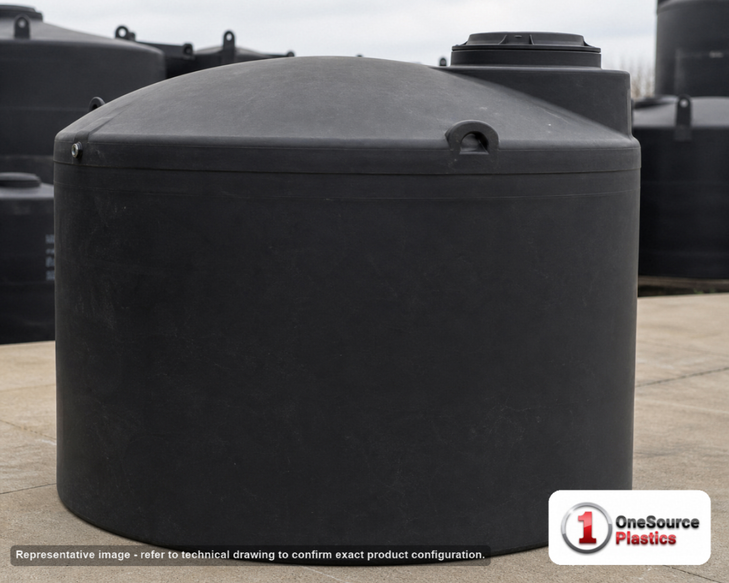
10,500 gallons on a 142 inch footprint, the largest Snyder water tank that still ships as class 300
The WB101 is Snyder's 10,500 gallon vertical water tank: 142 inches across, 170 inches tall, black polyethylene, 2,490 pounds empty. It is the tank people buy when the last reserve has proven too small twice. The black wall blocks light so the water stays clean, and the 1.0 specific gravity rating is the honest statement of what it is for: water, and nothing heavier.
Ready to price it? The listed price is before freight; quote freight to your ZIP in a few seconds, then add to cart above or call 866-418-1777.
Eighty-seven thousand pounds of water needs a real pad
Full, this tank holds 87,570 pounds. That is not a number to put on compacted gravel. The concrete pad sizing guide works the ACI 360R-10 method for a 142 inch circle carrying this load, and the answer is a reinforced slab in full contact with the whole floor of the tank, level to the point that a carpenter's level shows nothing. A tank this size that settles unevenly on one side puts the sidewall into a bending load it was never molded for. Confirm the capacity you actually need against your draw with the tank sizing calculator and the tank sizing guide before pouring, because the pad is the part you cannot change later.
Ten, ten and a half, or twelve thousand gallons
| Part | Gallons | Diameter x height | Empty weight |
|---|---|---|---|
| 32034 | 10,000 | 142 x 166.5 in | 1,816 lb |
| WB101 (this tank) | 10,500 | 142 x 170 in | 2,490 lb |
| WG101, green | 10,500 | 142 x 170 in | 2,490 lb |
| 32076 | 12,000 | 142 x 196.5 in | 2,075 lb |
All four share the 142 inch floor, so the pad you pour for one fits the others. The interesting line is the weight: the WB101 carries 674 more pounds of resin than the 10,000 gallon 32034 on a shell only 3.5 inches taller, and 415 more than the 12,000 gallon tank that stands 26.5 inches above it. That resin is wall, and a heavier wall on a water tank is a longer service life in sun, not a higher rating. Buy the 12,000 gallon tank when you need the gallons; buy this one when you want the wall. The green WG101 is the same tank in a resin color chosen for water standing in full sun, at the same 2,490 pounds.
Want us to check the fit? Send the site dimensions to 866-418-1777 or through a written quote request and we will confirm the tank, the pad and the freight.
Ports, manway and the stainless outlet
- Inlet: 1-1/2 inch polypropylene female NPT bulkhead fitting.
- Outlet: 2 inch polypropylene bolted fitting with stainless steel hardware. On a tank this tall the outlet sees the full head of 170 inches of water, and a bolted flange holds a seal under that pressure where a plain bulkhead can weep.
- Access: 18 inch threaded, vented manway. The vent path matters more as the tank gets bigger: emptying 10,500 gallons quickly moves a large volume of air, and the vent is what stops the wall from being sucked inward.
- Service limit: 120 F / 48 C. Three year warranty.
Plumb the outlet with a full-port valve before anything else, so the tank can be isolated without draining it, and put a union between the valve and the pump; on a 2,490 pound tank nobody wants to unscrew a pump against a rigid line. The inlet on the top is where a float valve or a fill from a well pump goes, and the manway is for inspection only, not for filling, because a hose left in an open manway is how debris gets into 10,500 gallons of stored water.
The jobs a 10,500 gallon tank does
At this size the tank is a fire reserve first. The fire-water reservoir design guide covers NFPA 22 sizing for a rural property and the freeze protection a poly tank needs in cold country. It is also the storage block in a water reuse train that aggregates rainwater, condensate and grey water; the industrial water reuse topology guide shows where a single large tank sits against a bank of smaller ones. Irrigation reserves, stock water at scale and process makeup water are the rest of the list. For a level reading through the black wall, the level gauge selection guide compares the sensor types that work on poly.
Delivery day
Freight class 300, LTL, 2,490 pounds shipping at 142 by 142 by 170 inches; the freight cost estimator quotes your ZIP and the listed price is before freight. Have a telehandler or crane on site with straps rated well past the empty weight, and a path to the pad that clears 142 inches. Then fill it the slow way: the hydrostatic test methodology sets out the staged fill, the settlement checks and the hold time that prove the pad and the fittings before you trust 87,570 pounds to them.
Freight and documents
Ships from: Lincoln, NE; Philippi, WV. LTL freight is quoted to your ZIP with the freight cost estimator or by phone at 866-418-1777. The listed price is before freight.
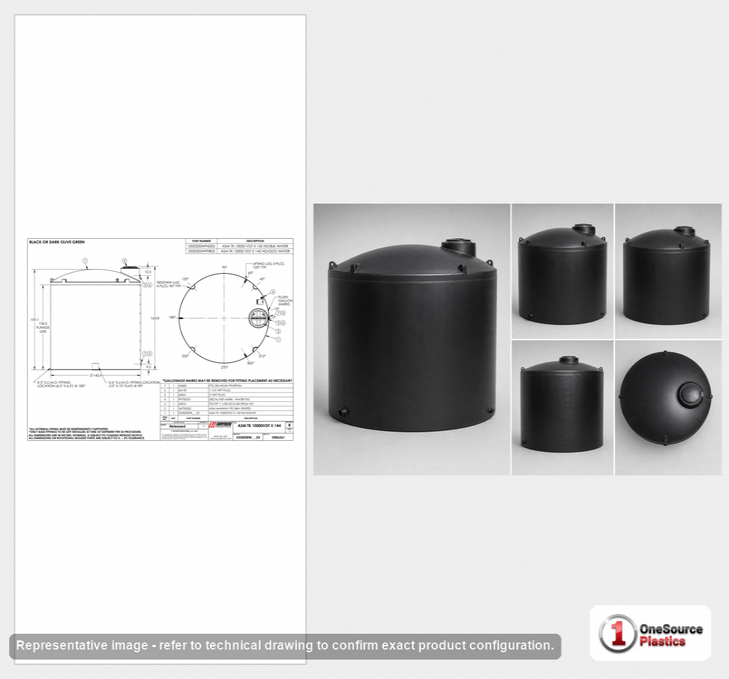
Technical drawing (PDF) for Snyder Industries WB101.
See this tank
Interactive 3D model with live fill. This tank has an interactive 3D model built to its manufacturer dimensions. Rotate it, and set a fill level to see how much liquid it holds at any height. Open the 3D view on the product photo above. Download the 3D model (GLB).
Ready to order?
Add it to your cart at the top of this page, get LTL freight to your ZIP, request a written quote, or call 866-418-1777. The listed price is before freight.