Industrial Water Softener and Ion-Exchange Tank Coordination With Bulk Storage: Brine Tank Sizing Math, Resin Bed Volume Selection, Regeneration Cycle Timing, Soft-Water Day-Tank Buffering, and Cation-Anion Train Architecture
An industrial water softener and an ion-exchange train do not operate in isolation; they are coupled to the bulk water storage that buffers the process flow against regeneration interruptions, and to the brine storage that supplies the regenerant chemistry. The coordination between the bulk water tanks, the day-tank buffers, the resin vessels, and the brine tanks is what determines whether the process plant runs steady or surges with regeneration cycles. Sizing the brine tank too small forces regeneration to wait for brine make-up. Sizing the resin bed too small forces frequent regeneration that interrupts process water supply. Sizing the soft-water day-tank too small forces process to throttle during regeneration. The coordinated sizing of all four storage volumes against the process duty cycle is the engineering problem this article walks. The treatment is grounded in the chemistry of cation and anion exchange, the engineering of regeneration sequences, and the procurement of polyethylene tanks across the 5-brand catalog.
List pricing on each tank product page; LTL freight quoted to your ZIP via the freight estimator or by phone at 866-418-1777.
1. The Industrial Water Softener and Ion-Exchange Process Overview
The industrial water softener and the ion-exchange train remove dissolved ions from feed water that would otherwise foul downstream process equipment. The chemistry, the equipment, and the duty-cycle structure define the coordination requirements:
- The cation-exchange softening chemistry. A cation-exchange resin bed in sodium form (sulfonated polystyrene crosslinked with divinylbenzene, regenerated with sodium chloride brine) exchanges sodium ions for the calcium and magnesium ions in the feed water. The resin bed produces softened water with hardness reduced from feed-typical 5-25 grains per gallon to less than 1 grain per gallon. The bed is regenerated periodically by passing concentrated brine through the bed; the brine displaces the calcium and magnesium back into solution and restores the sodium form of the resin.
- The strong-acid cation chemistry. A strong-acid cation resin in hydrogen form (regenerated with hydrochloric or sulfuric acid) exchanges hydrogen ions for all cations including sodium, calcium, magnesium, and other dissolved metals. The strong-acid cation produces decationized water that is acidic from the released hydrogen. The decationized water typically feeds an anion column to neutralize the acidity.
- The strong-base anion chemistry. A strong-base anion resin in hydroxide form (regenerated with sodium hydroxide) exchanges hydroxide ions for the dissolved anions including chloride, sulfate, nitrate, and bicarbonate. The combination of strong-acid cation followed by strong-base anion produces deionized water with very low residual ion content suitable for high-purity process applications.
- The mixed-bed polishing. For ultra-pure water, a mixed-bed column containing both cation and anion resin in intimate contact polishes the deionized water to micro-Siemens conductivity. The mixed bed is regenerated less frequently and produces water for semiconductor, pharmaceutical, and high-pressure boiler applications.
- The duty-cycle structure. The treatment trains operate continuously while resin bed capacity remains. As the bed approaches exhaustion, the treatment is switched to a parallel bed (in twin-bed configuration) or interrupted (in single-bed configuration) for regeneration. The regeneration sequence (backwash, brine draw, slow rinse, fast rinse) takes 1 to 2 hours per cycle. The process water demand during regeneration must be met by stored softened water or by parallel-bed continuous service.
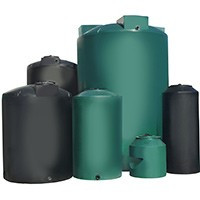
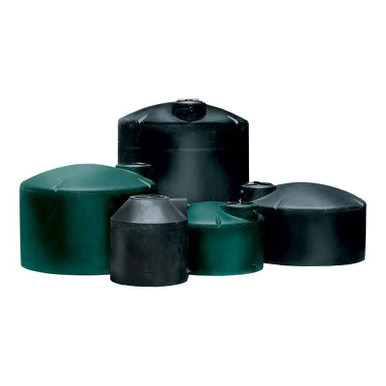
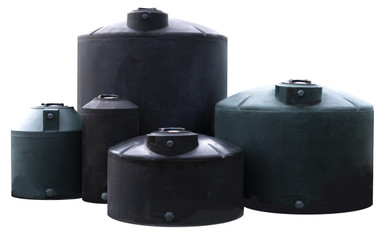
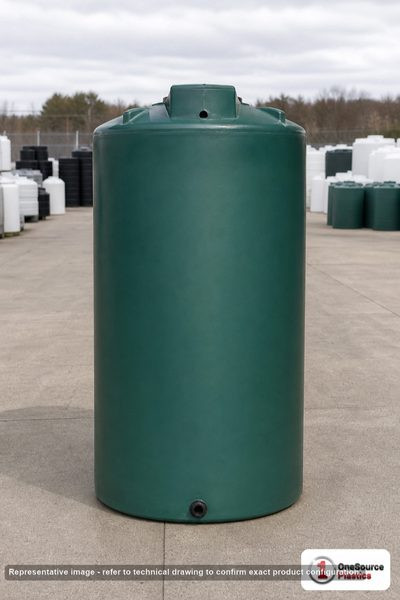
- The bulk water storage at every interface. Feed water is buffered before the train; softened water is buffered after the train; brine is stored before regeneration. The polyethylene bulk storage at each interface enables the surge capacity that smooths the process flow. Reference N-40164 5000 gallon Norwesco vertical as a typical bulk storage tank in this service.
The treatment train is the chemistry layer; the bulk storage tanks are the coordination layer that enables steady process water supply against the inevitable interruption of regeneration cycles.
2. Brine Tank Sizing Mathematics
The brine tank holds the saturated sodium chloride brine that regenerates the cation softener resin. Brine tank sizing is governed by the resin volume, the regeneration salt dosage, and the regeneration frequency:
- The salt-dosage per cubic foot of resin. Standard cation-softener regeneration dosage is 6 to 15 pounds of sodium chloride per cubic foot of resin. Lower dosage gives lower regenerated capacity (fewer grains-removed before next regeneration); higher dosage gives higher regenerated capacity at higher salt cost. Industrial sites typically use 10 to 15 pounds per cubic foot for high-capacity continuous operation.
- The brine concentration assumption. Saturated sodium chloride brine at 60 degrees Fahrenheit holds approximately 26 percent NaCl by weight, equivalent to 2.65 pounds of salt per gallon of saturated brine. The brine tank holds saturated brine plus an inventory of solid salt that dissolves into the brine as brine is drawn for regeneration.
- The brine-volume per regeneration calculation. A 30 cubic foot resin bed regenerated at 12 pounds per cubic foot consumes 360 pounds of salt per regeneration. At 2.65 pounds per gallon of saturated brine, the regeneration consumes 136 gallons of saturated brine.
- The salt-inventory and refill frequency selection. The brine tank holds salt and brine in a 2-to-1 mass ratio at the typical fill state. A 1500 gallon brine tank can hold approximately 5000 pounds of salt and 1500 gallons of brine, supporting roughly 14 regeneration cycles between salt refills (5000 pounds divided by 360 pounds per regeneration). The refill frequency should be set against the salt-delivery logistics (single-bag manual refill versus bulk truck delivery).
- The refill-event tank-headspace requirement. The brine tank must have headspace to accept a salt refill without overflow. Typically the tank is sized 30 percent larger than the saturated-brine-plus-salt working volume to provide refill headspace and condensation allowance.
- Reference 1500 gallon tank for brine service. Reference N-40154 1500 gallon Norwesco vertical as a typical industrial brine tank size. The polyethylene wall handles the saturated NaCl chemistry without corrosion. The translucent wall (in natural color) supports visual level monitoring without dedicated instrumentation.
The brine tank is the regeneration-supply buffer. Sizing it to the regeneration cadence and to the salt-delivery logistics produces an installation that supports the process train without becoming a refill-attention drain on operations.
3. Resin Bed Volume Selection
The resin bed volume sets the capacity per regeneration cycle and defines the regeneration frequency at the design feed-water hardness and process flow:
- The resin grain capacity at design dosage. Sodium-form cation resin regenerated at 12 pounds salt per cubic foot delivers approximately 30,000 grains of hardness removal per cubic foot before exhaustion. The capacity scales linearly with salt dosage up to the maximum-capacity dosage near 20 pounds per cubic foot.
- The hardness-load per day calculation. Process water demand of 50 gallons per minute at feed hardness of 15 grains per gallon equals 750 grains per minute, or 1,080,000 grains per day. The resin-bed sizing covers this daily load with regeneration frequency selected for operational convenience.
- The single-regeneration-per-day target. For typical 24/7 industrial operation a single regeneration per day is the operational sweet spot. Sizing the resin bed to handle one day of hardness load delivers regeneration once per shift change, predictable timing for operator attention.
- The two-bed parallel architecture. Sites that cannot tolerate any process-water interruption use a two-bed architecture: one bed in service while the other is in regeneration or standby. The two-bed sizing splits the daily load between the beds with regeneration alternating.
- The bed-vessel polyethylene compatibility. The cation softener bed itself is housed in a steel or fiberglass pressure vessel; the polyethylene tanks in the system are the upstream feed-water buffer, the downstream softened-water day-tank, and the brine supply tank. The polyethylene compatibility considerations apply to those tanks; the resin vessel is a different procurement category.
- The salt cost optimization tradeoff. Higher dosage gives more grain capacity per regeneration but at higher salt cost per regeneration. The optimization compares the total annual salt cost across multiple dosage scenarios. For sites with low salt cost, the higher-dosage approach is favored. For sites with high salt cost, lower-dosage with more frequent regeneration is favored.
The resin bed sizing is the heart of the treatment-train design. The bulk tank coordination follows from the bed-sizing decisions.
4. Regeneration Cycle Timing and Process Coordination
The regeneration cycle interrupts service for 1 to 2 hours per regeneration. The coordination with the process water demand determines whether the interruption is invisible or disruptive:
- The backwash step duration. Backwash flushes accumulated solids out of the resin bed with upward water flow at 4 to 8 gallons per minute per square foot of bed cross-section. Duration is typically 5 to 10 minutes. Water consumed in backwash is not available to process during the regeneration cycle.
- The brine-draw step duration. Concentrated brine is drawn from the brine tank and diluted to 10 to 15 percent concentration before passing slowly through the resin bed. The brine-draw step takes 30 to 45 minutes depending on resin volume and brine flow rate. The displacement of calcium and magnesium from the resin happens during this step.
- The slow rinse step duration. After brine draw, a slow water rinse displaces residual brine from the bed at low flow that maintains contact for residual exchange. Slow rinse takes 30 to 45 minutes.
- The fast rinse step duration. The final fast rinse purges residual chloride from the bed at service flow rate. Duration is 10 to 15 minutes. After fast rinse the bed is back in softening service.
- The single-bed cycle interruption. A single-bed installation interrupts process water for the full regeneration duration (75 to 110 minutes). The downstream day-tank must hold enough soft water to bridge the interruption at the process demand rate. A 50 gallon-per-minute process requires 5500 to 8000 gallons of day-tank capacity to bridge a single regeneration.
- The twin-bed continuous service. A twin-bed installation runs one bed in service while the other regenerates. The cycle alternates as each bed approaches exhaustion. Process water supply is continuous; the day-tank buffer is reduced to a smaller surge capacity that covers brief upset conditions only.
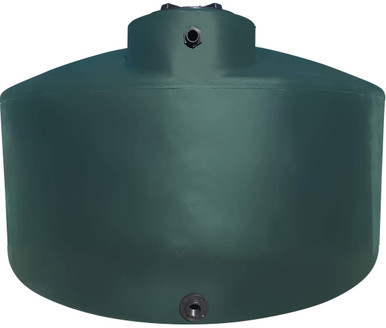
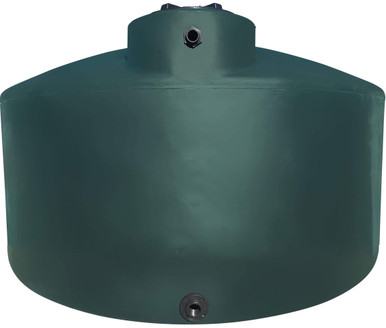
- Reference 2500 gallon tank for day-tank scoping. Reference N-41524 2500 gallon Norwesco vertical as a typical soft-water day-tank size that supports moderate-flow process applications.
The cycle timing and the bed-architecture choice (single or twin) drive the day-tank sizing. The two decisions are coupled and should be made together.
5. Soft Water Day-Tank Buffering Architecture
The soft-water day-tank holds the softened water output between the treatment train and the process consumers. The day-tank architecture absorbs the cycle interruptions and decouples the train from the process demand fluctuations:
- The tank-volume-equals-bridge-time-times-demand calculation. The minimum day-tank volume is the maximum bridge time (single-bed regeneration duration plus contingency) times the maximum process demand. A 90-minute bridge at 60 gallons per minute peak demand requires 5400 gallons minimum, with a 25 percent safety factor giving 6750 gallons design.
- The level-control hysteresis design. The treatment train cycles on at low day-tank level and off at high day-tank level. The hysteresis band should be wide enough to avoid short-cycling the train. A typical band is 30 to 60 percent of the day-tank volume. Narrow hysteresis stresses the train; wide hysteresis sacrifices buffer capacity.
- The level-monitoring instrumentation. Level instrumentation can be ultrasonic (non-contact, no penetration through tank wall), differential-pressure (penetration at floor), or mechanical (float arm, tape gauge). Polyethylene tanks support all three; the choice depends on site preference and accuracy requirement.
- The freezing-protection requirement for outdoor day-tanks. Outdoor day-tanks in cold climates require freeze protection. Tank-wall heat trace, internal recirculating heater, or insulated enclosure are the principal options. The protection is sized against the historical low temperature with a margin for unusually cold events.
- The disinfection-residual maintenance. Soft water held in the day-tank for extended periods can support microbial growth. Sites with extended residence times maintain a low-level disinfection residual (typically free chlorine or chlorine dioxide) to suppress growth. The disinfection chemistry must be compatible with downstream process needs.
- The vent and overflow design. The day-tank vent must accommodate the maximum-fill-rate displacement of air. The overflow must accommodate the maximum-fill-rate liquid discharge if the level control fails. The vent and overflow are sized at the procurement stage and confirmed against the worst-case scenarios.
- Reference 1000 gallon tank for small-scale day-tank. Reference N-40152 1000 gallon Norwesco vertical as a small-scale day-tank suitable for low-flow process applications or for parallel-bed installations with smaller surge requirement.
The day-tank is the operational keystone of the soft-water supply. Sizing it to the regeneration architecture and the process demand profile produces a system that runs without the operators noticing the regeneration cycles.
6. Cation-Anion Train Architecture for Deionization
For applications requiring deionized water (low boilers, semiconductor, pharmaceutical, specialty chemical), the strong-acid cation followed by strong-base anion train provides the chemistry. The bulk-storage coordination is more involved than for softening:
- The acid-regeneration and storage requirements. Strong-acid cation regenerates with hydrochloric acid at 2 to 5 percent concentration or sulfuric acid at 2 to 4 percent concentration. The regeneration acid is typically diluted from concentrated bulk acid storage. The acid-handling tanks are typically dedicated polyethylene rated for the acid concentration.
- The caustic-regeneration and storage requirements. Strong-base anion regenerates with sodium hydroxide at 2 to 4 percent concentration, diluted from 25 to 50 percent bulk caustic storage. Polyethylene tanks at appropriate specific-gravity rating support the bulk-caustic storage. Reference the material-specific catalog and OEM compatibility data for caustic concentration limits.
- The decationized-water intermediate buffering. Between the cation and anion columns the water is acidic. An intermediate buffer tank may be installed to decouple the cation regeneration from the anion regeneration. The intermediate tank is small (10 to 30 minutes of flow) and made of polyethylene compatible with mild acidity.
- The deionized-water polishing requirement. The output of the strong-acid plus strong-base train is typically 1 to 5 microSiemens. For higher-purity targets (less than 1 microSiemens, 0.1 microSiemens for semiconductor) a mixed-bed polisher follows. The mixed-bed is sized smaller than the working columns since the inlet ion load is much lower.
- The deionized-water storage and recirculation. Deionized water held in static storage tanks degrades through CO2 absorption and microbial growth. Storage tanks are typically continuously recirculated through the polishing bed. The recirculation rate is set to maintain the conductivity target.
- The regeneration waste neutralization. The combined regeneration waste from cation (acidic) and anion (basic) typically self-neutralizes when blended in a neutralization tank. The neutralization tank is sized to hold the daily regeneration waste and is fitted with pH monitoring. Discharge to the site wastewater system is permitted-by-discharge-permit.
The full deionization train is more complex than a softener but follows the same coordination principles: each chemistry interface has a buffer tank that decouples the upstream operation from the downstream demand.
7. Operating Protocols and Day-Shift Routine
The coordinated soft-water and ion-exchange installation runs through a defined daily routine that maintains the buffer levels and the regeneration cadence:
- The morning startup checks. The operator confirms day-tank level above the regeneration low limit, brine tank level above the salt-refill threshold, and treatment-train status (in service, in regeneration, in standby). Anomalies are addressed before the day production load arrives.
- The regeneration-event monitoring. When a regeneration event triggers, the operator confirms the train is responding correctly. The brine draw, slow rinse, and fast rinse stages are monitored for normal duration. Anomalous duration prompts investigation.
- The salt-refill schedule. The salt-inventory level is checked daily; bag salt refills are added as needed to maintain the working inventory. Bulk-truck refills are scheduled against the inventory consumption rate and the truck-delivery lead time.
- The water-quality monitoring. Soft-water hardness is checked at the day-tank discharge daily or at each shift. Hardness above the specification target indicates resin exhaustion not caught by the cycle automation, instrumentation drift, or bypass leakage. Each cause is investigated and addressed.
- The end-of-day buffer-level check. The end-of-shift soft-water day-tank level should be at the upper end of the operating band. A consistently low end-of-shift level indicates the train cannot keep up with demand; the operator should escalate for sizing review.
- The weekly resin-vessel inspection. The resin vessels are inspected weekly for external condition, valve operation, and instrument calibration. Anomalies are addressed at the next available service window.
- The monthly performance review. Monthly, the regeneration frequency, the salt consumption, the water-quality results, and the equipment uptime are tabulated and reviewed. Trends inform the longer-term decisions about resin replacement, equipment upgrades, and operating-protocol adjustments.
The operating protocols are the daily discipline that converts the engineered installation into reliable production-water supply. Without the operating protocols even a well-designed installation drifts toward poor performance.
8. Procurement Implications and 5-Brand Tank Selection
The coordinated softener and ion-exchange installation requires multiple polyethylene tanks at defined specifications. The procurement strategy aggregates the requirements across the brand catalog:
- The brine tank specification. Polyethylene rated for saturated NaCl service at ambient temperature. Translucent natural color supports visual level monitoring. Manway placement for salt-bag refill access. Reference the Norwesco line for standard sizes; reference Snyder or Chem-Tainer for larger or specialty configurations.
- The bulk caustic tank specification. Polyethylene rated for 25 to 50 percent NaOH service with appropriate specific-gravity rating. Heat trace or insulated enclosure for cold climates (caustic crystallizes below 50 degrees Fahrenheit at 50 percent concentration). Cross-reference the OEM compatibility catalog for the specific concentration before procurement.
- The bulk acid tank specification. Polyethylene rated for the acid type and concentration. Hydrochloric and sulfuric acids at typical regeneration concentrations are compatible with polyethylene; concentrated acids may require enhanced ratings. Vent and overflow protection sized for the chemistry.
- The soft-water and deionized-water day-tanks. Standard polyethylene, sized to the regeneration architecture and the process demand. Insulation or heat trace for cold-climate installations. Vent and overflow sized for the maximum fill rate.
- The neutralization tank specification. Polyethylene rated for both acid and caustic exposure. Sized for the daily regeneration waste plus margin. pH monitoring instrumentation and discharge controls. Coordinated with the site wastewater discharge permit.
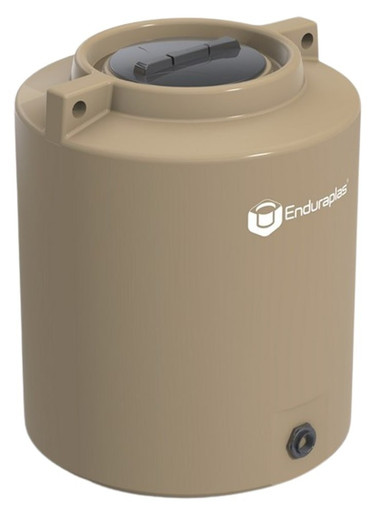
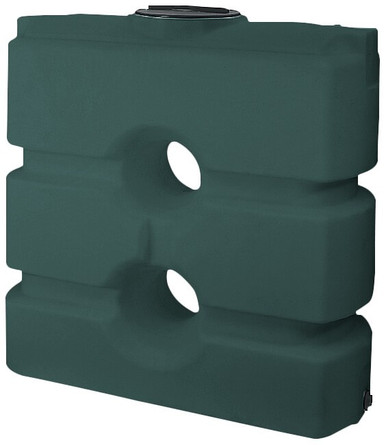
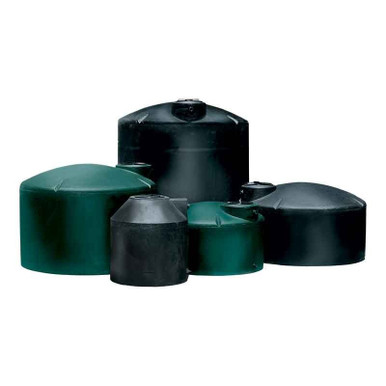
- The 5-brand catalog cross-reference. The coordinated installation typically uses tanks from multiple brands selected for the chemistry and size specifications. Norwesco for general bulk water and brine. Snyder for specialty geometries. Chem-Tainer for larger horizontal configurations. Enduraplas for higher-strength applications. Bushman for compact above-ground configurations. The procurement flexibility is part of the OneSource Plastics value proposition.
The procurement aggregation across the brand catalog produces installations matched to each tank role. List pricing on each product page; LTL freight to your ZIP via the freight estimator or by phone at 866-418-1777.
9. The Softener and Ion-Exchange Coordination Conclusion
The industrial water softener and the ion-exchange train are coupled to the bulk water storage that buffers the process flow against regeneration interruptions and to the brine and chemistry storage that supplies the regenerants. The brine tank sizing follows from the resin volume, the salt dosage, and the refill logistics. The resin bed volume sets the daily-cycle architecture. The regeneration timing dictates the soft-water day-tank size that bridges the cycle. The cation-anion train extends the architecture for deionized-water applications. The operating protocols maintain the buffer levels and the cadence. The procurement strategy aggregates polyethylene tanks across the 5-brand catalog at specifications matched to each role. Sites that engineer the coordination produce installations that supply steady process water without operators noticing the regeneration cycles; sites that procure tanks in isolation produce installations that surge with every regeneration and require continuous operator attention.
OneSource Plastics ships polyethylene tanks across the 5-brand catalog for the brine, caustic, acid, soft-water, deionized-water, and neutralization roles in industrial water-treatment installations. Tank specification for any specific application is performed by the customer site engineer with reference to the chemistry, the regeneration cycle, the process demand, and the site climate. List pricing on each product page; LTL freight to your ZIP via the freight estimator or by phone at 866-418-1777.
Recommended Tanks for This Guide
Live pricing, updated automatically · estimate freight to your ZIP.